1993 BMW 325i Iat
[x] Cancel search: IatPage 457 of 759

To
access
the
rear
window
blower
relay,
remove
the
glove
compariment
.
See
Fig
.
32
.
Fig
.
32
.
Rear
window
blower
relay
located
in
frontof
glove
compart-
ment
(arrow)
.
AIR
CONDITIONING
Thissection
covers
removal
and
installation
of
air
condition-
ing
refrigerant
components
.
A/C
testing
and
diagnosis,
refrig-
erantdischarge,
evacuatíon
and
recharge
are
not
covered
here
.
The
subassemblies
and
lines
of
the
air
conditionerare
filled
with
either
refrigerant
R12
(1992
cars)
or
R-134a
(1993
and
later
cars)
.
The
major
components
of
the
A/Csystem
are
shown
in
Fig
.
33
.
A/CSystem
Warnings
and
Cautions
WARNING
-
"
Always
be
careful
that
refrigerant
does
not
come
in
contact
with
your
skin
.
Always
wearhand
andeye
protection
(gloves
and
goggles)
when
work-
ing
around
the
AIC
system
.
If
refrigerant
does
come
in
contact
with
your
skin
oreyes
:
-Do
not
rub
skin
oreyes
;
-Immediately
flush
skin
oreyes
withcool
water
for
15
minutes
;
-Rush
to
a
doctor
orhospital
;
-Do
not
attempt
to
treat
yourself
.
"
Work
in
a
wefl
ventilated
area
.
Avoid
breathing
re-
frigerant
vapors
.
Exposure
may
irrítate
eyes,
nose,
and
throat
.
Switch
on
exhaustlventilation
systems
when
working
on
the
refrigerant
system
.
"
Do
not
expose
any
component
of
the
AIC
system
to
high
temperatures
(Above
80°Cl176°F)or
open
flames
.
Excessive
heat
will
cause
a
pres-
sureincrease
whichcould
burst
the
system
.
HEATING
AND
AIR
CONDITIONING
640-
1
1
0013015
WARNING
-
"
Keep
refrigerant
away
from
open
llames
.
Poison-
ous
gas
will
be
produced
if
it
bums
.
Do
not
smoke
near
refrigerant
gases
for
the
same
reason
.
"
The
AICsystem
is
filled
with
refrigerant
gas
which
is
under
pressure
.
Pressurized
refrigerant
in
the
presenceof
oxygen
may
forma
combusti-
ble
mixture
.
Never
introduce
compressed
air
finto
any
refrigerant
container
(full
or
empty),
capped
off
AIC
component,
or
piece
of
service
equip-
ment
.
"
Refrígerant
gases
are
heavier
than
air,
displace
oxygen
and
may
cause
suffocation
in
areas
of
poor
círculation,
for
example
under
a
car
.
Switch
on
exhaustlventilation
systems
when
working
on
the
refrigerant
system
.
"
State
and
local
governments
may
have
additional
requirements
regarding
air
conditioning
servic-
ing
.
Alwayscomply
with
state
and
local
laws
.
"
Electric
welding
near
refrigerant
hoses
causes
R-134a
to
decompose
.
Discharge
system
before
welding
.
CA
UTION
-
-As
of
January
1,
1992,
any
person
who
services
a
motor
vehicle
air
conditioner
must,
by
law,
be
properly
trained
and
certified,
and
use
approved
refrigerant
recycling
equipment
.
Technicians
must
complete
an
EPA-approved
recycling
course
to
be
certified
.
"
It
is
recommended
that
al¡
system
refrigerant
AIC
refrigerant
be
left
to
an
authorized
BMW
dealer
or
other
qualified
AIC
service
facility
.
"
Do
not
top
off
a
partially
charged
refrigerant
sys-
tem
.
Dischargesystem,evacuate
and
then
re-
charge
system
.
"
R-134a
and
R-12
refrigerants
and
refrigerant
oils
and
system
components,
including
hoses
and
sealing
O-rings,
are
NOT
compatible
.
Compo-
nent
damage
andlor
system
contamination
will
result
.
"
The
mixture
of
refrigerant
oil
(PAG
oil)
and
refrig-
erant
R-134a
attacks
some
metals
and
alloys
(for
example,copper)
and
breaks
down
certain
hose
materials
.
Use
only
hoses
and
lines
that
are
iden-
tified
with
a
green
mark
(stripe)
or
the
lettering
R-
134a"
.
"
Immediately
plug
open
connections
on
AIC
com-
ponents
to
prevent
dirt
and
moisture
contamina-
tion
.
"
Do
not
steam
clean
condensers
or
evaporators
.
Use
only
cold
water
or
compressed
air
.
AIR
CONDITIONING
Page 459 of 759
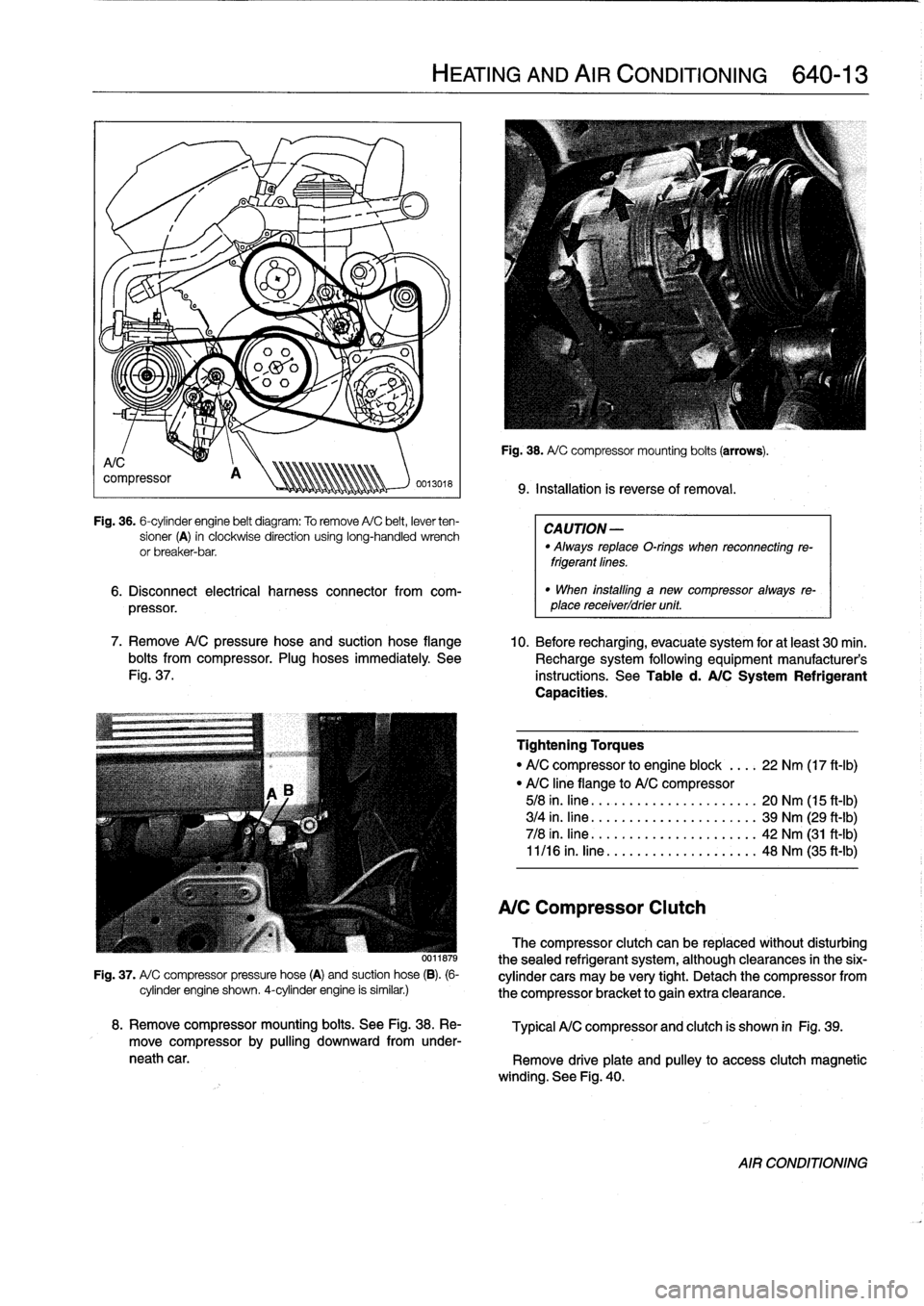
Fig
.
36
.
6-cylinder
engine
belt
diagram
:
To
remove
A/C
belt,
lever
ten-
sioner
(A)
in
clockwise
direction
using
long-handled
wrench
or
breaker-bar
.
6
.
Disconnect
electrical
harness
connector
from
com-
pressor
.
7
.
Remove
A/C
pressure
hose
and
suction
hose
flange
10
.
Before
recharging,
evacuate
system
for
at
least
30
min
.
bolts
from
compressor
.
Plug
hoses
immediately
See
Recharge
system
following
equipment
manufacturer's
Fig
.
37
.
instructions
.
See
Table
d
.
A/C
System
Refrigerant
Capacities
.
0011879
Fig
.
37
.
A/
C
compressor
pressure
hose
(A)
and
suction
hose
(B)
.
(6-
cylinder
engine
shown
.
4-cylinder
engine
is
similar
.)
HEATING
AND
AIR
CONDITIONING
640-
1
3
Fig
.
38
.
A/
C
compressor
mounting
boits
(arrows)
.
9
.
Installation
is
reverseof
removal
.
CAUTION
-
"
Always
replaceO-rings
when
reconnecting
re-
frigerantfines
.
"
When
installlng
a
new
compressor
always
re-
place
receiverldrier
unit
.
Tightening
Torques
"
A/C
compressor
to
engine
block
....
22
Nm
(17
ft-Ib)
"
A/C
line
flange
to
A/C
compressor
5/8
in
.
fine
.
......
.....
....
.
.....
20
Nm
(15
ft-Ib)
3/4
in
.
fine
.......
.....
..........
39
Nm
(29
ft-Ib)
7/8
in
.
fine
...
....
.....
..........
42
Nm
(31
ft-Ib)
11/16
in
.
fine
.....
..
..
..
...
.
.....
48
Nm
(35
ft-Ib)
A/C
Compressor
Clutch
The
compressor
clutch
can
be
replaced
without
disturbing
thesealed
refrigerant
system,
although
clearances
in
the
six-
cylinder
cars
may
be
very
tight
.
Detach
the
compressor
from
the
compressor
bracket
togain
extra
clearance
.
8
.
Remove
compressor
mounting
boits
.
See
Fig
.
38
.
Re-
Typical
A/C
compressor
and
clutch
is
shown
in
Fig
.
39
.
move
compressor
by
pulling
downward
from
under-
neath
car
.
Remove
driveplate
and
pulley
to
access
clutch
magnetic
winding
.
See
Fig
.
40
.
AIR
CONDITIONING
Page 460 of 759

640-14
HEATING
AND
AIR
CONDITIONING
7
Fig
.
39
.
A/
C
compressorand
clutch
components
.
8
00871208
1.
Clutch
plate
retaining
bolt
5
.
A/C
compressor
pulley
2
.
Clutch
plate
6
.
Clutch
retaining
circlip
3
.
Pulley
retaining
circlip
7
.
Clutch
(magnetic
winding)
4
.
Clutch
bearing
8
.
Compressor
00870082
Fig
.
40
.
A/
C
compressor
driveplate
canbe
held
stationary
with
strap
toolto
allow
removal
of
retaining
bolt
.
NOTE-
BMWs
are
equipped
with
compressors
from
various
manufacturers
.
Special
tools
may
be
required
tore-
move
driveplate
orpulley
.
AIR
CONDITIONING
Tightening
Torque
"
Compressor
clutch
bolt
to
compressor
shaft
.....
.
....
..
.
.
20
Nm
(15
ft-Ib)
A/C
condenser,
replacing
1
.
Following
manufacturer's
instructions,
connect
an
ap-
proved
refrigerant
recovery/recycling/recharging
unitto
A/Csystemand
discharge
system
.
WARNING
-
Do
not
dischargelcharge
the
AIC
system
without
proper
equipment
and
training
.
Damage
to
the
vehi-
cle
and
personal
injury
may
result
.
2
.
Remove
front
bumper
and
radiator
grilles
.
See510
Ex-
terior
Trim,
Bumpers
.
3
.
Remove
auxiliary
electric
radiator
fan
.
See
170
Cool-
ing
System
.
4
.
DetachA/C
lines
from
lower
right
corner
of
condenser
.
Plug
lines
immediately
.
See
Fig
.
41
.
Fig
.
41
.
A/
C
flange
bolts
at
condenser
(arrows)
.
5
.
Remove
condenser
mounting
bolts
from
frontradiator
support
.
See
Fig
.
42
.
6
.
Lift
up
condenser
to
disengage
from
lower
mounts
and
remove
from
below
.
7
.
Installation
is
reverse
of
removal
.
CA
UTION-
"
Always
replace
O-rings
when
reconnecting
re-
frigerant
fines
.
"
When
installing
a
new
condenser
always
replace
receiverldrier
unit
.
Page 461 of 759
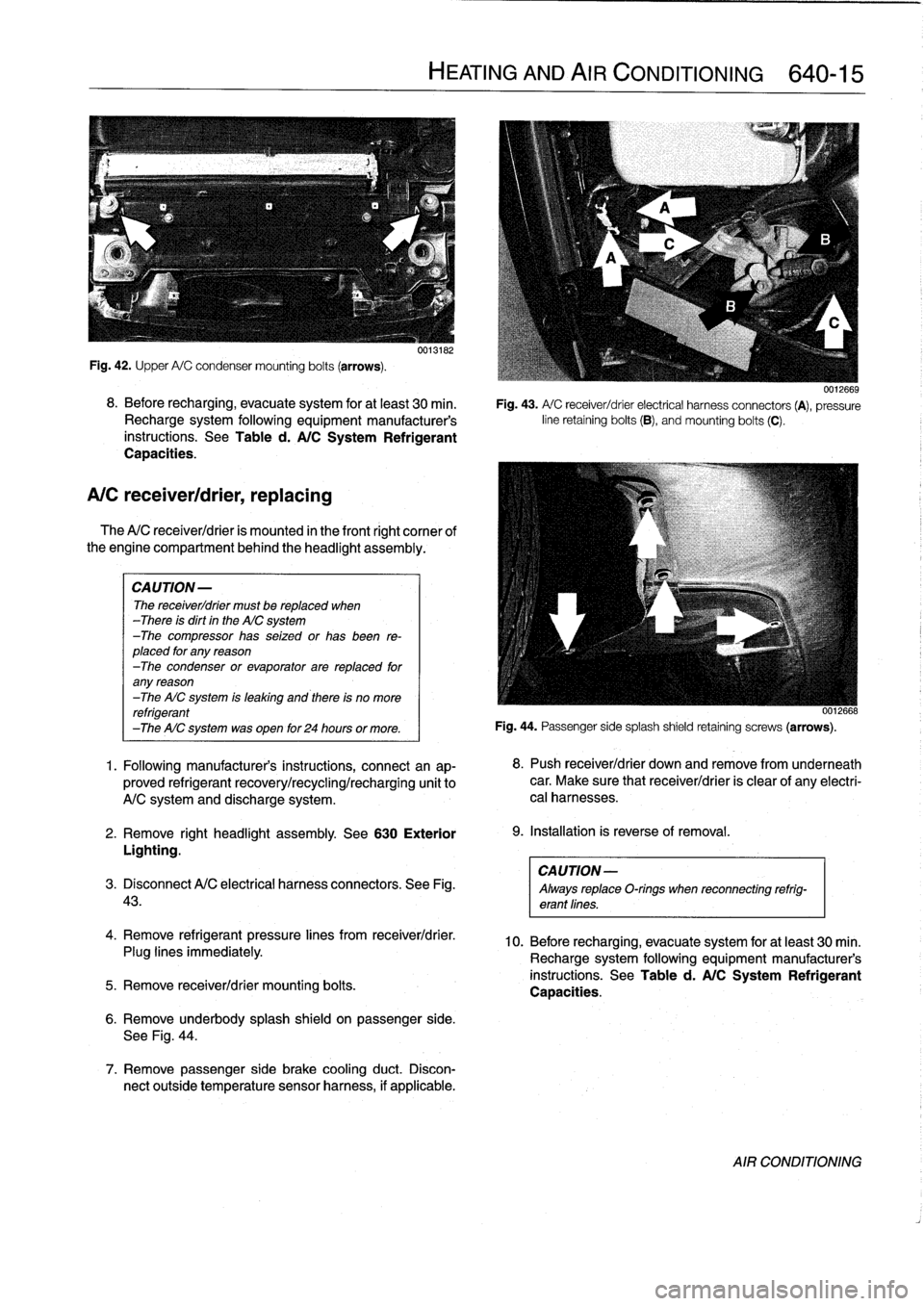
Fig
.
42
.
Upper
A/C
condensermounting
bolts
(arrows)
.
8
.
Before
recharging,
evacuate
system
for
at
least
30
min
.
Recharge
system
following
equipment
manufacturer's
instructions
.
See
Table
d
.
A/C
System
Refrigerant
Capacities
.
A/C
receiver/drier,
replacing
The
A/C
receiver/drier
is
mounted
in
the
front
right
cornee
of
the
engine
compartment
behind
the
headlight
assembly
.
CAUTION-
The
receiver/drier
must
be
replaced
when
-There
is
dirt
in
the
AIC
system
-The
compressor
has
seized
or
has
been
re-
placed
for
any
reason
-The
condenser
or
evaporator
are
replaced
for
any
reason
-The
AIC
system
is
leaking
and
there
is
no
more
refrigerant
-The
AIC
system
was
open
for
24
hours
or
more
.
1
.
Following
manufacturer's
instructions,
connectan
ap-
proved
refrigerant
recovery/recycling/recharging
unit
to
A/C
system
and
discharge
system
.
2
.
Remove
right
headlight
assembly
.
See
630
Exterior
Lighting
.
CAUTION-
3
.
Disconnect
A/C
electrical
harness
connectors
.
See
Fig
.
Always
replaceO-rings
when
reconnecting
refrig-
43
.
erant
lines
.
4
.
Remove
refrigerant
pressure
lines
from
receiver/drier
.
Plug
lines
immediately
.
5
.
Remove
receiver/drier
mounting
bolts
.
0013182
6
.
Remove
underbody
splash
shield
on
passenger
side
.
See
Fig
.
44
.
7
.
Remove
passenger
side
brake
cooling
duct
.
Discon-
nect
outside
temperature
sensor
harness,
if
applicable
.
HEATING
AND
AIR
CONDITIONING
640-15
0012669
Fig
.
43
.
A/
C
receiver/drier
electrical
harness
connectors
(A),
pressure
line
retaining
bolts
(B),
andmounting
bolts
(C)
.
0012668
Fig
.
44
.
Passenger
sidesplash
shield
retaining
screws
(arrows)
.
8
.
Push
receiver/drier
down
andremove
from
underneath
car
.
Make
sure
that
receiver/drier
is
clear
of
any
electri-
cal
harnesses
.
9
.
Installation
is
reverse
of
removal
.
10
.
Before
recharging,
evacuate
system
for
at
least
30
min
.
Recharge
system
following
equipment
manufacturer's
instructions
.
See
Table
d
.
A/C
System
Refrigerant
Capacities
.
AIR
CONDITIONING
Page 462 of 759

640-16
HEATING
AND
AIR
CONDITIONING
A/C
expansion
valve,
removing
and
installing
Fig
.
45
.
Control
module
carrier
retaining
screws
(arrows)
.
1
.
Following
manufacturers
instructions,
connectanap-
proved
refrigerant
recovery/recycling/recharging
unit
to
A/C
system
and
discharge
system
.
WARNING
-
Do
not
discharge%harge
the
WC
system
without
properequipmentand
training
.
Damage
to
the
vehi-
cle
and
personal
injury
may
result
.
2
.
Remove
glove
compartment
and
glove
compartment
support
frame
.
See513
Interior
Trim
.
3
.
Remove
right
side
footwell
vents
.
4
.
Remove
right
side
control
module
carrier
screws
and
tilt
carrier
down
.
See
Fig
.
46
.
5
.
Remove
expansion
valve
cover
.
See
Fig
.
46
.
Fig
.
46
.
Four
screws
retain
expansion
valve
cover
(arrows)
.
AIR
CONDITIONING
0012666
0012663
6
.
Remove
A/C
refrigerant
line
fiange
bolt(s)
from
expan-
sion
valve
.
Plug
lines
immediately
.
See
Fig
.
47
.
NOTE
-
If
necessary,
remove
air
plenum
grille
fromrear
of
en-
gine
compartment
as
described
earlier
in
Blower
mo-
tor,
removing
and
installing
.
Remove
wiring
hamess
cover
screws
and
then
remove
right
side
plenum
screws
.
Reaching
finto
the
plenum
chamber,
remove
AIC
fine
flange
bolt
to
allow
expansion
valve
room
for
removal
.
Fig
.
47
.
Refrigerant
line
fiange
mounting
boltat
expansion
valve(arrow)
.
7
.
Remove
screws
from
top
of
expansion
valve
and
re-
move
expansion
valve
from
evaporator
.
See
Fig
.
48
.
Fig
.
48
.
Expansion
valve
mountingscrews
(A)
.
0011667
Page 477 of 759

721
Airbag
System
(SRS)
Airbag
Systems
.......
.
...
.
.
.
.
.
....
.
.
.
.
721-1
AIRBAG
SENSORS
AND
ELECTRONICS
721-2
SRS
Warning
Light
and
Fault
Display
.
.
.
.
.
..
721-2
Airbagcontact
ring,
replacing
........
.
.
.
.
.
721-3
Airbag
crash
sensor,replacing
..
.
....
.
...
.
721-4
ZAE
control
module,
replacing
.
.
.
.........
721-5
GENERAL
This
repair
group
covers
only
removal
and
installation
of
air-
bag
components
.
Airbag
system
repair
and
fault
diagnosis
is
not
covered
here
.
Diagnostics,
component
testing,
and
airbag
system
repair
should
be
carried
out
by
trained
BMW
service
technicians
.
NOTE-
Special
test
equipment
is
required
to
retrieve
SRS
fault
codes,
diagnose
system
faults,
and
resetltum
off
the
SRS
indicator
light
.
The
SRS
indicator
light
will
remain
on
until
any
problem
has
been
corrected
and
the
fault
memory
has
been
cleared
.
When
servicing
cars
equipped
with
SRS,
the
precautions
on
this
page
mustbeobserved
to
prevent
personal
injury
.
Airbag
Systems
The
airbag
system
installed
on
E36
cars
through
the
1993
model
year
consisted
of
a
single
airbag
in
the
steering
wheel
.
This
systemcan
be
identified
by
the
orange
crash
sensors
lo-
cated
on
the
front
wheel
wells
and
the
absence
of
a
passenger
side
airbag
.
The
ZAE
airbag
system,
starting
in
model
year
1994
(pro-
duction
date9/93
and
later),
provides
both
a
driver
side
and
a
passenger
sideairbag
.
On
ZAE
vehicles,
the
crash
sensorsare
integrated
into
the
airbag
control
module,
located
under
thecenter
of
the
rear
seat
.
The
ZAE
control
module
triggers
deployment
of
the
airbags
When
it
sensos
the
vehicle
deceler-
ating
at
a
rate
equivalent
to
a
head-on
collisionof
at
least
13
mph
(18
km/h)
.
In
some
1997
4-door
models
and
all
1998
models,
side-impact
airbags
were
installed
in
the
front
doors
.
The
airbag
units
are
mounted
behindthe
door
trim
panels
.
Caution
mustbeused
when
working
on
vehicle
systems
in
the
proximity
of
air
bags,
such
as
the
steering
column,
the
dashboard,
or
the
doors
.
AIRBAG
SYSTEM
(SRS)
721-1
GENERAL
.
.
.
.
.
.
.
.
.
.
.......
.
......
.
.
.
.
721-1
Front
side-impact
airbag
crash
sensor,
removing
and
installing
....
.
.....
.
.....
.
721-5
AIRBAGS
..............
.
.
.
.
.
.
.
.
.
.
.
.
.
.
.
721-5
Driver
side
airbag,
removing
and
installing
.
.
.
721-5
Passenger
side
airbag,
removing
and
installing
..............
.
.
.721-6
Front
side-impact
airbag,
removing
and
installing
.
.
.
.
.
.
.
.
.
.
......
.721-7
WARNING
-
"
Airbag(s)
are
inflated
byan
explosive
device
.
Handled
improperly
or
without
adequate
safe-
guards,
the
System
can
be
very
dangerous
.
Spe-
cial
precautions
must
be
observed
prior
to
any
work
ator
near
the
driverside
airbag,
the
passen-
ger
side
airbag
(where
applicable)
or
the
side-im-
pact
airbags
(where
applicable)
.
"
The
airbag
is
a
vehicle
safety
system
.
Serious
in-
jury
may
result
if
System
service
is
attempted
by
persons
unfamiliar
with
the
BMW
SRS
and
its
ap-
proved
service
procedures
.
BMW
advises
that
all
inspection
and
service
be
performed
by
an
autho-
rized
BMW
dealer
.
"
Always
disconnect
the
battery
and
cover
the
neg-
ative
()
battery
terminal
with
an
insulator
before
startingdiagnostic,
troubleshooting
or
service
worknot
associated
with
SRS,
and
before
doing
any
welding
on
the
car
.
"
If
an
airbag
has
been
activated
due
to
an
acci-dent,
BMW
specifies
that
SRS
components
be
replaced
.
For
more
information
on
post-collision
SRS
service,
see
an
authorized
BMW
dealer
.
"
Do
not
allow
the
airbag
unit
to
come
in
contact
with
cleaning
solutions
orgrease
.
Never
subject
an
airbag
unit
to
temperatures
aboye
212°F
(100°C)
.
When
reconnecting
the
battery,
no
per-
son
should
be
inside
the
vehicle
.
"
Always
place
an
airbag
unitthat
has
been
re-
moved
from
its
packaging
with
the
padded
sidefacing
upward
.
Do
not
leave
an
airbag
unlt
unat-
tended
.
"
!f
the
airbag
unit
or
airbag
control
modulehas
been
dropped
froma
height
of
!
1
2
meter
(1
Y2
ft.)
ormore,
theairbag
unit
should
not
be
installed
.
Aírbag
system
components
are
shown
in
Fig
.
1.
GENERAL
Page 485 of 759

GENERAL
This
section
contains
wiring
diagrams
for
1992
through
1998
BMW
3
Series
models
.
WARNING
-
On
cars
equipped
with
airbags,
special
precautions
apply
to
any
electrical
testing
or
repair
.
The
airbag
unit
is
an
explosive
device
and
must
be
handled
with
exterme
care
.
Before
starting
any
work
onan
airbag
equipped
car,
refer
to
the
warnings
and
cau-
tions
in
720
Seatbelts
and
721
Airbag
Systems
(SRS)
.
NOTE-
The
"
gear
position/neutral
safetyswitch
is
also
some-
timesreferred
to
as
the
automatic
transmission
range
switch
.
"
The
EWS
11
system
is
also
sometimes
referred
to
as
the
Driveaway
Protection
System
or
the
electronic
im-
mobilization
system
.
ELECTRICAL
WIRING
DIAGRAMS
ELE-1
Electrical
Wiring
Diagrams
GENERAL
.
.
.
.
.
.
.
.
.
................
.
.
.
ELE-1
Horns
.....
.
.....
.
.
.
....
.
.
.
.
.
...
.
.
ELE-153
Instrument
Panel
.
.
.
.
.
.
..............
ELE-165
ELECTRICAL
WIRING
DIAGRAMS
...
.
.
.
ELE-2
Interior
Lights/Illumination
.............
ELE-211
ABS
..............
.
.
.
.....
.
.....
ELE-117
Lumbar
Control
.
....................
ELE-247
ABS/AST
.............
.
.
.
...
.
.
.
.....
ELE-120
On-Board
Computer
..................
ELE-173
Airbag
(Supplemental
Restraint
System)
..
ELE-140
Park
Ventilation
.
.
.
...........
.
...
.
..
ELE-139
Air
Conditioning
and
Heating
.
.
.
.
.
.
.....
ELE-129
Power
Distribution
......
.
...
.
.
.
.
.
.
.
...
.
ELE-2
Anti-Theft
(Alpine)
..........
.
.
.
...
.
...
ELE-144
Power
Door
Locks
.
.
......
.
.
.
.
.
.
.
.
.
..
ELE-226
Anti-Theft
(EWS
II)
.
........
.
.
.
...
.
...
ELE-150
Power
Mirrors
...
.
.
.
......
.
.
.
.
.
.
.
.
.
..
ELE-241
Body
Computer
Module
.....
.
.....
.
...
ELE-176
Power
Seats
......
.
......
.
.
.
...
.
.
.
..
ELE-243
Charging
System
.
.
................
.
.
.
ELE-67
Power
Sunroof
.
.
.
.
.
.
.
...............
ELE-248
Convertible
Top
.
.
.
.
................
.
.
ELE-253
Power
Windows
.
.
.
.
.
.
.....
.
.........
ELE-231
Cruise
Control
..
.
.
.
...........
.
....
.
.
ELE-112
Radio/Cassette/CD/Speakers
..........
ELE-255
Data
Link
Connector
................
.
.
.
ELE-86
Rear
Window
Defogger
...............
ELE-160
Engine
Cooling
.......
.
.......
.
....
.
.
.
ELE-94
Shift
Interlock
.
.
.
.
.
.
.
.
...............
ELE-110
Engine
Management
...
.
.......
.
....
.
.
.
ELE-70
Starting
....
.
.
.
.
.
...
.
................
ELE-63
Exterior
Lights
........
.
.
.
.
.
.
.
.
.
......
ELE-194
Transmission
Electronics
.
..............
ELE-96
Ground
Distribution
....
.
.
.
.
.
.
.
.
.
.......
ELE-35
Warning
System
:
Chimes
.............
ELE-178
Headlights/Foglights
...
.
.
.
.
.
.
.
.
.
......
ELE-180
Wiper/Washer
.
.....
.
...............
ELE-155
Heated
Seats
........
.
.
.
.
.
.
.
.
.
......
ELE-245
ELECTRICAL
COMPONENT
LOCATIONS
Relayand
fuse
positions,
ground
locations
...........
.
.
.
.
.
.
.
.
.
................
seeRepair
Group
610
CAUTION-
Always
switchthe
ignition
off
and
disconnect
the
negative
(-)
battery
cablebefore
removing
any
electrical
components
.
"
Prior
to
disconnecting
the
battery,
read
the
bat-tery
disconnection
cautions
given
at
the
front
of
this
manual
on
page
viii
.
"
Connect
and
disconnect
ignition
system
wires,
multiple
connectors
and
ignition
test
equipment
leads
only
while
ignition
is
switched
off
.
-Always
switch
a
test
meter
to
the
appropiate
func-
tion
and
range
before
making
test
connections
.
"
All-Season
Traction
(AST)
is
also
referred
to
as
ASC
or
ASC+T
.
GENERAL
Page 529 of 759

890fi9
INTER-
WASHER
I
I
MEDIATE
I
I
FLUID
I
IPRESSUREI
I
-
ILEVEL
I
(SWITCH
I
-
I
SWITCH
--
(1997)
'3
HEADLIGHT/
RIGHT
I
RIGHT_
_
_
_
I
-
LEFT
I
I
I
FOG
LIGHT
I
I
I
(
)
FRONT
I
I
I
TEMPERATURE
I
(
AUXILIARY
I
'
LEFT
I
(
)
FRONT
I
I
-
I
I
RIGHT
HIGH
I
-
TURN
I
SWITCH
WASHER
i
(
LIGHT
BEAM
I
LIGHT
I
I
I
fOGH7
I
(FANMOTOR
HIGH
i
I
I
II
(
)
I
i
IBEAM
LIGHT
I
,HORN
-
LEFT
LIJ
PUMP
L-
--
---I
-
LIGHT
'~
I
I
LIGHT
1----
---1
'~
L
GHT
'
1T
1Y
T
IT
T
-T
2
WASHER
RIGHT
PRESSURE
I
(PUMP
I
(LOW
I
(
SWITCH
I
(
(1996)
I
I
I
BEAM
I
I
(
(1996)
I
-
I
(CANADA)
I
_(LIGHT
I
_I
z
T
I
_
RIGHT
I
I
)
PARK
I
I
_
PARK
I
I
-
LIGHT
I
I
-
LIGHT
I
1
G302
Ground
Distribution
1996-97
Except
318ti
(1
of
5)
LEFT
LEFT
LEFT
I
(
POP-OUT
I
(
REAR
I
(REAR
I
RIVERS
I
(CENTRAL
AIRBAG
I
(WINDOW
I
(DOOR
I
(WINDOW
I
(
POWER
POWER
I
(
SYSTEM
I
SWITCH
I
(CONSOLE)
SWITCH
WINDOW
I
IWINDOW
I
(CONTROL
-
POWER
I
SWITCH
v
I
v
I
I
-I(
I
-(SWITCH
-_(
(CONVERTIBLE)
I
MODULE
ELECTRICAL
WIRING
DIAGRAMS
ELE-45
WINDOW
SWITCH
T
/
6
7
f-1996
(6pDOE)
¢~
rtl
Qr
QBFN
ONLY
RIGHT
I
RIGHT
CHILD
I
(
POP-OUT
(
REAR
I
(
PROTECTION
I
-
1
PASSENGERS
I
(
CONVERTIBLE
I
(WINDOW
I
(DOOR
CONTROL'WINDOW
SWITCH
I
ITOPCONTROL
((CONSOLE)
I
_
(
(CONSOLE)
-I
-(
I
S,
To.
MODULE
I
POWER6YWINDOW
6Y
I
I
SWITCH
(4
DOOR)
'
LEFT
FRONT
BRAKE
WIPER
THROTTLE
LOW
WIPER/
LEFT
I
(
WASHER
I
(
FOG
I
(
FLUID
I
(
MOTOR
I
:THROTTLE
I
IBEAM
I
I
WgSHER
(
)
FRONT
I
_(JET
I
(LIGHT
I
ILEVEL
I
I
I
(HEATER
I
(LIGHT
I
(MODULE
AVXILIAflV
I
(HEATER
I
-
IRELAY
I
-(SWITCH_
I
_II
-((1897)
I
-IRELAY
L-1
(LOWIV
TURN
LIGHT
A
2
1
t
7I
RIGHT
STARTER
~
WIPER
HIGH
BLOWER
HAZARD
I
(WASHER
I
IIMMOBILIZER
rtI
(
RELAY
I
IBEAM
II
RELAY
I(
FLASHER
I
(JET
I
(SWITCH
I
((CANADA)
m
I
(LIGHT
II
I
IRELAY
I
(HEATER
I
-((1997)
I
_
((1997)
I
_IRELAV
I
_I
I
-I
1/
t
G202
-
ANTI-
I
(THEFT
I
(
MORN
I
ENGINECRUISE
LEFTLEFT
I
(
COOLANT
I
(CONTROL
I
-
(
MORN
I
(
LOW
I
ILEVEL
I
(ACTUATOR
I
II
I
ISEA.
I
(SWITCH
I
I
I_
_
I
(LIGHT
tY
BY
,Y
,Y
G100
1
G203
j
G303
INSTRUMENT
LIGHT
ELECTRONIC
IGNITION
CHIME
INSTRUMENT
DIMMER
RIGHT
I(
CLUSTER
I
(
SWITCH
I
I
IMMOBILI2ER
I(
SWITCH
I
(
MODULE
I
(
CLUSTER
I
I
(
_
)
FRONT
I
I
I
I
I
(CONTROL
I
II
I
I
(
(1997)
I
I
AUXILIARY
MODULE
I
II
I
I
-I_
_
_
_
III
I
I
I
I
T
Y
Y
y-
L
U
IG
R
HNT
3
7
7
CASSETTE
12
WIPER/
HORN
UNLOADER
BRAKE
BOX
I(
WASHER
I(
SWITCH
II
RELAV
I
(LIGHT
q
LIGHT
I
(SWITCH
I
I
OBDII
II
I
II
I
I
SWITCH
Do
NNNECToR(199fi)
I
,Y
I
F
Y
I
,
.~
.
,
J
.