Page 105 of 225
Loading Cargo
The maximum load you can carry
in your Honda is 325 kg (700 Ibs). It
includes the total weight of all
passengers and their belongings,
any accessories, and the tongue
weight of a trailer. This 325 kg (700
Ibs) figure
is shown as the Vehicle
Capacity Weight on the tire infor-
mation label attached to the driver's
door jamb.
To figure out how much cargo you
can carry:
Figure the total "occupant
weight" you will be transporting.
To do this, multiply the number
of people (driver and all passen-
gers) by 70 kg (150 Ibs). Subtract this number from the
Vehicle Capacity Weight (325 kg/
700 Ibs).
If you are towing a trailer,
subtract the tongue weight. See
Towing a Trailer on page 121.
This final number is the total
weight of cargo you can load in or on the car. With four occupants
(driver and three passengers), the
maximum recommended weight
for cargo is 45 kg (100 Ibs). Where you store this cargo, and
how well you secure it, are just as
important as how much it weighs.
Make sure you load cargo so it will
not shift while driving. Items
stored in the trunk should be placed as far forward as possible.
You could store additional items on
the floor behind the front seats. Make sure they cannot roll under
the front seat and interfere with
the pedals.
If you must carry large objects that
prevent you from closing the trunk
lid, be aware that exhaust gas can enter the interior. See Carbon
Monoxide Hazard on page 25 .
Never place items on the shelf
behind the back seat. Those items
can fly forward and injure you or
your passengers if you brake hard
or are involved in a collision.
Before DrivingProCarManuals.comMain Menu Table of Contents s t
Page 107 of 225
Preparing to Drive
You should do the following checks and adjustments every day before
you drive your car.
1. Make sure all windows, mirrors, and outside lights are clean and
unobstructed. Remove frost,
snow, or ice.
2. Check that the hood and trunk are fully closed.
3. Check that any items you may be carrying with you inside are
stored properly or fastened down
securely. 4. Check the adjustment of the seat
(see page 51 ).
5. Check the adjustment of the
inside and outside mirrors (see
page 59 ).
6. Chec k
the adjustment of the
steering wheel (see page 43 ).
7. Make sure the doors are securely
closed and locked.
8. Fasten your seat belt. Check that your passengers have fastened
their seat belts (see page 7 ). 9. Turn the ignition ON (II). Check
the indicator lights in the instru-
ment panel.
10.Start th
e
engine.
11.Check the gauges and indicator
lights in the instrument panel
(see page 31 ).
Driving
ProCarManuals.comMain Menu Table of Contents s t
Page 122 of 225
Towing a Trailer
Mirrors
Many states and provinces have
laws requiring special outsidemirrors when you are towing a
trailer. Check the laws in your area.
You may want to install mirrors, even if they are not required. Hook
up the trailer and see how much it obscures your ability to see behind
you with the standard mirrors. Ifyou cannot see directly behind you,
or have a large blind spot next to
the trailer or the car, you should
install mirrors intended for towing.
Connecting the Trailer
Most trailers that have a gross
weight of 450 kg (1,000 Ibs) do not
have their own braking system. If you are thinking of getting a trailer
that does have brakes, make sure
they are electrically-operated.
There are no provisions in your car
to tap into its hydraulic braking
system. Any attempt to attach the
trailer's brakes to your car's
hydraulic system, no matter how successful it may seem, will lower
braking effectiveness and create a potential hazard.
Always use a safety chain when towing a trailer. Connect the safety
chain securely at both ends. Make
sure the chain crosses under the
tongue so it will catch the trailer if
it becomes unhitched. Leave
enough slack in the chain so it can't
bind in a sharp turn. Do not let it drag on the ground.
Before Starting Out
As you are preparing to tow your
trailer, do the following:
Measure the trailer's tongue load.
You can do this with a bathroom
scale.
Verify that the hitch and safety chain are securely fastened.
Check the condition and air
pressure of all tires on the trailer
and your car. Low tire pressure
can seriously affect the handling.
Also check the spare tires.
With everything loaded and the
trailer connected, check that the
rear of the car is not sagging. If
so, redistribute the load in the
car.
Check that all lights on the car
are working properly.
DrivingProCarManuals.comMain Menu Table of Contents s t
Page 133 of 225
Engine Oil
Checking Engine Oil
Check the engine oil a couple of
minutes after shutting off the
engine. This will allow the oil to
drain down to the bottom of the
engine. Make sure the car is parked
on level ground.
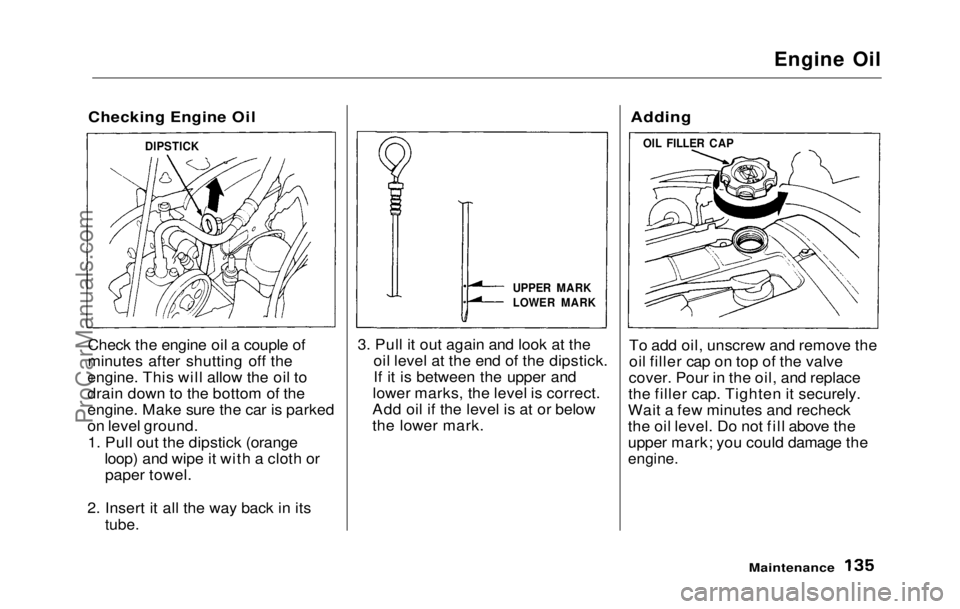
1. Pull out the dipstick (orange
loop) and wipe it with a cloth orpaper towel.
2. Insert
it all the way back in its
tube.
3. Pull
it out again and look at the
oil level at the end of the dipstick.
If it is between the upper and
lower marks, the level is correct.
Add oil if the level is at or below
the lower mark.
Adding
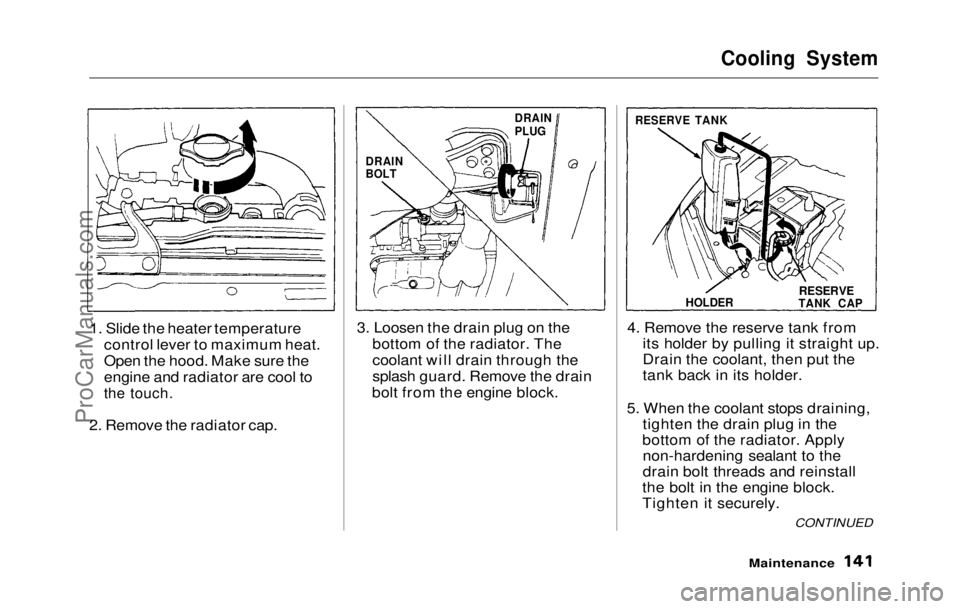
To add oil, unscrew and remove the
oil filler cap on top of the valve
cover. Pour in the oil, and replace
the filler cap. Tighten it securely.
Wait a few minutes and recheck
the oil level. Do not fill above the
upper mark; you could damage the
engine.
Maintenance
UPPER MARK
LOWER MARK
OIL FILLER CAP
DIPSTICKProCarManuals.comMain Menu Table of Contents s t
Page 139 of 225
Cooling System
1. Slide the heater temperature control lever to maximum heat.
Open the hood. Make sure the
engine and radiator are cool to
the touch.
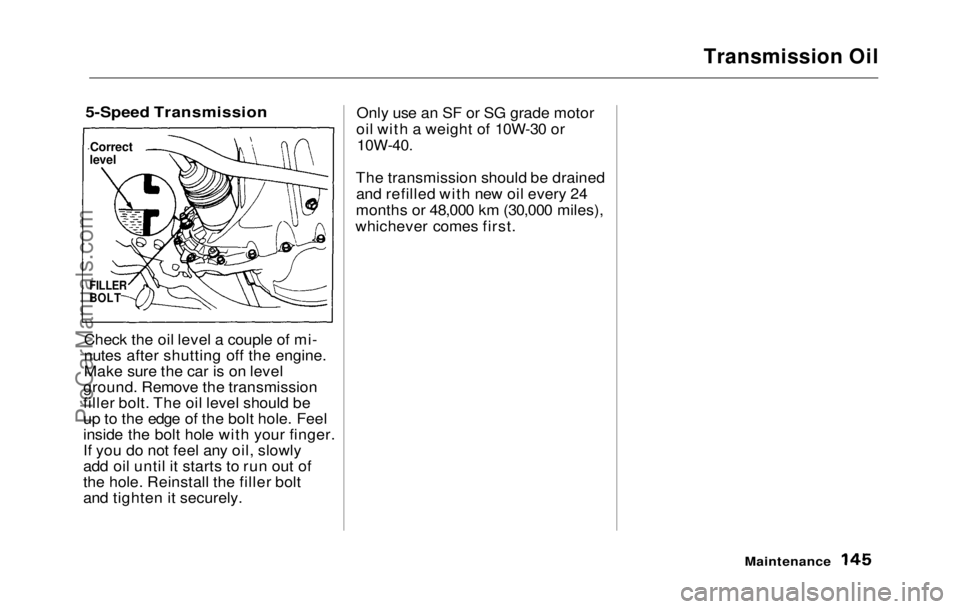
2. Remove the radiator cap. 3. Loosen the drain plug on the
bottom of the radiator. The
coolant will drain through the
splash guard. Remove the drain
bolt from the engine block. 4. Remove the reserve tank from
its holder by pulling it straight up.
Drain the coolant, then put the
tank back in its holder.
5. When the coolant stops draining, tighten the drain plug in the
bottom of the radiator. Apply non-hardening sealant to the
drain bolt threads and reinstall
the bolt in the engine block.
Tighten it securely.
Maintenance
DRAIN
PLUG
DRAIN
BOLT RESERVE TANK
HOLDER
RESERVE
TANK CAP
CONTINUEDProCarManuals.comMain Menu Table of Contents s t
Page 143 of 225
Transmission Oil
5-Speed Transmission
Check the oil level a couple of mi-
nutes after shutting off the engine.
Make sure the car is on level
ground. Remove the transmission
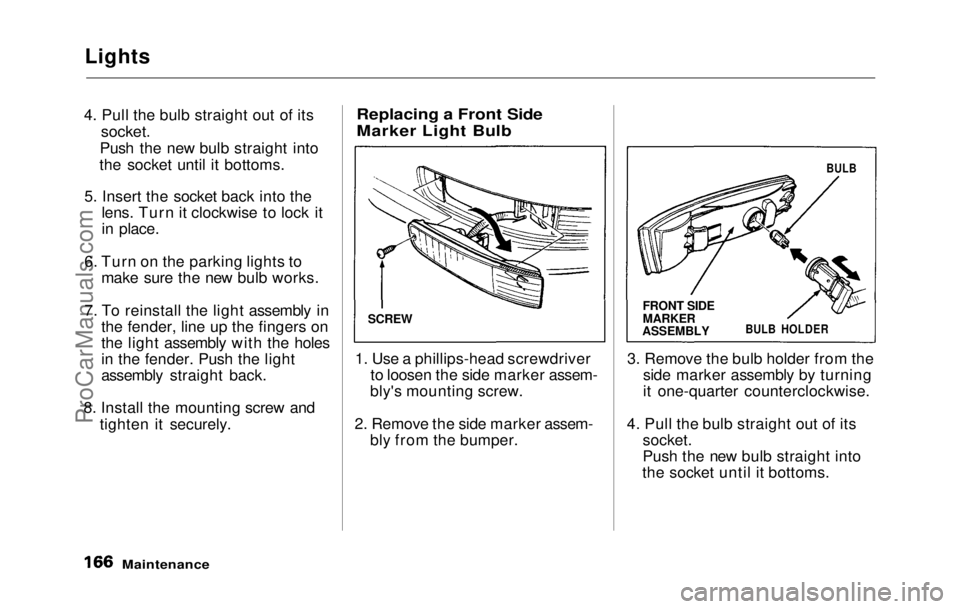
filler bolt. The oil level should be
up to the edge of the bolt hole. Feel
inside the bolt hole with your finger.
If you do not feel any oil, slowly
add oil until it starts to run out of
the hole. Reinstall the filler bolt
and tighten it securely. Only use an SF or SG grade motor
oil with a weight of 10W-30 or
10W-40.
The transmission should be drained and refilled with new oil every 24
months or 48,000 km (30,000 miles),
whichever comes first.
Maintenance
Correct
level
FILLER
BOLTProCarManuals.comMain Menu Table of Contents s t
Page 164 of 225
Lights
4. Pull the bulb straight out of its
socket.
Push the
new bulb straight into
the socket until it bottoms
.
5. Insert
the socket back into the
lens. Turn it clockwise to lock it
in place.
6. Turn
on the parking lights to
make sure the new bulb works.
7. To
reinstall the light assembly in
the fender, line up the fingers on
the light assembly with the holes
in the fender. Push the light
assembly straight back.
8. Instal
l
the mounting screw and
tighten it securely.
Replacing a
Front Side
Marker Light Bulb
1. Use a phillips-head screwdriver to loosen the side marker assem-
bly's mounting screw.
2. Remove the side marker assem- bly from the bumper. 3. Remove the bulb holder from the
side marker assembly by turning
it one-quarter counterclockwise.
4. Pull the bulb straight out of its socket.
Push the new bulb straight into
the socket until it bottoms.
Maintenance
SCREW
BULB HOLDER
BULB
FRONT SIDE
MARKER
ASSEMBLYProCarManuals.comMain Menu Table of Contents s t
Page 167 of 225
Lights
Replacing Rear Bulbs
1. Open the trunk and the taillight
assembly cover.
2. Use
a phillips head screwdriver
to remove the two screws from
the bulb holder. Remove the
holder from the taillight assem-
bly.
3. Try the tail/stoplights, rear turn
signals and back-up lights to
verify which bulb needs replac- ing. Remove that bulb from the
socket by pushing it in slightly
and turning it counterclockwise.
4. Instal l
the new bulb in the socket.
Test it to make sure it works.
5. Reinstal
l
the bulb holder assem-
bly. Install the two screws and
tighten them securely.
Maintenance
COVERProCarManuals.comMain Menu Table of Contents s t