Page 168 of 225
Lights
Replacing a Rear Side Marker
Light Bulb
1. Use a phillips-head screwdriver
to loosen the side marker assem-
bly mounting screw.
2. Remove
the assembly from the
fender by pulling out the back
edge and sliding the assembly
backwards.
3. Remove the socket from the
light assembly by turning it
counterclockwise.
4. Remov
e
the bulb from the socket
by pulling it straight out.
Install the new bulb. Turn on the
headlights to test the bulb.
5. Inser t
the socket in the assembly.
Turn it clockwise to lock it in
place.
6. Reinstal
l
the side marker assem-
bly in the fender. Tighten the
mounting screw securely.
Maintenance
SCREWProCarManuals.comMain Menu Table of Contents s t
Page 169 of 225
Lights
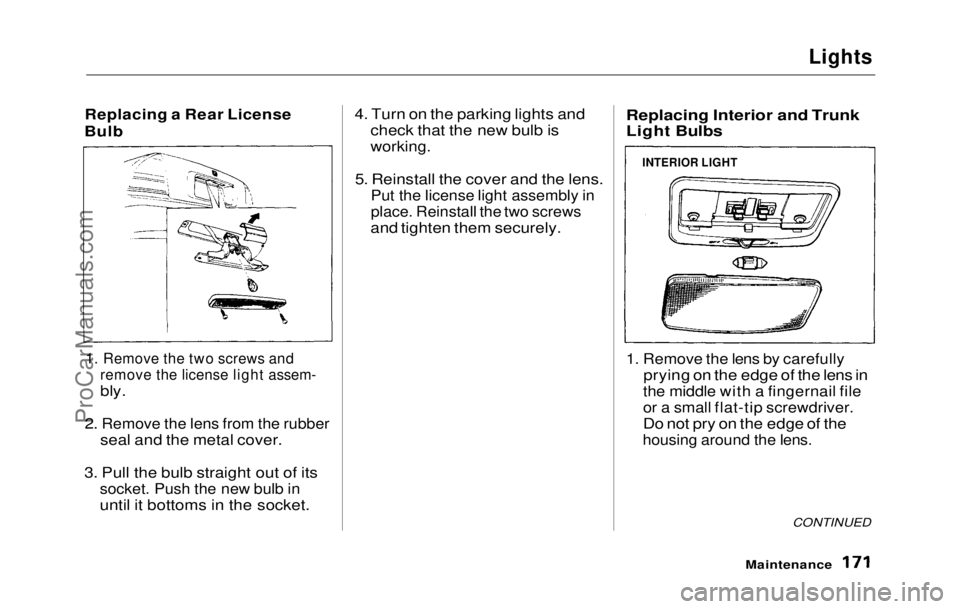
Replacing a Rear License
Bulb
1. Remove the two screws and remove the license light assem-
bly.
2. Remove the lens from the rubber
seal and the metal
cover.
3. Pull the bulb straight out of its
socket. Push the new bulb in
until it bottoms in
the socket.4. Turn on the parking lights and
check that the new bulb is
working.
5. Reinstall the cover and the lens.
Put the license light assembly in
place. Reinstall the two screws
and tighten them securely.
Replacing
Interior and Trunk
Light Bulbs
1. Remove the lens by carefully
prying on the edge of the lens in
the middle with a fingernail file
or a small flat-tip screwdriver.
Do not pry on the edge of the
housing around the lens.
CONTINUED
Maintenance
INTERIOR
LIGH
TProCarManuals.comMain Menu Table of Contents s t
Page 177 of 225
Interior Care, Corrosion Protection
Windows
Clean the windows, inside and out,
with a commercially-available glass
cleaner. You can also use a mixture of one part white vinegar to ten
parts water. This will remove the
haze that builds up on the inside of
the windows. Use a soft cloth or
paper towels to clean all glass and
clear plastic surfaces.
The rear window defogger wires
are bonded to the inside of the glass.
Wiping vigorously up-and-down
can dislodge and break the defog-
ger wires. When cleaning the rear
window, use gentle pressure and
wipe side-to-side.
Air Fresheners
If you want to use an air freshener/
deodorizer in the interior of your
car, it is best to use a solid type.
Some liquid air fresheners contain
chemicals that may cause parts of
the interior trim and fabric to crack or discolor.
If you use a liquid air freshener,
make sure you fasten it securely so
it does not spill as you drive.
Corrosion Protection
Two factors normally contribute to causing corrosion in your car:
1. Moisture trapped in body cavi-
ties. Dirt and road salt that col-
lects in hollows on th
e underside
of the car stays damp, promotin
g
corrosion in that area.
2. Remova l
of paint and protective
coatings from the exterior and
underside of the car.
Many corrosion-preventive mea
-
sures are built into your Honda.
You can help keep your car from
corroding by performing some
simple periodic maintenance: Repair chips and scratches in the
paint as soon as you discover
them.
Appearance Care
NOTICEProCarManuals.comMain Menu Table of Contents s t
Page 185 of 225
Changing a Flat Tire
15.Tighten the
wheel nuts securely
in the same crisscross pattern.
Have the wheel nut torque check-
ed at the nearest automotive
service facility.
Tighten the wheel nuts to:
110 N .
m (1
1 kg-m, 80 Ib-ft)
16.Remove the wheel cover or
center cap.
Place the flat tire face down in
the trunk well.
17.Remove the
spacer cone from
the wing bolt, turn it over, and
put it back on the bolt.
18.Secure th e
flat tire by screwing
the wing bolt back into its hole.
19.Store th
e
jack in its holder with
the end bracket facing to the
rear. Turn the jack'
s end bracket
to lock it in place. Replace the
cover. Store the tool kit.
20.Store th e
wheel cover or center
cap in the trunk.
Taking Car
e
of the Unexpected
WING BOLT
SPACERCONEProCarManuals.comMain Menu Table of Contents s t
Page 208 of 225

Emission Controls
Exhaust Emission Controls
The exhaust emission controls
include four systems: PGM-FI,
Ignition Timing Control, Exhaust
Gas Recirculation and Catalytic
Converter. These four systems
work together to control the engine's combustion and minimize
the amount of HC, CO, and NOx
that comes out the tailpipe. The
exhaust emission control systems
are separate from the crankcase
and evaporative emission control
systems.
PGM-FI System
The PGM-FI System on your car
has three sub systems: Air Intake,
Electronic Control, and Fuel
Control. The Electronic Control
Unit (ECU) uses various sensors to
determine how much air is going
into the engine. It then controls
how much fuel to inject under all
operating conditions. Ignition Timing Control System
This system constantly adjusts the
ignition timing, reducing the
amount of HC, CO and NOx
produced.
Exhaust Gas Recirculation (EGR)
The EGR system takes some of the
exhaust gas and routes it back into
the intake manifold. Adding ex-
haust gas to the air/fuel mixture re-
duces the amount of NOx produced
when the fuel is burned.
Catalytic Converter
The catalytic converter is in the exhaust system. Through chemical
reactions, it converts HC, CO, and
NOx in the engine's exhaust to
carbon dioxide (CO 2), dinitrogen
(N 2), and water vapor.
Replacement Parts
The emission control systems are
designed and certified to work to-
gether in reducing emissions to
levels that comply with the Clean
Air Act. To make sure the emis-
sions remain low, you should use
only new genuine Honda replace-
ment parts or their equivalent for
repairs. Using lower quality parts
may increase the emissions from
your car .
The emissions control systems are
covered b y
warranties separate
from the rest of your car. Read
your warranty manual for more
information.
Technical InformationProCarManuals.comMain Menu Table of Contents s t
Page:
< prev 1-8 9-16 17-24