Page 163 of 225

Lights
3. Turn the lock ring counterclock-
wise (about one-quarter turn) to unlock the headlight bulb.
4. Remove
the bulb by pulling it
straight out of its recess.
5. Install
the new bulb with the
electrical connector pointing
down. Make sure all three tabs on the bulb are seated in their
slots in the headlight.
6. Turn the lock ring clockwise to
lock the bulb in place. Do not
force the ring. Check the seating
of th e
bulb's tabs if the ring will
not return to its original position.
7. Reinstall the harness connector on the bulb connector. Make sure
it locks in place.
Turn o n
the headlights to test
the new bulb.
8. (Passenger'
s
side)
Reinstall the radiator reserve
tank.
Replacing a
Parkin
g Light
Bulb
1. Use a phillips head screwdriver
to remove the screw from the top
of the fender.
2. Mov e
the parking light assembly
forward until it slides out of the
body.
3. Tur n
the socket one-quarter turn
counterclockwise to remove it
from the lens.
CONTINUED
Maintenance
SCREW
ProCarManuals.comMain Menu Table of Contents s t
Page 170 of 225
Lights
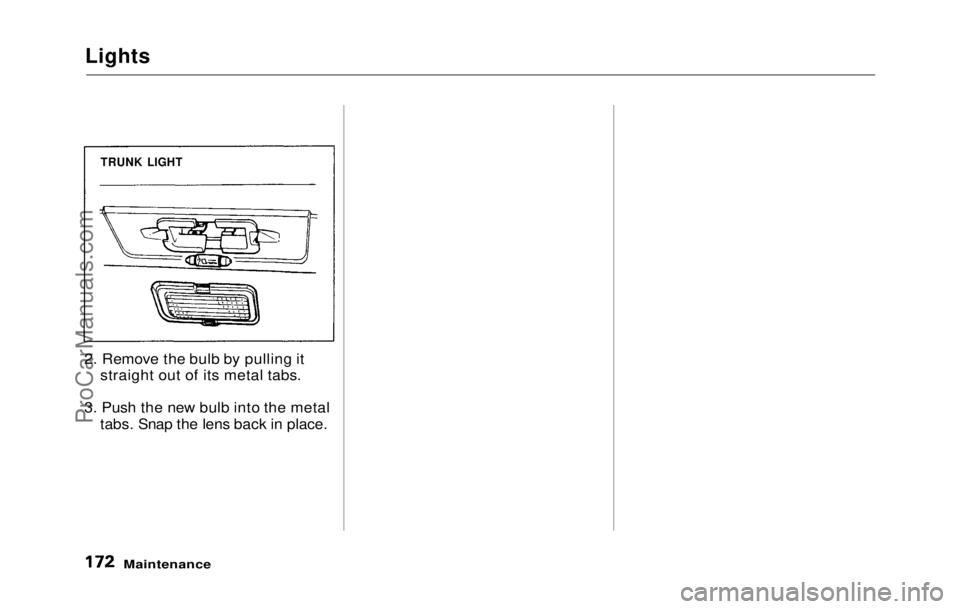
2. Remove the bulb by pulling it straight out of its metal tabs.
3. Push the new bulb into the metal tabs. Snap the lens back in place.
Maintenance
TRUNK LIGHTProCarManuals.comMain Menu Table of Contents s t
Page 178 of 225

Corrosion Protection, Body Repairs
Inspect and clean out the drain
holes in the bottom of the doors
and body.
Check the floor coverings for
dampness. Carpeting and floor mats may remain damp for a long
time, especially in winter. This dampness can eventually cause
the floor panels to corrode.
Use a high-pressure spray to
clean the underside of your car.
This is especially important in
areas that use road salt in winter. It is also a good idea in humid
climates and areas subject to salt
air. Cars equipped with ABS
have a sensor and wiring at each
wheel. Be careful not to damage
them.
Have the corrosion-preventive
coatings on the underside of your
car inspected and repaired
periodically.
Body Repairs
Body repairs affect your car's
resistance to corrosion. If your car
needs repairs after a collision, pay
close attention to the parts used in
the repair and the quality of the
work.
Make sure the repair facility uses
genuine Honda replacement body
parts. Some companies make
sheetmetal pieces that seem to
duplicate the original Honda body parts, but are actually inferior in fit,
finish, and quality. Once installed,
they do not give the same high- quality appearance and level of
corrosion resistance. When reporting your collision to
the insurance company, tell them
you want genuine Honda parts
used in the repair. Although most insurers recognize the higherquality of original parts, some may
try to specify that the repairs be
done with the "lowest cost" parts
available. You should investigate
this before any repairs are begun.
Take your car to your authorized Honda dealer for inspection after
the repairs are completed. He can make sure that quality materials
were used, and that corrosion-
preventive coatings were applied to
all repaired and replaced parts.
Appearance Car e
ProCarManuals.comMain Menu Table of Contents s t
Page 204 of 225

Anti-lock Brake System
The Anti-lock Brake System (ABS) is standard equipment on the
Prelude Si, Si 4WS sold in the U.S.
and SR, SR 4WS sold in Canada. It
is not available on any other models.
The ABS works by measuring how
fast the wheels are turning during
braking and comparing their speed.If any wheel is rotating much
slower than the others (on the
verge of locking up and skidding),
the system reduces hydraulicpressure to that wheel's brake
caliper. When that wheel's speed
matches the other wheels, the
system applies normal hydraulic pressure. This can take place
several times per second at each
wheel. You feel the ABS working as rapid pulsations in the brake
pedal.
Each wheel has a wheel speed
sensor assembly. As the wheel
rotates, the sensor sends electrical
pulses to the ABS control unit. The
pulse frequency varies with the
wheel speed.
The electrical output of the ABScontrol unit is connected to the
modulator/solenoid unit. During
braking, the ABS control unit monitors the pulse frequencies
from the four wheels. When the control unit detects a wheel locking
up, it energizes the appropriate
solenoid in the modulator/solenoid
unit. There are three solenoids: one
for each front wheel, and one for
the rear wheels. The energized solenoid reduces hydraulic pres-
sure to one side of a modulator
valve. This, in turn, reduces hydrau- lic pressure in the brake line going
to the affected wheel. When that
wheel speeds up because of the re- duced braking effort, the control unit de-energizes the solenoid. This
builds hydraulic pressure on the
modulator valve. The pressure in-
creases in the hydraulic line to the
wheel.
For the system to react quickly, the
modulator/solenoid unit must have
brake fluid under high pressure.
This is supplied by an accumulator
that is pressurized by an electric pump. A pressure-sensing switch
on the accumulator controls this
pump.
The control unit also contains error detection circuitry. It monitors the
operation of the wheel sensors, solenoids, pump, and electronics. If
the control unit detects any faults,
it shuts off power to the pump
motor and solenoids. The light on
the instrument panel comes on.
The brakes then work like a conventional system without anti-
lock capabilities.
Technical InformationProCarManuals.comMain Menu Table of Contents s t
Page 217 of 225

Index
Accessories
Installation................................. 105
ACCESSORY
(Ignition Key Position).............. 48
Adding
Automatic Transmission
Fluid........................................ 144
Brake Fluid............................... 146 Clutch Fluid.............................. 147
Engine Oil...:.............................. 135
Manual Transmission Fluid... 145
Power Steering Fluid.............. 148
Radiator Coolant...................... 139
Windshield Washer fluid ........ 143
Additional Safety Information .... 16
Door Locks.................................. 16
Driving with Pets....................... 17
Seat-back Position..................... 16
Storing Cargo Safely................. 17
Additives, Engine Oil................... 136
Adjustments
Mirrors....................................... .
59
Seats............................................. 51
Steering Wheel..........................
43
Airbag (SRS).................................. 1
0
Air Conditioning............................. 68
Maintenance..............................
157
Usage............................................ 6 8
Ai
r Filter........................................
149
Air Outlet
s
(Vents)......................... 68
Air Pressure, Tires ......................
159
Alcohol an d
Drugs.......................... 24
Alcohol in Gasoline........................ 98
Antifreeze......................................
139
Anti-lock Brake s
(ABS)
Description................................
208
Indicator Light.................. .
34,
118
Operation................................... 117
Anti-theft Steerin
g
Column
Lock.............................................. 48
Appearance Care..........................
175
Ashtray............................................. 65
Audio System................................. .
75
Automatic Speed Control............. 44
Automatic Transmission............ 112
Capacity, Fluid........................
.
206
Checking Fluid Level.............. 144
Shifting
...................................... 113
Shift Leve r
Positions...............
112
Shift Lock Release................... 115
Battery
Charging System Light............. 33
Jump Starting............................ 191
Maintenance.............................. 152
Specifications............................ 207
Before Driving
................................ 97
Belts, Seat ......................................... 4
Body Repair
...................................
181
Brakes
Anti-lock Syste
m (ABS)..........
117
Break-in, Ne
w
Linings.............. 98
Fluid............................................
146
Light, Burned-out................... .
169
Parking......................................... 61
System Light.............................. .
33
Wear Indicators.....................
116
Brakes, AB S
Description...............................
.
208
Operation................................... 117
System Indicator...............
.
34,
118
Braking System...........................
.
116
Break-in, Ne
w
Car ......................... 98
CONTINUEDProCarManuals.comMain Menu s t