1991 MITSUBISHI ECLIPSE air condition
[x] Cancel search: air conditionPage 501 of 1216

FUEL SYSTEM - Service Adjustment Procedures <1.8L Engine>14-47
A
E3x>
/ )Engine speed
(rpm)1 FU446Engine speed (rpm)
>3FU262EGR VALVE CONTROL VACUUM CHECK
Check ConditionEngine coolant temperature: 85-‘95”C (185-205°F)
(1) Disconnect the vacuum hose from the throttle body EGR
vacuum nipple and connect a hand vacuum pump to the
nipple.(2) Start the engine and check to see that, after raising the
engine speed by racing the engine, vacuum raises pro-
portionately with the rise in engine speed.
NOTEIf there is a problem with the change in vacuum, it is
possible that the throttle body port may be clogged and
require cleaning.
PURGE PORT VACUUM CHECKCheck ConditionN14FvBcEngine coolant temperature:
85-95°C (185-205°F)
(1) Disconnect the vacuum hose from the throttle body purge
hose nipple and connect a hand vacuum pump to the
nipple.(2) Start the engine and check to see that, after raising the
engine speed by racing the engine, vacuum remains fairly
constant.NOTE
If there is no vacuum created, it is possible that the throttlebody port may be clogged and require cleaning.
Page 503 of 1216

FUEL SYSTEM - Service Adjustment Procedures <2.0L Engine>14-49
TerminalNo.10screw(2) Disconnect the female connector (for waterproof protec-
tion of the connector) from the connector for ignition timing
adjustment.
(3) Connect the ignition timing adjusting terminal to the groundusing a jumper wire with alligator clips.
(4) Connect terminal No.
10 of the self-diagnosis connector to
the ground with a jumper wire with alligator clips.
(5) Start the engine and run at idle.
(6) Check to be sure that the engine idling speed is the basic
idle speed.
Basic idle speed: 750
250 rpm
If there is a deviation of the engine speed from the basic
idle speed, first determine whether or not the conditions
described below exist, and then use the speed adjustment
screw to adjust to the basic idle speed.
(a) The engine speed may be
20-100 rpm low for a
new vehicle [driven about 500 km (300 miles) or
less], but adjustment is not necessary.
(b) If engine stalling occurs or the engine speed is low
even though the vehicle has been driven about 500
km (300 miles) or more, it is probable that these are
deposits adhered to the throttle valve, so it should
be cleaned.
(Refer to
P.14-51.)(c) If the engine speed is higher than the standard
value even though the speed adjusting screw is
fully close, check for any indication that the idle
position switch (fixed speed adjusting screw) posi-
tion has changed; if there is such an indication,
adjust the idle position switch (fixed speed adjust-
ing screw).
If there is no evidence of a change of position, it is
probable that there is leakage resulting from de-
terioration of the fast-idle air valve (FIAV), so
replace the throttle body.
(7) Turn OFF the ignition switch and stop the engine.
(8) Disconnect the grounding jumper wire from the diagnosis
connector.(9) Disconnect the grounding jumper wire from the ignition
timing connector and mount a waterproof connector.
(1O)Disconnect the tachometer.
(11)Star-t the engine once again and let it idle for about 5
minutes; check to be sure that the idling condition is
normal.
Page 508 of 1216
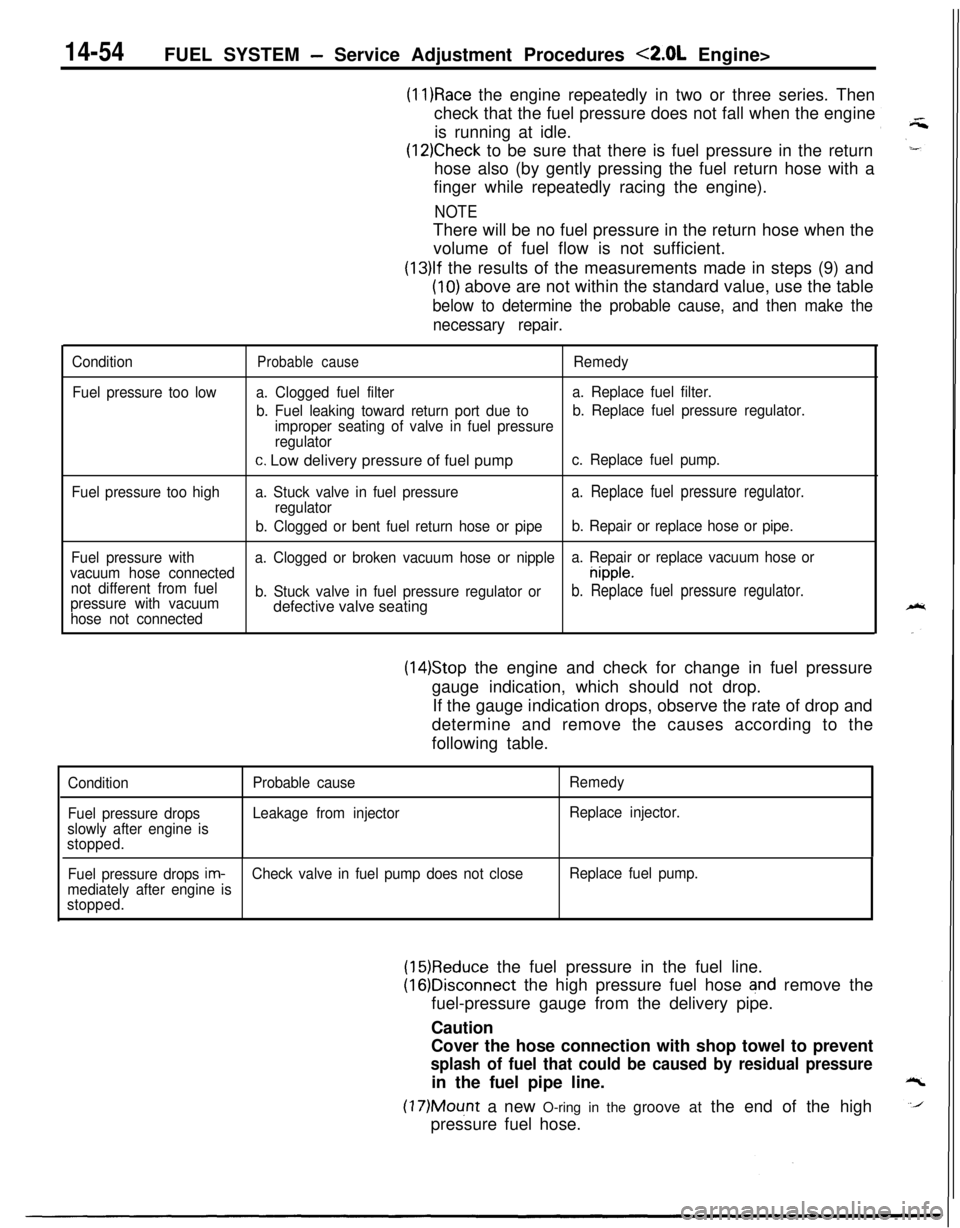
14-54FUEL SYSTEM - Service Adjustment Procedures <2.0L Engine>
(11)Race the engine repeatedly in two or three series. Then
check that the fuel pressure does not fall when the engine
is running at idle.
(12)Check to be sure that there is fuel pressure in the return
hose also (by gently pressing the fuel return hose with a
finger while repeatedly racing the engine).
NOTEThere will be no fuel pressure in the return hose when the
volume of fuel flow is not sufficient.
(13)lf the results of the measurements made in steps (9) and
(10) above are not within the standard value, use the table
below to determine the probable cause, and then make the
necessary repair.
Condition
Fuel pressure too lowProbable causeRemedy
a. Clogged fuel filtera. Replace fuel filter.
b. Fuel leaking toward return port due tob. Replace fuel pressure regulator.
improper seating of valve in fuel pressure
regulator
c. Low delivery pressure of fuel pumpc. Replace fuel pump.
Fuel pressure too higha. Stuck valve in fuel pressure
a. Replace fuel pressure regulator.regulator
b. Clogged or bent fuel return hose or pipeb. Repair or replace hose or pipe.
Fuel pressure witha. Clogged or broken vacuum hose or nipplea. Repair or replace vacuum hose or
vacuum hose connected
nipple.
not different from fuel
pressure with vacuumb. Stuck valve in fuel pressure regulator or
b. Replace fuel pressure regulator.
hose not connecteddefective valve seating
(14)Stop the engine and check for change in fuel pressure
gauge indication, which should not drop.
If the gauge indication drops, observe the rate of drop and
determine and remove the causes according to the
following table.
Condition
Fuel pressure drops
slowly after engine is
stopped.Probable cause
Leakage from injectorRemedy
Replace injector.
Fuel pressure drops
im-Check valve in fuel pump does not closeReplace fuel pump.
mediately after engine is
stopped.
(15)Reduce the fuel pressure in the fuel line.
(16)Disconnect the high pressure fuel hose and remove the
fuel-pressure gauge from the delivery pipe.
Caution
Cover the hose connection with shop towel to prevent
splash of fuel that could be caused by residual pressurein the fuel pipe line.
(17)Mount a new O-ring in the groove at the end of the high
pressure fuel hose.
Page 509 of 1216
FUEL SYSTEM - Service Adjustment Procedures <2.0L Engine>14-55
(18)Connect the high-pressure fuel hose,,to the delivery pipe
and tighten the screws to the specified torque.
(19)Check for fuel leaks.
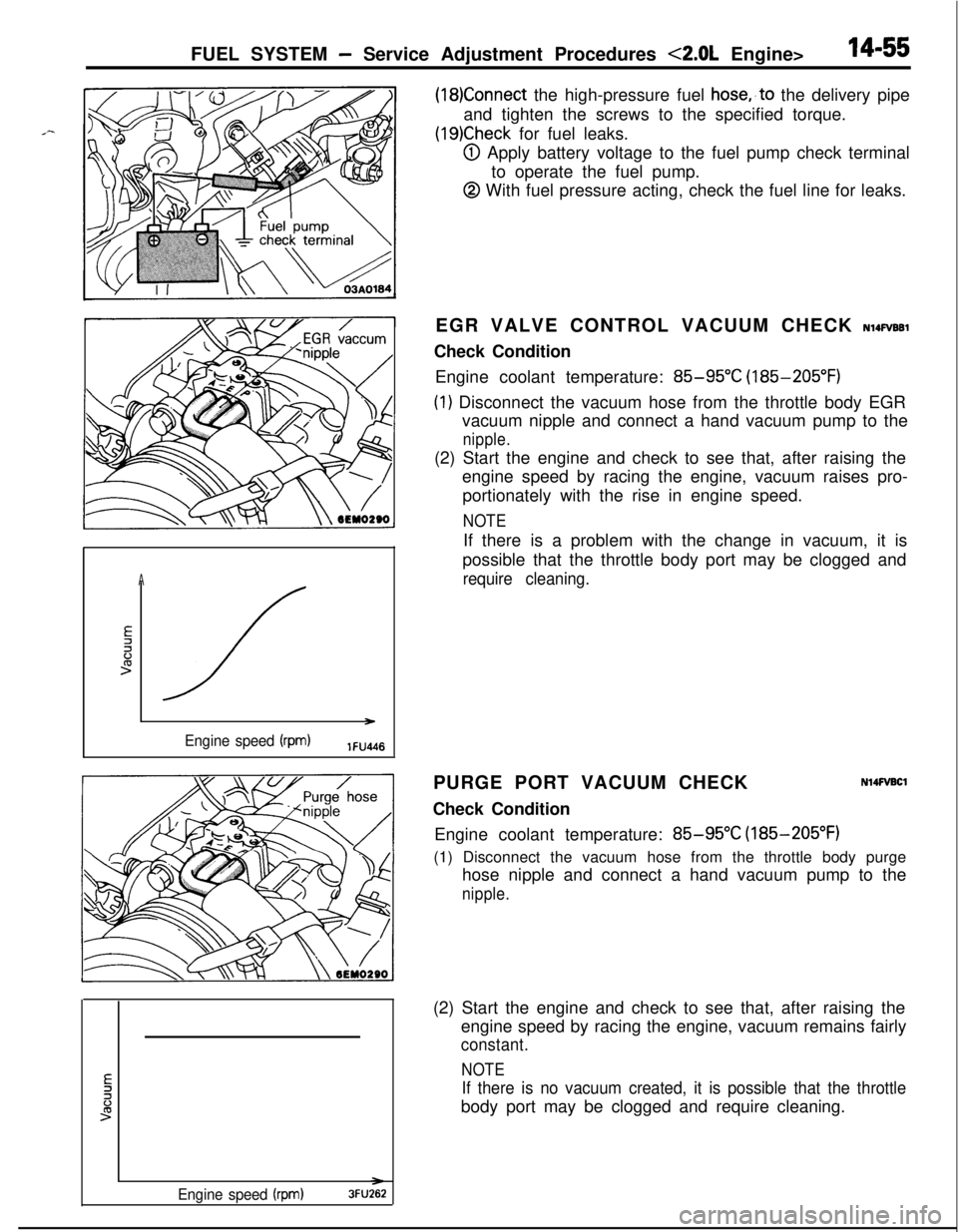
@I Apply battery voltage to the fuel pump check terminal
to operate the fuel pump.
@ With fuel pressure acting, check the fuel line for leaks.
A
E2li:>
/ )
Engine speed (rpm)lFU4l6EGR VALVE CONTROL VACUUM CHECK
NlQFVBBlCheck Condition
Engine coolant temperature:
85-95°C (185-205°F)
(1) Disconnect the vacuum hose from the throttle body EGR
vacuum nipple and connect a hand vacuum pump to the
nipple.(2) Start the engine and check to see that, after raising the
engine speed by racing the engine, vacuum raises pro-
portionately with the rise in engine speed.
NOTEIf there is a problem with the change in vacuum, it is
possible that the throttle body port may be clogged and
require cleaning.PURGE PORT VACUUM CHECK
Check Condition
N14FVBClEngine coolant temperature:
85-95°C (185-205°F)
(1) Disconnect the vacuum hose from the throttle body purge
hose nipple and connect a hand vacuum pump to the
nipple.
Engine speed (rpm)3FU262(2) Start the engine and check to see that, after raising the
engine speed by racing the engine, vacuum remains fairly
constant.
NOTE
If there is no vacuum created, it is possible that the throttlebody port may be clogged and require cleaning.
Page 512 of 1216

14-58FUEL SYSTEM -MPI System Inspection <1.8L Engine>
MALFUNCTION INDICATOR LIGHTNWQAB
Among the self-diagnosis items, a malfunction indicator light
comes on to notify the driver of the emission control items
when an irregularity is detected.
However, when an irregular signal returns to
notmal ‘and the
engine control unit judges that it has returned to normal, the
malfunction indicator light goes out.
Moreover, when the ignition switch is turned off, the light goes
out. Even if the ignition switch is turned on again, the light doesnot come on until the irregularity is detected.
Here, immediately after the ignition switch is turn on, the
malfunction indicator light is lit for 5 seconds to indicate that
the malfunction indicator light operates normally.
Items indicated by the lightening malfunction light
Engine control unit
Oxygen sensor
Air-flow sensor
Intake air temperature sensor
Throttle position sensor
Motor position sensor
Engine coolant temperature sensor
Crank angle sensor
No. 1 cylinder TDC sensor
Barometric pressure sensor
Ignition timing adjustment signal
Injector
Fuel pump
EGR system
The malfunction indicator light lights up when the ignition
timing adjustment terminal is short-circuited
,‘t’o ground.
Consequently, it lights up ,when the ignition timing
adjustment is grounded when adjusting ignition timing,
but in this case there is no abnormality.
MALFUNCTION INDICATOR LIGHT INSPECTlON
When turning on the ignition switch, check that the light comes
on.
NOTElf the light does not come on, check the harness and light for
breakage.SELF-DIAGNOSIS
Nl4PMFaThe engine control unit monitors the input/output signals
(some signals at all times and the others under specified
conditions) of the engine control unit.
Page 514 of 1216

14-60FUEL SYSTEM - MPI Svstem lnwection <1.8L Engine>
7 MPI
diagnosis
LGround
DIAGNOSIS CHART (FAULT TREE)output
preference
orderDiagnosis item
1Engrne control
unit
2 2Oxygen sensor Oxygen sensor
3 3Air flow sensor Air flow sensor
4 4Intake air Intake airtemperature sensor temperature sensor
5 5Throttle position Throttle positionsensor sensor
6 6Motor position Motor positionsensor sensor
INSPECTION PROCEDURE - USING VOLTMETERN14PCAGl
(1) Connect an analogue voltmeter to the self-diagnosis con-,z
nectar.
‘~(2) Turn ignition switch to ON, and indication of engine control
unit memory contents will immediately start. If the system
is in normal condition, pointer of voltmeter indicates normalpattern. If any abnormality is in memory, the pointer of
voltmeter will deflect, indicating abnormal item as de-
scribed in “Diagnosis Chart”.
After recording the abnormal item, check and repair each
part according to the check items in “Diagnosis Chart”.
(3) If the defective parts have been repaired, disconnect the
negative terminal of battery cable for
10 seconds or more
and connect it again to make sure that the abnormal code
has been erased.
N14PRACDiagnosis code
Output signal pattern
:1
12A0104
12A0104
12A0104
12A0104
:JJlJJ--
12A0104
LII
12A0104
No.
-
11Retained
12Retained
14
15MemoryCheck item (Remedy)
-(ll#ace engine control
l Harness and connectorl Fuel, pressurel Injectors
(Replace if defective)
l Intake air leaks0 Oxygen sensor
l Harness and connector
(If harness and connector
are normal, replace airflow sensor assembly.)
Page 518 of 1216

14-64FUEL SYSTEM -MPI System Inspection <1.8L Engine>
Idle speed controlservo connector
6FU098t(3) Disconnect the idle speed control servo connector.
(4) Connect DC
6V between terminals @) and @ of the idle
speed control servo connector, and then measure the
resistance between terminals
@ and @ of the motor
position sensor connector when the idle speed control
servo is activated (caused to expand and contract).
Standard value: Smooth increase/decrease in accord-
ance with extension and retraction of
idle speed control servo plunger.
Caution
Apply only a 6V DC or lower voltage. Application of
higher voltage could cause locking of the servo gears.
(5) If there is a deviation from the standard value, or if the
change is not smooth, replace the idle speed control servo
assembly.
OXYGEN SENSORN14QDBAb
INSPECTIONCaution
1. Before checking, warm up the engine until engine
coolant temperature reaches 85 to
95°C (185 to 205°F).2. Use an accurate digital voltmeter.
(1) Disconnect the oxygen sensor connector and connect a
voltmeter to the oxygen sensor connector.
(2) While repeating engine racing, measure the oxygen sensor
output voltage.
EngineOxygen sensor
output voltageRemarks
Race0.6- 1 .OVMake air-fuel mixture
rich by accelerator
operation
NOTEFor removal and installation of the oxygen sensor, refer
toGROUP 11
- Exhaust Manifold.
Oxygen sensor installation torque:
40
-50 Nm (30 - 36 klbs.)
EGR TEMPERATURE SENSOR
- Exhaust Gas Recirculation System.
VEHICLE SPEED SENSORN14QEEBaRefer to GROUP 8
- Meters and Gauges.
AIR CONDITIONER SWITCHRefer to GROUP 8
- Column Switch.
N14QQABa
Page 521 of 1216

FUEL SYSTEM - MPI System Inspection <1.8L Engine>
POWER TRANSISTOR
Refer to GROUP 8
- Ignition System
14-67
NlQRCGAAIR CONDITIONER POWER RELAY
Refer to GROUP 24
- Air Conditioner.
N14RCLBPURGE CONTROL SOLENOID VALVE
N14RCKARefer to GROUP 25
- Evaporative Emission Control System.
EGR CONTROL SOLENOID VALVE
N14RCLARefer to GROUP 25
- Exhaust Gas Recirculation System.