Page 633 of 1216

REAR SUSPENSION - Rear Suspension ~Assembly
14AO520
12AOlOQ
SERVICE POINTS OF REMOVALN17GQAOa4. REMOVAL OF CALIPER ASSEMBLY
(1) Remove the lock pin, rotate the calipei
&&e-@blyupward, then remove the caliper assembly and secure
it with wire, etc.
Caution
The lock pin has a special grease appl‘ied tq it, so besure not to wipe it off, and ensure that the lock pin
stays clean.
(2) After removing the caliper assembly,
.cover the guide
pin with a cloth, etc.
8. REMOVAL OF PROPELLER SHAFT INSTALLATION
BOLT AND NUT
Place mating marks on the differential carrier companion
flange and the propeller shaft flange yoke.
NOTEThe mating marks should be used as a reference for
re-installation.9. REMOVAL OF SELF LOCKING NUT
(1) Before removing the self’ locking nuts, support the
differential case with a transaxle jack.
(2) Remove the self locking nuts.
12. REMOVAL OF PARKING BRAKE CABLE AND REAR
SPEED SENSOR INSTALLATION BOLT
(1) Lower the transaxle jack slightly.
(2) Remove the parking brake cable installation bolts.
NOTEThe task may be made easier by increasing the gap
between the body and the
crossmember.
Page 634 of 1216

17-24REAR SUSPENSION - Rear Suspension Assembly
1
II
brakeA022116. REMOVAL OF REAR SUSPENSION ASSEMBLY
(1) Supporting the rear suspension assembly with a trans-
mission jack, move it toward the rear (in the direction of
wtthe fuel tank).
c1(2) Gradually lower the transmission jack, avoiding contact
with the stabilizer bar and the propeller shaft.
Caution
1. Ensure that the propeller shaft does not bend
greatly.
2.Ensure that the liibro joint does not receive any
shock.
NOTEThe lowering of the rear suspension assembly from the
transmission jack requires three individuals due to the
amount of weight being handled (one on the differen-
tial, and one on either side of the lower arm).
(3) In order to protect the rear suspension assembly dust
shield, support the lower arm ball joint with a wooden
block.
INSPECTIONNl7GCAMl Check crossmember for cracks or other damage.
SERVICE POINTS OF INSTALLATIONN17GOAR -
8.INSTALLATION OF PROPELLER SHAFT INSTALLATIONBOLT AND NUT
Install the propeller shaft to the differential carrier, ensuringthat the mating marks are aligned.
3. INSTALLATION OF PARKING BRAKE CABLE END
NOTE
Connecting a parking brake cable end to parking brake lever
and prying up the parking brake lever, the installation of theother cable end will be easy.
’ice,
Page 638 of 1216

17-28REAR SUSPENSION - Trailing Arm
TRAILING ARMr
{EMOVAL AND INSTALLATION
9-14 Nm7-10 ft.lbs.
\SO-110
Nm50-60 Nm36-43 ft.lbs. !65-80 ftlbs.
/160-220 Nm\\\ /zdnnecting
/
/
13
_-_ --- .~~~~116-159 ftlbs.55-65
Nm40-47 ft.lbs.5m
60-72 Nrn43-52 ft.lbs.
/-\
103Removal steps
1. Parking cable end
4*2. Rear brake assembly
3. Rear brake disc
4. Drive shaft and companion flange
installation bolt, nut4I)
l +5. Self locking nut++ 6. Companion flange
7. Rear speed sensor 8. O-ring
+I) ++ 9. Rear axle shaft
10. Dust shield
::11. Self locking nut (upper arm)
12. Self locking nut (lower arm)
13. Parking brake cable and rear speed sensor
installation bolt
14. Trailing arm installation bolt, nut
15. Rear shock absorber installation bolt
16. Trailing arm
12A0639Post-installation Operation
Kheck of Wheel Alignment
(Refer to P.17-20.)@Check of Parking Brake Lever Stroke
(Refer to GROUP 5-Service Adjust-
ment Procedures.)
@Rear Brake Disc Run-out Check
(Refer to GROUP 5-Service Adjust-
ment Procedures.)
NOTE(I) Reverse the removal procedures to reinstall.(2) ++ : Refer to “Service Points of Removal”.(3) W : Refer to “Service Points of Installation”.(4) m : Non-reusable parts(5) *: Indicates parts which should be temporarily tight-
ened, and then fully tightened with the vehicle in
the unladen condition.
9%NlTTA-
“c
_
k.
Page 645 of 1216
-.
J-
REAR SUSPENSION - Stabilizer Bar
STABILIZER BAR:_-REMOVAL AND INSTALLATION/rq7lA-i.i;: 112AO620
70-85 Nm110-130 Nm51-81 ft.lbs.80-94 ftlbs.9-14 Nm
7-10 ft.lbs./4
IL-v \
‘3w35-45 Nm
25-33 ft.lbg.Removal steps
::
1. Self locking nut
2. Crossmember bracket‘----e212A01133. Parking brake cable and rear speed sensormeA
installation bolt
4. Stabilizer bracket5. Bushing
+e l +6. Self locking nut7. Joint cup (A)
8. Stabilizer rubber9. Joint cup
(B)+e l a 10. Self locking nut++ l + 11. Stabilizer link!ykeverse the removal procedures to reinstall.
12. Joint cup (A)(2) +I) : Refer to “Service Points of Removyl”.
13. Stabilizer rubber(3) l * : Refer to “Service Points of Installation”.
4*14. Stabilizer bar(4) m : Non-reusable parts
L
Page 836 of 1216
21-142AUTOMATIC TRANSAXLE - General Information
Klckdown servo
-,Low-reverse
brake
End clutch
Front clutch
FDamper clutch
control valve
Damper clutch
control
solenordTo lubrication
+_ifront)To lubncatlon CJIrear)
I I .“‘---Shaft control
114 !!. B ii IIII III/lII II.
TlPressure control
Pressure
\ \, Yal”eEm
0 011 pump suctton pressure
0 Modulated line pressure
m Damper clutch pressure
Damper clutch control
solenoidvalve pressure
-IPressure control solenoidvalve pressure
ILine pressure
xque converter and lubrlcatlonessure
Reducing pressure
TFA0071
Page 872 of 1216

21-178AUTOMATIC TRANSAXLE - Troubleshooting
09P0010Fluid level must be
within this range.09PoOll
0”
Two302
DIAGNOSIS AND TEST
FLUID LEVEL AND CONDITION1. Drive until the fluid temperature reaches the usual tem-
perature
[70-80°C (160- 18O”F)I.2. Place vehicle on level floor.
3. Move selector lever sequentially to every position to fill
torque converter and hydraulic circuit with fluid, then place
lever in “N” Neutral position. This operation is necessary tobe sure that fluid level check is accurate.
4. Before removing dipstick, wipe all dirt from area around
dipstick. Then take out the dipstick and check the conditionof the fluid.
The transaxle should be overhauled under the following
conditions.l If there is a “burning” odor.
l If the fluid color has become noticeably blacker.
lIf there is a noticeably great amount of metal particles inthe fluid.
5.Check to see if fluid level is in “HOT” range on dipstick. If
fluid level is low, add automatic transaxle fluid until level
reaches “HOT” range.
Low fluid level can cause a variety of conditions because itallows pump to take in air along with fluid. Air trapped in
hydraulic circuit forms bubbles which make fluid spongy.
Therefore, pressures will be erratic.
Improper filling can also raise fluid level too high. When
transaxle has too much fluid, gears churn up foam and
cause same conditions which occur with low fluid level,
resulting in accelerated deterioration of automatic transaxle
fluid.In either case, air bubbles can cause overheating, fluid
oxidation, which can interfere with normal valve, clutch,
and servo operation. Foaming can also result in fluid
escaping from transaxle vent where it may be mistaken for
a leak.
6. Be sure to examine fluid on dipstick closely.
CONTROL CABLE
Whether control cable is properly adjusted can be confirmed bychecking whether inhibitor switch is performing well.
1. Apply parking brakes and service brakes securely.
2. Place selector lever to “R” range.
3. Set ignition key to “ST” position.
4. Slowly move the selector lever upward until it clicks as it
fits in notch of “P” range. If starter motor operates when
lever makes a click, “P” position is correct.
5.Then slowly move selector lever to “N” range by the same
procedure as in foregoing paragraph. If starter motor
operates when selector lever fits in “N”, “N” position is
correct.6. Also check to be sure the vehicle doesn’t begin to move
and the lever doesn’t stop between P-R-N-D.
7. The control cable is properly adjusted if, as described
above, the starter motor starts at both the “P” range and
the “N” range.
Page 896 of 1216
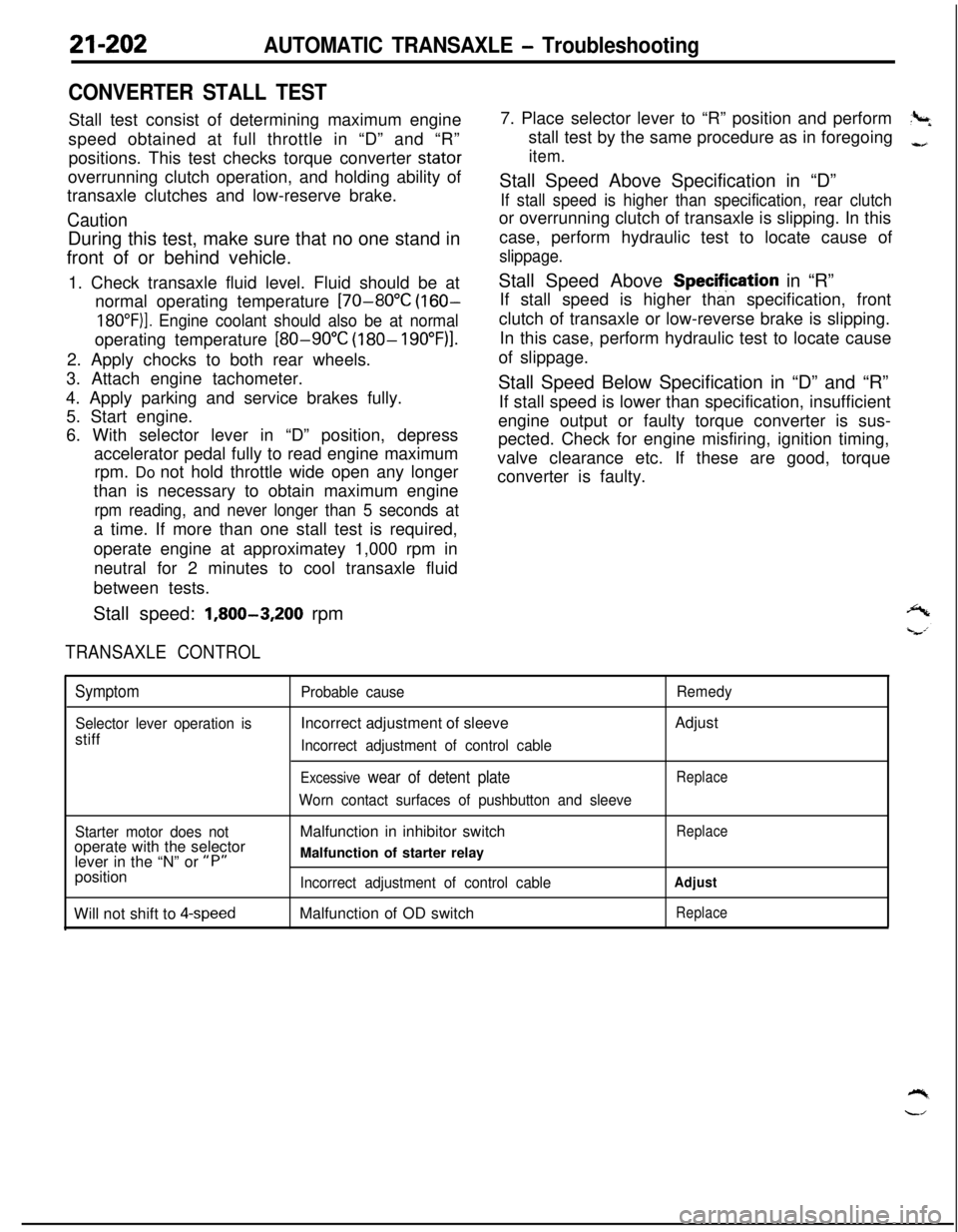
21-202AUTOMATIC TRANSAXLE - Troubleshooting
CONVERTER STALL TESTStall test consist of determining maximum engine
speed obtained at full throttle in “D” and “R”
positions. This test checks torque converter stator
overrunning clutch operation, and holding ability of
transaxle clutches and low-reserve brake.
CautionDuring this test, make sure that no one stand in
front of or behind vehicle.
1. Check transaxle fluid level. Fluid should be at
normal operating temperature
[70-80°C (160-
18O”F)]. Engine coolant should also be at normaloperating temperature
[80-90°C (180- 19O”F)l.2. Apply chocks to both rear wheels.
3. Attach engine tachometer.
4. Apply parking and service brakes fully.
5. Start engine.
6. With selector lever in “D” position, depress
accelerator pedal fully to read engine maximum
rpm. Do not hold throttle wide open any longer
than is necessary to obtain maximum engine
rpm reading, and never longer than 5 seconds ata time. If more than one stall test is required,
operate engine at approximatey 1,000 rpm in
neutral for 2 minutes to cool transaxle fluid
between tests.
Stall speed:
1,800-3,200 rpm
TRANSAXLE CONTROL7. Place selector lever to “R” position and perform
?+stall test by the same procedure as in foregoing
-,
item.Stall Speed Above Specification in “D”
If stall speed is higher than specification, rear clutchor overrunning clutch of transaxle is slipping. In this
case, perform hydraulic test to locate cause of
slippage.Stall Speed Above Specifjcation in “R”
If stall speed is higher than specification, front
clutch of transaxle or low-reverse brake is slipping.
In this case, perform hydraulic test to locate cause
of slippage.
Stall Speed Below Specification in “D” and “R”
If stall speed is lower than specification, insufficient
engine output or faulty torque converter is sus-
pected. Check for engine misfiring, ignition timing,
valve clearance etc. If these are good, torque
converter is faulty.
Symptom
Selector lever operation isstiff
Probable causeIncorrect adjustment of sleeve
Incorrect adjustment of control cable
Excessive wear of detent plate
Worn contact surfaces of pushbutton and sleeveRemedyAdjust
Replace
Starter motor does notoperate with the selector
lever in the “N” or
“P”position
Will not shift to
4-speedMalfunction in inhibitor switch
Malfunction of starter relay
Incorrect adjustment of control cableMalfunction of OD switch
Replace
Adjust
Replace
Page 935 of 1216
AUTOMATIC TRANSAXLE - Transaxle Assemblv 27-241O-ring groove
Set screw hole
Manual control
shaft
1750442(5) Install the snap ring.
(6)Install the special tool and a dial gauge at the rear side
of the transaxle case.
Caution
Install the dial gauge so that it contacts the brake
reaction plate at a right angle from the transfer idler
shaft hole.
(7) Using a manual pump, pump air in from the position
shown in the illustration; then read the indication of the
dial gauge, and select the pressure plate that will
provide the standard value.
Standard value:
1.0-1.2 mm (.039-.047 in.)
(8) When the pressure plate is completely selected,
remove the assembled part.
2. Install the parking sprag rod to the manual control shaft.
Then, as shown in the figure, press into the transaxle case.
At this time, do not install O-ring (larger one of two O-rings)on manual control shaft.
NOTEIf installed before inserting shaft, the O-ring will interface
with shaft set screw hole.


