1991 MITSUBISHI 3000GT check oil
[x] Cancel search: check oilPage 837 of 1146

STEERING - Service Adjustment Procedures37A-9
LL:13N002E
FluId f[uctuatlon
While
engineWhile engme
runningstopped13uo13:
Return ho
Vinyl hose13AO142
j
1.Press in V-belt at the illustrated position with about 100 N
(22 Ibs.) and measure deflection.
Standard value:
When belt tension is inspectedor readjusted
When new belt is installed
/ 9 - 11 mm (.35 - .43 in.)
I
’ 7 - 8.5 mm (.28 - .33 in.)
2.If the deflection is out of the standard values, adjust the belt
tension using the following procedure.
(1) Loosen the tension pulley’s securing bolts A and
B.(2) Mount the extension bar on the tension pulley.
(3) While increasing the tension of the V-belt with the
extension bar, retighten the tension pulley’s securing
bolts A and B in the order mentioned.
FLUID LEVEL CHECKM37FlAJ
1.Park the vehicle on a flat, level surface, start the engine, and
then turn the steering wheel several times to raise the
temperature of the fluid to approximately 50
- 60°C (122 -
140°F).
2.With the engine running, turn the wheel all the way to the
left and right several times.
3.Check the fluid in the oil reservoir for foaming or milkiness.
Check the difference of the fluid level when the engine is
stopped, and while it is running. If the fluid level changes
considerably, air bleeding should be done.
FLUID REPLACEMENTM37FJAL1. Raise the front wheels on a jack, and then support them
with rigid racks.
2. Disconnect the return hose connection.
3. Connect a vinyl hose to the return hose, and drain the oil
into a container.
4. Disconnect the high-tension cable, and then while operat-
ing the starting motor intermittently, turn the steering
wheel all the way to the left and right several times to drain
all of the fluid.
Caution
Be careful not to position the high-tension cable nearthe carburetor or the delivery pipe.
5.Connect the return hoses securely, and then secure it with
the clip.
6.Fill the oil reservoir with the specified fluid up to the lower
position of the filter, and then bleed the air.
Specified fluid:MITSUBISHI PLUS ATF/Automatic
transmission fluid “DEXRON” or
“DEXRON II”
1 TSB Revision
Page 838 of 1146

37A-10STEERING - Service Adjustment Procedures
BLEEDINGM37FKAl
1.Jack up the front wheels and support them by using a floor
stand.
2. Manually turn the oil pump pulley a few times.
3. Turn the steering wheel all the way to the left and to the
right several times.
4. Disconnect the high-tension cable, and then, while operat-
ing the starting motor intermittently, turn the steering
wheel all the way to the left and right several times (for 15
to 20 seconds).
Caution1. During air bleeding, replenish the fluid supply so
that the level never falls below the lower position ofthe filter.
2. If air bleeding is done while engine is running, the
air will be broken up and absorbed into the fluid; besure to do the bleeding only while cranking.
5. Connect the ignition cable, and then start the engine
(idling).
6.Turn the steering wheel to the left and right until there are
no air bubbles in the oil reservoir.
7.Confirm that the fluid is not milky, and that the level is up to
the specified position on the level gauge.
8. Confirm that there is very little change in the fluid level
when the steering wheel is turned left and right.
Fluid level change:wlthln 5 mm 1.2 in.)I
9.Check whether or not the change in the fluid level is within
5 mm
(.2 in.) when the engine is stopped and when it is
Irunning.
Caution
While enginerunningWhile enginestopped13UOl1. If the change of the fluid level is 5 mm
I.2 in.) or
more, the air has not been completely bled from thesystem, and thus must be bled completely.
2. If the fluid level rises suddenly after the engine is
stopped, the air has not been completely bled.
3. If air bleeding is not complete, there will be
abnormal noises from the pump and the flow-
control valve, and this condition could cause a
lessening of the life of the pump, etc.
LJ
I
I~
I~
I
LJ ,
I
\TSB Revision
Page 839 of 1146

STEERING - Service Adjustment Procedures37A-11
Shut-off valve
Pressure gauge(FuW dose)
Temperature
Shut-off valve
OIL PUMP PRESSURE TESTM37FLAl-l
CHECKING THE OIL PUMP RELIEF PRESSURE
1.Disconnect the pressure hose from the oil pump, and then
connect the special tools.
2. Bleed the air, and then turn the steering wheel several
times while the vehicle is not moving so that the tempera-
ture of the fluid rises to approximately 50
- 60°C (122 -
140°F).3. Start the engine and idle it at 1,000
+ 100 rpm.
4. Fully close the shut-off valve of the pressure gauge and
measure the oil pump relief pressure to confirm that it is
within the standard value range.
Standard value: 7.5
- 8.2 MPa (1,067 - 1,166 psi)
Caution
Pressure gauge shut off valve must not remain closedfor more than 10 seconds.
5.If it is not within the standard value, overhaul the oil pump.
6. Remove the special tools, and then tighten the pressure
hose to the specified torque.
7. Bleed the system.
CHECKING THE PRESSURE UNDER NO-LOAD CONDI-
TIONS
1.
2.
3.
4.
5.
6.
7.Disconnect the pressure hose from the oil pump, and then
connect the special tool.
Bleed the air, and then turn the steering wheel several
times while the vehicle is not moving so that the tempera-
ture of the fluid rises to approximately 50
- 60°C (122 -
140°F).Start the engine and idle it at 1,000
+ 100 rpm.
Check whether or not the hydraulic pressure is the standard
value when no-load conditions are created by fully opening
the shut-off valve of the pressure gauge.
Standard value: 0.8
- 1.0 MPa (114 - 142 psi)
Limit: 1.5
MPa (213 psi)
If it is not within the standard value, the probable cause is a
malfunction of the oil line or steering gear box, so check
these parts and repair as necessary.
Remove the special tools, and then tighten the pressure
hose to the specified torque.
Bleed the system.
TSB Revision
Page 840 of 1146

37A-12STEERING - Service Adjustment Procedures
Shut-off valvePressure gaugeTemperature (MB990662-01)(Fully open)I
13AO146
-01)
Shut-off
Adapter
Pressure gaugevalve
(MB990993-01)(MB990662-01) /
\Temperature
1310148
-01)
CHECKING THE STEERING GEAR RETENTION HYDRAULIC
PRESSURE
1.
2.
3.
4.
5.
6.
7.
8.Disconnect the pressure hose from the oil pump, and then
/connect the special tools.
Bleed the air, and then turn the steering wheel several
‘dtimes while the vehicle is not moving so that the tempera-
ture of the fluid rises to approximately 50
- 60°C (122 -
140°F).Start the engine and idle it at 1,000
& 100 rpm.
Fully close and fully open the shut-off valve of the pressure
gauge.Turn the steering wheel all the way to the left or right; then
check whether or not the retention hydraulic pressure is the
standard value.
Standard value: 7.5
- 8.2 MPa (1,067 - 1,166 psi)
When not within the standard value, overhaul the steering
gear box.
Remeasure fluid pressure.
Remove the special tools, and then tighten the pressure
hose to the specified torque.
Bleed the system.
OIL PRESSURE SWITCH CHECKM37FUAC
1.
2.
3.
4.
5.
6.
7.
8.Disconnect the pressure hose from the oil pump, and then
connect the special tools.
Bleed the air, and then turn the steering wheel several
times while the vehicle is not moving so that the tempera-
ture of the fluid rises to approximately 50
- 60°C (122 -
140°F).dThe engine should be idling.
Disconnect the connector for the oil pressure switch, and
place an ohmmeter in position.
Gradually close the shut-off valve of the pressure gauge and
increase the hydraulic pressure then check whether or not
the hydraulic pressure that activates the switch is the
standard value.
Standard value: 1.5
- 2.0 MPa (213 - 284 psi)
Gradually open the shut-off valve and reduce the hydraulic
pressure; then check whether the hydraulic pressure that
deactivates the switch is the standard value.
Standard value: 0.7
- 1.2 MPa (100 - 171 psi)
Remove the special tools, and then tighten the pressure
hose to the specified torque.
Bleed the system.
TSB Revision
Page 845 of 1146

STEERING- Power Steering Gear Box
POWER STEERING GEAR BOX
/REMOVAL AND INSTALLATION37A-17
M37PA- -
i
i/
Pre-removal ODerationl Draining of the Power Steering Fluid
(Refer to P.37A-9.)l Removal of Front Exhaust Pipe(Refer to GROUP 15 - Exhaust Pipe1 and Main Muffler.)1l Removal of Transfer Assembly
(Refer to GROUP 22 -Transfer.)
Post-installation Operationl Installation of Transfer Assembly
(Refer to GROUP 22 -Transfer.)
l Installation of Front Exhaust Pipe(Refer to GROUP 15 - Exhaust Pipeand Main Muffler.)l Supplying of the Power Steering Fluid
(Refer to P.37A-9.)l Bleeding of the Power Steering Fluid Line
(Refer to P.37A-IO.)l Checking of Steering Wheel Position with
Wheels Straight Ahead
l Adjustment of the Front Wheel Alignment
(Refer to GROUP 33A-Service AdiustmeniProcedures.)Removt
50 Nm
c40 Nm
29 ftlbs.
/60-70
Nm43 - 51ft.lbs.60-70Nm43 - 51ft.lbs.
36
ft.lb
35 Nm
25 ft.lbs.
15 Nm
11 ftlbs.
18 Nm
lal steps
1. Joint assembly and gear box connecting bolt
2. Cotter pin
3. Tie-rod end and knuckle connecting nut
4. Left member
5. Right member
6. Stabilizer bar bracket
7. Connection of steering gear box with 4WS
oil line
8. Clamp
9. Gear box assemblv
*a 10. Mounting rubber70 Nm51 ftlbs.13FOOE.5TSB Revision
Page 851 of 1146

i
LSTEERING
- Power Steering Gear Box37A-23
13R054f
_ Needlebearing
31. REMOVAL OF BALL BEARINGUse a brass bar to remove the ball bearing from the gear
housing.
32. REMOVAL OF NEEDLE ROLLER BEARINGUse the special tool to remove the needle roller bearing
from the rack housing.
Caution
Do not open special tool excessively to prevent damag-ing housing interior.
33. REMOVAL OF OIL SEAL
/ 34. BACK-UP WASHER
Use a piece of pipe or similar tool to remove the back-up
washer and oil seal from the gear housing.
Caution
Be careful not to damage the inner surface of the rackcylinder of the gear housing.
INSPECTION
RACK
M37PGAHl Check the rack tooth surfaces for damage or wear.
l Check the oil seal contact surfaces for uneven wear.
0 Check the rack for bends.
PINION AND VALVE ASSEMBLY
lCheck the pinion gear tooth surfaces for damage or wear.
l Check for worn or defective seal ring.
BEARINGl Check for roughness or abnormal noise during bearing
operation.
l Check the bearing for play.
l Check the needle roller bearings for roller slip-off.
OTHIERSl Check the cylinder inner surface of the rack housing for
damage.
l Check the boots for damage, cracking or deterioration.
l Check the rack support for uneven wear or dents.
l Check the rack bushing for uneven wear or damage.
TSB Revision
Page 854 of 1146
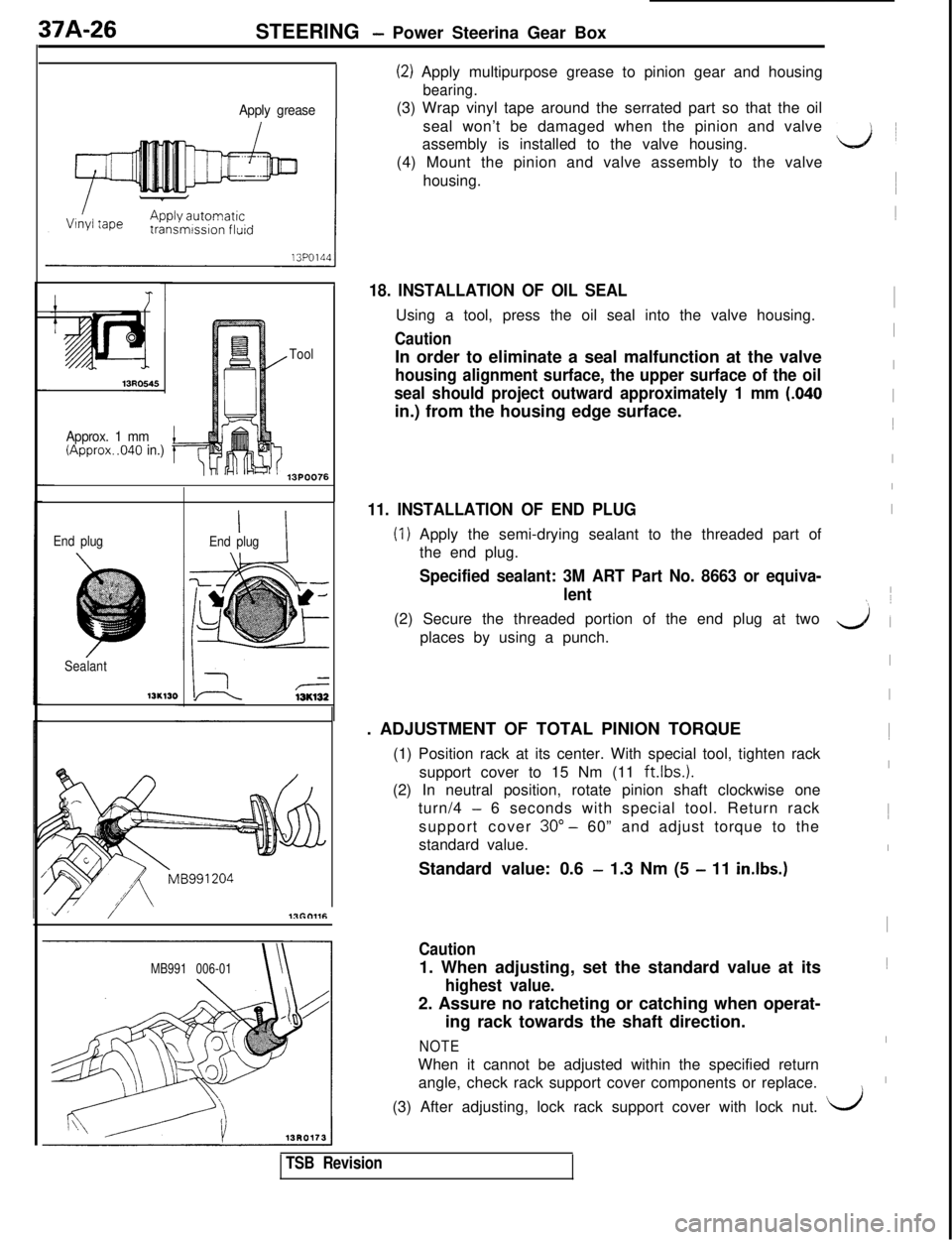
37A-26
STEERING - Power Steerina Gear Box
Apply grease
Approx. 1 mm
l-(Approx. .040 in.)
Tool
13POO76
End plug
Sealant
13K130
’ IEnd plug
r=13K132
MB991 006-01
(2) Apply multipurpose grease to pinion gear and housing
bearing.(3) Wrap vinyl tape around the serrated part so that the oil
seal won’t be damaged when the pinion and valve
assembly is installed to the valve housing.
(4) Mount the pinion and valve assembly to the valve
housing.
18. INSTALLATION OF OIL SEALUsing a tool, press the oil seal into the valve housing.
CautionIn order to eliminate a seal malfunction at the valve
housing alignment surface, the upper surface of the oil
seal should project outward approximately 1 mm
(.040in.) from the housing edge surface.
11. INSTALLATION OF END PLUG
(1) Apply the semi-drying sealant to the threaded part of
the end plug.
Specified sealant: 3M ART Part No. 8663 or equiva-
lent(2) Secure the threaded portion of the end plug at two
places by using a punch.
. ADJUSTMENT OF TOTAL PINION TORQUE
(1) Position rack at its center. With special tool, tighten rack
support cover to 15 Nm (11
ft.lbs.1.(2) In neutral position, rotate pinion shaft clockwise one
turn/4
- 6 seconds with special tool. Return rack
support cover 30”
- 60” and adjust torque to the
standard value.
Standard value: 0.6
- 1.3 Nm (5 - 11 in.lbs.)
Caution1. When adjusting, set the standard value at its
highest value.2. Assure no ratcheting or catching when operat-
ing rack towards the shaft direction.
NOTEWhen it cannot be adjusted within the specified return
angle, check rack support cover components or replace.
ii1
I1
I
I
I
I1
I
I
I
I
yl (
I
I1
I1
I
I1
I
I\(3) After adjusting, lock rack support cover with lock nut.
i/
TSB Revision
Page 856 of 1146

37A-28
STEERING - Power Steering Oil Pump
POWER STEERING OIL PUMP
REMOVAL AND INSTALLATION
I
M37RA-.
Pre-removal Operationl Draintng the Power Steenng Flurd
22 Nm
16 ft.lbs.
7
Post-installation Operationl Supplying of the Power Steering
Fluid
l Adjusting V-belt Tension(Refer to P.37A-8.)l Bleeding the Power Steering
Fluid Line (Refer to P.37A-10.)l Checking of the Oil Pump
Pressure
(Refer to P.37A-11.)Removal steps
31 ft.lbs.
1. V-belt
2. Suction hose
** 3. Pressure hose
4. O-ring
5. Pressure switch connector
6. Oil pump
7. Oil pump bracket
8. Tensioner pulley
43 Nm31 fklbs.
13N0029
Ij
INSPECTIONM37RCACl Check the V-belt for cracks.
l Check the pulley assembly for uneven rotation.
SERVICE POINT OF INSTALLATIONM37ROAL3. INSTALLATION OF PRESSURE HOSE
Connect the pressure hose so that its slit part contacts the
oil pump’s guide bracket.
TSB Revision
1