Page 453 of 4087
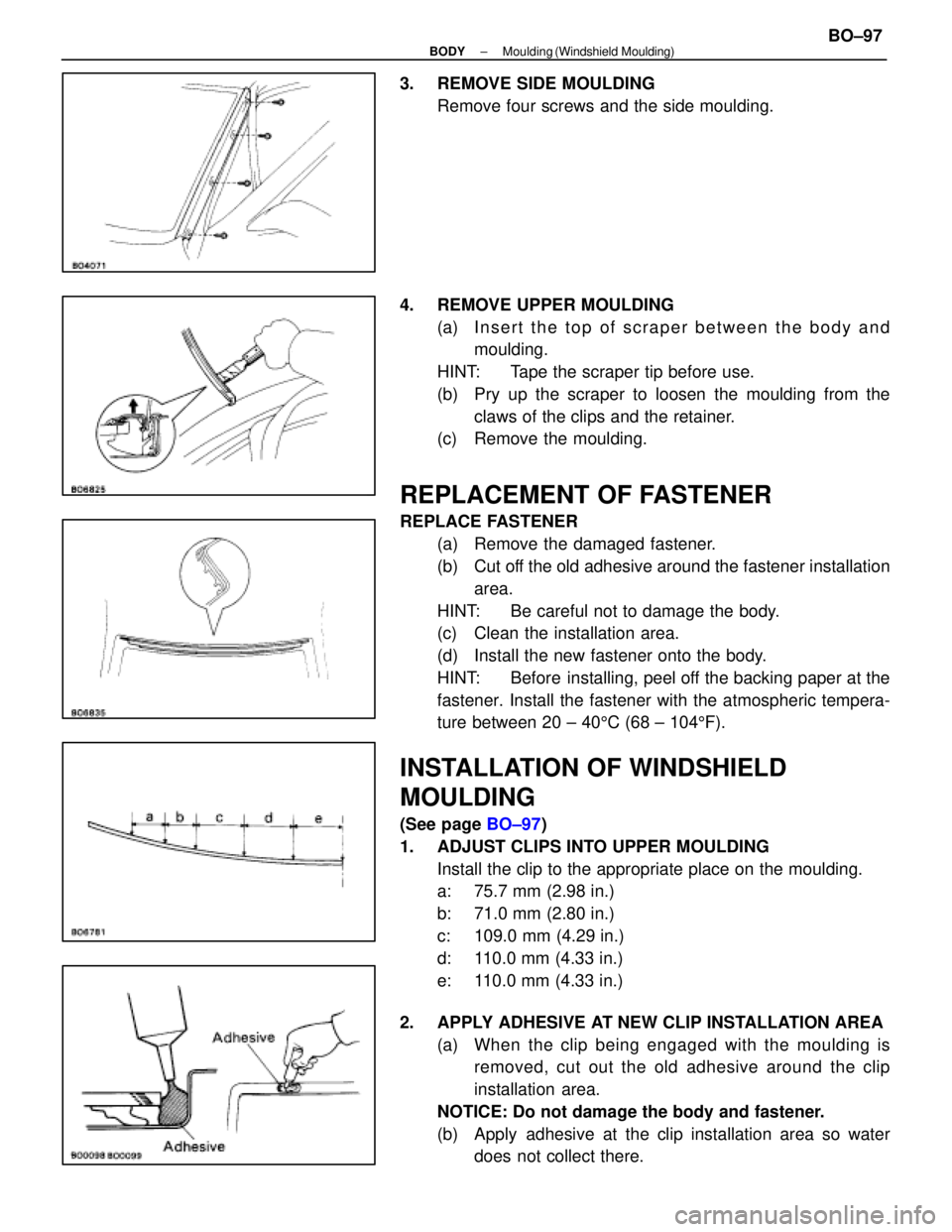
3. REMOVE SIDE MOULDINGRemove four screws and the side moulding.
4. REMOVE UPPER MOULDING (a) I n s e r t t h e t o p o f s c r aper between the body and
moulding.
HINT: Tape the scraper tip before use.
(b) Pry up the scraper to loosen the moulding from the claws of the clips and the retainer.
(c) Remove the moulding.
REPLACEMENT OF FASTENER
REPLACE FASTENER
(a) Remove the damaged fastener.
(b) Cut off the old adhesive around the fastener installationarea.
HINT: Be careful not to damage the body.
(c) Clean the installation area.
(d) Install the new fastener onto the body.
HINT: Before installing, peel off the backing paper at the
fastener. Install the fastener with the atmospheric tempera-
ture between 20 ± 40 5C (68 ± 104 5F).
INSTALLATION OF WINDSHIELD
MOULDING
(See page BO±97)
1. ADJUST CLIPS INTO UPPER MOULDING Install the clip to the appropriate place on the moulding.
a: 75.7 mm (2.98 in.)
b: 71.0 mm (2.80 in.)
c: 109.0 mm (4.29 in.)
d: 110.0 mm (4.33 in.)
e: 110.0 mm (4.33 in.)
2. APPLY ADHESIVE AT NEW CLIP INSTALLATION AREA (a) When the clip being e ngaged with the moulding is
removed, cut out the old adhesive around the clip
installation area.
NOTICE: Do not damage the body and fastener.
(b) Apply adhesive at the clip installation area so water does not collect there.
±
BODY Moulding (Windshield Moulding)BO±97
WhereEverybodyKnowsYourName
Page 645 of 4087
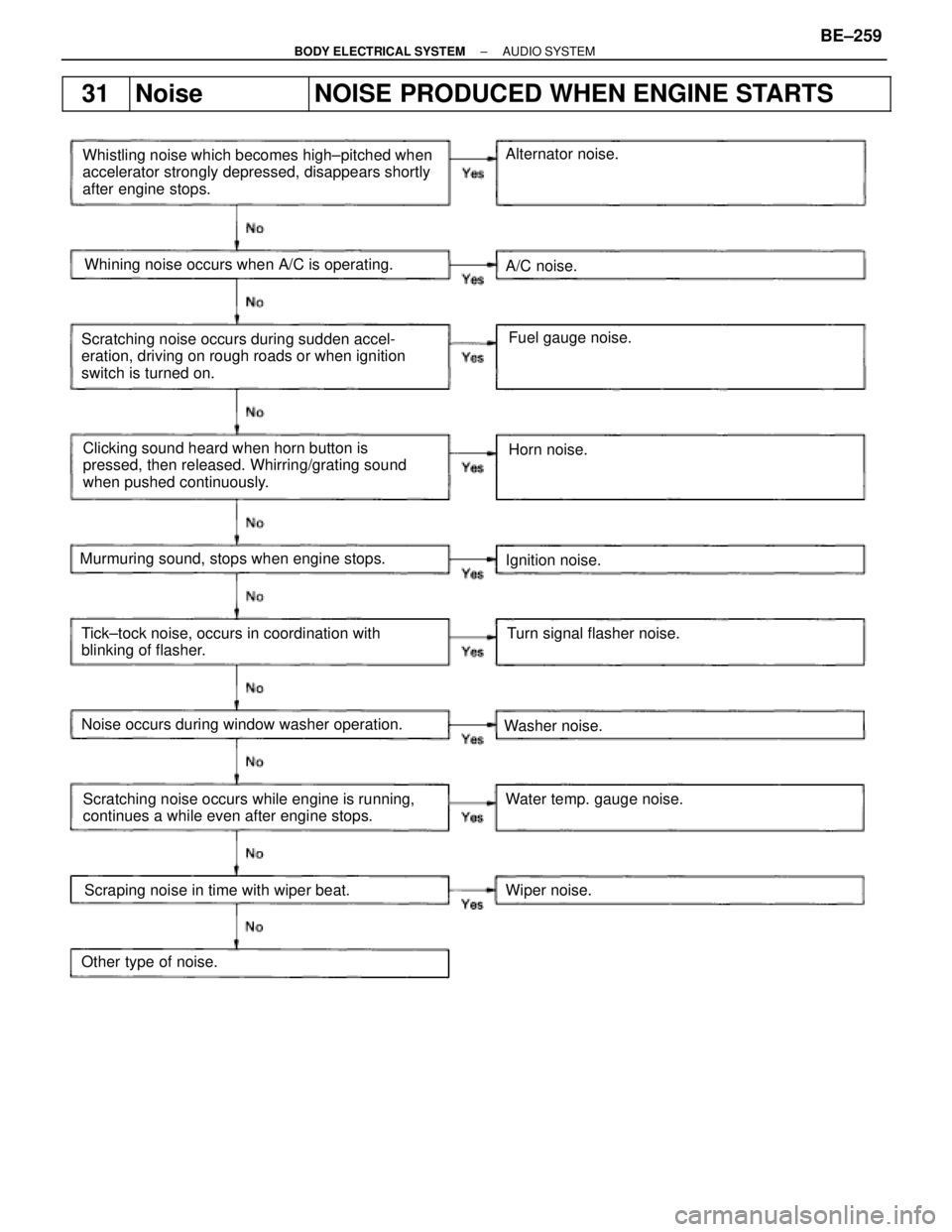
31NoiseNOISE PRODUCED WHEN ENGINE STARTS
Whistling noise which becomes high±pitched when
accelerator strongly depressed, disappears shortly
after engine stops.Whining noise occurs when A/C is operating.
Scratching noise occurs during sudden accel-
eration, driving on rough roads or when ignition
switch is turned on.
Clicking sound heard when horn button is
pressed, then released. Whirring/grating sound
when pushed continuously.
Murmuring sound, stops when engine stops. Tick±tock noise, occurs in coordination with
blinking of flasher.
Noise occurs during window washer operation.Scratching noise occurs while engine is running,
continues a while even after engine stops.Scraping noise in time with wiper beat.
Other type of noise. Alternator noise.
A/C noise.
Fuel gauge noise.
Horn noise.
Ignition noise. Turn signal flasher noise.
Washer noise. Water temp. gauge noise.
Wiper noise.
±
BODY ELECTRICAL SYSTEM AUDIO SYSTEMBE±259
WhereEverybodyKnowsYourName
Page 804 of 4087
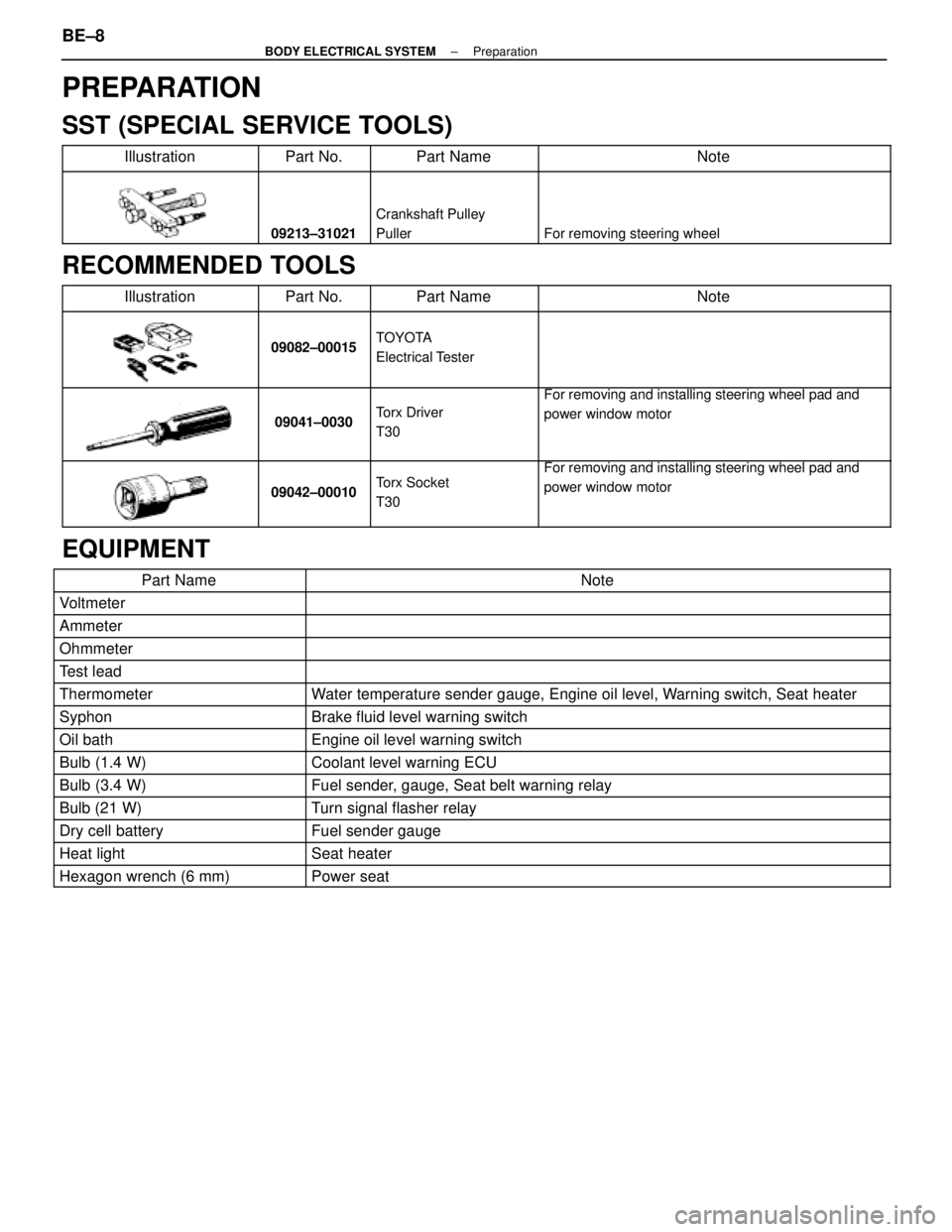
PREPARATION
SST (SPECIAL SERVICE TOOLS)
IllustrationPart No.Part NameNote
09213±31021
Crankshaft Pulley
Puller
For removing steering wheel
RECOMMENDED TOOLS
IllustrationPart No.Part NameNote
09082±00015TOYOTA
Electrical Tester
09041±0030Torx Driver
T30
For removing and installing steering wheel pad and
power window motor
09042±00010Torx Socket
T30For removing and installing steering wheel pad and
power window motor
EQUIPMENT
Part NameNote
Voltmeter
Ammeter
Ohmmeter
Test lead
ThermometerWater temperature sender gauge, Engine oil level, Warning switch, Seat heater
SyphonBrake fluid level warning switch
Oil bathEngine oil level warning switch
Bulb (1.4 W)Coolant level warning ECU
Bulb (3.4 W)Fuel sender, gauge, Seat belt warning relay
Bulb (21 W)Turn signal flasher relay
Dry cell batteryFuel sender gauge
Heat lightSeat heater
Hexagon wrench (6 mm)Power seat
BE±8±
BODY ELECTRICAL SYSTEM Preparation
WhereEverybodyKnowsYourName
Page 805 of 4087
EQUIPMENT (Cont'd)
PartNote
Torque wrench
Clip removerFor removing cowl louver
Masking tapeRear window defogger wire
Tim foilRear window defogger wire
SSM (SPECIAL SERVICE MATERIALS)
Part NamePart No.Use etc.
Adhesive 1324,
Three bond 1324 or equivalent08833±00070Power seat housing set nut, Power seat slide and vertical
motor set screw
Adhesive 1344,
Three bond 1344,
Loctite 242 or equivalent
08833±00080Low oil pressure warning switch Water temperature
sender gauge
Dupont paste No. 4817±Rear window defogger wire
±
BODY ELECTRICAL SYSTEM PreparationBE±9
WhereEverybodyKnowsYourName
Page 895 of 4087

DESCRIPTION
The combination meter has various meters and gauges which show the vehicle'\
s condition, warning lights which
monitor abnormalities in the vehicle and inform the driver, indicator lights which inform the driver of the condition
of each part of vehicle, and a function for illumination and brightness ad\
justment of meters and gauges.
The component parts of this system and their functions are described in \
the following table.
Parts NameFunction
SpeedometerThe speedometer needle moves in accordance with signals from the speed s\
ensor to
indicate the vehicle's speed.
TachometerThe tachometer needle moves in accordance with signals from the igniter \
to indicate the
engine's speed.
Water Temperatrue
GaugeThe water temperature gauge's needle moves in accordance with signals from the send-
er gauge and indicates the temperature of the engine coolant.
Fuel GaugeThe fuel gauge needle moves in accordance with signals from the sender g\
auge, indicat-
ing the amount of fuel remaining in the fuel tank.
OdometerThe odometer counts the total distance traveled by the vehicle in accord\
ance with pulse
signals from the speed sensor.
Twin Trip Switch
The twin trip meter counts the distance traveled by the vehicle in accor\
dance with pulse
signals from the speed sensor. It can be reset using a switch and can be used to switch
between trip meters A and B.
Circuit Plate
This plate contains the circuitry for each meter and gauge and for each \
warning light and
indicator light, as well as an internal engine oil level warning drive c\
ircuit, drive circuits for
the odometer and trip meter and brightness adjustment circuitry for each\
indicator.
Speed SensorMounted in the transmission, this sensor outputs pulse signals to the co\
mbination meter
in accordance with the speed of the output shaft.
Twin Trip SwitchOperation of this switch switches between the A and B trip meters and se\
nds reset sig-
nals to the combination meter.
Water
Temperature Sender
GaugeThis sender converts engine coolant temperatures to a resistance value i\
n signal form to
the combination meter.
Fuel Sender GaugeThis sender converts the level of fuel remaining in fuel tank to resista\
nce value and
sends the resistance value in signal form to combination meter.
Rheostat Light
Control VolumeIn order to adjust the degree of illumination of the combination meter, the resistance val-
ue of the built±in variable resistor is sent to the combination meter\
and rheostat light
control.
Fuel Level Warning
SwitchWhen the level of fuel remaining falls below a predetermined level, cont\
inuity is estab-
lished with this switch, which is built into the fuel sender gauge, caus\
ing a warning light
to light up.
Low Oil Pressure
Warning SwitchThis switch is mounted on the engine block. Continuity is established in\
this switch when
the oil pressure is low, causing a warning light to light up.
Integration Relay (Seat
Belt Warning Relay)
This relay receives current from fuse GAUGE and DOME and is connected to\
each
buckle switch, door courtesy switch, key unlock warning switch and warni\
ng light. As
part of the seat belt warning system, it sounds a chime and lights a war\
ning light when
seat belts are unfastened. As part of the key unlock warning system, it \
sounds a chime
when the set conditions are fulfilled.
Light Failure SensorThis sensor senses when a bulb in rear combination light is burnt out an\
d lights up a
warning light.
BE±96±
BODY ELECTRICAL SYSTEM Combination Meter
WhereEverybodyKnowsYourName
Page 901 of 4087
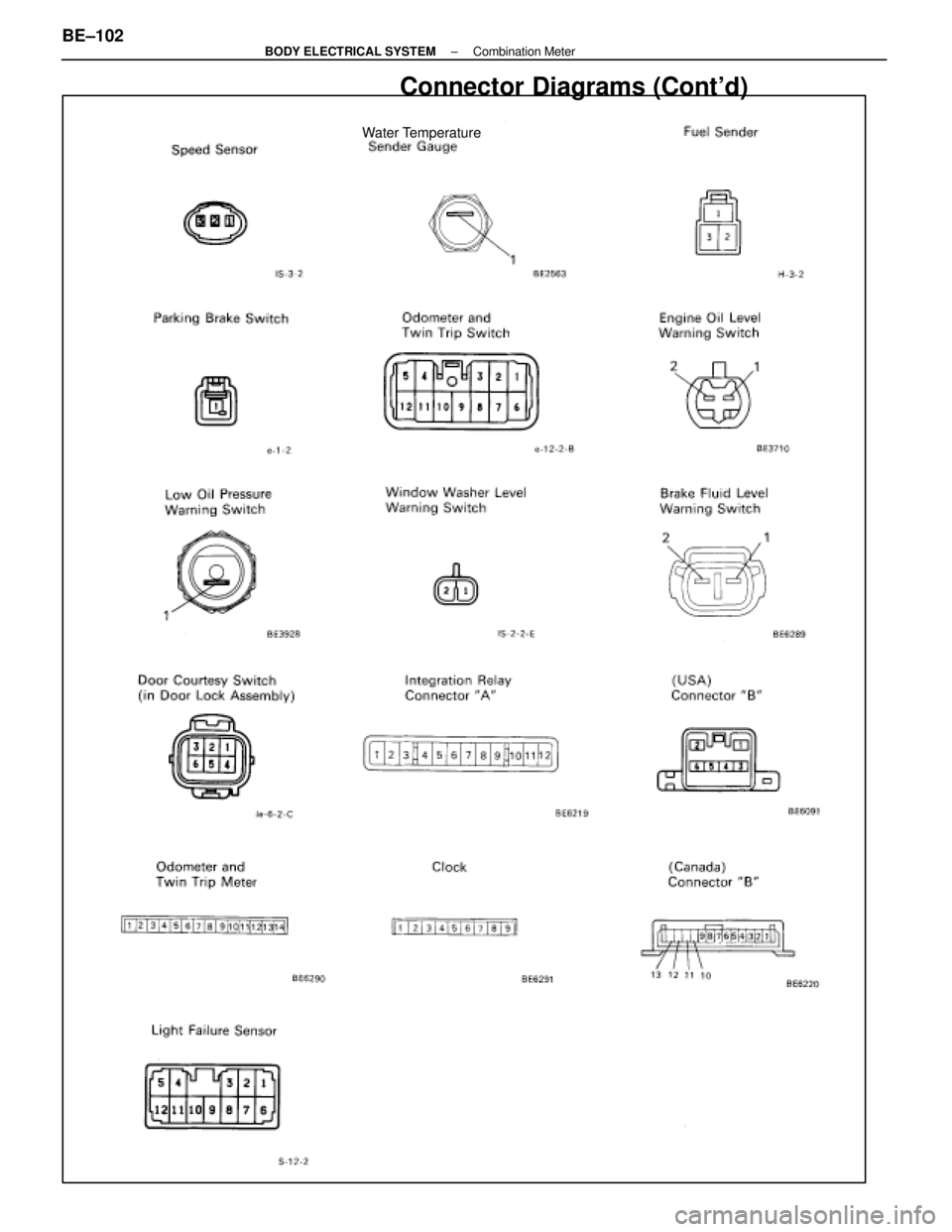
Water Temperature
Connector Diagrams (Cont'd)
BE±102±
BODY ELECTRICAL SYSTEM Combination Meter
WhereEverybodyKnowsYourName
Page 999 of 4087
3. LIFT UP CALIPER
(a) Hold the sliding pin on the bottom and loosen the installationbolt.
(b) Remove the installation bolt.
(c) Lift up and suspend the caliper.
HINT: Do not disconnect the flexible hose from the caliper.
4. REMOVE FOLLOWING PARTS:
(a) 2 anti±squeal springs
(b) 2 brake pads
(c) 4 anti±squeal shims
(d) 4 pad support plates
5. CHECK DISC THICKNESS AND RUNOUT (See page BR±33 )
6. INSTALL UNDER SIDE PAD SUPPORT PLATES
7. INSTALL UPPER SIDE PAD SUPPORT PLATES
(a) Using cleaner, wipe off dust, water, oil, etc. from the pad support plate contact area of the torque plate.
(b) Remove the pad support cover sheets from new pad support plate.
BR±30
±
BRAKE SYSTEM FRONT BRAKE (SC400)
WhereEverybodyKnowsYourName
Page 1137 of 4087
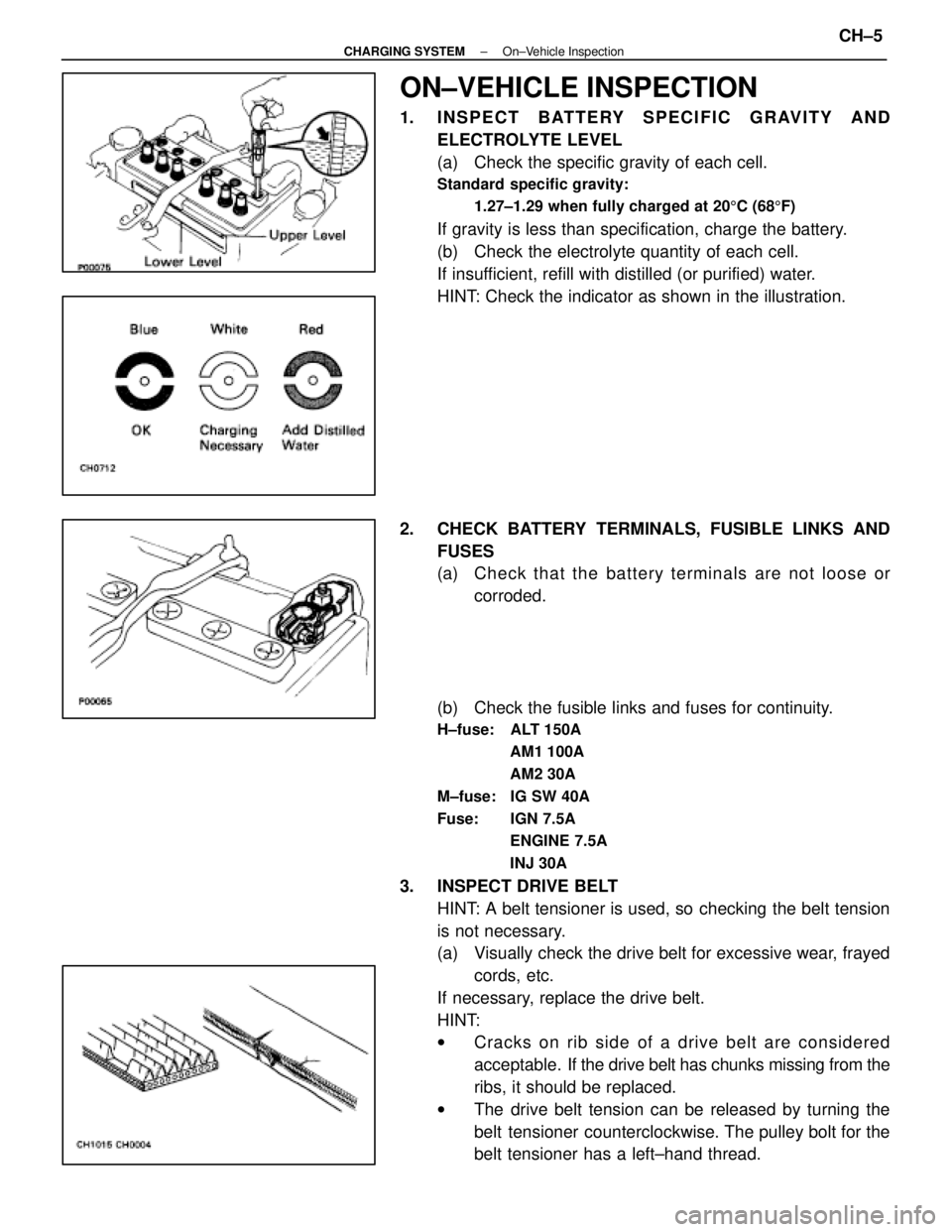
ON±VEHICLE INSPECTION
1. INSPECT BATTERY SPECIFIC GRAVITY ANDELECTROLYTE LEVEL
(a) Check the specific gravity of each cell.
Standard specific gravity:
1.27±1.29 when fully charged at 20 5C (68 5F)
If gravity is less than specification, charge the battery.
(b) Check the electrolyte quantity of each cell.
If insufficient, refill with distilled (or purified) water.
HINT: Check the indicator as shown in the illustration.
2. CHECK BATTERY TERMINALS, FUSIBLE LINKS AND FUSES
(a) Check that the battery terminals are not loose orcorroded.
(b) Check the fusible links and fuses for continuity.
H±fuse: ALT 150A AM1 100A
AM2 30A
M±fuse: IG SW 40A
Fuse: IGN 7.5A ENGINE 7.5A
INJ 30A
3. INSPECT DRIVE BELTHINT: A belt tensioner is used, so checking the belt tension
is not necessary.
(a) Visually check the drive belt for excessive wear, frayedcords, etc.
If necessary, replace the drive belt.
HINT:
w Cracks on rib side of a drive belt are considered
acceptable. If the drive belt has chunks missing from the
ribs, it should be replaced.
w The drive belt tension can be released by turning the
belt tensioner counterclockwise. The pulley bolt for the
belt tensioner has a left±hand thread.
±
CHARGING SYSTEM On±Vehicle InspectionCH±5
WhereEverybodyKnowsYourName