1991 HONDA CIVIC ignition
[x] Cancel search: ignitionPage 58 of 136
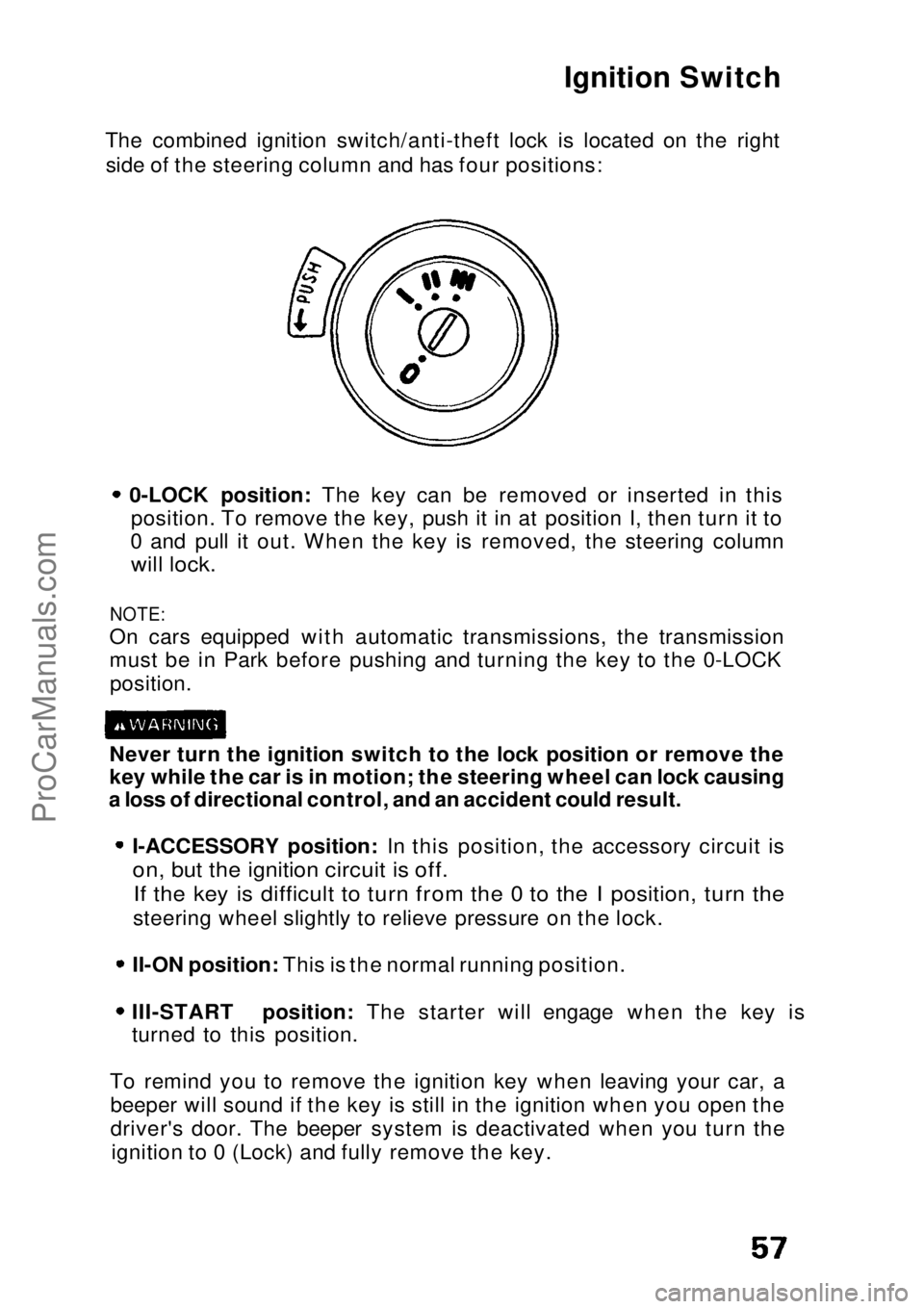
Ignition Switch
The combined ignition switch/anti-theft lock is located on the right side of the steering column and has four positions: 0-LOCK position: The key can be removed or inserted in this
position. To remove the key, push it in at position I, then turn it to
0 and pull it out. When the key is removed, the steering column
will lock.
NOTE:
On cars equipped with automatic transmissions, the transmission
must be in Park before pushing and turning the key to the 0-LOCK
position.
Never turn the ignition switch to the lock position or remove the
key while the car is in motion; the steering wheel can lock causing
a loss of directional control, and an accident could result. I-ACCESSORY position: In this position, the accessory circuit is
on, but the ignition circuit is off.
If the key is difficult to turn from the 0 to the I position, turn the
steering wheel slightly to relieve pressure on the lock. II-ON position: This is the normal running position.
III-START position: The starter will engage when the key is
turned to this position.
To remind you to remove the ignition key when leaving your car, a beeper will sound if the key is still in the ignition when you open the
driver's door. The beeper system is deactivated when you turn the ignition to 0 (Lock) and fully remove the key.ProCarManuals.comMain Menu s t
Page 65 of 136
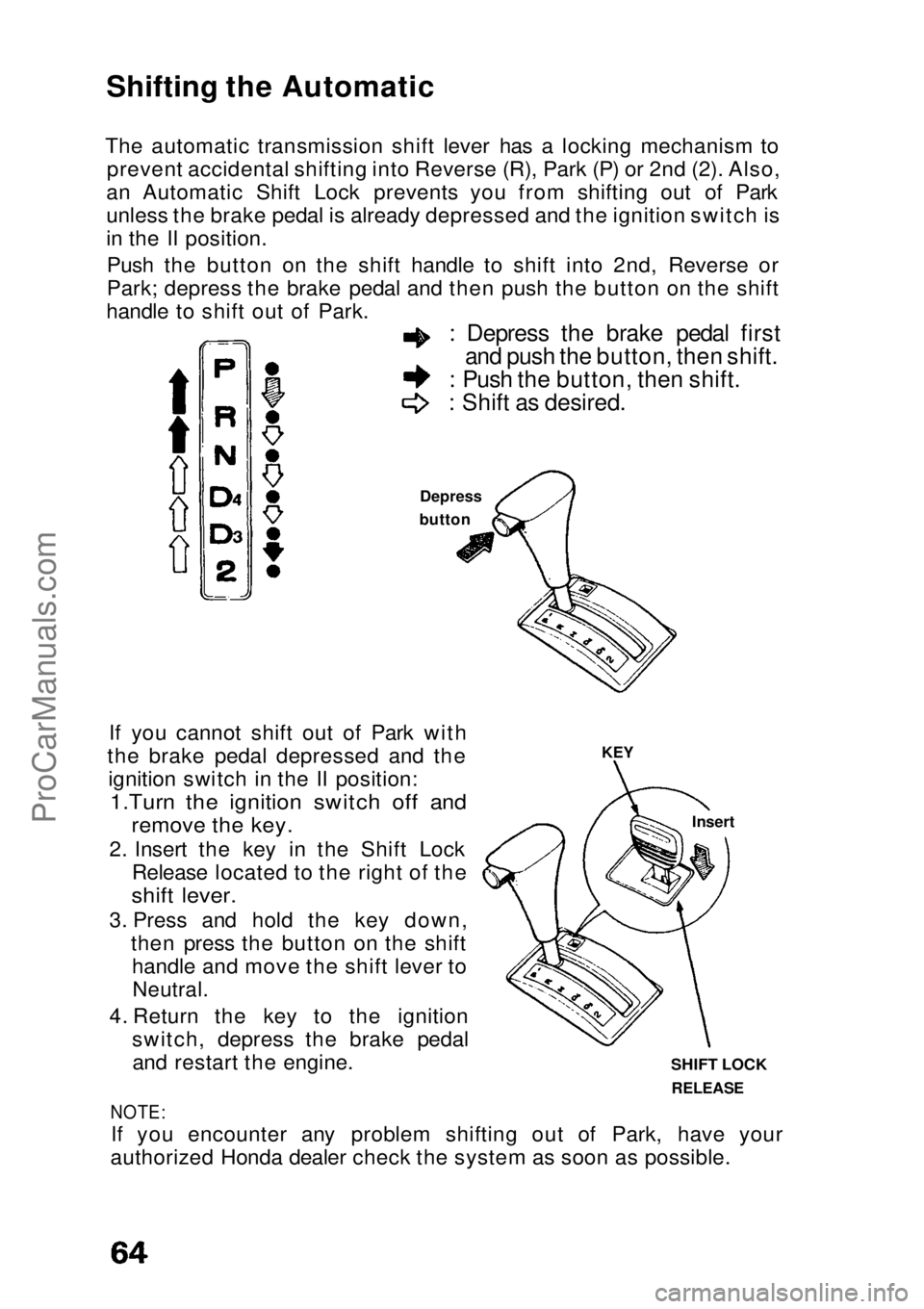
Shifting the Automatic
The automatic transmission shift lever has a locking mechanism to prevent accidental shifting into Reverse (R), Park (P) or 2nd (2). Also,
an Automatic Shift Lock prevents you from shifting out of Park
unless the brake pedal is already depressed and the ignition switch is
in the II position.
Push the button on the shift handle to shift into 2nd, Reverse or
Park; depress the brake pedal and then push the button on the shift
handle to shift out of Park. : Depress the brake pedal first
and push the button, then shift.
: Push the button, then shift.
: Shift as desired.
Depress
button
SHIFT LOCK
RELEASE
KEY
Insert
If you cannot shift out of Park with
the brake pedal depressed and the ignition switch in the II position:
1.Turn the ignition switch off and
remove the key.
2. Insert the key in the Shift Lock Release located to the right of the
shift lever.
3. Press and hold the key down, then press the button on the shifthandle and move the shift lever to
Neutral.
4. Return the key to the ignition switch, depress the brake pedaland restart the engine.
NOTE:
If you encounter any problem shifting out of Park, have your
authorized Honda dealer check the system as soon as possible.ProCarManuals.comMain Menu s t
Page 91 of 136
Checking the fuses:
1 .Turn off the ignition and all other switches.
2. If you find a blown or possibly faulty fuse, use the fuse remover, stored beside the spare fuse to pull the blown fuse out of its clips.
3. Check all other fuses as well as the one you suspect.
4. Push in a new fuse of the same rating, and make sure it fits tightly in the clips. If it fits loosely, have your dealer fix it.If you don't have a spare, take a fuse of the same rating (or lower)
out of a circuit you may not need, like the radio or cigarette lighter.
Remember to replace the borrowed fuse and the missing spares.
CAUTION:
A blown fuse may be just a symptom of some other problem. If a new fuse blows right away, the cause should be diagnosed and
corrected by a qualified Honda technician. Never replace a fuse with anything but another fuse of the same or lower rating. A
higher capacity fuse could cause damage and even start a fire.
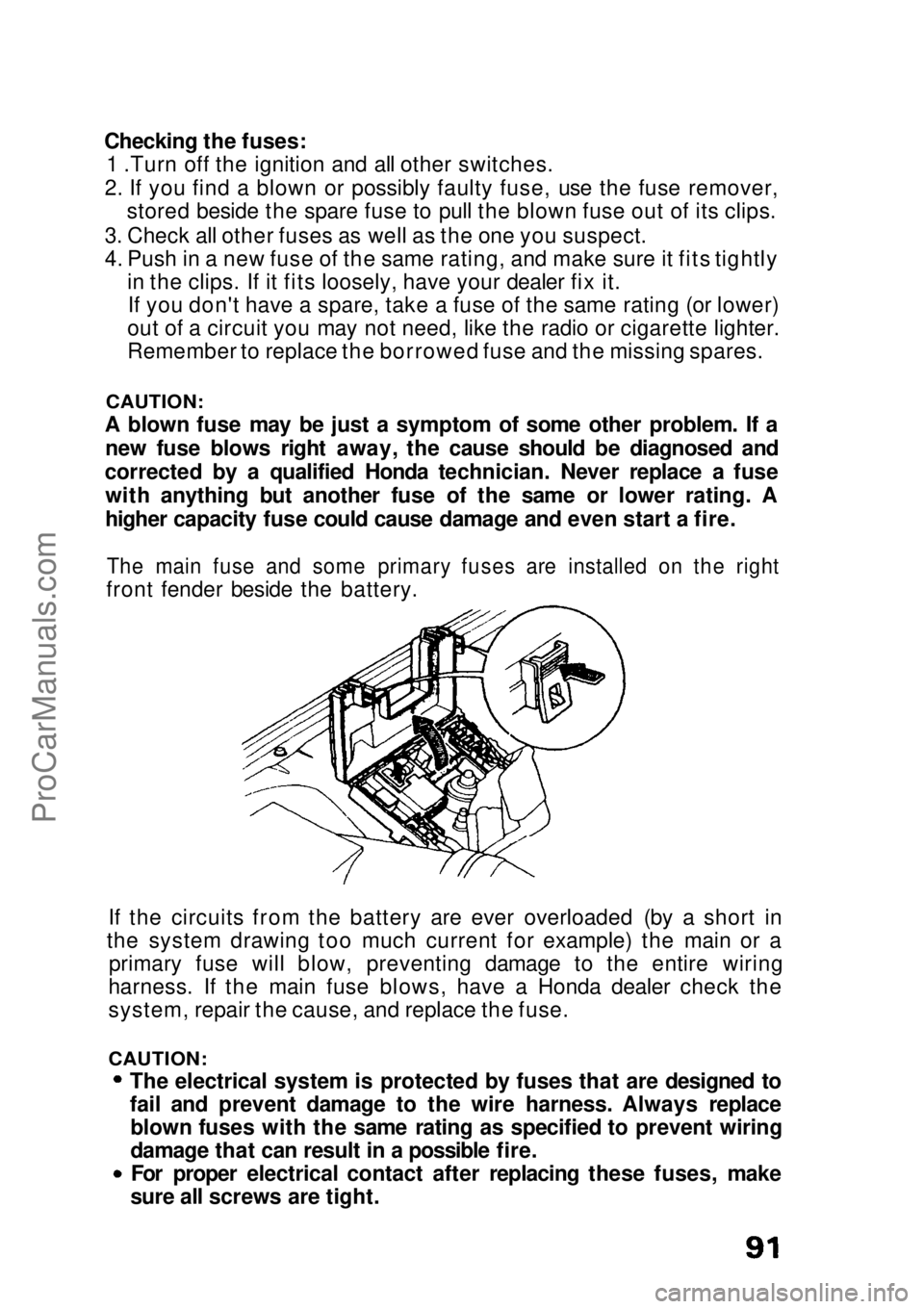
The main fuse and some primary fuses are installed on the right
front fender beside the battery.
If the circuits from the battery are ever overloaded (by a short in
the system drawing too much current for example) the main or a primary fuse will blow, preventing damage to the entire wiring
harness. If the main fuse blows, have a Honda dealer check the
system, repair the cause, and replace the fuse.
CAUTION:
The electrical system is protected by fuses that are designed to
fail and prevent damage to the wire harness. Always replaceblown fuses with the same rating as specified to prevent wiring
damage that can result in a possible fire.For proper electrical contact after replacing these fuses, make
sure all screws are tight.ProCarManuals.comMain Menu s t
Page 111 of 136
If towing is necessary, contact a professional towing service. Your
authorized Honda dealer can assist you with detailed towing
instructions.
Never use tow chains or rope to tow a car; your ability to safely
control the car may be adversely affected.
We recommend the following: Flat Bed Equipment —Entire car is winched on a flat bed vehicle.
This is the best way of transporting your Honda.
Wheel Lift Type—Tow with the front wheels off the ground.
If the car can only be towed with the front wheels on the ground:
make sure the transmission is full of fluid (see pages 78 — 79) and
tow with the transmission in neutral (N) and the ignition key in the 1
position.
CAUTION:
To avoid serious damage on automatic transmission cars, first
start the engine and shift to D4, then to N and shut the engine off. If the engine does not run or the transmission cannot be shifted
while the engine is running, the car must be transported on flat
bed equipment.
Check local regulations for towing.
CAUTION:
Do not exceed 35 mph (55 km/h) or tow for distances of more
than 50 miles (80 km).
If a sling type tow is used, the tow truck driver should position
wood spacer blocks between your car's frame and the chains
and lift straps to avoid damaging the bumper and the body. Do not use the bumpers to lift the car or to support the car's
weight while towing. TowingProCarManuals.comMain Menu s t
Page 125 of 136

Evaporative Emission Control System
The Evaporative Emission Control System is designed to prevent
fuel vapors from escaping into the atmosphere. Fuel vapors from the fuel tank are directed into the charcoal
canister where they are adsorbed and stored while the engine is stopped or idling. When the coolant temperature rises to a certain
value, the vapors are drawn into the engine through the throttlebody and the intake manifold during normal engine operation.
Engine Exhaust Emission Controls
The engine exhaust emission control systems are designed to control combustion during idle, acceleration, cruise, and deceleration.
These systems are entirely separate from the crankcase and evaporative emission control systems described previously.
HONDA PGM-FI System
The PGM-FI system consists of three independent sub-systems; Air Intake, Electronic Control and Fuel Control, thus allowing moreaccurate control of air/fuel ratios under all operating conditions.
The Electronic Control Unit (ECU) detects the amount of air
drawn into the cylinders and determines the amount of fuel to be injected to provide the optimum air/fuel ratio for all engine needs.
Ignition Timing Control System
This system automatically controls the ignition timing to reduce
the amount of HC and NOx.
Catalytic Converter
Three Way Catalyst
The catalyst is used to convert hydrocarbons (HC), carbon monoxide (CO) and oxides of nitrogen (NOx) in the exhaust gas,
to carbon dioxide (CO 2
), dinitrogen (N 2
) and water vapor.
Exhaust Gas Recirculation (EGR) (California automatic models except EX Sedan)
The EGR system is designed to control the formation of oxides of nitrogen (NOx) caused when fuel mixture burns at high
temperature. It works by recirculating exhaust gas through the EGR valve and intake manifold into the combustion chambers
where it reduces peak temperature by diluting the air/fuel mixture.ProCarManuals.comMain Menu s t
Page 126 of 136
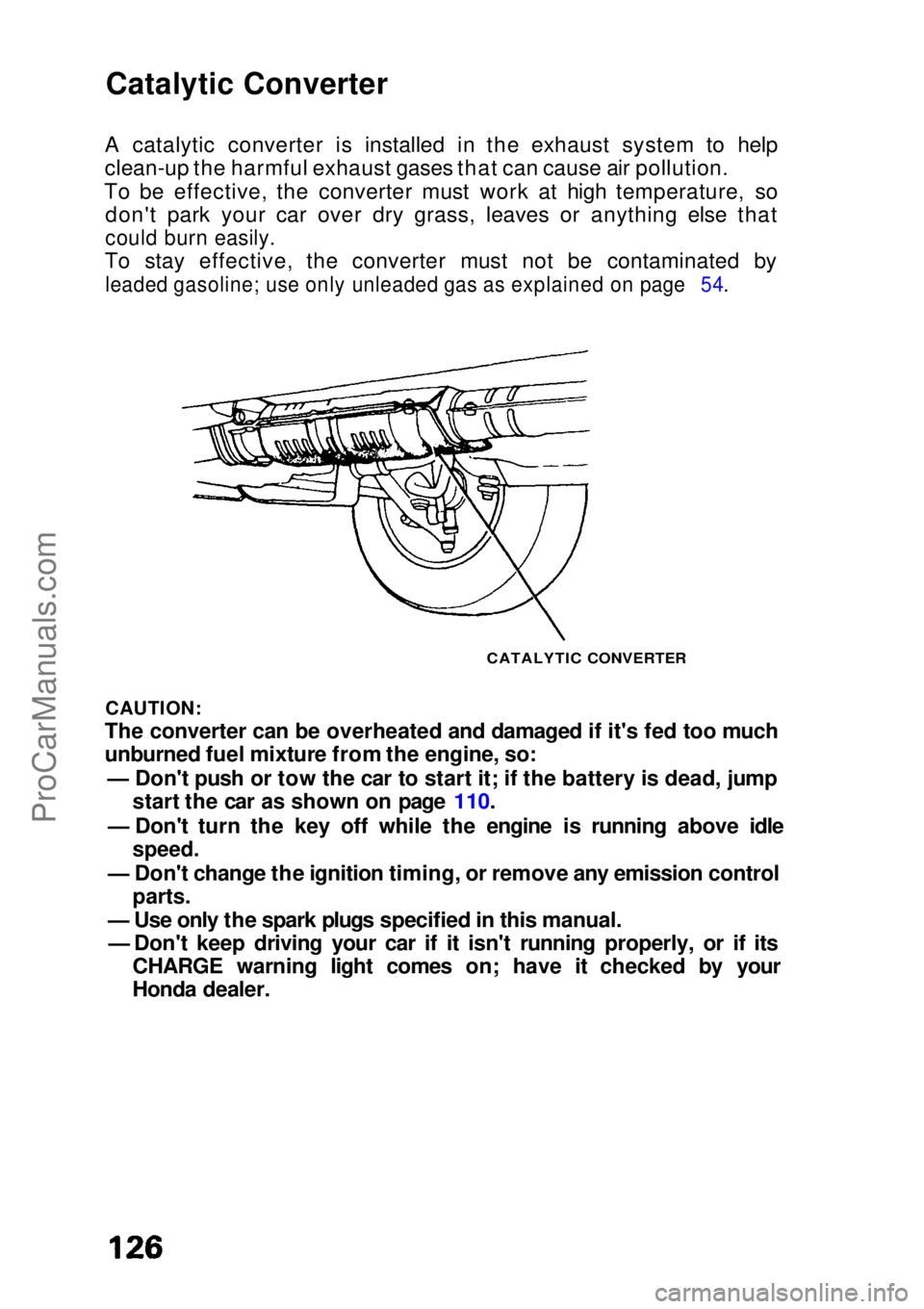
Catalytic Converter
A catalytic converter is installed in the exhaust system to help
clean-up the harmful exhaust gases that can cause air pollution.
To be effective, the converter must work at high temperature, so don't park your car over dry grass, leaves or anything else that
could burn easily.
To stay effective, the converter must not be contaminated by
leaded gasoline; use only unleaded gas as explained on page 54.
CAUTION:
The converter can be overheated and damaged if it's fed too much
unburned fuel mixture from the engine, so:
— Don't push or tow the car to start it; if the battery is dead, jump start the car as shown on page 110.
— Don't turn the key off while the engine is running above idle
speed.
— Don't change the ignition timing, or remove any emission control
parts.
— Use only the spark plugs specified in this manual. — Don't keep driving your car if it isn't running properly, or if its CHARGE warning light comes on; have it checked by your
Honda dealer.
CATALYTIC CONVERTERProCarManuals.comMain Menu s t
Page 130 of 136
Index (cont'd)
Specification (Sedan)............ 119
Engine Exhaust Gas Warning........ 60
Evaporative Emission Control
System.................................... 125
Exterior Care.................................. 99
Filters
Air.............................................. 86
Engine Oil.................................. 76
Fuel........................................... .86
Fluid..................................... See "Oil"
Foreign Countries, Operation in.... 55
Front Seat
Adjustment................................. 6
Fuel
Filler Door and Cap................... 55
Fitter..........................................86
Gasohol..................................... 54
Gasoline .................................... 54
Gauge........................................ 28
Requirement............................. 54
Fuse
Checking and Replacing .......... 91Specification (Hatchback).... 116
Specification (Sedan)............ 119
Hatch................................................. 5
Hatch/Trunk-open Indicator Light
...................................................31
Hazard Warning System............... 37
Headlights
Flasher...................................... 36
High Beam Indicator................. 29High Beam/Low Beam Switch ...............................................36
Switch...................................... 36
Headlight High Beam Indicator Light
...................................................29
Head Restraints................................ 7
Heating............................................. 50 High Beam
Indicator Light.......................... 29
Switch...................................... 36
Hood Latch..................................... 41
Identification Numbers................ 121
Ignition Keys............................................ 3
Switch....................................... 57
Indicator Lights.............................. 29
Inflation Pressures, Tire................ 94 Instrument Panel............................ 26
Instrument Panel Brightness Control ................................................... 37
Interior Light................................... 37
Interior Trim Care .......................... 99
Keys
Door Locks................................. 3
Hatch/Trunk Lid Lock................ 5
Ignition....................................... 57
Keys............................................ 3
Lap/Shoulder Belts .......................... See "Seat Belts"
Light Bulb Replacement.................... 92
Fuse Replacement................... 90
Operation.................................. 36
Warning and Indicator Lights.. 29
Locks
Anti-theft Steering Column Lock...............................................57
Child Proo f
Door Locks ............. 5
Doors........................................... 3
Fuel Filler Door.......................... 55 Hatch/Trunk Lid......................... 5
Power Doors.............................. 4
Luggage Area Light........................ 38
Luggage Cover................................. 9
Gasoline............................ See "Fuel"
Gas Station Information. back cover
Gauges............................................ 28
Glove Box....................................... 42 Jack.............................................. 106
Jump Starting.............................. 110ProCarManuals.comMain Menu s t