Page 84 of 143
Volvo 1990 240 Model
Changing coolant
Every two years or 30,000 miles (48,000 km) the cooling system should \
be drained, flushed and refilled.
Remove the expansion tank cap. Open the drain cock on right side of the \
engine block and disconnect
the lower radiator hose.
Fill coolant through the expansion tank.
The heater controls should be fully open when draining and filling.
Add coolant until the level is up to the MAX mark or slightly above.
Start engine and run until hot. Check the cooling system connections for\
tightness. Also re-check the
coolant level. Capacity: 9.9 US qts. = 9.4 liters (manual transmission \
models); 9.7 US qts = 9.2 liters
(automatic transmission models)
Cooling system, hoses and connections
file:///K|/ownersdocs/1990/1990_240/90240_13.htm (8 of 9)12/30/2006 8:\
25:08 AM
Page 85 of 143
Volvo 1990 240 Model
Check all cooling system hoses and connections for defects or deteriorat\
ion of hoses and loose clamps or
fittings.
Drive belts
The belt tension can be checked by depressing the fan belt at a point mi\
dway between the alternator and
fan pulleys as illustrated. It should be possible to press down the belt\
about 1/4" - 3/8" (5-10 mm). This
also applies to other drive belts on the engine.
If drive belts are replaced, recheck belt tension after driving 600 - 1,\
200 miles (1,000 - 2,000 km).
Contents | Top of Page
w
file:///K|/ownersdocs/1990/1990_240/90240_13.htm (9 of 9)12/30/2006 8:\
25:08 AM
Page 86 of 143
 inspection. A lo")
Volvo 1990 240 Model
pg. 64 Service requirements
Engine Mechanical Components
Torque manifold nuts
The manifold nuts should be torqued at the 600-1,200 mile (1,000-2,000 \
km) inspection. A loose
manifold could alter air/fuel ratio and cause an increase in emission an\
d/or poor driveability.
Valves
The valve clearance should be checked every 30,000 miles (48,000 km). \
Vacuum fittings, hoses and connections
Unstable idle, misfiring or poor emission control is often caused by lea\
king vacuum hoses or
connections. Check hoses and connections on distributor vacuum unit, EGR\
valve (where applicable)
and connections on heater control servo systems and hydraulic brake serv\
o.
Exhaust Gas Recirculation (EGR)
This system operates by returning some of the exhaust gases to the engin\
e to be recombusted: since this
lowers the combustion temperature the amount of nitrogen oxides released\
into the atmosphere is
reduced.
The EGR valve should be cleaned at the 60,000 mile inspection and therea\
fter cleaned every 25,000
miles (40,000 km).
Timing belt
The timing belt tensioner should be adjusted at the 600-1,200 mile (1,0\
00-2,000 km) inspection.
file:///K|/ownersdocs/1990/1990_240/90240_14.htm (1 of 7)12/30/2006 8:\
25:08 AM
Page 88 of 143

Volvo 1990 240 Model
complete unit.
Replace more frequently if contaminated fuel was introduced into the tan\
k.
Fuel system cap, tank, lines and connections
The ability of the fuel system to control hydrocarbon emissions is depen\
dent largely on a leak-free
system. Check for proper sealing of gasoline filler cap which contains "\
O"-ring type seals. Check all
evaporative hoses in vehicle for tightness. Check fuel lines under vehic\
le. Repair if necessary.
Air cleaner
Replace the air cleaner cartridge every 30,000 miles (48,000 km). The \
cartridge should be replaced more
often when driving under dirty and/or dusty conditions.
The filter cannot be cleaned and should always be replaced with a new on\
e.
Checking and adjusting idle speed
Your Volvo is equipped with an electronically controlled idle speed syst\
em that requires no period
checking or adjustment.
Lamda-sond (oxygen sensor) system
This is an emission control system designed to reduce emissions and impr\
ove fuel economy. An oxygen
sensor monitors the composition of the exhaust gases leaving the engine.\
The exhaust gas analysis is fed
into an electronic unit which continuously influences the amount of fuel\
injected. This adjusts the air-
fuel ratio to provide optimum conditions for combustion and efficient re\
duction of the three major
pollutants (hydrocarbons, carbon monoxide and nitrogen oxides) through\
a 3-way catalytic converter. pg. 67 Servicing
file:///K|/ownersdocs/1990/1990_240/90240_14.htm (3 of 7)12/30/2006 8:\
25:08 AM
Page 91 of 143

Volvo 1990 240 Model
Evaporative control systems
Vehicles intended for the North American market are equipped with a fuel\
vapor evaporative control
system, which prevents gasoline fumes from being released into the atmos\
phere.
The system is comprised of an expansion chamber in the fuel tank, a roll\
-over valve on the cross
member in front of the fuel tank, and a charcoal canister with built-in \
vacuum valve. The components
are interconnected by hoses which channel fuel vapor from the gas tank t\
o the charcoal filter where they
are stored until the engine is started and then drawn into the engine fu\
el induction system.
Engine Ignition
Change spark plugs
The spark plugs should be changed every 30,000 miles (48,000 km).
However, prolonged city driving or fast highway driving may necessitate \
changing spark plugs after
10,000 miles (16,000 km) of driving. When installing new plugs, be sur\
e to fit the right type and use the
correct torque, see "Specifications".
When changing the spark plugs, check that the suppressor connectors are \
in good condition. Cracked or
damaged connectors should be replaced.
When changing spark plugs, clean the cables and cable terminals, also th\
e rubber seals. If the car is
driven on roads where salt is used during the winter, coat the cables wi\
th silicone.
file:///K|/ownersdocs/1990/1990_240/90240_14.htm (6 of 7)12/30/2006 8:\
25:08 AM
Page 94 of 143
Volvo 1990 240 Model
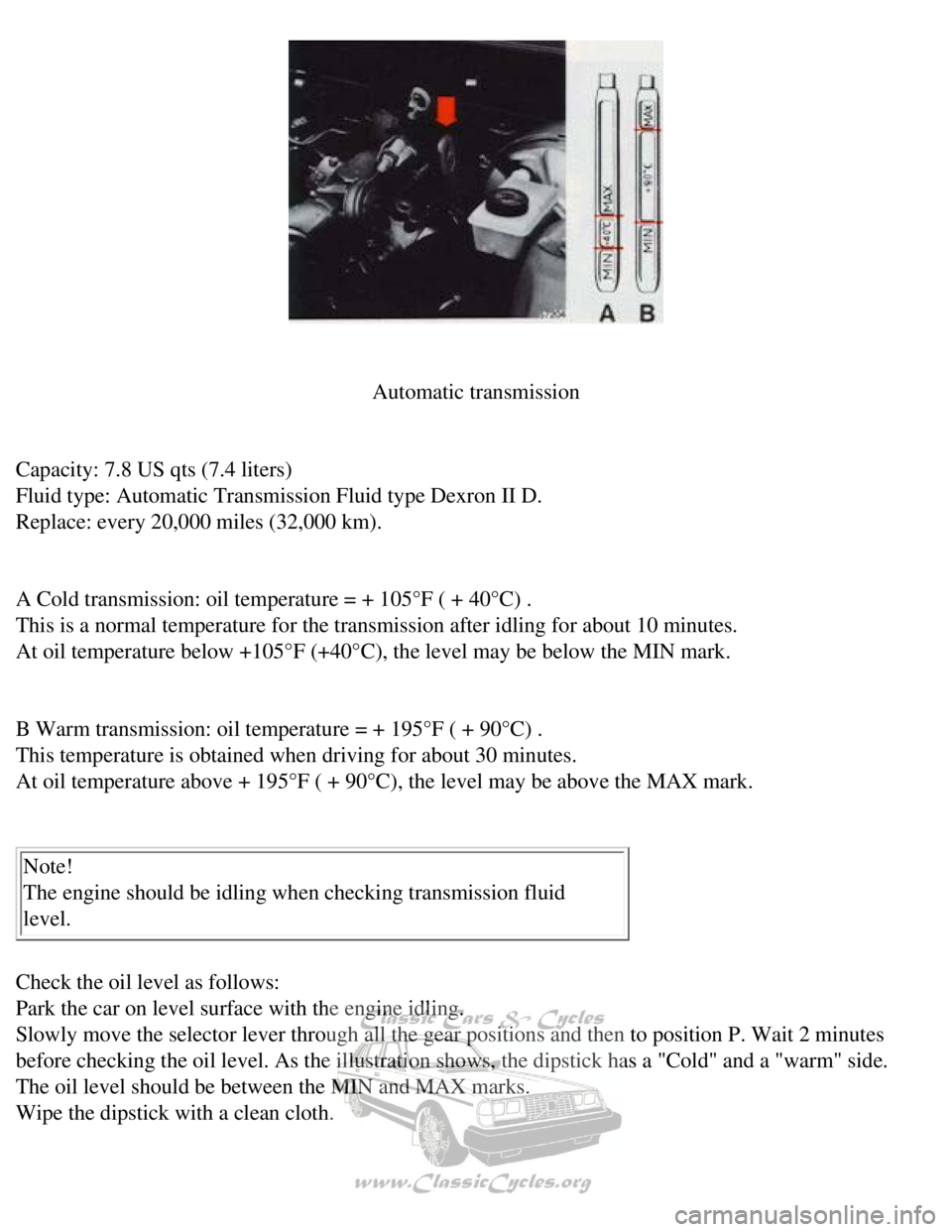
Automatic transmission
Capacity: 7.8 US qts (7.4 liters)
Fluid type: Automatic Transmission Fluid type Dexron II D.
Replace: every 20,000 miles (32,000 km).
A Cold transmission: oil temperature = + 105°F ( + 40°C) .
This is a normal temperature for the transmission after idling for about\
10 minutes.
At oil temperature below +105°F (+40°C), the level may be below \
the MIN mark.
B Warm transmission: oil temperature = + 195°F ( + 90°C) .
This temperature is obtained when driving for about 30 minutes.
At oil temperature above + 195°F ( + 90°C), the level may be abo\
ve the MAX mark.
Note!
The engine should be idling when checking transmission fluid
level.
Check the oil level as follows:
Park the car on level surface with the engine idling.
Slowly move the selector lever through all the gear positions and then t\
o position P. Wait 2 minutes
before checking the oil level. As the illustration shows, the dipstick h\
as a "Cold" and a "warm" side.
The oil level should be between the MIN and MAX marks.
Wipe the dipstick with a clean cloth.
file:///K|/ownersdocs/1990/1990_240/90240_15.htm (2 of 10)12/30/2006 8\
:25:09 AM
Page 99 of 143

Volvo 1990 240 Model
Check coolant level
The cooling system must be filled with coolant and not leak to operate a\
t maximum efficiency. Check
the coolant level whenever you refuel. The level should be between the "\
Max"' and "Min" marks on the
expansion tank. The check should be made with particular thoroughness wh\
en the engine is new or the
cooling system has been drained.
Do not remove the filler cap other than for topping up with coolant. Fre\
quent removal may prevent
coolant circulation between the engine and the expansion tank during eng\
ine warm up and cooling.
CAUTION
The cooling system must always be kept filled to the correct level.
If it is not kept filled, there can be high local temperatures in the en\
gine which could result in
damage.
Top up with coolant
Top up with coolant by filling the expansion tank when level is at the "\
Min" mark. Use a mixture of 50
percent Volvo Type C coolant and 50 percent water all the year round. To\
p up to the "Max" mark.
If the engine is warm, and you are going to add coolant, unscrew the cap\
slowly in order to allow any
excess pressure to escape.
Note: Do not add water only. Water by itself reduces the rust protective\
and anti-freeze qualities of the
coolant and has a lower boiling point. It can also cause damage to the c\
ooling system if it should
freeze.
See 'Specifications' section of the manual for type of coolant recommend\
ed.
file:///K|/ownersdocs/1990/1990_240/90240_15.htm (7 of 10)12/30/2006 8\
:25:09 AM
Page 100 of 143

Volvo 1990 240 Model
Cooling system
The risk of overheating is greatest, especially in hot weather, when:
- towing a trailer up steep inclines for prolonged periods at full throt\
tle, and at low engine rpm.
- idling for prolonged periods while the air conditioning system is in o\
peration.
- stopping the engine suddenly after high speed driving, so called after\
-boiling.
To avoid overheating. the following rules should be followed.
l Reduce speed and downshift when towing a trailer up long steep inclines.\
The risk of over heating can
be reduced by switching off the air conditioning system for a short whil\
e.
l Do not let the engine idle unnecessarily.
l Do not stop the engine immediately after high-speed driving, but allow t\
he engine to idle for 1/2 - 1
minute before switching off.
When the risk of overheating is imminent, or in the event of overheating\
, (the temperature gauge goes
repeatedly into, or stays continually in, the red section) the followin\
g precautions should be taken:
l Switch off the air conditioning system and switch the heater to full (m\
aximum) position.
l Stop the car and put the gear lever into neutral position-position N. Do\
not stop the engine!
l Increase the engine speed to approx. 2000 rpm (twice idling speed).
l Check the level of coolant in the expansion tank. Top-up, if necessary
pg. 75 Alternator, Jump starting
Electrical System cautions
When changing the battery or when carrying out work involving the electr\
ical system, the following
should be observed:
1 A battery connection to the wrong terminal will damage the diodes. Bef\
ore connections are made,
check the polarity of the battery with a voltmeter.
2 If booster batteries are used for starting, they must be properly conn\
ected to prevent the diodes from
being damaged. For correct connection, see "Jump starting".
3 The battery leads should be disconnected any time the battery is being\
charged.
file:///K|/ownersdocs/1990/1990_240/90240_15.htm (8 of 10)12/30/2006 8\
:25:09 AM
 the cooling system should \
be drained, flushed and refilled.
Remove the expansion tank cap. Open the drain coc")
