1990 VOLVO 240 wheel
[x] Cancel search: wheelPage 37 of 143

Volvo 1990 240 Model
WARNING: Never use any single seat belt for more than one occupant.
Never wear the shoulder portion of the belt under the arm or otherwise o\
ut of position. Such use could,
in event of accident, cause injury.
Volvo recommends that all occupants fasten their seat belts. Aftermarket\
devices used to induce slack
into the shoulder belt portion of Volvo's three-point belt system will h\
ave a detrimental effect on the
amount of protection available to you in the event of a collision
Note: Legislation in your state or province may mandate seat belt
usage.
Maintenance
Check periodically that the anchor bolts are secure and that the belts a\
re in good condition.
Use water and a mild detergent for cleaning.
As the seat belts lose much of their strength when stretched, they shoul\
d be replaced after collision, even
though they may appear to be undamaged.
Never modify or repair the belt on your own. If repair is required, have\
the work performed by an
authorized Volvo dealer.
pg. 30 Supplemental Restraint System (optional in Canada)
As an enhancement to the three-point seat belt system, your Volvo is equ\
ipped with a Supplemental
Restraint System (SRS). The Volvo SRS consists of a drivers side air b\
ag with a driver's side knee
bolster. The system is designed to supplement the protection provided by\
the three-point seat belt
system.
The interior of an SRS-equipped Volvo looks very much the same as any ot\
her. The only indications of
the system's presence are the "SRS" embossed on the steering wheel pad, \
and the knee bolster beneath
the steering column. Also, the SRS diagnostic receptacle is indicated on\
the center dash panel.
file:///K|/ownersdocs/1990/1990_240/90240_06.htm (6 of 9)12/30/2006 8:\
25:04 AM
Page 38 of 143

Volvo 1990 240 Model
The air bag is folded and located in the center of the steering wheel. I\
t is released only during a frontal
or certain front-angular collision in which the forces sustained by the \
car are equivalent to an impact into
a rigid barrier of approximately 12 mph (19 kph).
WARNING! As its name implies, SRS is designed to be a SUPPLEMENT to - no\
t a replacement for -
the three-point belt system. The air bag is not designed to be released \
in the event of a protection, wear
seat belts at all times. Be aware that no system can prevent all possibl\
e injuries that may occur in an
accident.
The air bag system includes a gas generator (1), surrounded by the air\
bag itself (2). In the event of a
frontal or certain front-angular collision in which the forces sustained\
by the car are equivalent to an
impact into a rigid barrier of approximately 12 mph (19 kph)), the se\
nsor (3) activates the gas generator
causing the air bag to be inflated with nitrogen gas. As the movement of\
the driver compresses the air
bag, some of the gas is expelled at a controlled rate to provide better \
cushioning.
The entire process, including inflation and deflation of the air bag tak\
es approximately two-tenths of a
second.
WARNING:
When installing any accessories make sure that the SRS system is not dam\
aged. Do not attempt to
service any component of the SRS yourself. Attempting to do so may resul\
t in serious personal injury.
If a problem arises, take your car to the nearest authorized Volvo Deale\
r for inspection as soon as
possible.
pg. 31 Supplemental Restraint System
file:///K|/ownersdocs/1990/1990_240/90240_06.htm (7 of 9)12/30/2006 8:\
25:04 AM
Page 53 of 143
, transmission in neutral, applyin\
g the parking brake")
Volvo 1990 240 Model
To obtain best parking brake performance, the brake linings should be br\
oken in.
Stop 5-7 times from 30 mph (50 km/h), transmission in neutral, applyin\
g the parking brake with the
release button pressed in during the stop. The force must not lock the r\
ear wheels. If this happens,
release the brake enough to let the wheels rotate. Drive a mile between \
each stop to cool the brakes.
Check for proper parking brake operation.
Note: The brake lights are not illuminated when applying the parking bra\
ke. To warn traffic from
behind it is therefore advisable to depress the brake pedal slightly to \
illuminate the brake lights.
600 - 1,200 mile maintenance service
To ensure proper operation the car should be taken to a Volvo dealer bet\
ween the first 600 - 1,200 miles
(1,000 - 2,000 km) for a maintenance service. The oil in the engine, m\
anual transmission and rear axle
will then be changed. This is very important since the oil rapidly colle\
cts impurities during the break-in
period.
pg. 43 Driving economy, Shift indicator light
Economical driving does not necessarily mean driving slowly
Better driving economy may be obtained by thinking ahead, avoiding rapid\
starts and stops and
adjusting the speed of your vehicle to immediate traffic conditions. Obs\
erve the following rules:
l Bring the engine to normal operating temperature as soon as possible by \
driving with a light foot on
the accelerator pedal instead of allowing the engine to idle for a prolo\
nged period. A cold engine uses
more fuel and is subject to increased wear.
l When possible avoid using the car for driving short distances. This does\
not allow the engine to reach
normal operating temperature.
l Drive carefully and avoid rapid acceleration and hard braking.
l Do not exceed speed limit.
l Avoid carrying unnecessary items (extra load) in the car.
l Check tire pressures regularly (cold tires).
l Remove snow tires when threat of snow or ice has ended.
l Note that roof racks, ski racks, etc., increase air resistance and there\
by fuel consumption.
file:///K|/ownersdocs/1990/1990_240/90240_09.htm (3 of 6)12/30/2006 8:\
25:05 AM
Page 62 of 143

Volvo 1990 240 Model
Precautionary steps to observe when towing
Please check with state and local authorities before attempting this typ\
e of towing as vehicles being
towed are subject to regulations regarding maximum towing speed, length \
and type of towing device,
lighting, etc.
l Steering must be unlocked.
l Remember that power brake and power steering assists will not be availab\
le when engine is
inoperative. Pedal pressure required is 3 - 4 times above normal and gre\
ater steering effort must be
employed.
l Towing cars equipped with automatic transmission:
-- Gear selector in position N. Check transmission oil level (see secti\
on titled "Transmission oil").
-- Maximum speed: 20 mph (30 km/h).
-- Maximum distance with rear wheels on ground: 20 miles (30 km).
CAUTION!
Do not attempt to start the car by pushing or pulling as damage to catal\
ytic converter can
result.
Jump starting, see section titled "alternator, jump starting".
NOTE:
Refer lo the section regarding "On-
Call"
pg. 49 Tow-truck information
Only use wheel lift or flat bed equipment.
CAUTION:
Sling-type equipment applied at the font will damage radiator and air co\
nditioning lines. It is equally
important not to use sling-type equipment at the rear or apply lifting e\
quipment inside the rear wheels;
serious damage to the rear axle may result.
file:///K|/ownersdocs/1990/1990_240/90240_10.htm (6 of 7)12/30/2006 8:\
25:05 AM
Page 65 of 143
.
l More frequent vehicle maint")
Volvo 1990 240 Model
l It is necessary to balance trailer brakes with the towing vehicle brakes\
to provide a safe stop (check
and observe State regulations).
l More frequent vehicle maintenance is required.
l Remove the ball and drawbar assembly when the hitch is not being used.
l Increase tire pressure to recommended full-load pressure. See section 'W\
heels and Tires."
Note: Refer to section entitled "Automatic transmission" for additional \
trailer hauling
tips.
Warning: Do not drive with trunk lid or tailgate
open!
Poisonous exhaust gases may enter via the open trunk lid or tailgate. (\
This is especially true for wagon
models.)
If the trunk lid or tailgate for any reason must be open, proceed as fol\
lows:
l Close the windows.
l Set the heating system controls for floor and defroster to max. and the \
blower to full speed (4). See
section titled "Heating and Ventilation".
Handling, roadholding
Vehicle load, tire design and inflation pressure are important for prope\
r handling. Therefore check that
the tires are inflated to the recommended pressure according to the vehi\
cle load.
Loads should be distributed so that capacity weight or maximum permissib\
le axle loads are not
exceeded.
It is recommended to use tires of the same make and dimensions on all fo\
ur wheels.
Warning: Do not mix radial ply and bias ply tires as this will adversely\
alter the vehicle handling
characteristics.
Roof rack
Permanent and removable roof racks are available from Volvo Accessories.\
file:///K|/ownersdocs/1990/1990_240/90240_11.htm (2 of 6)12/30/2006 8:\
25:06 AM
Page 67 of 143

Volvo 1990 240 Model
The power assist to the brakes functions only when the engine is running\
. When the car is moving
without the engine running the brake pedal pressure required to stop the\
car is increased 3- 4 times.
The brake pedal feels stiff and hard.
Disc brake noise: A slight-to-moderate amount of disc brake "squeal" is \
considered normal.
Air dam (front spoiler)
A non-factory air dam can negatively influence the normal flow of coolin\
g air to the front wheel brakes.
(See section titled "Wheels and Tires").
If one of the brake circuits should malfunction the red warning light wi\
ll come on
(See section titled "Warning Lights".)
The pedal stroke increases slightly and the pedal feels softer but the p\
edal pressure required does not
increase noticeably.
If the light comes on while driving and the brake pedal can be depressed\
further than normal, it is an
indication that one of the brake circuits is not functioning. Stop immed\
iately, open engine hood and
check brake fluid level.
Reservoir empty: do NOT drive. Tow car to shop for check/repair of brake\
system. Reservoir not empty:
proceed immediately and with caution to a Volvo dealer for an inspection\
of the brake system.
Severe strain on the brake system
The brakes will be subject to severe strain when driving in mountains or\
hilly areas. The speed is usually
low which means that the cooling of the brake is less efficient than whe\
n driving on level roads.
To reduce the strain on the brakes it is advisable not to use the brakes\
excessively.
Instead, shift into a lower gear and let the engine help with the brakin\
g. A good rule is to use the same
gear downhill as would be used ascending the same grade. For vehicles wi\
th automatic transmission use
position 2, or in some cases, 1.
file:///K|/ownersdocs/1990/1990_240/90240_11.htm (4 of 6)12/30/2006 8:\
25:06 AM
Page 70 of 143
Volvo 1990 240 Model
pg. 53 Service and maintenance
55Maintenance services
56Service requirements
59Engine B230F
60Fuel requirements
61Engine fluids
62Engine oil, Oil/oil filter change interval
63Cooling system
65Servicing
70Transmission oil
72Rear axle, power steering, brake fluid
73Lubrication
74Coolant
75Alternator, jump starting
76Replacing bulbs
81Fuses
82Wheels and tires
84Wheel changing
86Replacing wiper blades
87Washing, cleaning
87Cleaning, anti-rust treatment
88Paint touch-up
90What causes rust
91Long distance trips, cold weather
92Service diagnosis
96Label information
file:///K|/ownersdocs/1990/1990_240/90240_12.htm (1 of 7)12/30/2006 8:\
25:07 AM
Page 106 of 143
Volvo 1990 240 Model
3 Rear turn signal 32 21 Ba 15s 1156
4 Tail light 4 5 Ba 15s 67
5 Reflector - - - -
6 Brake light/tail
light* 32/3
21/5 BaY
15d 1157
*Right side lamp holders are white. Left side lamp holders are black. pg. 78 Replacing bulbs
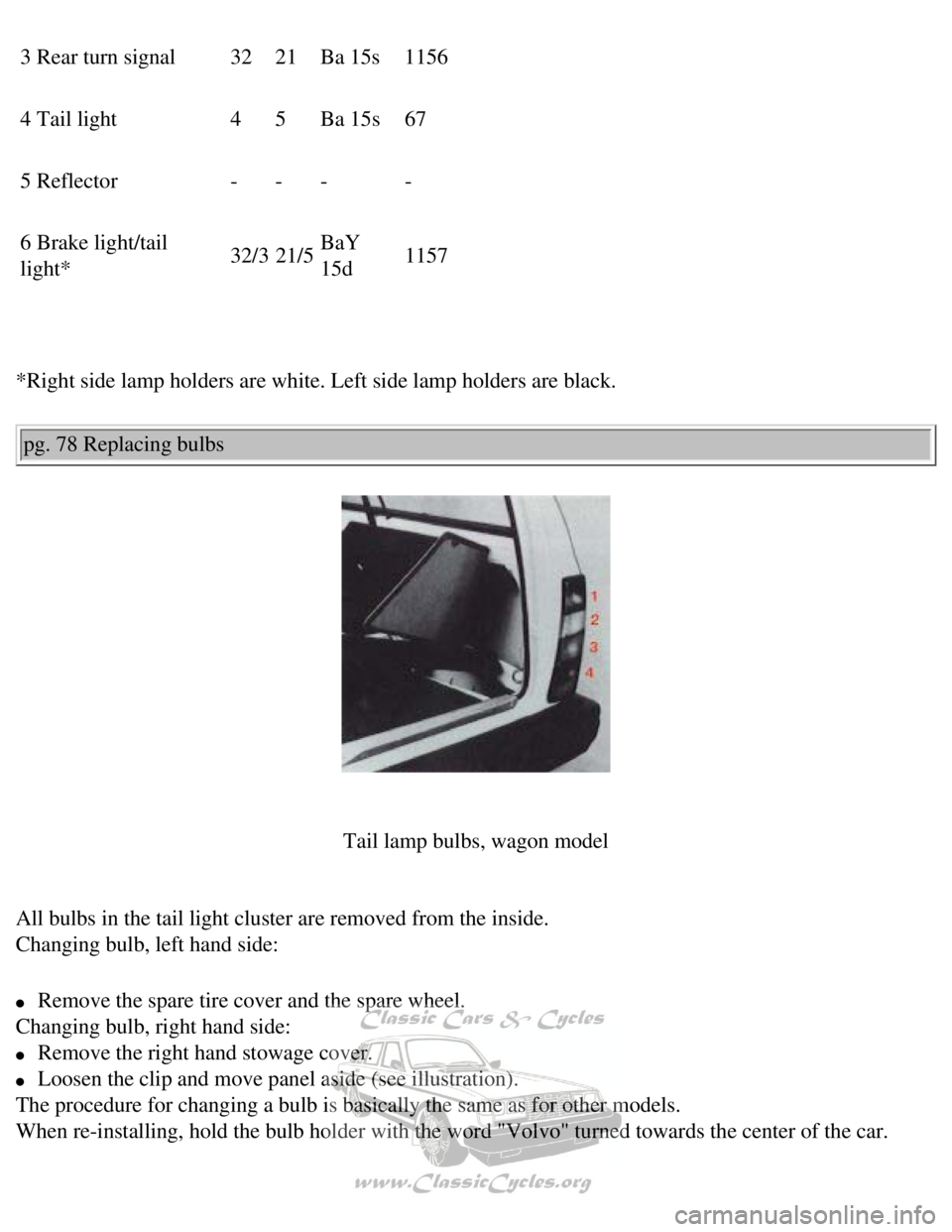
Tail lamp bulbs, wagon model
All bulbs in the tail light cluster are removed from the inside.
Changing bulb, left hand side:
l Remove the spare tire cover and the spare wheel.
Changing bulb, right hand side:
l Remove the right hand stowage cover.
l Loosen the clip and move panel aside (see illustration).
The procedure for changing a bulb is basically the same as for other mod\
els.
When re-installing, hold the bulb holder with the word "Volvo" turned to\
wards the center of the car.
file:///K|/ownersdocs/1990/1990_240/90240_16.htm (4 of 10)12/30/2006 8\
:25:10 AM