Page 39 of 143

Volvo 1990 240 Model
A self-diagnostic system incorporated in the sensor monitors the SRS. If\
a fault is detected, the "SRS"
warning light will illuminate. the light is included in the warning/indi\
cator light cluster in the instrument
panel. Normally, the SRS warning light will be illuminated along with th\
e other warning/indicator lights
when the ignition key is turned to the ON position (position II), and \
go out a short time after the engine
has been started. Check that this light is functioning properly every ti\
me the car is started.
The following items are monitored by the diagnostic system:
l Sensor unit electronics integrity.
l Reserve energy supply.
l Diagnostic output circuit.
l System voltage.
l Integrity of system connectors.
l Mercury switch closure.
l Gas generator ignitor
WARNING! If the SRS warning light stays on after the engine has started \
or if it comes on while you
are driving, drive the car to the nearest authorized Volvo Dealer for in\
spection as soon as possible.
ATTENTION! SRS VEHICLE!
THIS CAR IS EQUIPPED WITH A SUPPLEMENTAL RESTRAINT SYSTEM. TO PROVIDE
CONTINUED RELIABILITY, CERTAIN ELEMENTS OF THE SUPPLEMENTAL RESTRAINT
SYSTEM SHALL BE SERVICED OR REPLACED BY 1999. SEE OWNERS MANUAL FOR
FURTHER INFORMATION.
VOLVO
There is no maintenance to perform on the SRS yourself. The only periodi\
c maintenance recommended
on the SRS is that the air bag module and the sensor unit should be repl\
aced every ten years and that the
other components in the system (wiring, connectors, etc.) should also \
be inspected at this time. This
service must be performed by an authorized Volvo dealer.
file:///K|/ownersdocs/1990/1990_240/90240_06.htm (8 of 9)12/30/2006 8:\
25:04 AM
Page 47 of 143
Volvo 1990 240 Model
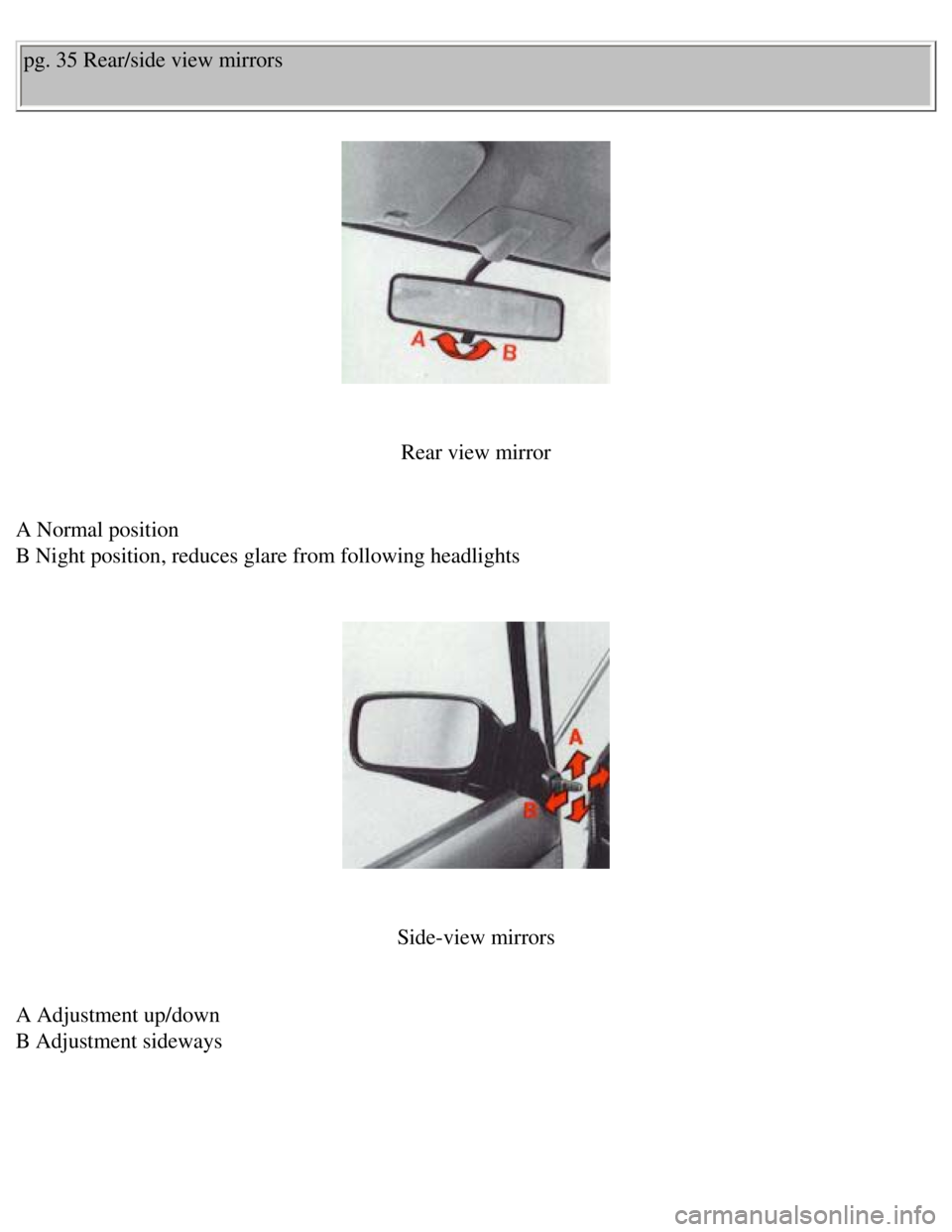
pg. 35 Rear/side view mirrors
Rear view mirror
A Normal position
B Night position, reduces glare from following headlights
Side-view mirrors
A Adjustment up/down
B Adjustment sideways
file:///K|/ownersdocs/1990/1990_240/90240_08.htm (1 of 4)12/30/2006 8:\
25:04 AM
Page 53 of 143
, transmission in neutral, applyin\
g the parking brake")
Volvo 1990 240 Model
To obtain best parking brake performance, the brake linings should be br\
oken in.
Stop 5-7 times from 30 mph (50 km/h), transmission in neutral, applyin\
g the parking brake with the
release button pressed in during the stop. The force must not lock the r\
ear wheels. If this happens,
release the brake enough to let the wheels rotate. Drive a mile between \
each stop to cool the brakes.
Check for proper parking brake operation.
Note: The brake lights are not illuminated when applying the parking bra\
ke. To warn traffic from
behind it is therefore advisable to depress the brake pedal slightly to \
illuminate the brake lights.
600 - 1,200 mile maintenance service
To ensure proper operation the car should be taken to a Volvo dealer bet\
ween the first 600 - 1,200 miles
(1,000 - 2,000 km) for a maintenance service. The oil in the engine, m\
anual transmission and rear axle
will then be changed. This is very important since the oil rapidly colle\
cts impurities during the break-in
period.
pg. 43 Driving economy, Shift indicator light
Economical driving does not necessarily mean driving slowly
Better driving economy may be obtained by thinking ahead, avoiding rapid\
starts and stops and
adjusting the speed of your vehicle to immediate traffic conditions. Obs\
erve the following rules:
l Bring the engine to normal operating temperature as soon as possible by \
driving with a light foot on
the accelerator pedal instead of allowing the engine to idle for a prolo\
nged period. A cold engine uses
more fuel and is subject to increased wear.
l When possible avoid using the car for driving short distances. This does\
not allow the engine to reach
normal operating temperature.
l Drive carefully and avoid rapid acceleration and hard braking.
l Do not exceed speed limit.
l Avoid carrying unnecessary items (extra load) in the car.
l Check tire pressures regularly (cold tires).
l Remove snow tires when threat of snow or ice has ended.
l Note that roof racks, ski racks, etc., increase air resistance and there\
by fuel consumption.
file:///K|/ownersdocs/1990/1990_240/90240_09.htm (3 of 6)12/30/2006 8:\
25:05 AM
Page 67 of 143

Volvo 1990 240 Model
The power assist to the brakes functions only when the engine is running\
. When the car is moving
without the engine running the brake pedal pressure required to stop the\
car is increased 3- 4 times.
The brake pedal feels stiff and hard.
Disc brake noise: A slight-to-moderate amount of disc brake "squeal" is \
considered normal.
Air dam (front spoiler)
A non-factory air dam can negatively influence the normal flow of coolin\
g air to the front wheel brakes.
(See section titled "Wheels and Tires").
If one of the brake circuits should malfunction the red warning light wi\
ll come on
(See section titled "Warning Lights".)
The pedal stroke increases slightly and the pedal feels softer but the p\
edal pressure required does not
increase noticeably.
If the light comes on while driving and the brake pedal can be depressed\
further than normal, it is an
indication that one of the brake circuits is not functioning. Stop immed\
iately, open engine hood and
check brake fluid level.
Reservoir empty: do NOT drive. Tow car to shop for check/repair of brake\
system. Reservoir not empty:
proceed immediately and with caution to a Volvo dealer for an inspection\
of the brake system.
Severe strain on the brake system
The brakes will be subject to severe strain when driving in mountains or\
hilly areas. The speed is usually
low which means that the cooling of the brake is less efficient than whe\
n driving on level roads.
To reduce the strain on the brakes it is advisable not to use the brakes\
excessively.
Instead, shift into a lower gear and let the engine help with the brakin\
g. A good rule is to use the same
gear downhill as would be used ascending the same grade. For vehicles wi\
th automatic transmission use
position 2, or in some cases, 1.
file:///K|/ownersdocs/1990/1990_240/90240_11.htm (4 of 6)12/30/2006 8:\
25:06 AM
Page 77 of 143
Volvo 1990 240 Model
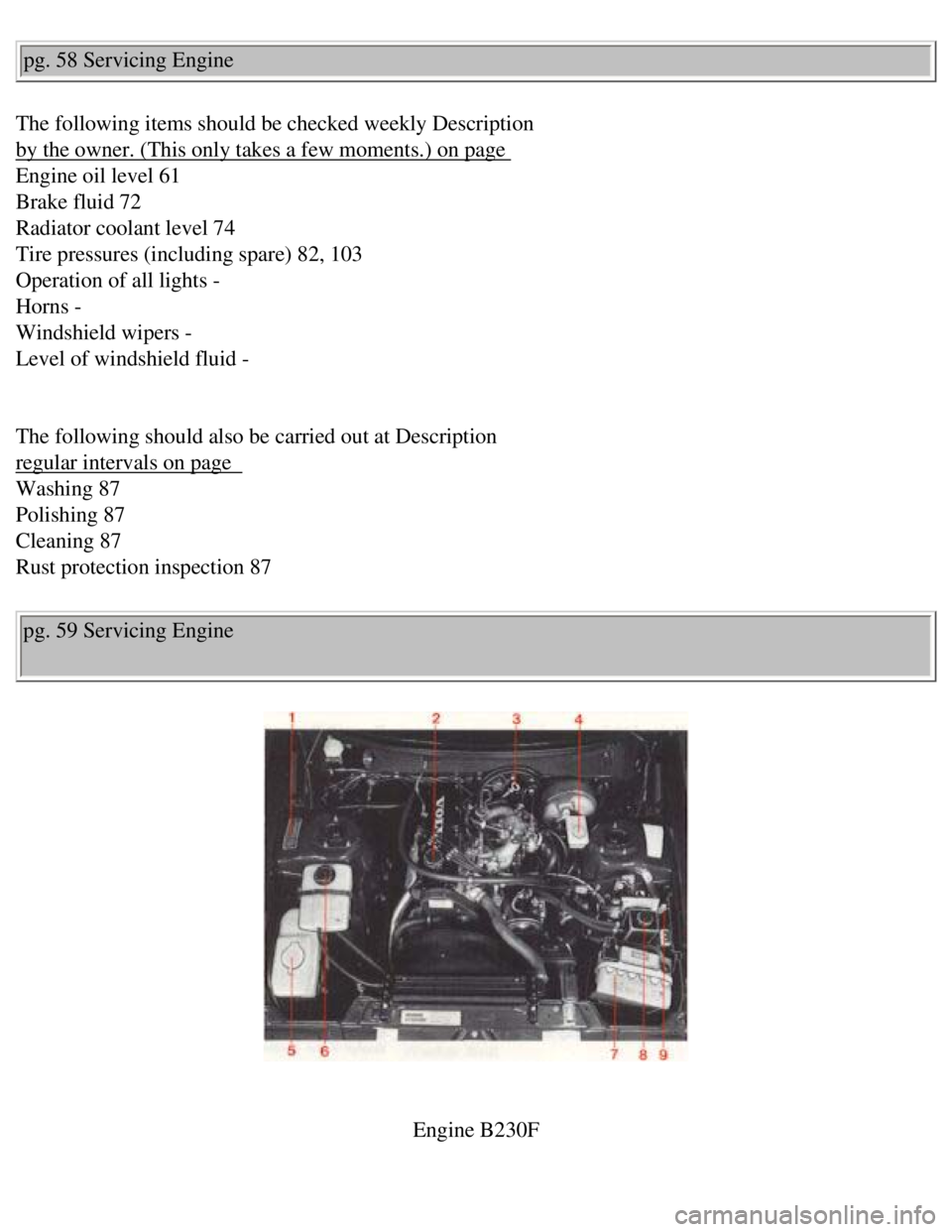
pg. 58 Servicing Engine
The following items should be checked weekly Description
by the owner. (This only takes a few moments.) on page
Engine oil level 61
Brake fluid 72
Radiator coolant level 74
Tire pressures (including spare) 82, 103
Operation of all lights -
Horns -
Windshield wipers -
Level of windshield fluid -
The following should also be carried out at Description
regular intervals on page
Washing 87
Polishing 87
Cleaning 87
Rust protection inspection 87 pg. 59 Servicing Engine
Engine B230F
file:///K|/ownersdocs/1990/1990_240/90240_13.htm (1 of 9)12/30/2006 8:\
25:08 AM
Page 104 of 143
Volvo 1990 240 Model
Front light bulbs
Loosen the Phillips screws and remove the lens. The bulbs can now be rem\
oved by pressing them
inwards and turning them slightly counterclockwise.
When re-installing lens, check that the gasket is in position.
Bulbs Power Socket
CP(W)
1 Front position 24/2.2(21/5) BaY15d
Side marker lights
2 Front turn signal 24/2.2(21/5) BaY15d 1) US Bulb No. 1157NA
pg. 77 Replacing bulbs
Tail lamp bulbs, sedan model
file:///K|/ownersdocs/1990/1990_240/90240_16.htm (2 of 10)12/30/2006 8\
:25:10 AM
Page 105 of 143
Volvo 1990 240 Model
All tail lamp bulbs are replaced from inside of trunk.
1 Unscrew and remove tail lamp inside cover. Note that inside cover is h\
ooked at the upper edge. Lift
the lower end out up and unhook upper edge.
2 Turn bulb holder approx 3,8" (1 cm) counterclockwise and remove it. \
3 Depress bulb n bulb holder turn it slightly counterclockwise and remov\
e it.
4 Install a new bulb Install bulb holder in tail lamp.
NOTE: One of the bulb holder tabs is wider and fits only in correspondin\
g
recess.
Turn bulb holder clockwise. Check that bulb lights Replace tail lamp ins\
ide cover.
Power
Power
Bulbs CP W Socket US Bulb
No
1 Rear fog light 32 21 Ba 15s 1156
2 Back-up light 32 21 Ba 15s 1156
file:///K|/ownersdocs/1990/1990_240/90240_16.htm (3 of 10)12/30/2006 8\
:25:10 AM
Page 109 of 143
Volvo 1990 240 Model
High-mounted stop light
On sedans (top), use screwdriver to depress catch then pull plastic co\
ver up and away from the light
assembly.
On wagons (bottom). depress the marked areas on the side of the housin\
g and pull it away from the light
assembly.
Press in reflector catch to release reflector assembly. Swing out reflec\
tor and replace bulb.
Snap reflector in and check that bulb lights when brake pedal is depress\
ed.
Align the light assembly catches with the holes in the lamp housing and \
press it into place.
Bulbs Power Socket US Bulb No
High mounted 32 cp/ 21 W Ba 15 s 1156
file:///K|/ownersdocs/1990/1990_240/90240_16.htm (7 of 10)12/30/2006 8\
:25:10 AM


, use screwdriver to depress catch then pull plastic co\
ver up and away from the light
assembly.
On wagons (bottom). depress the")