Page 62 of 143

Volvo 1990 240 Model
Precautionary steps to observe when towing
Please check with state and local authorities before attempting this typ\
e of towing as vehicles being
towed are subject to regulations regarding maximum towing speed, length \
and type of towing device,
lighting, etc.
l Steering must be unlocked.
l Remember that power brake and power steering assists will not be availab\
le when engine is
inoperative. Pedal pressure required is 3 - 4 times above normal and gre\
ater steering effort must be
employed.
l Towing cars equipped with automatic transmission:
-- Gear selector in position N. Check transmission oil level (see secti\
on titled "Transmission oil").
-- Maximum speed: 20 mph (30 km/h).
-- Maximum distance with rear wheels on ground: 20 miles (30 km).
CAUTION!
Do not attempt to start the car by pushing or pulling as damage to catal\
ytic converter can
result.
Jump starting, see section titled "alternator, jump starting".
NOTE:
Refer lo the section regarding "On-
Call"
pg. 49 Tow-truck information
Only use wheel lift or flat bed equipment.
CAUTION:
Sling-type equipment applied at the font will damage radiator and air co\
nditioning lines. It is equally
important not to use sling-type equipment at the rear or apply lifting e\
quipment inside the rear wheels;
serious damage to the rear axle may result.
file:///K|/ownersdocs/1990/1990_240/90240_10.htm (6 of 7)12/30/2006 8:\
25:05 AM
Page 67 of 143

Volvo 1990 240 Model
The power assist to the brakes functions only when the engine is running\
. When the car is moving
without the engine running the brake pedal pressure required to stop the\
car is increased 3- 4 times.
The brake pedal feels stiff and hard.
Disc brake noise: A slight-to-moderate amount of disc brake "squeal" is \
considered normal.
Air dam (front spoiler)
A non-factory air dam can negatively influence the normal flow of coolin\
g air to the front wheel brakes.
(See section titled "Wheels and Tires").
If one of the brake circuits should malfunction the red warning light wi\
ll come on
(See section titled "Warning Lights".)
The pedal stroke increases slightly and the pedal feels softer but the p\
edal pressure required does not
increase noticeably.
If the light comes on while driving and the brake pedal can be depressed\
further than normal, it is an
indication that one of the brake circuits is not functioning. Stop immed\
iately, open engine hood and
check brake fluid level.
Reservoir empty: do NOT drive. Tow car to shop for check/repair of brake\
system. Reservoir not empty:
proceed immediately and with caution to a Volvo dealer for an inspection\
of the brake system.
Severe strain on the brake system
The brakes will be subject to severe strain when driving in mountains or\
hilly areas. The speed is usually
low which means that the cooling of the brake is less efficient than whe\
n driving on level roads.
To reduce the strain on the brakes it is advisable not to use the brakes\
excessively.
Instead, shift into a lower gear and let the engine help with the brakin\
g. A good rule is to use the same
gear downhill as would be used ascending the same grade. For vehicles wi\
th automatic transmission use
position 2, or in some cases, 1.
file:///K|/ownersdocs/1990/1990_240/90240_11.htm (4 of 6)12/30/2006 8:\
25:06 AM
Page 77 of 143
Volvo 1990 240 Model
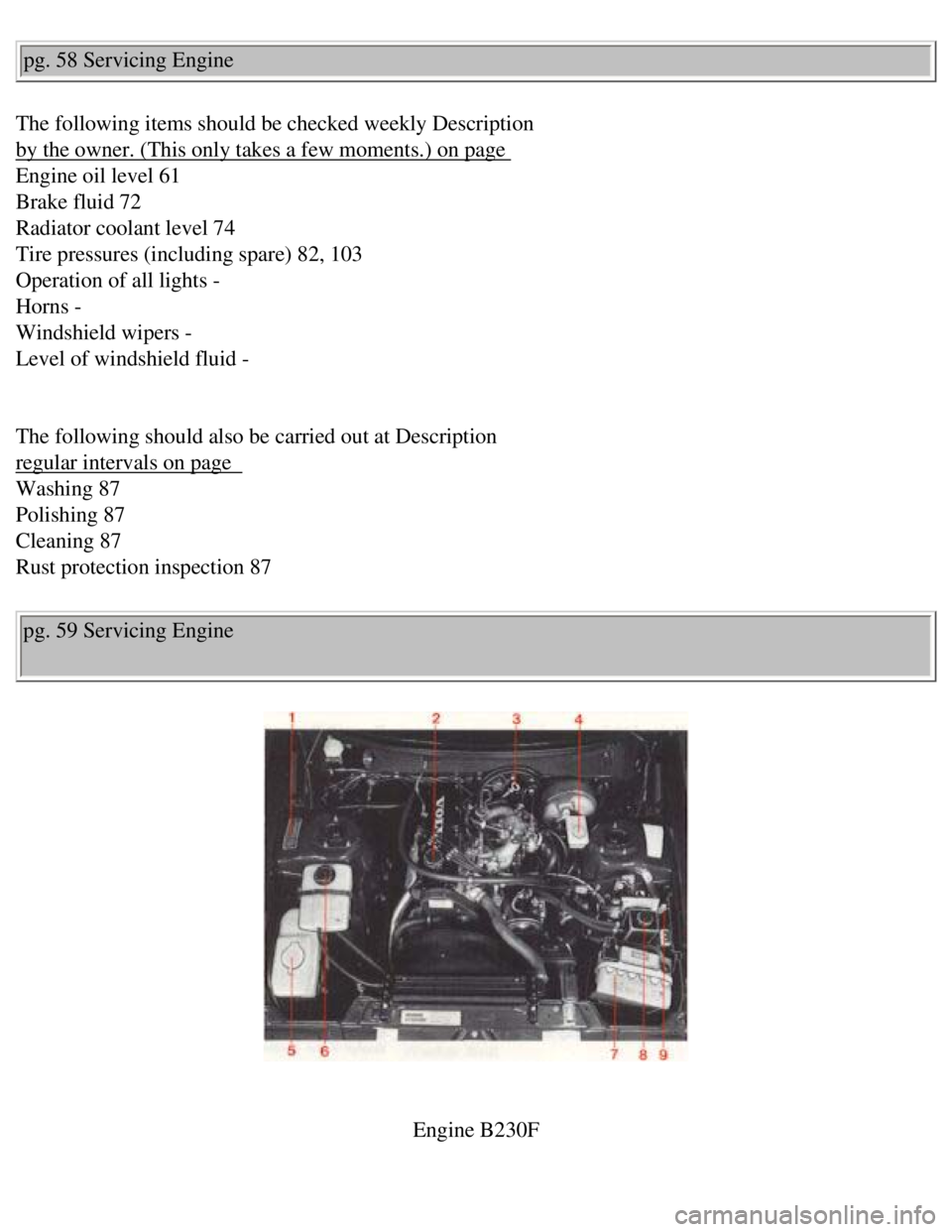
pg. 58 Servicing Engine
The following items should be checked weekly Description
by the owner. (This only takes a few moments.) on page
Engine oil level 61
Brake fluid 72
Radiator coolant level 74
Tire pressures (including spare) 82, 103
Operation of all lights -
Horns -
Windshield wipers -
Level of windshield fluid -
The following should also be carried out at Description
regular intervals on page
Washing 87
Polishing 87
Cleaning 87
Rust protection inspection 87 pg. 59 Servicing Engine
Engine B230F
file:///K|/ownersdocs/1990/1990_240/90240_13.htm (1 of 9)12/30/2006 8:\
25:08 AM
Page 84 of 143
Volvo 1990 240 Model
Changing coolant
Every two years or 30,000 miles (48,000 km) the cooling system should \
be drained, flushed and refilled.
Remove the expansion tank cap. Open the drain cock on right side of the \
engine block and disconnect
the lower radiator hose.
Fill coolant through the expansion tank.
The heater controls should be fully open when draining and filling.
Add coolant until the level is up to the MAX mark or slightly above.
Start engine and run until hot. Check the cooling system connections for\
tightness. Also re-check the
coolant level. Capacity: 9.9 US qts. = 9.4 liters (manual transmission \
models); 9.7 US qts = 9.2 liters
(automatic transmission models)
Cooling system, hoses and connections
file:///K|/ownersdocs/1990/1990_240/90240_13.htm (8 of 9)12/30/2006 8:\
25:08 AM
Page 103 of 143
Volvo 1990 240 Model
pg. 76 Replacing bulbs
Replacing bulbs
The replacement of bulbs in the various lighting units is shown on the f\
ollowing pages. Make sure when
installing bulbs, that the guide pin on the socket fits into its corresp\
onding recess.
When installing bulbs, do not touch the glass with your fingers. The rea\
son for this is that grease, oil or
any other impurities can be carbonized onto the bulb and damage the refl\
ector.
Use bulbs of correct type and voltage. Failure to do so could activate t\
he bulb failure warning light.
Replacing headlight bulbs
Working inside the engine compartment, separate the socket contact from \
the bulb holder (1). Unscrew
and remove the bulb holder retaining ring (2) Pull out the bulb holder\
assembly, and replace it as a unit
(3).
Installation is the reverse of removal.
Check headlight alignment.
Bulb Power Trade No.
Headlamp 45/65W 9004
file:///K|/ownersdocs/1990/1990_240/90240_16.htm (1 of 10)12/30/2006 8\
:25:10 AM
Page 111 of 143
Volvo 1990 240 Model
Remove screw holding the light assembly Lift it out to remove.
Replace the bulb.
Reinstall by first inserting the guides into one side, then press ir, th\
e light assembly and install the screw.
Bulb Power Socket
Engine compartment light 15 W S 8.5 - 8
Trunk light 15 W S 8.5 - 8
Instrument and heater control lighting
Due to the location of these bulbs their replacement should be carried o\
ut by a Volvo dealer. pg. 81 Fuses
Replacing fuses
The fuse box is positioned in front of the left front door pillar. When \
replacing fuses, check that the
correct amperage is used.
Never use fuses of higher amperage. unless specified by your Volvo deale\
r. If one fuse repeatedly fails,
take the car to your Volvo dealer for fault tracing.
A spare fuse kit is available from your Volvo dealer.
file:///K|/ownersdocs/1990/1990_240/90240_16.htm (9 of 10)12/30/2006 8\
:25:10 AM
Page 118 of 143

Volvo 1990 240 Model
The floor mats should be vacuumed or brushed clean regularly, especially\
during the winter when they
should be taken out for drying.
Spots on textile mats can be removed with a mild detergent.
Anti-rust treatment
Your Volvo has been rust protected at the factory. On external surfaces \
a heavy coat of wear resistant
material has been used, while on the internal surfaces a lighter rust in\
hibitor is used.
The rust protection should be inspected regularly by your authorized Vol\
vo dealer. Consult the Volvo
Protection Limited Warranty found in your Warranty Information Booklet f\
or additional terms and
conditions.
For further information, see section titled "What causes rust" or see yo\
ur Volvo dealer. pg. 88 Paint touch-up
Paint touch-up
Paint damage requires immediate attention to avoid rusting. Make it a ha\
bit to check the finish regularly,
for instance when washing the car. Touch-up if necessary.
Paint repairs require special equipment and skill. Contact your Volvo de\
aler for any extensive damages.
Minor scratches can be repaired by using Volvo touch-up paint.
Note: When ordering touch-up paint from your Volvo dealer, use the paint\
code indicated on the
service label. The label is located on the wheel housing in the engine c\
ompartment.
Minor stone chips and scratches
Material:
Primer-can
Paint-can or touch-up bottle
file:///K|/ownersdocs/1990/1990_240/90240_18.htm (4 of 8)12/30/2006 8:\
25:11 AM
Page 123 of 143

Volvo 1990 240 Model
pg. 91 Long distance trips, Cold weather
Prior to a long distance trip
Have your car checked at a Volvo dealer. Preventive maintenance will hel\
p to ensure a trouble free trip.
Remember to take along a Volvo dealer directory.
The main items to check are listed below:
1. Brakes, front wheel alignment and steering gear.
2. Engine running condition.
3. Fuel system operation.
4. Oil leaks: engine, transmission, rear axle.
5. Cooling system for leaks or worn hoses.
6. Examine tires carefully, replace worn tires.
7. Battery and terminals.
8. Tool equipment.
9. Lighting.
10. Drive belts, for tightness and wear.
11. All fluid levels.
Cold weather/Engine fuel system
During the winter, large variations in temperature cause condensation to\
form in the fuel tank and can
impair the running of the engine. This can be reduced by adding dry gas \
to the fuel. There is less risk of
condensation forming in the fuel tank if it is kept full or nearly full.\
Engine cooling system
Volvo type C (blue-green) coolant should be used all year round. The c\
ooling system should always
contain water plus anti-freeze and rust inhibitor, even during the summe\
r. Experience has also shown
that extremely weak anti-freeze solutions (10-25 percent) are ineffect\
ive for rust protection. For this
reason, the quantity of antifreeze/summer coolant should be about 50 per\
cent of the solution. This
lowers the freezing point to - 30 ° F (-35 ° C).
Engine lubricating system
file:///K|/ownersdocs/1990/1990_240/90240_19.htm (1 of 7)12/30/2006 8:\
25:13 AM
 the cooling system should \
be drained, flushed and refilled.
Remove the expansion tank cap. Open the drain coc")

