Page 90 of 677

E
COOLING SYSTEM
1NDEX . ..*....*~.....*..*~~**~=~~.~~.~...~..**.~.....*...~.. E- 2
OUTLINE .................................................. E- 4
OUTLlNE OF CONSTRUCTION.. ................ E- 4
COOLANT FLOW CHART.. ....................... E- 4
SPECIFICATKINS
.................................... E- 5
TWO-STAGE THERMOSTAT.. .................... E- 6
RADIATOR AND COOLING FAN.. .............. E- 7
ELECTRIC COOLING FAN SYSTEM ........... E- 8
SUPPLEMENTAL SERVICE INFORMATION E- 9
THERMOSTAT
.......................................... E- 9
INSPECTION
.......................................... E- 9
ELECTRIC COOLING FAN SYSTEM ............ E-l 0
SYSTEM INSPECTlON
.............................. E-l 0
FAN MOTOR
............................................. E-If
iNSPECTION .......................................... E-l 1
WATER THERMOSWITCH
.......................... E-l I
INSPECTION .......................................... E-f 1
RADIATOR THERMOSWITCH
..................... E-l 2
REMOVAL I INSPECTION I INSTALLATION.. E-12
FAN RELAY .............................................. E-l 3
REMOVAL I tNSPECTlUN .......................... E-l 3
93GOEX-701
Page 92 of 677
INDEX E
BP DOHC TURBO
III 6 No.2 AND No.3 RELAY
1. Thermostat 4. Water thermoswitch
Inspection ...................................
page E- 9 inspection ...................................
page E-l 1
2. Electric cooling fan system 5. Radiator thermoswitch
System
inspection .......................
page E-l 0 Removal I Inspection I
3. Fan motor Instailation .................................
page E-1 2
Inspection ...................................
page E-l 1 6 Fan relay
Removal I Inspection .................. page E-1 3
E-3
Page 93 of 677
E OUTLINE
OUTLINE
OUTttNE OF CONSTRUCTION
The cooling system in the 323 4WD model is basically the same as in the 323 2WD model.
Although there is no fundamental change from the BP DOHC of the 2WD model, the coolant circulation
path has been changed to direct coolant to the water-cooied turbocharger.
A two-stage thermostat is used in the BP DUHC turbocharged engine to stabilize the engine coolant tem-
peratu re.
The radiator and cooling fan specifications are different. The BP DOHC turbocharged engine of the 4WD
model uses a two-speed electric cooling fan.
93GOEX-704
COOLANT FLOW CHART (BP DOHC TURBO)
E-4
Page 96 of 677
RADIATOR AND COOLING FAN
The radiator and cooling fan specifications are revised.
Specifications
r
EnginelTransaxle BP SOHC 1 BP DOHC Turbo
ATX I
Item MTX MTX 1 Radiator I
Width 647 +
+
Core size
mm (in) H etght 390 t *-
Depth 16 25 e
Fm pnch
mm (in) 1.3 t c
Heat dissipaton capacity kcallh
38,800 43,800 C
Type -
Double tube - Transaxle oil cooler
Heat dissipation capacity
-
kcal/h I 1,650 -
Cooling fan
Number of biades
4 5 +
Outer drameter
mm (in> 320
340 C
Capacity
w-v 80-12 160-12 c
Current
A
1 I 6.6 * 1 Hi : 13.3 + 7 0% max. + Lo: 8.8 + 10% max.
93GOEX-708
OIL COOLER (ATX
;ECTION A-A
4WD MODEL ZWD MODEL
I
DEPTH E-7
Page 97 of 677

E OUTLINE
ELECTRIC COCUNG FAN SYSTEM (BP DOHC TURBO)
System Circuit
I I
WITH A/C
r----‘-- -___- ---------.--------;
ADDITIONAL
FAN
MOTOR
I
II 1 A/C RELAY
RAD1ATdTHERMOSWITCH
ABOVE 105% I221 OF-): ON +IIAGNOSlS
CONNECTOR
WATER
THERMOSWlTCH
ABOVE 97% (207OF): ON
Operation 1. When the coolant temperature exceeds 97OC (207*F), the water thermoswitch turns ON to close the No.7
relay, and connects the + I and -1 terminals of the fan motor
connector. The fan motor turns at low
speed (about 1,660 rpm).
2. When the coolant temperature exceeds 105OC (221 OF), the radiator thermoswitch turns ON, to close the
No.2 and No.3 relays, and connects
the +2 and -2 terminals of the fan motor connector. The fan mo-
tor turns at high speed (about 2,200 rpm).
3. if the vehicle is equipped with air conditioning, the cooling fan motor operates whenever the
NC switch
and the blower switch are on, regardless of
the coolant temperature. Also, when the A/C switch and the blower switch are on, the A/C retay closes
to operate the additional fan
motur.
Note
l The water thermoswitch and the cooling fan reIay are normally-open switches.
Checking cooling fan operation 1. Jump across the TFA and the GND terminals
of the diagnosis connector with a jumper wire.
2. Turn the ignition switch to ON and verify that the cooling fan operates smoothly.
Note
l When the water thermoswitch connector is disconnected, the cooling fan wiif not operate.
E-8
Page 98 of 677
SUPPLEMENTAL SERVICE INFORMAT1ON, THERMOSTAT E
SUPPLEMENTAL SERVICE INFURMATtON
The following points in the section are changed in comparison with Workshop Manual [Europe (1203-l 0-89F),
Australia (I 204-I 0-89f)].
Thermostat (BP DUHC Turbo only)
l Inspection
Electric cooling fan system (BP DOHC Turbo only)
l System inspection
Fan motor
l 1 nspection
Water thermoswitch (BP DOHC Turbo only)
l tnspection
Radiator thermoswitch (BP DOHC Turbo only)
l Removal I Inspection I Installation
Fan relay (BP DOHC Turbo only)
l Removal ! Inspection 93GOEX-710
-
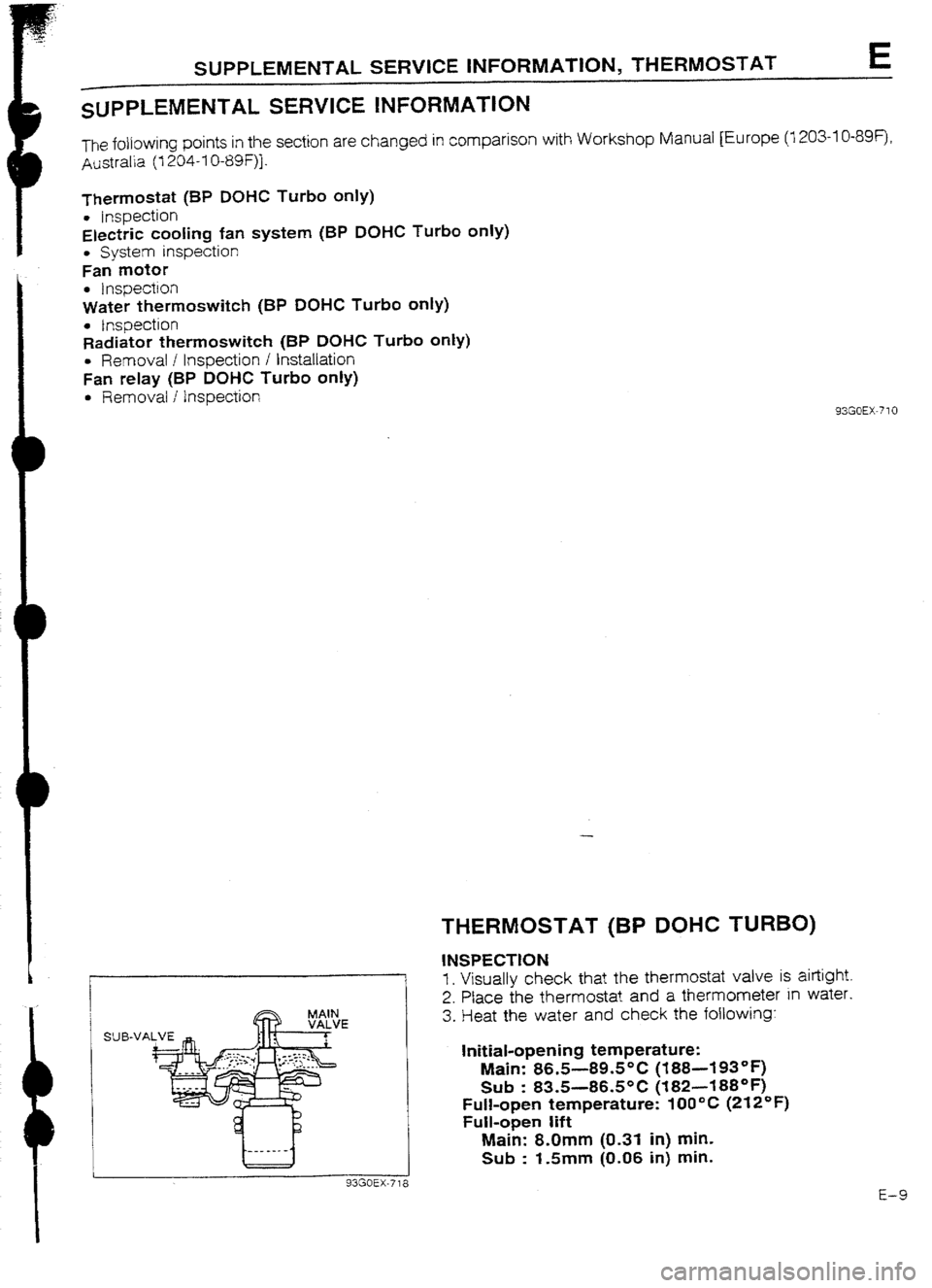
THERMOSTAT (BP DOHC TURBO)
SUB-V E
‘A
/ INSPECTKM
1. Visually check that the thermostat valve is airtight.
2. Place the thermostat and a thermometer in water.
3. Heat the water and check the following:
Initial-opening temperature:
Main: 86.5-89.5% (188--t93°F)
Sub : 83.5-86.5OC (f82--f88QF)
Full-open temperature: 100°C (212°F)
Full-open lift
Main: 8.Umm CU.31 in) min.
Sub : f.5mm (0.06 in) min.
E-9
Page 99 of 677
E ELECTRIC COOLING FAN SYSTEM
ELECTRIC COOLING FAN SYSTEM (BP
DUHC TURBO)
SYSTEM ClRCUIT
r
WITH A/C
r-- _______ ------
I ADDITIONAL
1 FAN
I PRESSL
SWITCH
I WATER
THERMOSWfTCtl
ABOVE 87OC (207OF): ON
RADlATOjl THERMOSWITCH
ABOVE 105*C (221 “I=): ON
8 93GOEX-719
-
%
J--- QY- -THERMOME?ERsi-=i
--
--------L-
93GOEX-7 i 2
E-10 SYSTEM INSPECTION
1. Jump across the test fan (TFA) terminal and the ground
(GN D) terminal of the diagnosis connector.
2. Turn the ignition switch ON and verify that the fan operates.
If the fan does not operate, inspect the cooling fan system
components and wiring harness.
3. Remove the radiator cap and place a thermometer in the
radiator filler neck.
4. Start the engine.
5. Verify that the fan operates when the coolant temperature
reaches approx. 97*C (207°F).
If it does, check the water thermoswitch.
(Refer to page
E--i I.)
Page 131 of 677
![MAZDA 232 1990 Workshop Manual Suplement F2 TURBOCHARGER CONTROL [BP TURBO]
93GOF.Z721
!=2-14 LARGE
+ FULLY OPEN
BYPASS AIR
i 8EGlNNIp
AMOLIN OF OPEN
SMALIL
430 VACUUM
(5-l) mmt-lg
TURBOCHARGER OnW
INLET
lntercooler
The air-to-a](/manual-img/28/57056/w960_57056-130.png "MAZDA 232 1990 Workshop Manual Suplement F2 TURBOCHARGER CONTROL [BP TURBO]
93GOF.Z721
!=2-14 LARGE
+ FULLY OPEN
BYPASS AIR
i 8EGlNNIp
AMOLIN OF OPEN
SMALIL
430 VACUUM
(5-l) mmt-lg
TURBOCHARGER OnW
INLET
lntercooler
The air-to-a")
F2 TURBOCHARGER CONTROL [BP TURBO]
93GOF.Z721
!=2-14 LARGE
+ FULLY OPEN
BYPASS AIR
i 8EGlNNIp
AMOLIN OF OPEN
SMALIL
430 VACUUM
(5-l) mmt-lg
TURBOCHARGER OnW
INLET
lntercooler
The air-to-air intercooler utilizes fresh air flow through the in-
tercooler core to reduce the intake air temperature.
If
the air compressed by the turbocharger was sent directly
into the combustion chamber without passing through the in-
tercooler, the charging air efficiency would be
reduced by the
high temperature of the intake aii-.
The intercooler, by cooling this high temperature air, substan-
tially increases the charging air efficiency
and engine output,
as well as supressing ignition knocking by reducing the com-
bustion gas temperature.
The intercooler is mounted at
the left front of the vehicle.
Air Bypass Valve
The air bypass valve bypasses intake air from the air funnel
to before the turbocharger in order to reduce air vibration noise
during deceleration.
When the throttle valve is closed suddenly during high-rpm
and heavy-load operation, air vibration occurs between the
throttle vatve and the turbocharger as a result of pressuriza-
tion
caused by inertia of the intake air. This system prevents
such noise.