1990 HONDA PRELUDE coolant
[x] Cancel search: coolantPage 19 of 143

Instrument Panel
TURN SIGNAL/ LIGHT SWITCH/
DIMMER SWITCH
SUNROOFSWITCH
HEADLIGHT
MOTOR
SWITCH PANEL BRIGHTNESS
CONTROL KNOB HAZARD WARNING
LIGHT SWITCH
FOG LAMP
SWITCH REAR WINDOW
DEFOGGER
SWITCH
DIGITAL
CLOCK
CENTER
VENTS
CRUISE
CONTROL
MASTER
SWITCH
FUSE BOX COIN BOX
HORN
BUTTON WINDSHIELD
WIPER/WASHER
SWITCH LEVER
IGNITION SWITCH CIGARETTE
LIGHTER
HEATING/
COOLING
CONTROL
PANEL
TACHOMETER SPEEDOMETER
FUEL GAUGESHIFT LEVER
POSITION
INDICATOR
(AUTOMATIC)
ODOMETER TRIP METER
TRIP METERRESET BUTTON SAFETY
INDICATOR
LIGHT
COOLANT
TEMPERATURE
GAUGEProCarManuals.comMain Menu t s
Page 20 of 143

Speedometer
The speed is indicated in miles per hour (outside scale) and
kilometers per hour (inside).
Odometer
The numbers on the odometer indicate miles.
The odometer registers total distance traveled, and serves as your
guide for determining when periodic maintenance is due. Federal law makes it illegal to alter the odometer of any motor vehicle with the
intent to change the number of miles indicated.
Trip Meter
The numbers on the trip meter indicate miles.
The trip meter can be returned to zero by pushing in the resetbutton. Use it for checking fuel consumption or distance traveled per trip.
Tachometer
The tachometer indicates engine speed in revolutions per minute.The beginning of the RED ZONE indicates the maximum allowable
engine R.P.M. Do not run the engine with the tachometer indicator
needle in the RED ZONE.
Fuel Gauge
FUEL TANK CAPACITY: 60 l (15.9 US gal, 13.2 Imp gal)
As a convenience, the gauge continues to show the same fuel level as when the ignition was last on. After refueling, the gauge will
slowly change to the new fuel level when the ignition is switched on.
When the needle first indicates E (empty), you have a usable reserve left in the tank of about:
4 l
(1.1
US gal, 0,9 Imp gal)
Coolant Temperature GaugeCAUTION:
The needle should stay within the white range. If the needle reaches the red line at "H" (Hot), pull safely off the road, stop the
engine and check the coolant level in the reserve tank on the passenger side of the radiator under the hood.
Do not remove the radiator cap when the engine is hot. The
coolant is under pressure and may blow out and scald you.
GaugesProCarManuals.comMain Menu t s
Page 21 of 143
Warning and Indicator Lights
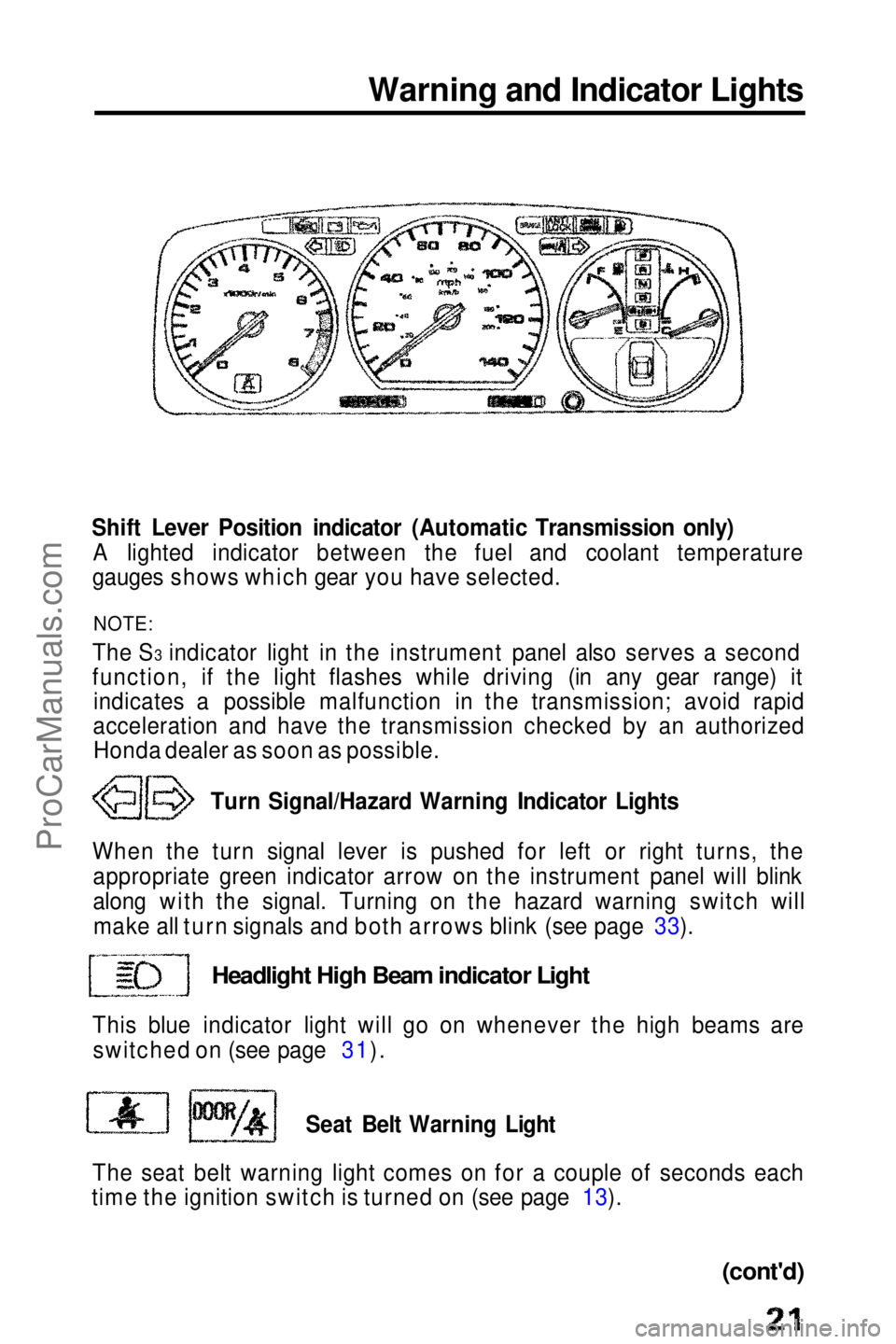
Shift Lever Position indicator (Automatic Transmission only) A lighted indicator between the fuel and coolant temperature
gauges shows which gear you have selected.
NOTE:
The S3 indicator light in the instrument panel also serves a second
function, if the light flashes while driving (in any gear range) it indicates a possible malfunction in the transmission; avoid rapid
acceleration and have the transmission checked by an authorized Honda dealer as soon as possible.
Turn Signal/Hazard Warning Indicator Lights
When the turn signal lever is pushed for left or right turns, the appropriate green indicator arrow on the instrument panel will blink
along with the signal. Turning on the hazard warning switch willmake all turn signals and both arrows blink (see page 33).
Headlight High Beam indicator Light
This blue indicator light will go on whenever the high beams are switched on (see page 31).
Seat Belt Warning Light
The seat belt warning light comes on for a couple of seconds each
time the ignition switch is turned on (see page 13).
(cont'd)ProCarManuals.comMain Menu t s
Page 44 of 143
Heating and Cooling (cont'd)
NOTE:
The windows may become fogged if the system is in the
position for an extended period of time with the air
conditioner off. As soon as the interior is warmed, switch to the
position.
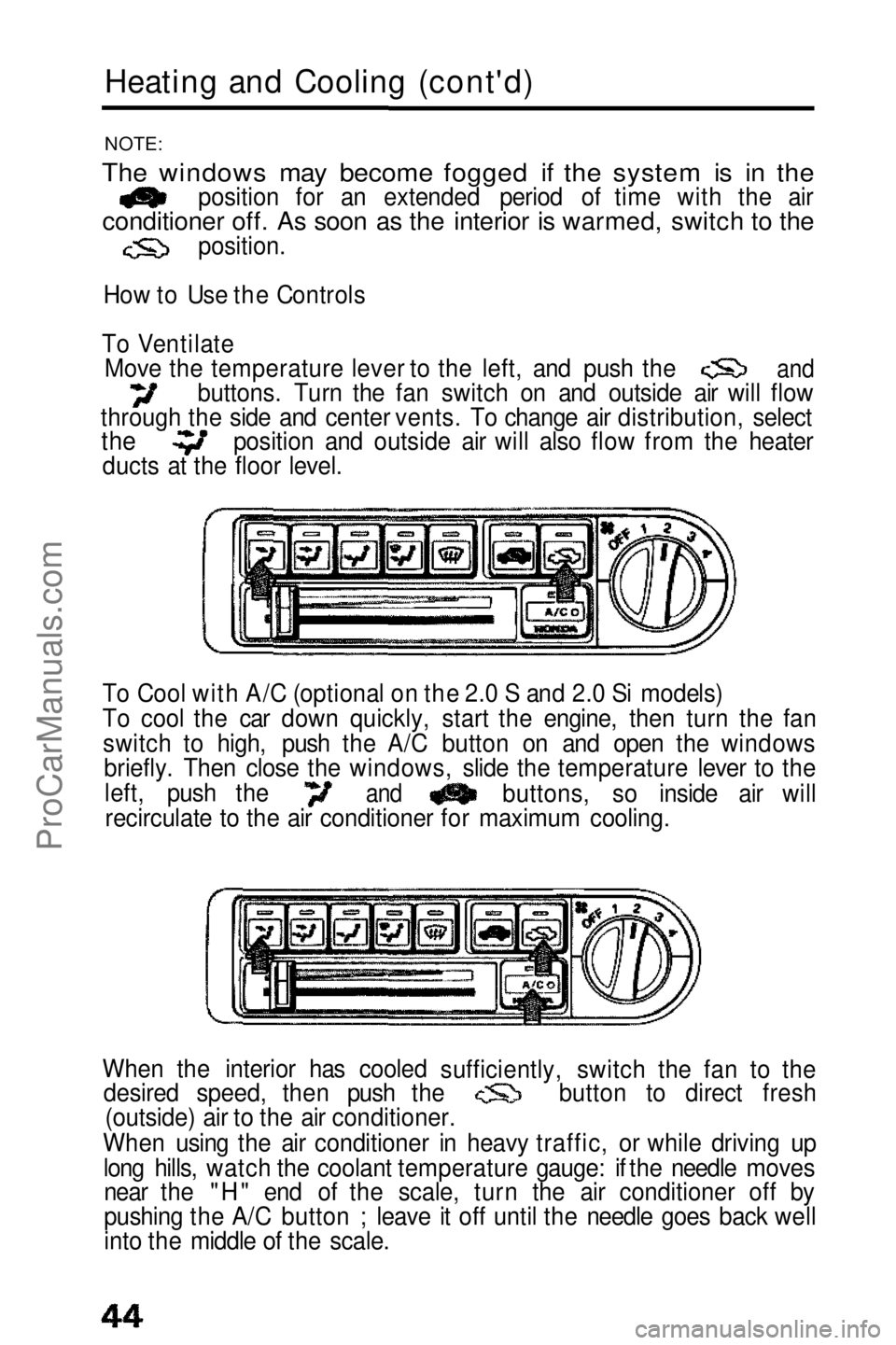
How to Use the Controls
To Ventilate Move the temperature lever to the left, and push the buttons. Turn the fan switch on and outside air will flow
through the side and center vents. To change air distribution, select
To Cool with A/C (optional on the 2.0 S and 2.0 Si models)
To cool the car down quickly, start the engine, then turn the fanswitch to high, push the A/C button on and open the windows briefly. Then close the windows, slide the temperature lever to the
When the interior has cooled desired speed, then push the (outside) air to the air conditioner.
When using the air conditioner in heavy traffic, or while driving up long hills, watch the coolant temperature gauge: if the needle movesnear the "H" end of the scale, turn the air conditioner off by
pushing the A/C button ; leave it off until the needle goes back well
into the middle of the scale.
and
the
ducts at the floor level. position and outside air will also flow from the heater
sufficiently, switch the fan to thebutton to direct fresh
and
left, push the
recirculate to the buttons, so inside air will
air conditioner for maximum cooling.ProCarManuals.comMain Menu t s
Page 75 of 143

CAUTION:
Before starting out, check the operation of the lights and all car/
trailer connections. After driving a short distance, stop and
recheck the lights and connections.
Reversing is difficult and requires practice. While backing-up,
the trailer may pivot off-course. To correct for this, grip the bottom of the steering wheel and move your hand to the left to
move the trailer to the left, or to the right to move the trailer to
the right. Turn the steering wheel a little at a time, and keep the
speed very low. Have someon e guide you when backing.
To help
prevent overheating of the brakes, shift into a lower
gear to make use of engine braking before descending steep or
long grades. Do not make sudden downshifts. Pay strict attention to the coolant temperature gauge when
going up hills. Because of the added load of the trailer, your car's
engine may overheat on hot days. Turning off the air conditioner
will reduce the load on the cooling system.
On cars equipped with automatic transmission. —Do not hold the car stationary on an incline by using the accelerator pedal; this can cause the transmission fluid tooverheat. Instead, use the handbrake or footbrake.
—When towing trailers, avoid high transmission fluid temperatures (caused by the transmission frequently shiftingbetween 3rd and 4th gears) by driving in S3.
NOTE:
Be sure to check state and local laws concerning maximum speed or
other driving restrictions for cars towing trailers. If you are driving
across several states, check each state's requirements before
leaving home, because restrictions may vary.
Parking with a Trailer
Whenever parking your car on an incline with a trailer attached, first
place and seat chocks at each wheel of the car and trailer. This is in
addition to the normal parking preparations of firmly applying the parking brake and placing the transmission in first or reverse
(manual transmission) or P (automatic transmission).
CAUTION:
Parking on an incline is not recommended and should be done only
if it cannot be avoided. Follow all precautions mentioned above
and turn the wheels to point towards a curb if facing downhill,
away from a curb if facing uphill. When leaving an inclined parking place, move the car slightly to unseat the chocks. Then while
keeping the foot brakes firmly applied, have an assistant remove
the chocks.ProCarManuals.comMain Menu t s
Page 77 of 143

Check the following items at each fuel stop:
1. Engine oil level.
2. Radiator coolant level.
Check the following items periodically: 1. Brakes: for braking efficiency, brake pedal travel and hydraulic fluid level.
2. Lights: for operation of headlights, taillights, side marker lights, stoplights, turn signals and back-up lights.
3. Tires: for correct pressures (including spare); inspect for cuts and uneven or excessive wear. Rotate every 7,500 miles (12,000 km)
in the pattern shown on page 107.
4. Steering: for excessive play or vibration while driving. 5. Exhaust system: for leaks or loose mounts.
6. Wipers: for operation of windshield wipers and washer, and condition of wiper blades.
7. Seat belts: for condition of fabric and buckles, and operation of the restraint mechanism.
8. Battery condition.
(cont'd)ProCarManuals.comMain Menu t s
Page 78 of 143

Maintenance Schedule and Records (cont'd)
Cheek oil and coolant level at each fuel stop,
Under severe driving conditions, service these items twice as often. (See page 80 )ProCarManuals.comMain Menu t s
Page 88 of 143

Cooling System
Your Honda engine contains a number of aluminum parts. Therefore, it requires an antifreeze/coolant specifically formulated to protect
the aluminum parts from corrosion. Failure to use a suitable antifreeze/coolant may seriously shorten the life of the engine as
the result of rapid corrosion damage. Some antifreeze/coolants, although labelled for use in engines containing aluminum, may not provide adequate protection for your engine.
Therefore, use only a Honda RECOMMENDED antifreeze/coolant.
CHECK WITH YOUR AUTHORIZED HONDA DEALER.
For best corrosion protection, the mixture of coolant and water
must be maintained year-round at 50/50. Concentrations less than50% coolant may not provide sufficient protection against
corrosion and freezing. Concentrations of greater than 60% coolant
will impair cooling efficiency and are not recommended. Low- mineral drinking water or distilled water should be mixed with the
antifreeze/coolant. Coolant loss should be replenished by a mixture
containing the proper concentration of antifreeze and water. Do not mix different antifreeze/coolants.
Do not use additional rust inhibitors or anti-rust products, as they
may not be compatible with the radiator coolant.
ENGINE DAMAGE CAUSED BY IMPROPER COOLANT USAGE IS
NOT COVERED BY THE NEW CAR WARRANTY.
Checking Coolant
Check the coolant level in the reserve tank when the engine is at
normal operating temperature (with the engine off and the car on
the level ground), using the dipstick in the reserve tank. Remove the dipstick and wipe it off. Insert the dipstick and remove it. The
coolant level should be between the MAX and MIN marks. Do not remove the radiator cap when the engine is hot; the
coolant is under pressure and could severely scald you. Keep hands away from the radiator fan. The fan may start
automatically without warning and run for up to 15 minutes,
even after the engine is turned off.ProCarManuals.comMain Menu t s