Page 60 of 143
Four Wheel Steering (cont'd)
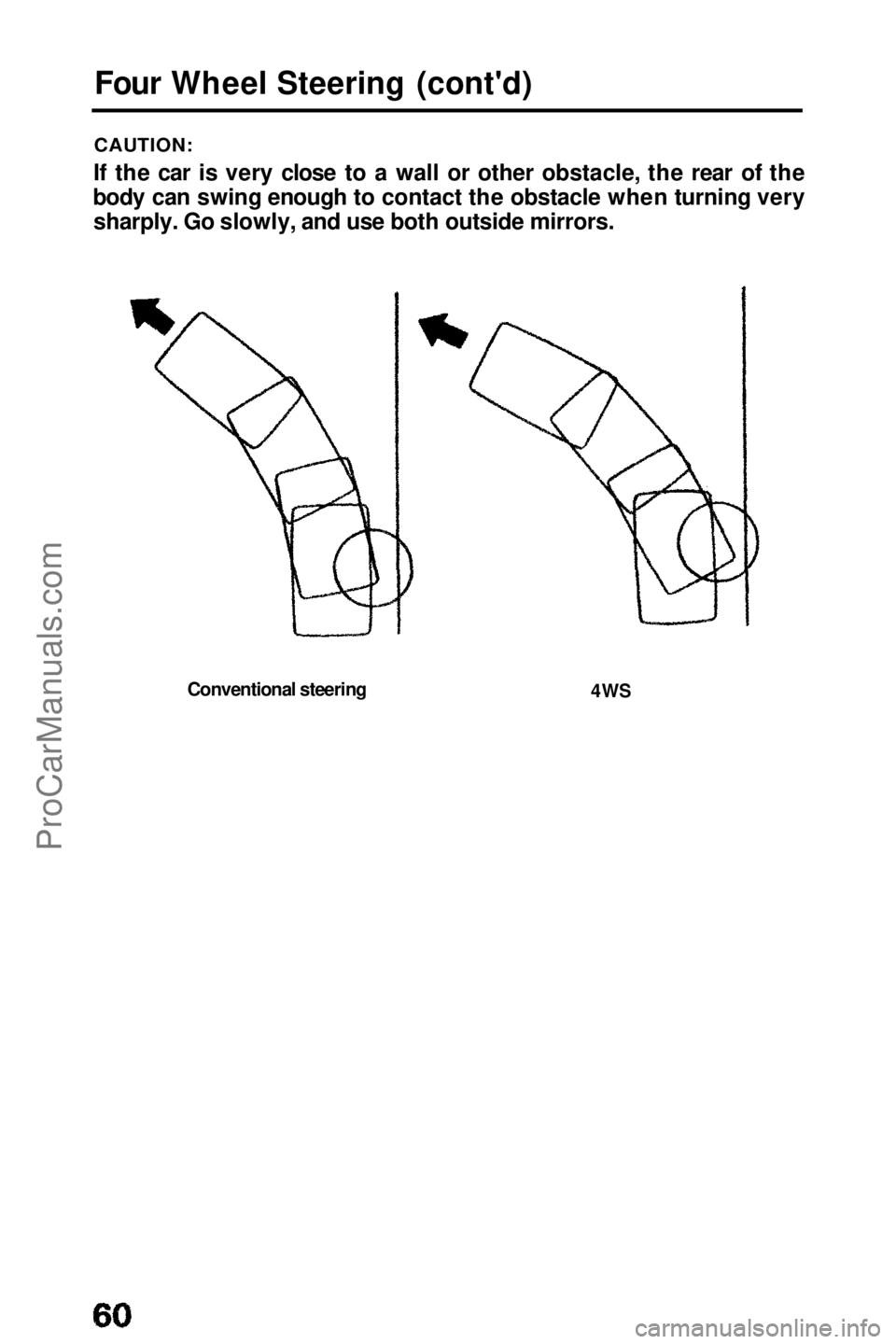
CAUTION:
If the car is very close to a wall or other obstacle, the rear of the
body can swing enough to contact the obstacle when turning very sharply. Go slowly, and use both outside mirrors.
Conventional steering
4WSProCarManuals.comMain Menu t s
Page 63 of 143

Safety Items
Before driving away, check that: The doors are closed properly. The mirrors are properly adjusted, and the windows clean.
The driver and passengers are wearing properly adjusted seat
belts.
The head restraints are properly adjusted.
The warning and indicator lights are operating properly.
The brake pedal feels normal.
All luggage and cargo is secured.
Nothing is interfering with the driver's feet or blocking vision to
the rear.
While driving remember to: Always drive defensively; expect the unexpected. Reduce your speed during night hours and bad weather.
Follow at a safe distance; don't tailgate.
Get off the highway when you are tired; stop and take a rest.
When stopping for repairs: Park the car well off the road.
Turn on the hazard warning flasher. Use flares or other warning devices to warn other motorists.
After parking your car: Apply the parking brake and shift to first gear if equipped withmanual transmission, or PARK on automatic transmission
equipped cars.
Make sure the windows are closed and all doors are locked.
If parked on a hill:
Turn the front wheels away from the curb if facing uphill.
Turn the front wheels toward the curb if facing downhill. Never leave children unattended in a parked car.
Take your
keys.ProCarManuals.comMain Menu t s
Page 65 of 143
Shifting the 5 Speed
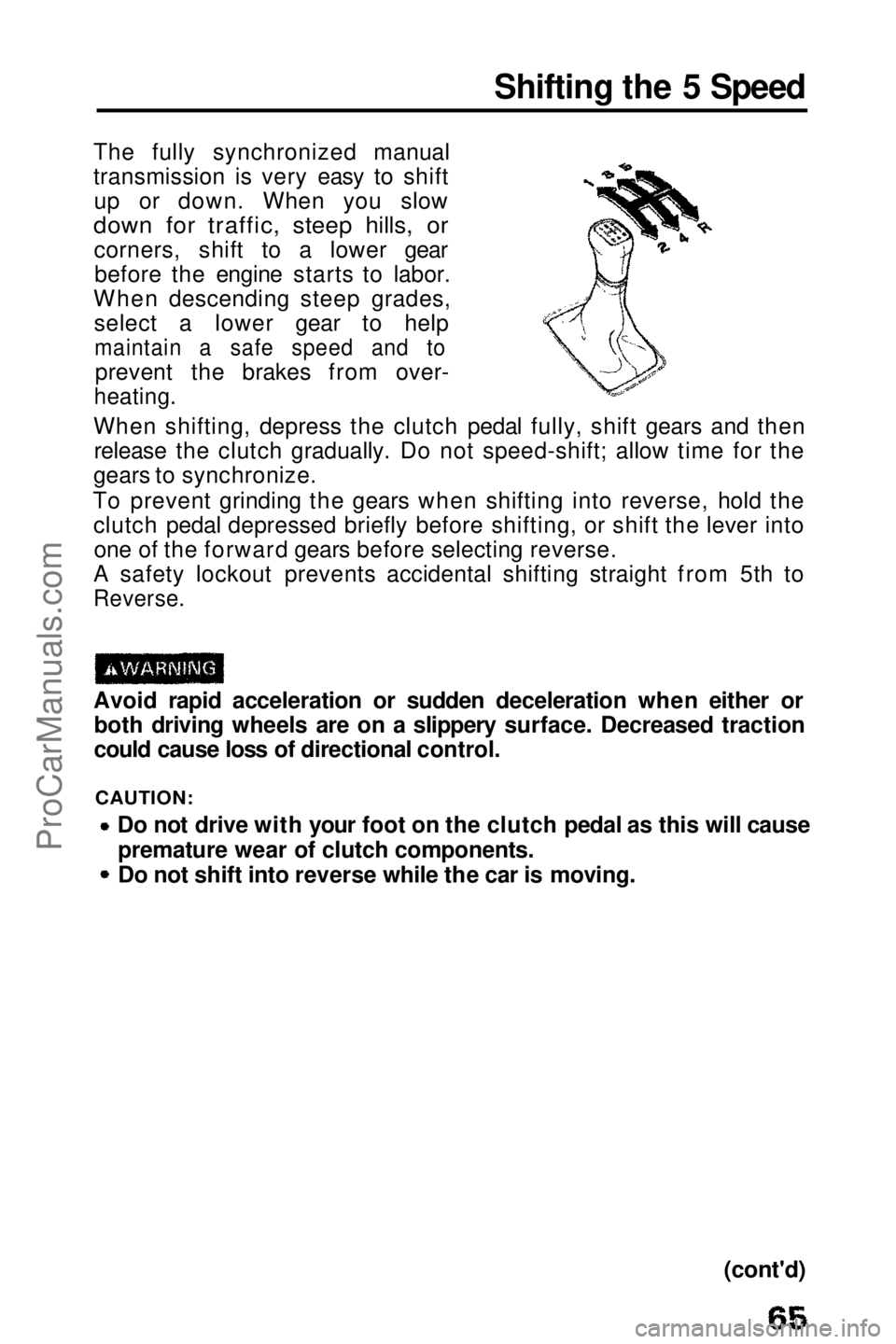
The fully synchronized manual
transmission is very easy to shift up or down. When you slow
down for traffic, steep hills, or
corners, shift to a lower gearbefore the engine starts to labor.
When descending steep grades, select a lower gear to help
maintain a safe speed and to
prevent the brakes from over-
heating.
When shifting, depress the clutch pedal fully, shift gears and then release the clutch gradually. Do not speed-shift; allow time for the
gears to synchronize.
To prevent grinding the gears when shifting into reverse, hold the clutch pedal depressed briefly before shifting, or shift the lever intoone of the forward gears before selecting reverse.
A safety lockout prevents accidental shifting straight from 5th to
Reverse.
Avoid rapid acceleration or sudden deceleration when either or both driving wheels are on a slippery surface. Decreased traction
could cause loss of directional control.
CAUTION:
Do not drive with your foot on the clutch pedal as this will causepremature wear of clutch components.
Do not shift into reverse while the car is moving.
(cont'd)ProCarManuals.comMain Menu t s
Page 70 of 143
R-Reverse
2-2nd
Use 2nd gear
for increased engine braking when driving
downhill,
and increased power when driving uphill; also for driving on slippery
roads, and freeing the car from mud or
sand, where 1 st gear could
provide too much power and cause skidding or wheel-spin. The
maximum recommended speed in 2nd gear is:
60 mph (97
km/h)
CAUTION:
Shift into or out of reverse only after the car has come to a
complete stop; the transmission may be damaged if you shift
while the car is moving.
P-Park
CAUTION:
Use this position when starting the engine , or when parking. Shift
into Park only when the car is COMPLETELY stopped.
N — Neutral
Use when starting the engine or during prolonged idling in traffic.
Shifting the Automatic (cont'd)
ProCarManuals.comMain Menu t s
Page 74 of 143

Towing a Trailer (cont'd)
Towing Safety
Stopping distance will be increased when towing a trailer. For
each 10 mph (16 km/h) of speed, allow at least two car lengths between you and the vehicle ahead. Avoid sudden braking
which may cause trailer jackknifing and loss of control.
Avoid jerky starts and sudden acceleration. If your car has amanual transmission, always start out in first gear and release
the clutch at moderate engine rpm.
Avoid rapid lane changing and sharp turns. The trailer could hit your car in a tight turn. Slow down before making a turn.
Remember, the total length of your car plus trailer will require a
wider turning circle.
Crosswinds may adversely affect handling of your car and
trailer, Use the rearview mirrors frequently to warn you of approaching large vehicles that may pass you causing your car
and trailer to sway. When being passed, firmly grip the steering wheel and be prepared to reduce speed immediately but
gradually. Never increase speed. Steer straight ahead.
Towing a trailer in bad weather will magnify any difficulty in
controlling the car caused by the weather itself. Avoid sudden maneuvers: slow down and use extra caution.
Be careful when passing other vehicles. Passing requires
considerable distance because of the added weight and length
of your trailer.ProCarManuals.comMain Menu t s
Page 75 of 143

CAUTION:
Before starting out, check the operation of the lights and all car/
trailer connections. After driving a short distance, stop and
recheck the lights and connections.
Reversing is difficult and requires practice. While backing-up,
the trailer may pivot off-course. To correct for this, grip the bottom of the steering wheel and move your hand to the left to
move the trailer to the left, or to the right to move the trailer to
the right. Turn the steering wheel a little at a time, and keep the
speed very low. Have someon e guide you when backing.
To help
prevent overheating of the brakes, shift into a lower
gear to make use of engine braking before descending steep or
long grades. Do not make sudden downshifts. Pay strict attention to the coolant temperature gauge when
going up hills. Because of the added load of the trailer, your car's
engine may overheat on hot days. Turning off the air conditioner
will reduce the load on the cooling system.
On cars equipped with automatic transmission. —Do not hold the car stationary on an incline by using the accelerator pedal; this can cause the transmission fluid tooverheat. Instead, use the handbrake or footbrake.
—When towing trailers, avoid high transmission fluid temperatures (caused by the transmission frequently shiftingbetween 3rd and 4th gears) by driving in S3.
NOTE:
Be sure to check state and local laws concerning maximum speed or
other driving restrictions for cars towing trailers. If you are driving
across several states, check each state's requirements before
leaving home, because restrictions may vary.
Parking with a Trailer
Whenever parking your car on an incline with a trailer attached, first
place and seat chocks at each wheel of the car and trailer. This is in
addition to the normal parking preparations of firmly applying the parking brake and placing the transmission in first or reverse
(manual transmission) or P (automatic transmission).
CAUTION:
Parking on an incline is not recommended and should be done only
if it cannot be avoided. Follow all precautions mentioned above
and turn the wheels to point towards a curb if facing downhill,
away from a curb if facing uphill. When leaving an inclined parking place, move the car slightly to unseat the chocks. Then while
keeping the foot brakes firmly applied, have an assistant remove
the chocks.ProCarManuals.comMain Menu t s
Page 96 of 143

Fuel Filters/Clutch Fluid
Fuel Filters
(2.0 S)
There are two fuel filters in your car; the main filter is located near
the left side of the fuel tank and an auxiliary filter is at the left side
of the air filter in the engine compartment. Both should be replaced at 60,000 miles (96,000 km) or 48 months,
whichever comes first, or any time you suspect contaminated gas
may have clogged them.
For easier access to the main filter, remove the left rear wheel to
inspect or replace the filter.
The fuel filter is located in the engine compartment, on the right
center of the firewall. It should be replaced at 60,000 miles (96,000km) or 48 months whichever comes first, or any time you suspect
contaminated gas may have clogged it.
CAUTION:
Because the fuel system is under pressure, the filter should be
replaced only by a qualified Honda technician.
CLUTCH FLUID
RESERVOIR
Clutch Fluid
Check the fluid level in the clutchreservoir periodically; it should be
between the MAX and MIN marks
on the reservoir.
If the level is near the MIN mark, add
fluid to raise it to the MAX mark. Do not overfill. Use only brake fluid
manufactured to DOT 3 or DOT 4
specifications from a sealed
container. Follow the manufacturer's instructions printed on the can.
NOTE:
A low clutch fluid level may be an indication of clutch fluid leakage.
You should have your clutch checked if the clutch fluid level in the reservoir is low.
When removing the rear wheel, use safety stands to support the
car.
AUXILIARYFILTER
(2.0 Si,Si)
MAIN FILTERProCarManuals.comMain Menu t s
Page 97 of 143

Power Steering
The power steering on your car provides easy handling while parking and maneuvering in traffic, without loss of road "feel" at
highway speeds. An engine-driven hydraulic pump provides full
power assist at low speeds and decreasing assist as the car goes
faster.
CAUTION:
If the power steering system should fail, or if the engine should
stall, the car can still be steered. However, much greater effort will be required, particularly in sharp turns at low speed.
NOTE:
You may feel a slight clunk or knock when turning the wheel with
the engine off. This is a normal condition due to the design of the system.
Power Steering Fluid
Check the power steering fluid level with the engine cold and the
car parked on level ground. Make sure the fluid level is between theupper and lower marks on the reservoir. If the level has dropped
close to or below the lower mark, check for leaks before adding
fluid to the upper mark. Do not overfill.
CAUTION:
Use only genuine Honda power steering fluid. The use of other
fluids such as A.T.F. or other manufacturer's power steering fluid will damage the system. POWER STEERING
FLUID RESERVOIR
UPPER
LOWERProCarManuals.comMain Menu t s