1988 OPEL VECTRA ESu
[x] Cancel search: ESuPage 3 of 525
3Air cleaner - removal and
refitting
2
Removal
1Remove the air cleaner element, as
described in Chapter 1.
2Release the crankcase ventilation hose
from the plastic clip on the left-hand side of
the air cleaner body.
3Disconnect the inlet duct from the hot air
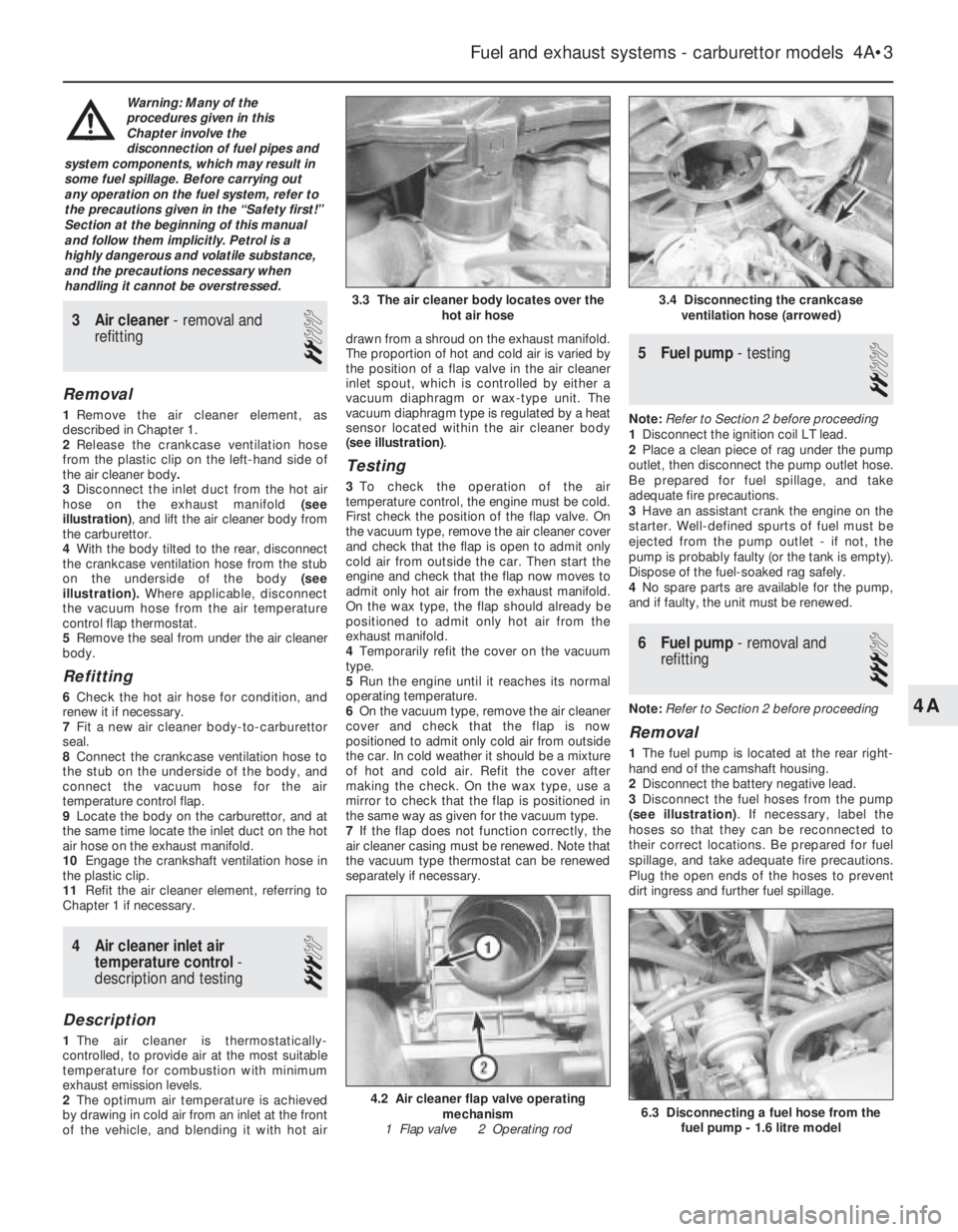
hose on the exhaust manifold (see
illustration), and lift the air cleaner body from
the carburettor.
4With the body tilted to the rear, disconnect
the crankcase ventilation hose from the stub
on the underside of the body (see
illustration).Where applicable, disconnect
the vacuum hose from the air temperature
control flap thermostat.
5Remove the seal from under the air cleaner
body.
Refitting
6Check the hot air hose for condition, and
renew it if necessary.
7Fit a new air cleaner body-to-carburettor
seal.
8Connect the crankcase ventilation hose to
the stub on the underside of the body, and
connect the vacuum hose for the air
temperature control flap.
9Locate the body on the carburettor, and at
the same time locate the inlet duct on the hot
air hose on the exhaust manifold.
10Engage the crankshaft ventilation hose in
the plastic clip.
11Refit the air cleaner element, referring to
Chapter 1 if necessary.
4Air cleaner inlet air
temperature control -
description and testing
3
Description
1The air cleaner is thermostatically-
controlled, to provide air at the most suitable
temperature for combustion with minimum
exhaust emission levels.
2The optimum air temperature is achieved
by drawing in cold air from an inlet at the front
of the vehicle, and blending it with hot airdrawn from a shroud on the exhaust manifold.
The proportion of hot and cold air is varied by
the position of a flap valve in the air cleaner
inlet spout, which is controlled by either a
vacuum diaphragm or wax-type unit. The
vacuum diaphragm type is regulated by a heat
sensor located within the air cleaner body
(see illustration).
Testing
3To check the operation of the air
temperature control, the engine must be cold.
First check the position of the flap valve. On
the vacuum type, remove the air cleaner cover
and check that the flap is open to admit only
cold air from outside the car. Then start the
engine and check that the flap now moves to
admit only hot air from the exhaust manifold.
On the wax type, the flap should already be
positioned to admit only hot air from the
exhaust manifold.
4Temporarily refit the cover on the vacuum
type.
5Run the engine until it reaches its normal
operating temperature.
6On the vacuum type, remove the air cleaner
cover and check that the flap is now
positioned to admit only cold air from outside
the car. In cold weather it should be a mixture
of hot and cold air. Refit the cover after
making the check. On the wax type, use a
mirror to check that the flap is positioned in
the same way as given for the vacuum type.
7If the flap does not function correctly, the
air cleaner casing must be renewed. Note that
the vacuum type thermostat can be renewed
separately if necessary.
5Fuel pump - testing
2
Note: Refer to Section 2 before proceeding
1Disconnect the ignition coil LT lead.
2Place a clean piece of rag under the pump
outlet, then disconnect the pump outlet hose.
Be prepared for fuel spillage, and take
adequate fire precautions.
3Have an assistant crank the engine on the
starter. Well-defined spurts of fuel must be
ejected from the pump outlet - if not, the
pump is probably faulty (or the tank is empty).
Dispose of the fuel-soaked rag safely.
4No spare parts are available for the pump,
and if faulty, the unit must be renewed.
6Fuel pump - removal and
refitting
3
Note: Refer to Section 2 before proceeding
Removal
1The fuel pump is located at the rear right-
hand end of the camshaft housing.
2Disconnect the battery negative lead.
3Disconnect the fuel hoses from the pump
(see illustration). If necessary, label the
hoses so that they can be reconnected to
their correct locations. Be prepared for fuel
spillage, and take adequate fire precautions.
Plug the open ends of the hoses to prevent
dirt ingress and further fuel spillage.
Fuel and exhaust systems - carburettor models 4A•3
3.4 Disconnecting the crankcase
ventilation hose (arrowed)
6.3 Disconnecting a fuel hose from the
fuel pump - 1.6 litre model4.2 Air cleaner flap valve operating
mechanism
1 Flap valve 2 Operating rod
3.3 The air cleaner body locates over the
hot air hose
4A
Warning: Many of the
procedures given in this
Chapter involve the
disconnection of fuel pipes and
system components, which may result in
some fuel spillage. Before carrying out
any operation on the fuel system, refer to
the precautions given in the “Safety first!”
Section at the beginning of this manual
and follow them implicitly. Petrol is a
highly dangerous and volatile substance,
and the precautions necessary when
handling it cannot be overstressed.
Page 5 of 525
10Throttle pedal - removal and
refitting
3
Removal
1Working inside the vehicle, remove the
lower trim panel from the driver’s footwell.
2Slide the cable retainer from the bracket on
the top of the pedal, and disconnect the cable
end from the pedal.
3Extract the circlip from the right-hand end
of the pedal pivot shaft, then slide out the
pivot shaft from the left-hand side of the pivot
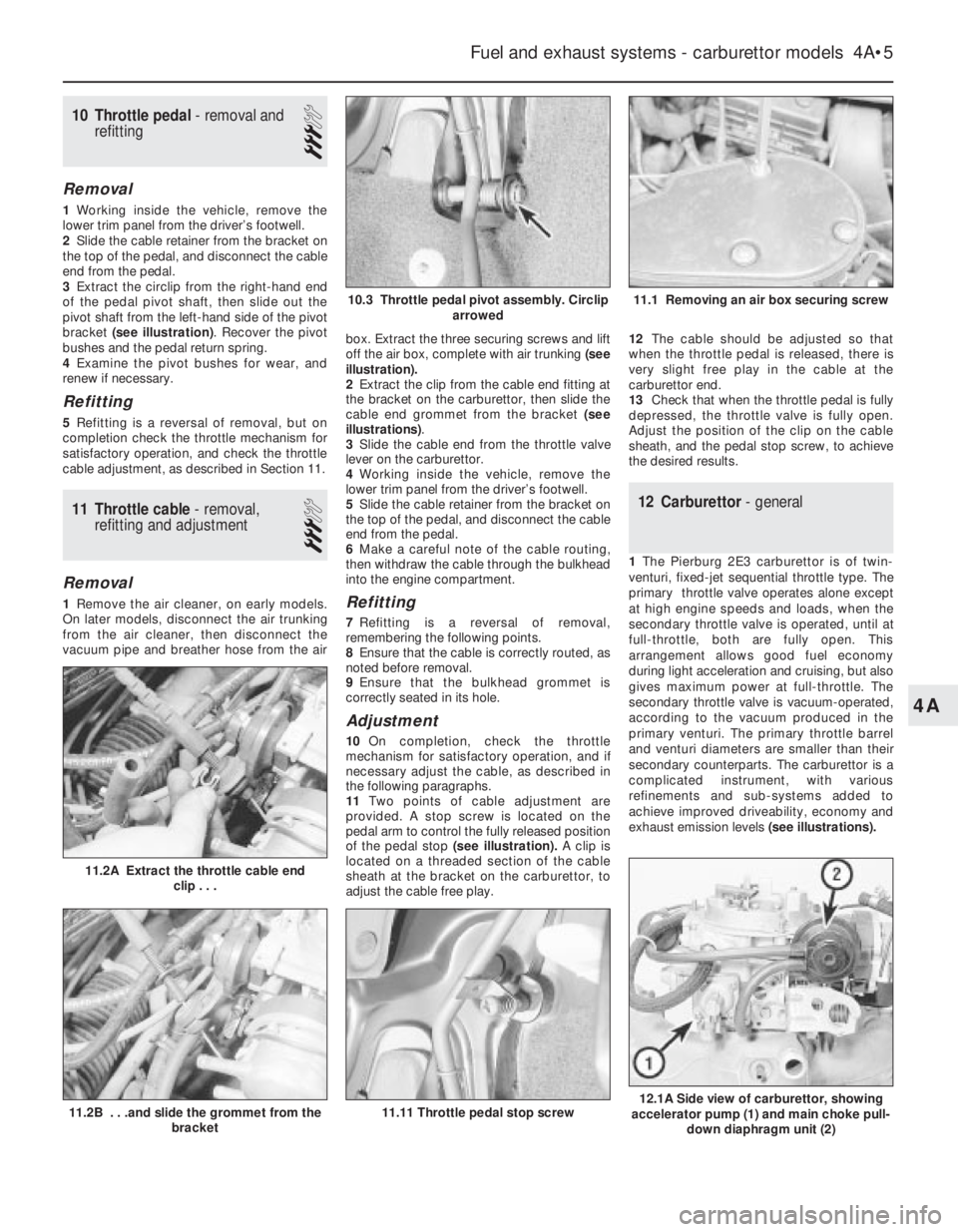
bracket (see illustration). Recover the pivot
bushes and the pedal return spring.
4Examine the pivot bushes for wear, and
renew if necessary.
Refitting
5Refitting is a reversal of removal, but on
completion check the throttle mechanism for
satisfactory operation, and check the throttle
cable adjustment, as described in Section 11.
11Throttle cable - removal,
refitting and adjustment
3
Removal
1Remove the air cleaner, on early models.
On later models, disconnect the air trunking
from the air cleaner, then disconnect the
vacuum pipe and breather hose from the airbox. Extract the three securing screws and lift
off the air box, complete with air trunking(see
illustration).
2Extract the clip from the cable end fitting at
the bracket on the carburettor, then slide the
cable end grommet from the bracket (see
illustrations).
3Slide the cable end from the throttle valve
lever on the carburettor.
4Working inside the vehicle, remove the
lower trim panel from the driver’s footwell.
5Slide the cable retainer from the bracket on
the top of the pedal, and disconnect the cable
end from the pedal.
6Make a careful note of the cable routing,
then withdraw the cable through the bulkhead
into the engine compartment.Refitting
7Refitting is a reversal of removal,
remembering the following points.
8Ensure that the cable is correctly routed, as
noted before removal.
9Ensure that the bulkhead grommet is
correctly seated in its hole.
Adjustment
10On completion, check the throttle
mechanism for satisfactory operation, and if
necessary adjust the cable, as described in
the following paragraphs.
11Two points of cable adjustment are
provided. A stop screw is located on the
pedal arm to control the fully released position
of the pedal stop (see illustration).A clip is
located on a threaded section of the cable
sheath at the bracket on the carburettor, to
adjust the cable free play.12The cable should be adjusted so that
when the throttle pedal is released, there is
very slight free play in the cable at the
carburettor end.
13Check that when the throttle pedal is fully
depressed, the throttle valve is fully open.
Adjust the position of the clip on the cable
sheath, and the pedal stop screw, to achieve
the desired results.
12Carburettor - general
1The Pierburg 2E3 carburettor is of twin-
venturi, fixed-jet sequential throttle type. The
primary throttle valve operates alone except
at high engine speeds and loads, when the
secondary throttle valve is operated, until at
full-throttle, both are fully open. This
arrangement allows good fuel economy
during light acceleration and cruising, but also
gives maximum power at full-throttle. The
secondary throttle valve is vacuum-operated,
according to the vacuum produced in the
primary venturi. The primary throttle barrel
and venturi diameters are smaller than their
secondary counterparts. The carburettor is a
complicated instrument, with various
refinements and sub-systems added to
achieve improved driveability, economy and
exhaust emission levels(see illustrations).
Fuel and exhaust systems - carburettor models 4A•5
11.2A Extract the throttle cable end
clip . . .
12.1A Side view of carburettor, showing
accelerator pump (1) and main choke pull-
down diaphragm unit (2)11.11 Throttle pedal stop screw11.2B . . .and slide the grommet from the
bracket
11.1 Removing an air box securing screw10.3 Throttle pedal pivot assembly. Circlip
arrowed
4A
Page 17 of 525
to-metal contact between components, due
to flexible rubber mountings, etc.
To check whether a component is properly
earthed, disconnect the battery, and connect
one lead of an ohmmeter to a known good
earth point. Connect the other lead to the wire
or earth connection being tested. The
resistance reading should be zero; if not,
check the connection as follows.
If an earth connection is thought to be
faulty, dismantle the connection, and clean
back to bare metal both the bodyshell and the
wire terminal or the component earth
connection mating surface. Be careful to
remove all traces of dirt and corrosion, then
use a knife to trim away any paint, so that a
clean metal-to-metal joint is made. On
reassembly, tighten the joint fasteners
securely; if a wire terminal is being refitted,
use serrated washers between the terminal
and the bodyshell, to ensure a clean and
secure connection. When the connection is
remade, prevent the onset of corrosion in the
future by applying a coat of petroleum jelly or
silicone-based grease.
3Fuses and relays - general
Fuses
1Fuses are designed to break a circuit when
a predetermined current is reached, to protect
the components and wiring which could be
damaged by excessive current flow. Any
excessive current flow will be due to a fault in
the circuit, usually a short-circuit (Section 2).
2The main fuses and relays are located in a
panel at the lower right-hand side of the facia,
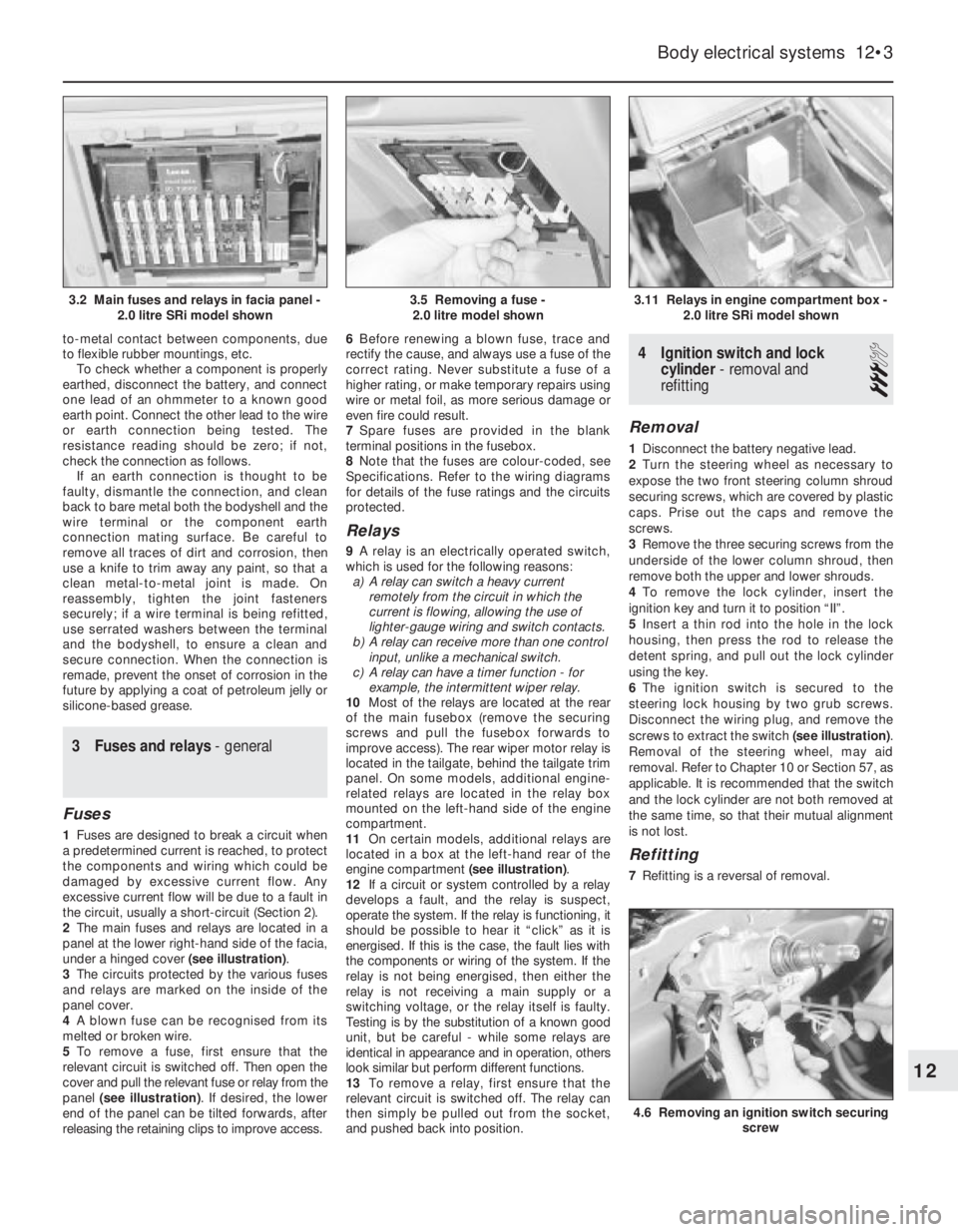
under a hinged cover (see illustration).
3The circuits protected by the various fuses
and relays are marked on the inside of the
panel cover.
4A blown fuse can be recognised from its
melted or broken wire.
5To remove a fuse, first ensure that the
relevant circuit is switched off. Then open the
cover and pull the relevant fuse or relay from the
panel (see illustration). If desired, the lower
end of the panel can be tilted forwards, after
releasing the retaining clips to improve access. 6Before renewing a blown fuse, trace and
rectify the cause, and always use a fuse of the
correct rating. Never substitute a fuse of a
higher rating, or make temporary repairs using
wire or metal foil, as more serious damage or
even fire could result.
7Spare fuses are provided in the blank
terminal positions in the fusebox.
8Note that the fuses are colour-coded, see
Specifications. Refer to the wiring diagrams
for details of the fuse ratings and the circuits
protected.
Relays
9A relay is an electrically operated switch,
which is used for the following reasons:
a)A relay can switch a heavy current
remotely from the circuit in which the
current is flowing, allowing the use of
lighter-gauge wiring and switch contacts.
b)A relay can receive more than one control
input, unlike a mechanical switch.
c)A relay can have a timer function - for
example, the intermittent wiper relay.
10Most of the relays are located at the rear
of the main fusebox (remove the securing
screws and pull the fusebox forwards to
improve access). The rear wiper motor relay is
located in the tailgate, behind the tailgate trim
panel. On some models, additional engine-
related relays are located in the relay box
mounted on the left-hand side of the engine
compartment.
11On certain models, additional relays are
located in a box at the left-hand rear of the
engine compartment (see illustration).
12If a circuit or system controlled by a relay
develops a fault, and the relay is suspect,
operate the system. If the relay is functioning, it
should be possible to hear it “click” as it is
energised. If this is the case, the fault lies with
the components or wiring of the system. If the
relay is not being energised, then either the
relay is not receiving a main supply or a
switching voltage, or the relay itself is faulty.
Testing is by the substitution of a known good
unit, but be careful - while some relays are
identical in appearance and in operation, others
look similar but perform different functions.
13To remove a relay, first ensure that the
relevant circuit is switched off. The relay can
then simply be pulled out from the socket,
and pushed back into position.
4Ignition switch and lock
cylinder - removal and
refitting
3
Removal
1Disconnect the battery negative lead.
2Turn the steering wheel as necessary to
expose the two front steering column shroud
securing screws, which are covered by plastic
caps. Prise out the caps and remove the
screws.
3Remove the three securing screws from the
underside of the lower column shroud, then
remove both the upper and lower shrouds.
4To remove the lock cylinder, insert the
ignition key and turn it to position “II”.
5Insert a thin rod into the hole in the lock
housing, then press the rod to release the
detent spring, and pull out the lock cylinder
using the key.
6The ignition switch is secured to the
steering lock housing by two grub screws.
Disconnect the wiring plug, and remove the
screws to extract the switch (see illustration).
Removal of the steering wheel, may aid
removal. Refer to Chapter 10 or Section 57, as
applicable. It is recommended that the switch
and the lock cylinder are not both removed at
the same time, so that their mutual alignment
is not lost.
Refitting
7Refitting is a reversal of removal.
Body electrical systems 12•3
3.11 Relays in engine compartment box -
2.0 litre SRi model shown
4.6 Removing an ignition switch securing
screw
3.5 Removing a fuse -
2.0 litre model shown3.2 Main fuses and relays in facia panel -
2.0 litre SRi model shown
12
Page 25 of 525
29Front indicator lamp unit -
removal and refitting
2
Removal
1Disconnect the battery negative lead.
2Remove the single indicator lamp unit
securing screw, which is accessible through
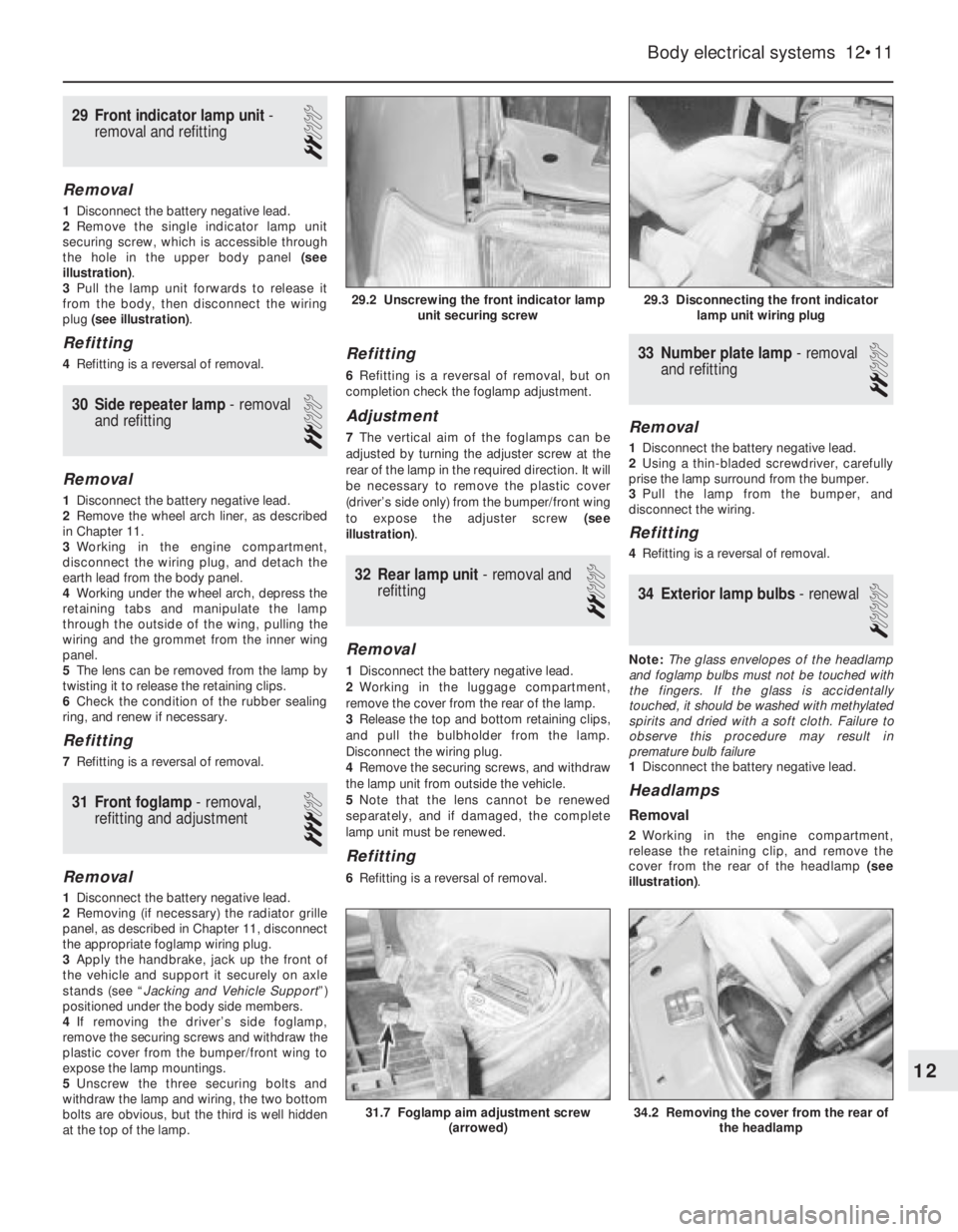
the hole in the upper body panel (see
illustration).
3Pull the lamp unit forwards to release it
from the body, then disconnect the wiring
plug (see illustration).
Refitting
4Refitting is a reversal of removal.
30Side repeater lamp -removal
and refitting
2
Removal
1Disconnect the battery negative lead.
2Remove the wheel arch liner, as described
in Chapter 11.
3Working in the engine compartment,
disconnect the wiring plug, and detach the
earth lead from the body panel.
4Working under the wheel arch, depress the
retaining tabs and manipulate the lamp
through the outside of the wing, pulling the
wiring and the grommet from the inner wing
panel.
5The lens can be removed from the lamp by
twisting it to release the retaining clips.
6Check the condition of the rubber sealing
ring, and renew if necessary.
Refitting
7Refitting is a reversal of removal.
31Front foglamp - removal,
refitting and adjustment
3
Removal
1Disconnect the battery negative lead.
2Removing (if necessary) the radiator grille
panel, as described in Chapter 11, disconnect
the appropriate foglamp wiring plug.
3Apply the handbrake, jack up the front of
the vehicle and support it securely on axle
stands (see “Jacking and Vehicle Support”)
positioned under the body side members.
4If removing the driver’s side foglamp,
remove the securing screws and withdraw the
plastic cover from the bumper/front wing to
expose the lamp mountings.
5Unscrew the three securing bolts and
withdraw the lamp and wiring, the two bottom
bolts are obvious, but the third is well hidden
at the top of the lamp.
Refitting
6Refitting is a reversal of removal, but on
completion check the foglamp adjustment.
Adjustment
7The vertical aim of the foglamps can be
adjusted by turning the adjuster screw at the
rear of the lamp in the required direction. It will
be necessary to remove the plastic cover
(driver’s side only) from the bumper/front wing
to expose the adjuster screw (see
illustration).
32Rear lamp unit - removal and
refitting
2
Removal
1Disconnect the battery negative lead.
2Working in the luggage compartment,
remove the cover from the rear of the lamp.
3Release the top and bottom retaining clips,
and pull the bulbholder from the lamp.
Disconnect the wiring plug.
4Remove the securing screws, and withdraw
the lamp unit from outside the vehicle.
5Note that the lens cannot be renewed
separately, and if damaged, the complete
lamp unit must be renewed.
Refitting
6Refitting is a reversal of removal.
33Number plate lamp -removal
and refitting
2
Removal
1Disconnect the battery negative lead.
2Using a thin-bladed screwdriver, carefully
prise the lamp surround from the bumper.
3Pull the lamp from the bumper, and
disconnect the wiring.
Refitting
4Refitting is a reversal of removal.
34Exterior lamp bulbs - renewal
1
Note: The glass envelopes of the headlamp
and foglamp bulbs must not be touched with
the fingers. If the glass is accidentally
touched, it should be washed with methylated
spirits and dried with a soft cloth. Failure to
observe this procedure may result in
premature bulb failure
1Disconnect the battery negative lead.
Headlamps
Removal
2Working in the engine compartment,
release the retaining clip, and remove the
cover from the rear of the headlamp (see
illustration).
Body electrical systems 12•11
31.7 Foglamp aim adjustment screw
(arrowed)34.2 Removing the cover from the rear of
the headlamp
29.3 Disconnecting the front indicator
lamp unit wiring plug29.2 Unscrewing the front indicator lamp
unit securing screw
12
Page 97 of 525
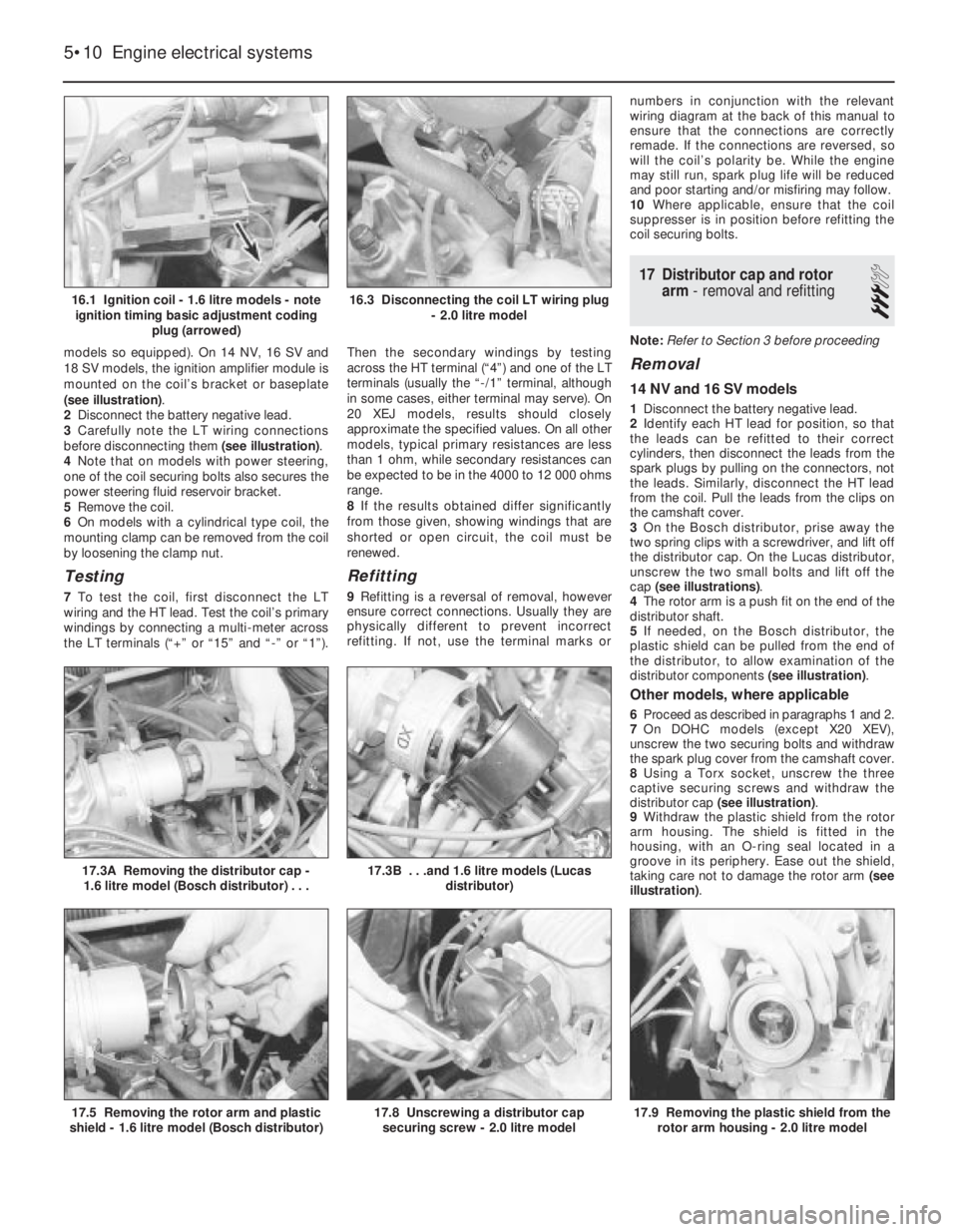
models so equipped). On 14 NV, 16 SV and
18 SV models, the ignition amplifier module is
mounted on the coil’s bracket or baseplate
(see illustration).
2Disconnect the battery negative lead.
3Carefully note the LT wiring connections
before disconnecting them (see illustration).
4Note that on models with power steering,
one of the coil securing bolts also secures the
power steering fluid reservoir bracket.
5Remove the coil.
6On models with a cylindrical type coil, the
mounting clamp can be removed from the coil
by loosening the clamp nut.
Testing
7To test the coil, first disconnect the LT
wiring and the HT lead. Test the coil’s primary
windings by connecting a multi-meter across
the LT terminals (“+” or “15” and “-” or “1”).Then the secondary windings by testing
across the HT terminal (“4”) and one of the LT
terminals (usually the “-/1” terminal, although
in some cases, either terminal may serve). On
20 XEJ models, results should closely
approximate the specified values. On all other
models, typical primary resistances are less
than 1 ohm, while secondary resistances can
be expected to be in the 4000 to 12 000 ohms
range.
8If the results obtained differ significantly
from those given, showing windings that are
shorted or open circuit, the coil must be
renewed.
Refitting
9Refitting is a reversal of removal, however
ensure correct connections. Usually they are
physically different to prevent incorrect
refitting. If not, use the terminal marks ornumbers in conjunction with the relevant
wiring diagram at the back of this manual to
ensure that the connections are correctly
remade. If the connections are reversed, so
will the coil’s polarity be. While the engine
may still run, spark plug life will be reduced
and poor starting and/or misfiring may follow.
10Where applicable, ensure that the coil
suppresser is in position before refitting the
coil securing bolts.
17Distributor cap and rotor
arm -removal and refitting
3
Note: Refer to Section 3 before proceeding
Removal
14 NV and 16 SV models
1Disconnect the battery negative lead.
2Identify each HT lead for position, so that
the leads can be refitted to their correct
cylinders, then disconnect the leads from the
spark plugs by pulling on the connectors, not
the leads. Similarly, disconnect the HT lead
from the coil. Pull the leads from the clips on
the camshaft cover.
3On the Bosch distributor, prise away the
two spring clips with a screwdriver, and lift off
the distributor cap. On the Lucas distributor,
unscrew the two small bolts and lift off the
cap (see illustrations).
4The rotor arm is a push fit on the end of the
distributor shaft.
5If needed, on the Bosch distributor, the
plastic shield can be pulled from the end of
the distributor, to allow examination of the
distributor components (see illustration).
Other models, where applicable
6Proceed as described in paragraphs 1 and 2.
7On DOHC models (except X20 XEV),
unscrew the two securing bolts and withdraw
the spark plug cover from the camshaft cover.
8Using a Torx socket, unscrew the three
captive securing screws and withdraw the
distributor cap (see illustration).
9Withdraw the plastic shield from the rotor
arm housing. The shield is fitted in the
housing, with an O-ring seal located in a
groove in its periphery. Ease out the shield,
taking care not to damage the rotor arm (see
illustration).
5•10Engine electrical systems
16.1 Ignition coil - 1.6 litre models - note
ignition timing basic adjustment coding
plug (arrowed)
17.3A Removing the distributor cap -
1.6 litre model (Bosch distributor) . . .
17.9 Removing the plastic shield from the
rotor arm housing - 2.0 litre model17.8 Unscrewing a distributor cap
securing screw - 2.0 litre model17.5 Removing the rotor arm and plastic
shield - 1.6 litre model (Bosch distributor)
17.3B . . .and 1.6 litre models (Lucas
distributor)
16.3 Disconnecting the coil LT wiring plug
- 2.0 litre model
Page 100 of 525
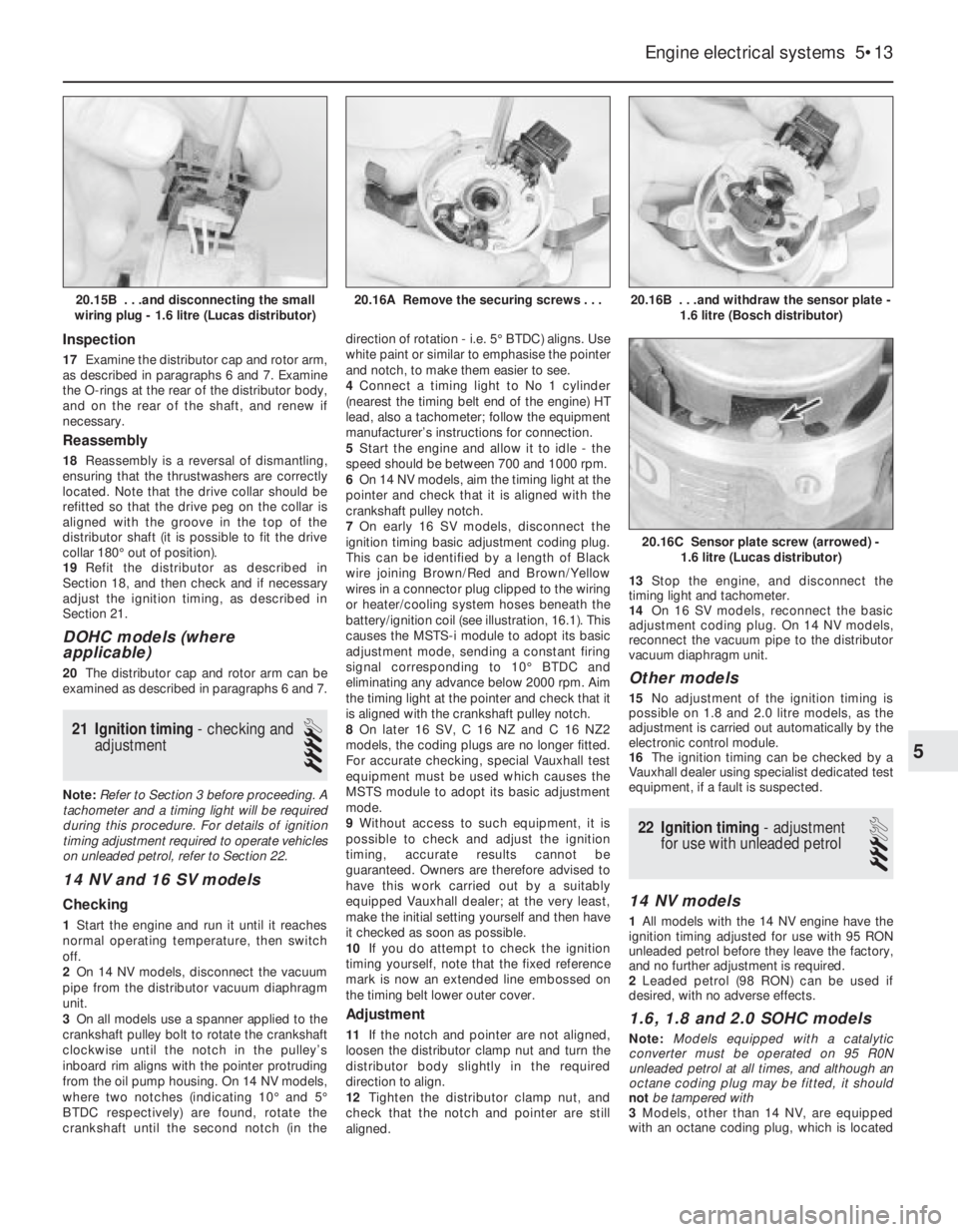
Inspection
17Examine the distributor cap and rotor arm,
as described in paragraphs 6 and 7. Examine
the O-rings at the rear of the distributor body,
and on the rear of the shaft, and renew if
necessary.
Reassembly
18Reassembly is a reversal of dismantling,
ensuring that the thrustwashers are correctly
located. Note that the drive collar should be
refitted so that the drive peg on the collar is
aligned with the groove in the top of the
distributor shaft (it is possible to fit the drive
collar 180°out of position).
19Refit the distributor as described in
Section 18, and then check and if necessary
adjust the ignition timing, as described in
Section 21.
DOHC models (where
applicable)
20The distributor cap and rotor arm can be
examined as described in paragraphs 6 and 7.
21Ignition timing -checking and
adjustment
4
Note: Refer to Section 3 before proceeding. A
tachometer and a timing light will be required
during this procedure. For details of ignition
timing adjustment required to operate vehicles
on unleaded petrol, refer to Section 22.
14 NV and 16 SV models
Checking
1Start the engine and run it until it reaches
normal operating temperature, then switch
off.
2On 14 NV models, disconnect the vacuum
pipe from the distributor vacuum diaphragm
unit.
3On all models use a spanner applied to the
crankshaft pulley bolt to rotate the crankshaft
clockwise until the notch in the pulley’s
inboard rim aligns with the pointer protruding
from the oil pump housing. On 14 NV models,
where two notches (indicating 10°and 5°
BTDC respectively) are found, rotate the
crankshaft until the second notch (in thedirection of rotation -i.e. 5°BTDC) aligns. Use
white paint or similar to emphasise the pointer
and notch, to make them easier to see.
4Connect a timing light to No 1 cylinder
(nearest the timing belt end of the engine) HT
lead, also a tachometer; follow the equipment
manufacturer’s instructions for connection.
5Start the engine and allow it to idle -the
speed should be between 700 and 1000 rpm.
6On 14 NV models, aim the timing light at the
pointer and check that it is aligned with the
crankshaft pulley notch.
7On early 16 SV models, disconnect the
ignition timing basic adjustment coding plug.
This can be identified by a length of Black
wire joining Brown/Red and Brown/Yellow
wires in a connector plug clipped to the wiring
or heater/cooling system hoses beneath the
battery/ignition coil (see illustration, 16.1). This
causes the MSTS-i module to adopt its basic
adjustment mode, sending a constant firing
signal corresponding to 10°BTDC and
eliminating any advance below 2000 rpm. Aim
the timing light at the pointer and check that it
is aligned with the crankshaft pulley notch.
8On later 16 SV, C 16 NZ and C 16 NZ2
models, the coding plugs are no longer fitted.
For accurate checking, special Vauxhall test
equipment must be used which causes the
MSTS module to adopt its basic adjustment
mode.
9Without access to such equipment, it is
possible to check and adjust the ignition
timing, accurate results cannot be
guaranteed. Owners are therefore advised to
have this work carried out by a suitably
equipped Vauxhall dealer; at the very least,
make the initial setting yourself and then have
it checked as soon as possible.
10If you do attempt to check the ignition
timing yourself, note that the fixed reference
mark is now an extended line embossed on
the timing belt lower outer cover.
Adjustment
11If the notch and pointer are not aligned,
loosen the distributor clamp nut and turn the
distributor body slightly in the required
direction to align.
12Tighten the distributor clamp nut, and
check that the notch and pointer are still
aligned. 13Stop the engine, and disconnect the
timing light and tachometer.
14On 16 SV models, reconnect the basic
adjustment coding plug. On 14 NV models,
reconnect the vacuum pipe to the distributor
vacuum diaphragm unit.
Other models
15No adjustment of the ignition timing is
possible on 1.8 and 2.0 litre models, as the
adjustment is carried out automatically by the
electronic control module.
16The ignition timing can be checked by a
Vauxhall dealer using specialist dedicated test
equipment, if a fault is suspected.
22Ignition timing -adjustment
for use with unleaded petrol
3
14 NV models
1All models with the 14 NV engine have the
ignition timing adjusted for use with 95 RON
unleaded petrol before they leave the factory,
and no further adjustment is required.
2Leaded petrol (98 RON) can be used if
desired, with no adverse effects.
1.6, 1.8 and 2.0 SOHC models
Note: Models equipped with a catalytic
converter must be operated on 95 R0N
unleaded petrol at all times, and although an
octane coding plug may be fitted, it should
not be tampered with
3Models, other than 14 NV, are equipped
with an octane coding plug, which is located
Engine electrical systems 5•13
20.16B . . .and withdraw the sensor plate -
1.6 litre (Bosch distributor)
20.16C Sensor plate screw (arrowed) -
1.6 litre (Lucas distributor)
20.16A Remove the securing screws . . .20.15B . . .and disconnecting the small
wiring plug - 1.6 litre (Lucas distributor)
5
Page 106 of 525
Aluminium or plastic mesh, or glass fibre
matting, is probably the best material to use
for a large hole. Cut a piece to the
approximate size and shape of the hole to be
filled, then position it in the hole so that its
edges are below the level of the surrounding
bodywork. It can be retained in position by
several blobs of filler paste around its
periphery.
Aluminium tape should be used for small or
very narrow holes. Pull a piece off the roll and
trim it to the approximate size and shape
required. Then pull off the backing paper (if
used) and stick the tape over the hole. It can
be overlapped if the thickness of one piece is
insufficient. Burnish down the edges of the
tape with the handle of a screwdriver or
similar, to ensure that the tape is securely
attached to the metal underneath.
Bodywork repairs filling and
re-spraying
Before using this Section, see the Sections
on dent, deep scratch, rust holes and gash
repairs.
Many types of bodyfiller are available, but
generally those proprietary kits that contain a
tin of filler paste and a tube of resin hardener
are best for this type of repair. These can be
used directly from the tube. A wide, flexible
plastic or nylon applicator will be found
invaluable for imparting a smooth and well-
contoured finish to the surface of the filler.
Mix up a little filler on a clean piece of card
or board - measure the hardener carefully
(follow the maker’s instructions on the pack)
otherwise the filler will set too rapidly or too
slowly. Using the applicator apply the filler
paste to the prepared area; draw the
applicator across the surface of the filler to
achieve the correct contour and to level the
filler surface. When a contour that
approximates to the correct one is achieved,
stop working the paste - if you carry on too
long the paste will become sticky and begin to
“pick up” on the applicator. Continue to add
thin layers of filler paste at twenty-minute
intervals until the level of the filler is just proud
of the surrounding bodywork.
Once the filler has hardened, excess can be
removed using a metal plane or file. From then
on, progressively finer grades of abrasive
paper should be used, starting with a 40
grade production paper and finishing with 400
grade wet-and-dry paper. Always wrap the
abrasive paper around a flat rubber, cork, or
wooden block otherwise the surface of the
filler will not be completely flat. During the
smoothing of the filler surface the wet-and-dry
paper should be periodically rinsed in water.
This will ensure that a very smooth finish is
imparted to the filler at the final stage.
At this stage the “dent” should be
surrounded by a ring of bare metal, which in
turn should be encircled by the finely
“feathered” edge of the good paintwork.
Rinse the repair area with clean water, until all
the dust produced by the rubbing-down
operation has gone.Spray the whole repair area with a light coat
of primer. This will show up any imperfections
in the surface of the filler. Repair these
imperfections with fresh filler paste or
bodystopper, and again smooth the surface
with abrasive paper. If bodystopper is used, it
can be mixed with cellulose thinners to form a
thin paste that is ideal for filling small holes.
Repeat this spray and repair procedure until
you are satisfied that the surface of the filler,
and the feathered edge of the paintwork are
perfect. Clean the repair area with clean water
and allow to dry fully.
The repair area is now ready for final
spraying. Paint spraying must be carried out
in a warm, dry, windless and dust free
atmosphere. This condition can be created
artificially if you have access to a large indoor
working area, but if you are forced to work in
the open, you will have to pick your day very
carefully. If you are working indoors, dousing
the floor in the work area with water will help
to settle the dust that would otherwise be in
the atmosphere. If the repair area is confined
to one body panel, mask off the surrounding
panels; this will help to minimise the effects of
a slight miss-match in paint colours.
Bodywork fittings (e.g. chrome strips, door
handles, etc.), will also need to be masked off.
Use genuine masking tape and several
thicknesses of newspaper for the masking
operations.
Before beginning to spray, agitate the
aerosol can thoroughly, then spray a test area
(an old tin, or similar) until the technique is
mastered. Cover the repair area with a thick
coat of primer; the thickness should be built
up using several thin layers of paint rather
than one thick one. Using 400 grade
wet-and-dry paper, rub down the surface of
the primer until it is smooth. While doing this,
the work area should be thoroughly doused
with water, and the wet-and-dry paper
periodically rinsed in water. Allow to dry
before spraying on more paint.
Spray on the top coat, again building up the
thickness by using several thin layers of paint.
Start spraying in the centre of the repair area
and then work outwards, with a side-to-side
motion, until the whole repair area and about
2 inches of the surrounding original paintwork
is covered. Remove all masking material 10 to
15 minutes after spraying on the final coat of
paint.
Allow the new paint at least two weeks to
harden, then using a paintwork renovator or a
very fine cutting paste, blend the edges of the
paint into the existing paintwork. Finally, apply
wax polish.
Plastic components
With the use of more and more plastic body
components (e.g. bumpers, spoilers, and in
some cases major body panels), repair of
more serious damage to such items has
become a matter of either entrusting repair
work to a specialist in this field, or renewing
complete components. Repair of suchdamage by the DIY owner is not feasible
owing to the cost of the equipment and
materials required for effecting such repairs.
The basic technique involves making a groove
along the line of the crack in the plastic using
a rotary burr in a power drill. The damaged
part is then welded back together by using a
hot air gun to heat up and fuse a plastic filler
rod into the groove. Any excess plastic is then
removed and the area rubbed down to a
smooth finish. It is important that a filler rod of
the correct plastic is used, as body
components can be made of a variety of
different types (e.g. polycarbonate, ABS,
polypropylene).
Damage of a less serious nature (abrasions,
minor cracks, etc.), can be repaired by the DIY
owner using a two-part epoxy filler repair
material. Once mixed in equal proportions this
is used in similar fashion to the bodywork filler
used on metal panels. The filler is usually
cured in twenty to thirty minutes, ready for
sanding and painting.
If the owner is renewing a complete
component himself, or if he has repaired it
with epoxy filler, he will have a problem of
finding a paint for finishing which is
compatible with the type of plastic used. At
one time the use of a universal paint was not
possible owing to the complex range of
plastics come across in body component
applications. Standard paints, generally, will
not bond to plastic or rubber satisfactorily, but
special paints are available to match any
plastic or rubber finish can be obtained from
dealers. However, it is now possible to obtain
a plastic body parts finishing kit that consists
of a pre-primer treatment, a primer and
coloured top coat. Full instructions are
normally supplied with a kit, but the method of
use is to first apply the pre-primer to the
component concerned and allow it to dry for
up to 30 minutes. Then the primer is applied
and left to dry for about an hour before finally
applying the special coloured top coat. The
result is a correctly coloured component
where the paint will flex with the plastic or
rubber, a property that standard paint does
not normally possess.
5Major body damage - repair
5
Major impact or rust damage should only
be repaired by a Vauxhall dealer or other
competent specialist. Alignment jigs are
needed for successful completion of such
work, superficially effective repairs may leave
dangerous weaknesses in the structure.
Distorted components can also impose
severe stresses on steering and suspension
components with consequent premature
failure.
Bodywork and fittings 11•3
11
Page 129 of 525
b)Always keep the ignition and fuel systems
well maintained according to the
manufacturers schedule (see “Routine
maintenance” and the relevant Chapter).
In particular, ensure that the air cleaner
filter element, the fuel filter and the spark
plugs are renewed at the correct intervals.
If the inlet air/fuel mixture is allowed to
become too rich due to neglect, the
unburned surplus will enter and burn in
the catalytic converter, overheating the
element and eventually destroying the
converter.
c)If the engine develops a misfire, do not
drive the vehicle at all (or at least as little
as possible) until the fault is cured. The
misfire will allow unburned fuel to enter
the converter, which will result in its
overheating, as noted above.
d)The engine control indicator (the outline
of an engine with a lightning symbol
superimposed), will light when the ignition
is switched on and the engine is started,
then it will go out. While it may light briefly
while the engine is running, it should go
out again immediately and stays unlit. If it
lights and stays on while the engine is
running, seek the advice of a Vauxhall
dealer as soon as possible. A fault has
occurred in the fuel injection/ignition
system that, apart from increasing fuel
consumption and impairing the engine’s
performance, may damage the catalytic
converter.
e)DO NOT push or tow-start the vehicle.
This will soak the catalytic converter in
unburned fuel causing it to overheat when
the engine does start see (b) above.
f)DO NOT switch off the ignition at high
engine speeds. If the ignition is switched
off at anything above idle speed,
unburned fuel will enter the (very hot)
catalytic converter, with the possible risk
of its igniting on the element and
damaging the converter.
g)DO NOT use fuel or engine oil additives.
These may contain substances harmful to
the catalytic converter.
h)DO NOT continue to use the vehicle if the
engine burns oil to the extent of leaving a
visible trail of blue smoke. The unburned
carbon deposits will clog the converter
passages and reduce its efficiency; in
severe cases the element will overheat.
i)Remember that the catalytic converter
operates at very high temperatures hence
the heat shields on the vehicle’s under-
body and the casing will become hot
enough to ignite combustible materials
that brush against it. DO NOT, therefore,
park the vehicle in dry undergrowth, over
long grass or over piles of dead leaves.
j)Remember that the catalytic converter is
FRAGlLE. Do not strike it with tools during
servicing work. Take great care when
working on the exhaust system. Ensure
that the converter is well clear of any
jacks or other lifting gear used to raise thevehicle. Do not drive the vehicle over
rough ground, road humps, etc., in such a
way as to ground the exhaust system.
k)In some cases, particularly when the
vehicle is new and/or is used for
stop/start driving, a sulphurous smell (like
that of rotten eggs) may be noticed from
the exhaust. This is common to many
catalytic converter-equipped vehicles and
seems to be due to the small amount of
sulphur found in some petrol’s reacting
with hydrogen in the exhaust to produce
hydrogen sulphide (CS) gas. While this
gas is toxic, it is not produced in sufficient
amounts to be a problem. Once the
vehicle has covered a few thousand miles
the problem should disappear. In the
meanwhile a change of driving style or of
the brand of petrol may effect a solution.
l)The catalytic converter, used on a
well-maintained and well-driven vehicle,
should last for between 50 000 and 100
000 miles. From this point on, careful
checks should be made at all specified
service intervals of the CO level to ensure
that the converter is still operating
efficiently. If the converter is no longer
effective it must be renewed.
11Carbon canister - removal
and refitting
3
Removal
1Apply the handbrake, then jack up the front
of the vehicle, and support securely on axle
stands placed under the body side members
(see “Jacking and Vehicle Support”).
2Remove the front right hand wheel and
wheel arch liner.
3Note the hose and pipe connections to the
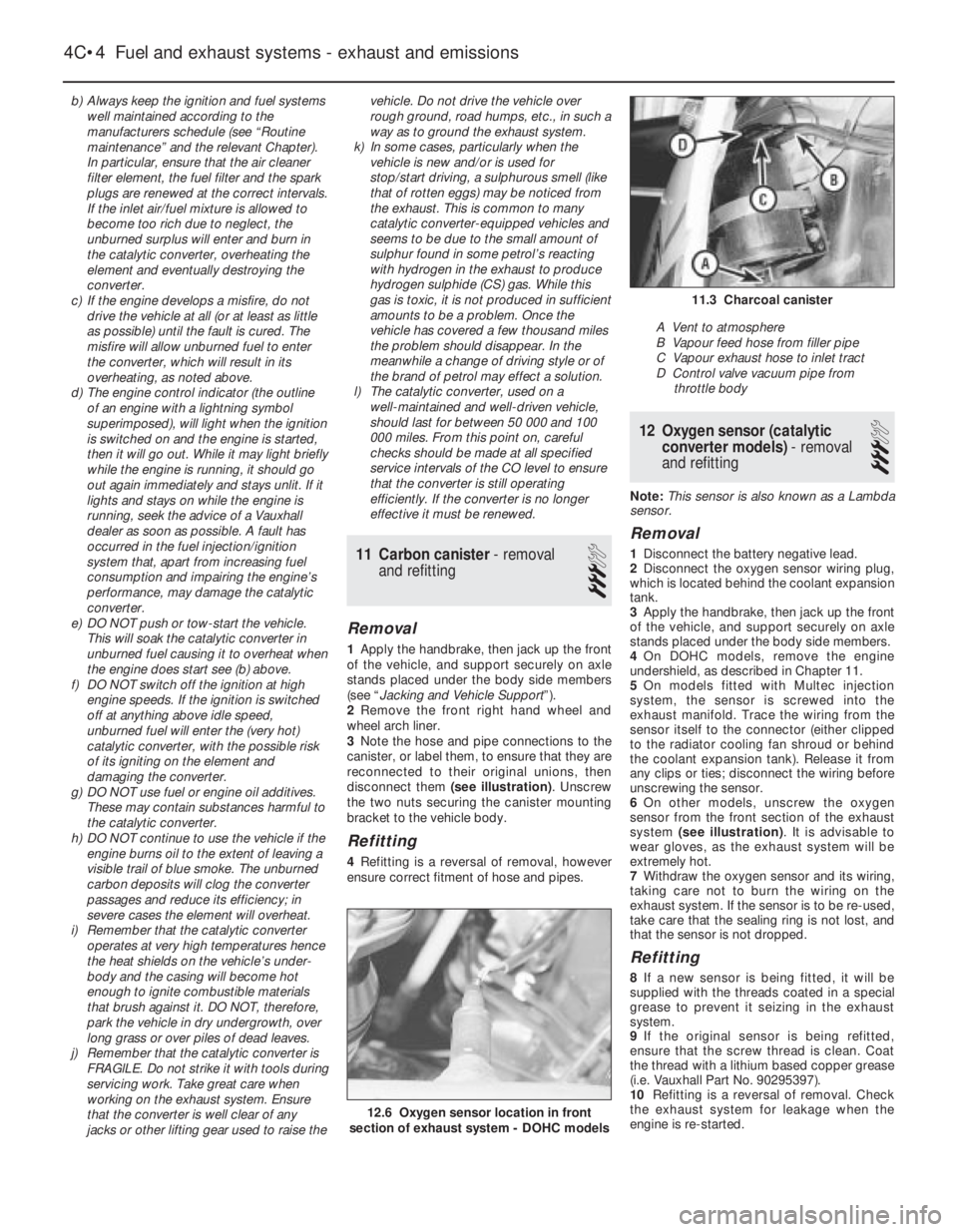
canister, or label them, to ensure that they are
reconnected to their original unions, then
disconnect them (see illustration). Unscrew
the two nuts securing the canister mounting
bracket to the vehicle body.
Refitting
4Refitting is a reversal of removal, however
ensure correct fitment of hose and pipes.
12Oxygen sensor (catalytic
converter models) - removal
and refitting
3
Note: This sensor is also known as a Lambda
sensor.
Removal
1Disconnect the battery negative lead.
2Disconnect the oxygen sensor wiring plug,
which is located behind the coolant expansion
tank.
3Apply the handbrake, then jack up the front
of the vehicle, and support securely on axle
stands placed under the body side members.
4On DOHC models, remove the engine
undershield, as described in Chapter 11.
5On models fitted with Multec injection
system, the sensor is screwed into the
exhaust manifold. Trace the wiring from the
sensor itself to the connector (either clipped
to the radiator cooling fan shroud or behind
the coolant expansion tank). Release it from
any clips or ties; disconnect the wiring before
unscrewing the sensor.
6On other models, unscrew the oxygen
sensor from the front section of the exhaust
system (see illustration). It is advisable to
wear gloves, as the exhaust system will be
extremely hot.
7Withdraw the oxygen sensor and its wiring,
taking care not to burn the wiring on the
exhaust system. If the sensor is to be re-used,
take care that the sealing ring is not lost, and
that the sensor is not dropped.
Refitting
8If a new sensor is being fitted, it will be
supplied with the threads coated in a special
grease to prevent it seizing in the exhaust
system.
9If the original sensor is being refitted,
ensure that the screw thread is clean. Coat
the thread with a lithium based copper grease
(i.e. Vauxhall Part No. 90295397).
10Refitting is a reversal of removal. Check
the exhaust system for leakage when the
engine is re-started.
4C•4Fuel and exhaust systems - exhaust and emissions
12.6 Oxygen sensor location in front
section of exhaust system - DOHC models
11.3 Charcoal canister
A Vent to atmosphere
B Vapour feed hose from filler pipe
C Vapour exhaust hose to inlet tract
D Control valve vacuum pipe from
throttle body