Page 209 of 648
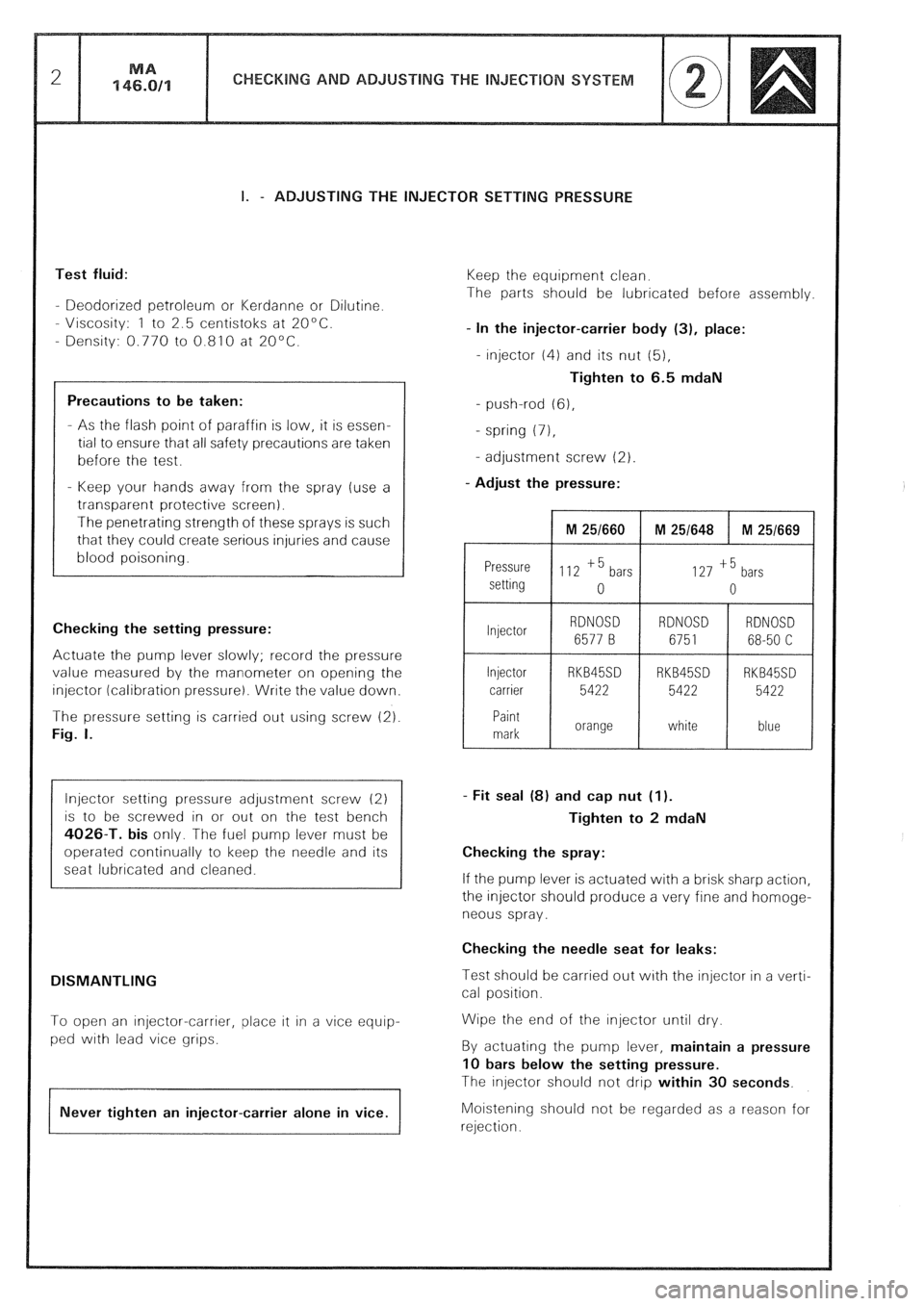
I. - ADJUSTING THE INJECTOR SETTING PRESSURE
Test fluid: Keep the equipment clean.
- Deodorized petroleum or Kerdanne or Dilutine. The parts should be lubricated before assembly.
- Viscosity: 1 to 2.5 centistoks at 2O’C.
- Density: 0.770 to 0.810 at 2O’C. - In the injector-carrier body (31, place:
- injector (4) and its nut (5),
Tighten to 6.5 mdaN
Precautions to be taken:
- push-rod (6),
- As the flash point of paraffin is low, it is essen-
- spring (7),
tial to ensure that all safety precautions are taken
before the test. - adjustment screw (2).
- Keep your hands away from the spray (use a - Adjust the pressure:
transparent protective screen).
The penetrating strength of these sprays is such
that they could create serious injuries and cause M 251660 M 251648 M 25/669
blood poisoning.
Pressure
112 t5 bars 127 t5 bars
setting
0 0
Checking the setting pressure: Injector RDNOSD RDNOSD RDNOSD
6577 B 6751 68-50 C
Actuate the pump lever slowly; record the pressure
value measured by the manometer on opening the Injector RKB45SD RKB45SD RKB45SD
Injector (calibration pressure). Write the value down. carrier 5422 5422 5422
The pressure setting is carried out using screw (2). Paint
Fig. I. mark orange white blue
Injector setting pressure adjustment screw (2)
is to be screwed in or out on the test bench
operated continually to keep the needle and its
If the pump lever is actuated with a brisk sharp action,
the injector should produce a very fine and homoge-
neous spray.
Checking the needle seat for leaks:
DISMANTLING Test should be carried out with the injector in a verti-
cal position.
To open an injector-carrier, place it in a vice equip- Wipe the end of the injector until dry.
ped with lead vice grips.
By actuating the pump lever, maintain a pressure
10 bars below the setting pressure.
The injector should not drip within 30 seconds,
Never tighten an injector-carrier alone in vice. Moistening should not be regarded as a reason for
rejection.
Page 213 of 648
CHECKING AND ADJUSTING
THE INJECTION SYSTEM
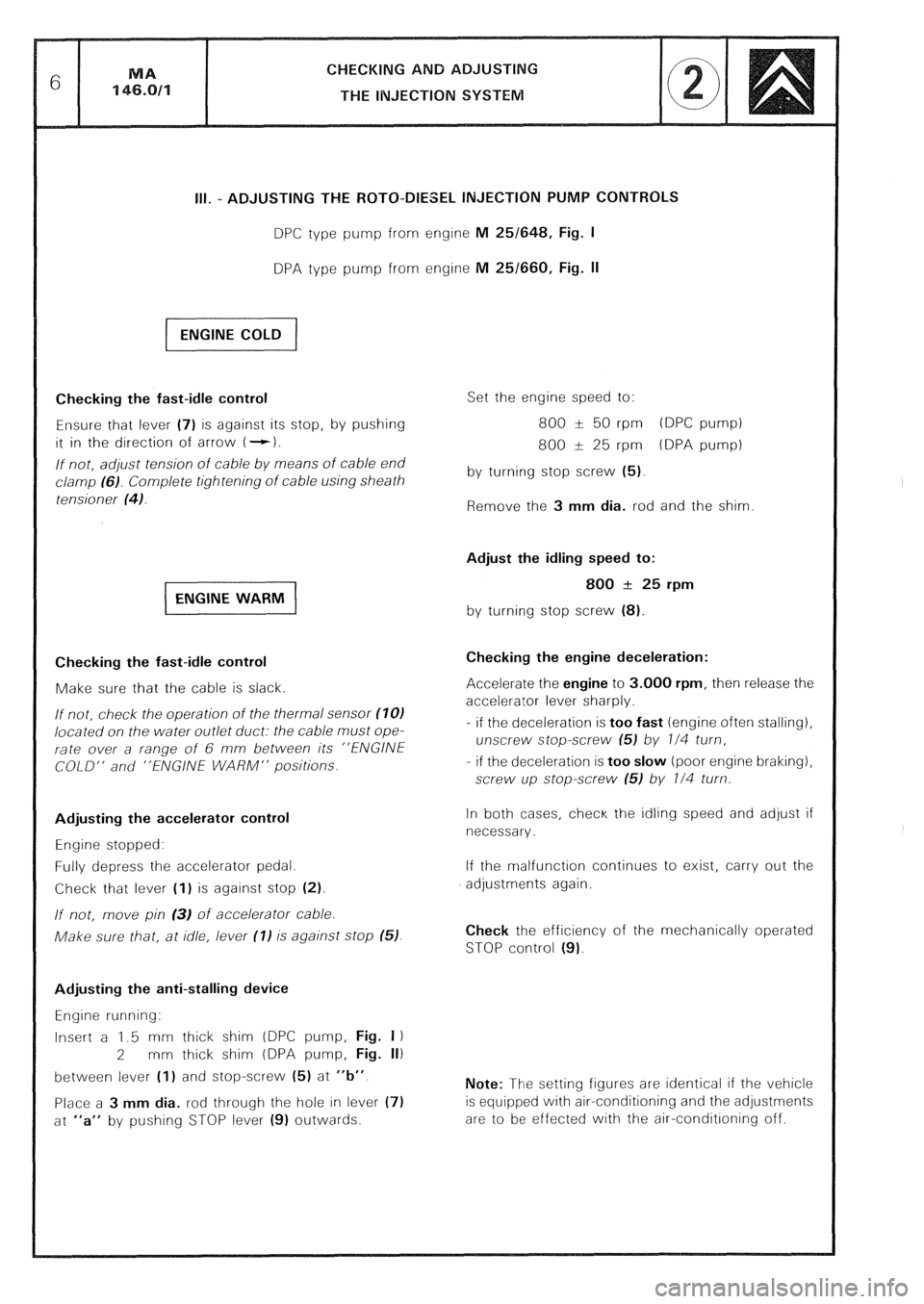
III. - ADJUSTING THE ROTO-DIESEL INJECTION PUMP CONTROLS
DPC type pump from engine M 25/648, Fig. I
DPA type pump from engine M 25/660, Fig. II
Checking the fast-idle control
Ensure that lever (7) is against its stop, by pushing
it in the direction of arrow (-).
If not, adjust tension of cab/e by means of cable end
clamp (6). Complete tightening of cable using sheath
tensioner (41.
Checking the fast-idle control
Make sure that the cable is slack.
If not, check the operation of the thermal sensor (101
located on the water outlet duct: the cable must ope-
rate over a range of 6 mm between its “ENGINE
COLD” and “ENGINE WARM” positions.
Adjusting the accelerator control
Engine stopped:
Fully depress the accelerator pedal.
Check that lever (I) is against stop (2).
If not, move pin (3) of accelerator cable.
Make sure that, at idle, lever (I) is against stop (5).
Adjusting the anti-stalling device
Engine running:
Insert a 1.5 mm thick shim (DPC pump, Fig. I)
2 mm thick shim (DPA pump, Fig. II)
between lever (I) and stop-screw (5) at “b”.
Place a 3 mm dia. rod through the hole in lever (7)
at “a” by pushing STOP lever (9) outwards. Set the engine speed to:
800 t 50 rpm (DPC pump)
800 f 25 rpm (DPA pump)
by turning stop screw (5).
Remove the 3 mm dia. rod and the shim
Adjust the idling speed to:
800 + 25 rpm
by turning stop screw (8).
Checking the engine deceleration:
Accelerate the engine to 3.000 rpm, then release the
accelerator lever sharply.
- if the deceleration is too fast (engine often stalling),
unscrew stop-screw (5) by 114 turn,
- if the deceleration is too slow (poor engine braking),
screw up stop-screw (51 by l/4 turn.
In both cases, check the idling speed and adjust if
necessary.
If the malfunction continues to exist, carry out the
adjustments again.
Check the efficiency of the mechanically operated
STOP control (9).
Note: The setting figures are identical if the vehicle
is equipped with air-conditioning and the adjustments
are to be effected with the air-conditioning off.
Page 286 of 648
FRONT MA
412.1/l 1
RECOMMENDED TOOLS
6303-T.
Upper arm shaft extractor. 6320-T.
Anti-roll bar link rod extractor 6602-T.
Set of three stands.
REMOVING AND REFITTING
AN UPPER WHEEL ARM
8531-8532
Page 287 of 648

REMOVING AND REFITTING
AN UPPER WHEEL ARM
REMOVAL
Raise and support the front of the vehicle on stands
6602-T.
Depressurize the hydraulic circuit.
Set the height control lever to the (( low )) position
Remove, Fig. I :
- the wheel,
- the suspension cylinder pivot retaining pin (I 1,
- the anti-roll bar link rod nut (2).
Uncouple ball-joint (3) from the anti-roll bar link rod
using puller 6320-T. Fig. II.
Screw up the tool nut in the ball-joint stem. Fit the
tool cross piece and pin.
Extract, Fig. Ill,
- the nut from upper ball-joint (4).
Disconnect the upper ball-joint.
NOTE:
If the vehicle is fitted with the ABS, the removal of
the upper ball-joint nut requires pushing back the
transmission.
Remove:
- the pin, C
- the nut lock,
- the drive-shaft nut.
Fig. IV
- nut (51,
Fig. V
- the spindle with extractor 6303-T.
Remark: An adjustment shim may be found between
the arm and the front face of the subframe. REFITTING
The LH wheel arm is different from the RH one. Boss
u a )a should be directed towards the rear of the
vehicle when the wheel arm has been fitted.
Reinstall, Fig. V :
- the arm fitted with its thrust cups (7)
frhe thinner cup facing rearwardsl,
- the adjustment shim (6) found on dismantling, facing
forward.
Engage the spindle ; place a new NYLSTOP nut.
Tighten to 12.5 mdaN
Recouple the upper ball-joint.
Tighten the new NYLSTOP nut to 7 mdaN
Reconnect the anti-roll bar link rod (wipe the ball-joint
fixing but do nor use solventl.
Tighten the new NYLSTOP nut to 4.7 mdaN
Refit the suspension cylinder pivot and pin.
Vehicles equipped with the ABS:
Fit the drive-shaft nut (with the faces and threads
lubricated).
Tighten to 37.5 mdaN.
Replace:
- the nut lock,
- the pin,
- the road wheel
Page 311 of 648

REMOVING AND REFITTING A SWIVEL
REFITTING Replace, Fig. IV:
Wipe the ball-joint fixings and location, do not use - flexible pipe (I I) into its fixing bracket,
solvent. - washer (I 0).
Recouple the upper ball-joint with the swivel. Tighten nut (9) to 2.2 mdaN.
Refit, Fig. I: Recouple:
- washer (I),
- Fig. IV, connection (I 2) provided with a new sea/.
- nut (2).
- Fig. V, the steering ball-joint.
Tighten to 7 mdaN (New NYLSTOP nut).
Refit:
Introduce the drive-shaft end into the wheel hub - washer (I 31,
(lubricate the hub seal lips). - nut (14) (New NYLSTOP one).
Couple up the lower ball-joint. Tighten to 6 mdaN.
Tighten to 6 mdaN the new NYLSTOP nut. Reconnect:
-cup (171,
Reconnect the brake pad wear warning lamp harness. - spring (I 61,
-cable (15).
Refit, Fig. II and Ill:
Adjust the handbrake (as indicated in @ 454.011).
- electrical harness fixing bracket (4).
- earth lead (5).
- screw (3). Put the drive-shaft nut into place.
- metal panel (6). (Faces and threads lubricated).
Lock the hub, utilizing tool 6310-T Fig. VI.
ABS vehicles, Fig. Ill:
Tighten to 37.5 mdaN.
Reinstall sensor (7) (spread MOB/L TEMP No. 1
grease over the outside of the sensor.
Bleed the front brakes (see @ 453.0/l/.
Tighten screw (8) to 1 mdaN.
Fit the wheel.
Lower the vehicle to the ground.
8531-8532
Page 313 of 648

REMOVING AND REFlTTlNG A FRONT
WHEEL HUB
REMOVAL
Support the front of the vehicle on stands
Take off the road wheel.
Withdraw, Fig. I
- the pin,
- the nut lock,
- the 35 mm A/F nut.
Lock the hub with tool 6310-T.
Remove the brake disc fas stated in chapter 0, op.
MA 45 1. l/3/.
Extract the swivel lower ball-joint nut
Uncouple the swivel lower ball-joint, Fig. II, using
either puller 3312-T or puller 6323-T (be careful
not to damage the ball-joint protection rubber).
Liberate the drive-shaft.
Take out, Fig. Ill :
- the screws,
- the hub. REFITTING
Introduce the wheel hub into the swivel.
Position the screws previously fitted with lugged
contact washers, Fig. Ill. Tighten to 2.7 mdaN.
Insert the drive-shaft end into the wheel hub (grease
the seal contact face).
Couple up the lower ball-joint.
Tighten the new NYSLTOP nut to 6 mdaN. (Wipe
the ball-joint fixing and recess, do not use solvent).
Refit the brake disc (Refer to @ MA 451. l/31.
Relocate, Fig. IV :
- the nut, use tool 6310-T to hold the hub in posi-
tion, tighten to 37.5 mdaN,
- the nut lock,
- the pin.
Bleed the front brakes
(See @ MA 453.0/l).
Reassemble the road wheel.
Lower the vehicle to the ground.
Page 358 of 648
RECOMMENDED TOOLS
3312-T
or 6323-T
Lower arm ball-joint extractor with bosses
Lower arm ball-joint extractor with or without bosses 6310-T
Hub locking tool 6320-T
Anti-roll bar link rod extractor 6602-T
Set of three stands
-- Torque wrench (40 mdaN)
- Socket 35 mm A/F \/,
8531
Page 359 of 648

REMOVING AND REFITTING
THE DRIVE SHAFT ASSEMBLIES
Support the front of the vehicle on stands 6602-T.
Release the pressure in the hydraulic system.
Set the height control to the “low” position.
Remove: Fig. I:
- the road wheel,
- the pin and nut lock,
- the nut (35 mm A/F). Retain the wheel hub using
tool 6310-T, Fig. I.
Fig. II,
- suspension cylinder swivel ball maintaining pin (I 1,
- anti-roll bar link-rod nut (2).
Uncouple spherical ball (3) from the anti-roll bar link-
rod by means of puller 6320-T, Fig. Ill: (Screw up
the tool nut to the ball-joint stem and fit the tool “U”
part and spindle).
Disconnect the brake pad wear warning lamp electri-
cal harness.
Take off the brake disc cooling plate securing screws. Extract the nut of the swivel lower ball pin.
Uncouple the swivel lower ball pin with extractor
3312-T or 6323-T (Avoid damaging the ball joint
protection rubber).
Removing the LH drive-shaft assembly:
Push the LH drive shaft (5) aside with a chisel (6),
bearing against the heads of the gearbox flange
screws, Fig. V.
Important : If a few hammer strokes are not enough
to push aside drive shaft (51, the circlip is probably
blocked inside the sun gear. In that case, undo
clamp (4) and remove the transmission without its
drive-shaft, (retrieve the rollerl.
Turn the steering through full lock to the left.
Leave the swivel hanging.
Liberate the LH transmission from the hub and remove
it.
Removing the RH drive-shaft assembly:
Slacken the drive-shaft bearing support nuts (71,
Fig. VI.
Swing through a half turn tie rods (81, so as to release
the bearing outer track.
Withdraw drive shaft (9) from the sun gear. (Remove
the shaft, the o’ring seal, bush, and dust seal).
Turn the steering to full right lock; leave the swivel
hanging.
Disengage the RH transmission from the wheel hub
and remove it.

