1987 PORSCHE 944 belt
[x] Cancel search: beltPage 19 of 66
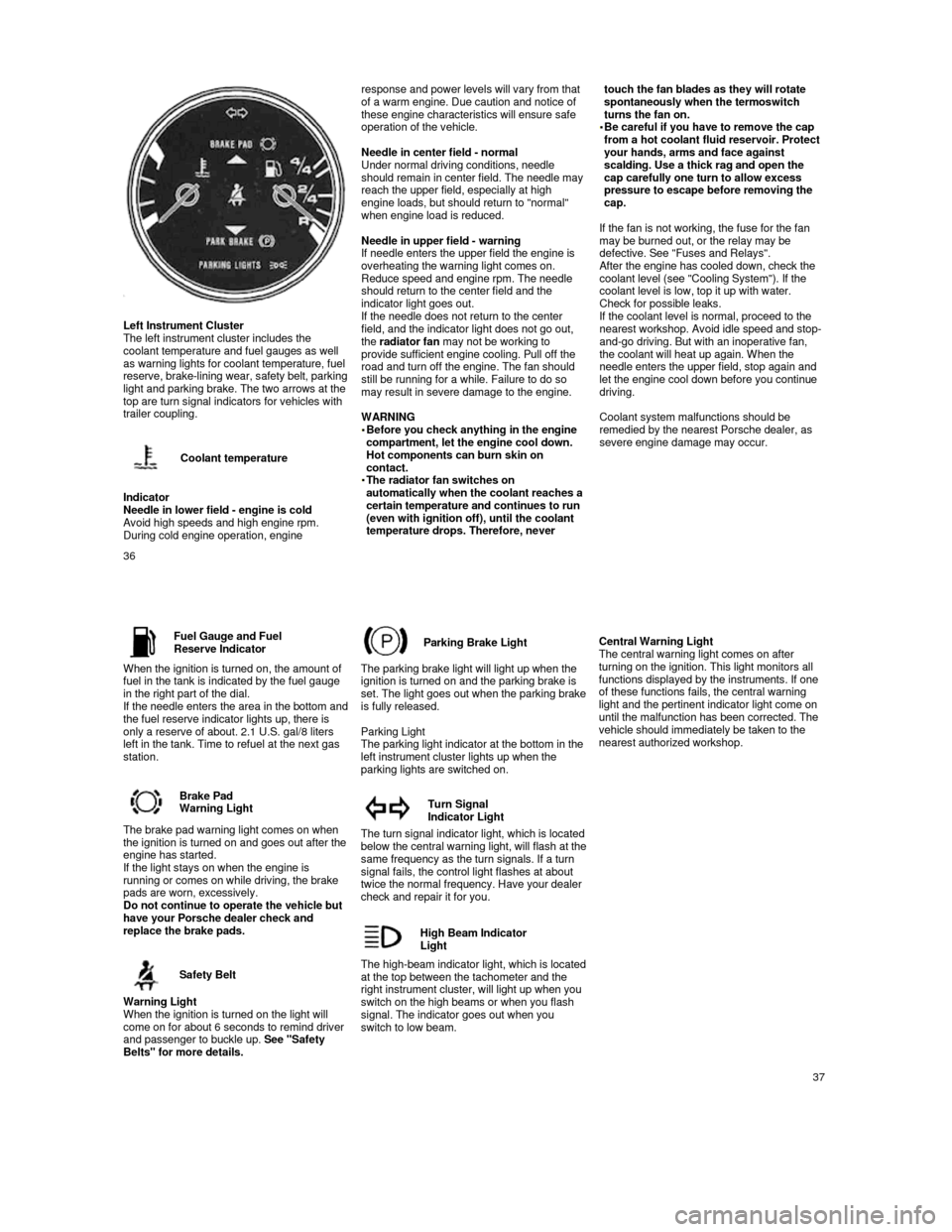
Left Instrument Cluster
The left instrument cluster includes the
coolant temperature and fuel gauges as well
as warning lights for coolant temperature, fuel
reserve, brake-
lining wear, safety belt, parking light and parking brake. The two arrows at the
top are turn signal indicators for vehicles with
trailer coupling.
Coolant temperature
Indicator
Needle in lower field - engine is cold
Avoid high speeds and high engine rpm. During cold engine operation, engine
response and power levels will vary from that
of a warm engine. Due caution and notice of
these engine characteristics will ensure safe
operation of the vehicle.
Needle in center field - normal
Under normal driving conditions, needle
should remain in center field. The needle may
reach the upper field, especially at high
engine loads, but should return to "normal"
when engine load is reduced.
Needle in upper field - warning
If needle enters the upper field the engine is
overheating the warning light comes on.
Reduce speed and engine rpm. The needle
should return to the center field and the
indicator light goes out.
If the needle does not return to the center
field, and the indicator light does not go out,
the radiator fan may not be working to
provide sufficient engine cooling. Pull off the
road and turn off the engine. The fan should
still be running for a while. Failure to do so
may result in severe damage to the engine.
WARNING
Before you check anything in the engine compartment, let the engine cool down.
Hot components can burn skin on
contact. The radiator fan switches on automatically when the coolant reaches a
certain temperature and continues to run
(even with ignition off), until the coolant
temperature drops. Therefore, never
touch the fan blades as they will rotate spontaneously when the termoswitch
turns the fan on.
Be careful if you have to remove the cap from a hot coolant fluid reservoir. Protect
your hands, arms and face against
scalding. Use a thick rag and open the
cap carefully one turn to allow excess
pressure to escape before removing the
cap.
If the fan is not working, the fuse for the fan
may be burned out, or the relay may be
defective. See "Fuses and Relays".
After the engine has cooled down, check the coolant level (see "Cooling System"). If the
coolant level is low, top it up with water.
Check for possible leaks.
If the coolant level is normal, proceed to the
nearest workshop. Avoid idle speed and stop-
and-go driving. But with an inoperative fan,
the coolant will heat up again. When the
needle enters the upper field, stop again and
let the engine cool down before you continue
driving.
Coolant system malfunctions should be
remedied by the nearest Porsche dealer, as
severe engine damage may occur.
36
Fuel Gauge and FuelReserve Indicator
When the ignition is turned on, the amount of
fuel in the tank is indicated by the fuel gauge
in the right part of the dial.
If the needle enters the area in the bottom and the fuel reserve indicator lights up, there is
only a reserve of about. 2.1 U.S. gal/8 liters
left in the tank. Time to refuel at the next gas
station.
Brake Pad
Warning Light
The brake pad warning light comes on when the ignition is turned on and goes out after the engine has started.
If the light stays on when the engine is
running or comes on while driving, the brake
pads are worn, excessively.
Do not continue to operate the vehicle but
have your Porsche dealer check and
replace the brake pads.
Safety Belt
Warning Light
When the ignition is turned on the light will
come on for about 6 seconds to remind driver
and passenger to buckle up. See "Safety
Belts" for more details.
Parking Brake Light
The parking brake light will light up when the
ignition is turned on and the parking brake is
set.
The light goes out when the parking brake is fully released.
Parking Light
The parking light indicator at the bottom in the
left instrument cluster lights up when the
parking lights are switched on.
Turn Signal
Indicator Light
The turn signal indicator light, which is located below the central warning light, will flash at the same frequency as the turn signals. If a turn
signal fails, the control light flashes at about
twice the normal frequency. Have your dealer
check and repair it for you.
High Beam Indicator
Light
The high-beam indicator light, which is located at the top between the tachometer and the
right instrument cluster, will light up when you
switch on the high beams or when you flash
signal. The indicator goes out when you
switch to low beam.
Central Warning Light
The central warning light comes on after
turning on the ignition. This light monitors all
functions displayed by the instruments. If one
of these functions fails, the central warning
light and the pertinent indicator light come on
until the malfunction has been corrected. The
vehicle should immediately be taken to the
nearest authorized workshop.
37
Page 20 of 66
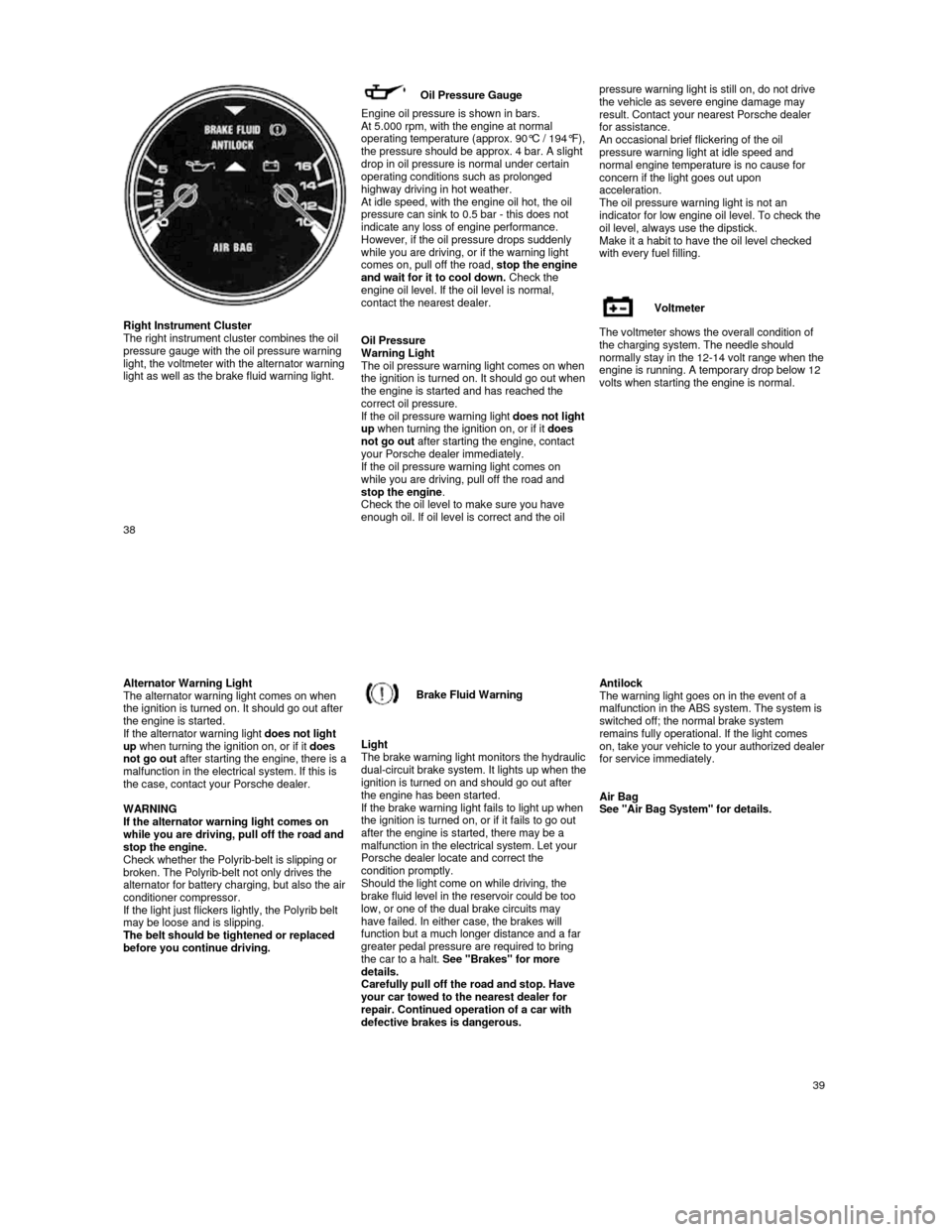
Right Instrument Cluster
The right instrument cluster combines the oil
pressure gauge with the oil pressure warning
light, the voltmeter with the alternator warning
light as well as the brake fluid warning light.
Oil Pressure Gauge
Engine oil pressure is shown in bars. At 5.000 rpm, with the engine at normal operating temperature (approx. 90°C / 194°F), the pressure should be approx. 4 bar. A slight
drop in oil pressure is normal under certain
operating conditions such as prolonged
highway driving in hot weather.
At idle speed, with the engine oil hot, the oil pressure can sink to 0.5 bar - this does not
indicate any loss of engine performance.
However, if the oil pressure drops suddenly
while you are driving, or if the warning light comes on, pull off the road,
stop the engine
and wait for it to cool down. Check the
engine oil level. If the oil level is normal,
contact the nearest dealer.
Oil Pressure
Warning Light
The oil pressure warning light comes on when the ignition is turned on. It should go out when the engine is started and has reached the
correct oil pressure.
If the oil pressure warning light
does not light up when turning the ignition on, or if it does
not go out after starting the engine, contact
your Porsche dealer immediately.
If the oil pressure warning light comes on
while you are driving, pull off the road and stop the engine .
Check the oil level to make sure you have
enough oil. If oil level is correct and the oil pressure warning light is still on, do not driv
e
the vehicle as severe engine damage may
result. Contact your nearest Porsche dealer
for assistance.
An occasional brief flickering of the oil pressure warning light at idle speed and
normal engine temperature is no cause for
concern if the light goes out upon
acceleration.
The oil pressure warning light is not an
indicator for low engine oil level. To check the
oil level, always use the dipstick.
Make it a habit to have the oil level checked
with every fuel filling.
Voltmeter
The voltmeter shows the overall condition of
the charging system. The needle should
normally stay in the 12-
14 volt range when the engine is running. A temporary drop below 12
volts when starting the engine is normal.
38
Alternator Warning Light
The alternator warning light comes on when
the ignition is turned on. It should go out after
the engine is started.
If the alternator warning light does not light
up when turning the ignition on, or if it does
not go out
after starting the engine, there is a malfunction in the electrical system. If this is
the case, contact your Porsche dealer.
WARNING
If the alternator warning light comes on
while you are driving, pull off the road and
stop the engine.
Check whether the Polyrib-belt is slipping or
broken. The Polyrib-belt not only drives the
alternator for battery charging, but also the air
conditioner compressor.
If the light just flickers lightly, the Polyrib bel t
may be loose and is slipping.
The belt should be tightened or replaced
before you continue driving.
Brake Fluid Warning
Light
The brake warning light monitors the hydraulic dual-circuit brake system. It lights up when the ignition is turned on and should go out after
the engine has been started.
If the brake warning light fails to light up when
the ignition is turned on, or if it fails to go out
after the engine is started, there may be a
malfunction in the electrical system. Let your
Porsche dealer locate and correct the
condition promptly.
Should the light come on while driving, the
brake fluid level in the reservoir could be too
low, or one of the dual brake circuits may
have failed. In either case, the brakes will
function but a much longer distance and a far
greater pedal pressure are required to bring
the car to a halt. See "Brakes" for more
details.
Carefully pull off the road and stop. Have
your car towed to the nearest dealer for
repair. Continued operation of a car with
defective brakes is dangerous.
Antilock
The warning light goes on in the event of a
malfunction in the ABS system. The system is
switched off; the normal brake system
remains fully operational. If the light comes
on, take your vehicle to your authorized dealer for service immediately.
Air Bag
See "Air Bag System" for details.
39
Page 24 of 66
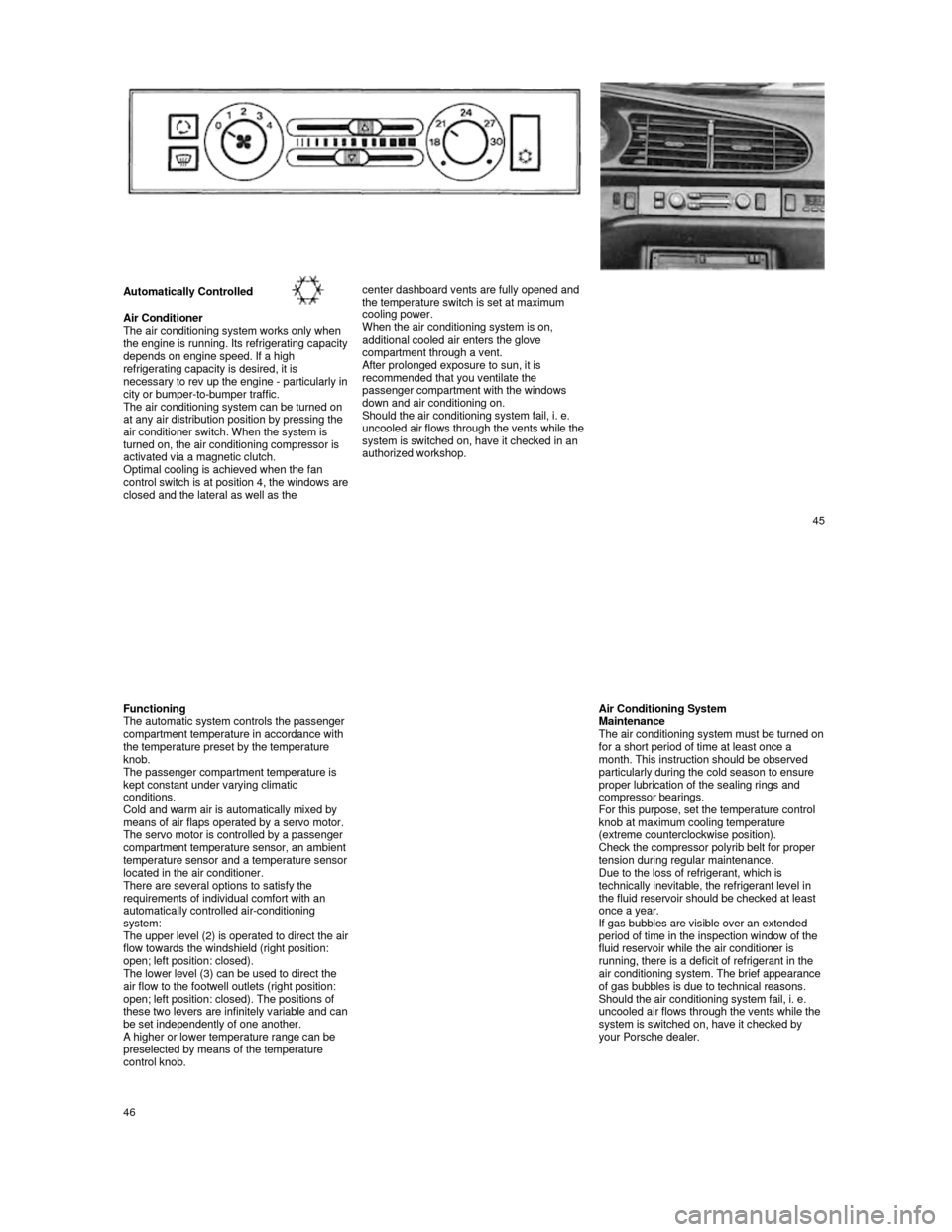
Automatically Controlled
Air Conditioner
The air conditioning system works only when
the engine is running. Its refrigerating capacity depends on engine speed. If a high
refrigerating capacity is desired, it is
necessary to rev up the engine -
particularly in city or bumper-to-bumper traffic.
The air conditioning system can be turned on
at any air distribution position by pressing the
air conditioner switch. When the system is
turned on, the air conditioning compressor is
activated via a magnetic clutch.
Optimal cooling is achieved when the fan
control switch is at position 4, the windows are closed and the lateral as well as the
center dashboard vents are fully opened and
the temperature switch is set at maximum
cooling power.
When the air conditioning system is on,
additional cooled air enters the glove
compartment through a vent.
After prolonged exposure to sun, it is recommended that you ventilate the
passenger compartment with the windows
down and air conditioning on.
Should the air conditioning system fail, i. e.
uncooled air flows through the vents while the
system is switched on, have it checked in an
authorized workshop.
45
Functioning
The automatic system controls the passenger
compartment temperature in accordance with
the temperature preset by the temperature
knob.
The passenger compartment temperature is
kept constant under varying climatic
conditions.
Cold and warm air is automatically mixed by
means of air flaps operated by a servo motor.
The servo motor is controlled by a passenger
compartment temperature sensor, an ambient
temperature sensor and a temperature sensor located in the air conditioner.
There are several options to satisfy the
requirements of individual comfort with an
automatically controlled air-conditioning
system:
The upper level (2) is operated to direct the air flow towards the windshield (right position:
open; left position: closed).
The lower level (3) can be used to direct the
air flow to the footwell outlets (right position:
open; left position: closed). The positions of
these two levers are infinitely variable and can be set independently of one another. A higher or lower temperature range can be preselected by means of the temperature
control knob.
Air Conditioning System Maintenance The air conditioning system must be turned on for a short period of time at least once a
month. This instruction should be observed
particularly during the cold season to ensure
proper lubrication of the sealing rings and
compressor bearings.
For this purpose, set the temperature control
knob at maximum cooling temperature
(extreme counterclockwise position).
Check the compressor polyrib belt for proper
tension during regular maintenance.
Due to the loss of refrigerant, which is
technically inevitable, the refrigerant level in
the fluid reservoir should be checked at least
once a year.
If gas bubbles are visible over an extended
period of time in the inspection window of the
fluid reservoir while the air conditioner is
running, there is a deficit of refrigerant in the
air conditioning system. The brief appearance
of gas bubbles is due to technical reasons.
Should the air conditioning system fail, i. e.
uncooled air flows through the vents while the
system is switched on, have it checked by
your Porsche dealer.
46
Page 34 of 66

Interior Glass
Use the same cleaning agents as for the
exterior and polish dry with a soft cloth or
paper towel.
Fabric
Use a vacuum cleaner or a soft bristle brush
to remove dust and loose dirt from carpeting,
upholstery, headliner and other trim. Dirt
stains can usually be removed with lukewarm
soap water or an all purpose cleaner solution,
or a dry foam cleaner. For greasy, oily and
other stubborn stains, use a spot remover. Do
not pour the liquid on the fabric. Dampen a
clean cloth and rub carefully, starting at the
edge and working inward.
Safety belts
Keep belts clean. Very dirty belts may not
retract properly. Do not remove belts from the
vehicle to be cleaned. Do not use chemical
cleaning agents, bleach or dyes. They
contain corrosive properties which will
weaken the webbing. Do not allow inertia
reel safety belts to retract before they are
completely dry.
For cleaning, use a mild soap water solution.
Let belts dry out thoroughly and away from
direct sun light.
Plastic, vinyl and leatherette
Use a clean, damp cloth or sponge to keep
this trim free from dust. For other spoilage,
use a lukewarm all purpose cleaning solution
or a mild saddle soap for vinyl and leather
trim. Remove water spots and soap traces
with a clean, damp cloth or sponge. Use a clean, soft cloth to rub dry.
Grease, tar or oil stains can be removed with
a clean cloth or sponge soaked with all
purpose cleaner or with a solvent type vinyl or
leather cleaning agent.
Occasionally apply a colorless vinyl or leather
preservative to retain the material's luster and
pliability.
Leather and leather trim
To keep leather seats and trim beautiful and
soft, they should be cleaned and cared for
regularly. Clean leather with a soft, white
woolen cloth and a mild soapwater solution. Do not use chemical or abrasive cleaning
agents. Do not let moisture seep through
perforated surfaces to safeguard against
corrosion and cracking from underneath. After cleaning, apply a leather preservative re-
commended by Porsche to all dry surfaces with a clean and soft woolen cloth. Let your
Porsche dealer advise you on the use of the
leather preservation product.
Corrosion protection
The engine compartment, as well as all
engine, transmission, front and rear axle
assembly surfaces have been treated with a
wax based coating at the factory for protection against corrosion.
WARNING
Do not apply additional undercoating or
rustproofing on or near the exhaust
manifold, exhaust pipes, catalytic
converter or heat shields. During driving,
the substance used for undercoating could overheat and cause a fire.
Engine Compartment
If it becomes necessary to steam clean or
otherwise wash the engine compartment, the
wax based protective coating is usually lost. It is therefore important to reapply this
protective coating to all engine compart-
65
ment panels, flanges, cavities, seams and
engine assembly surfaces.
When washing the engine compartment,
only use commercially available grease
cutting solvents made especially for this
purpose. Carefully fol
low directions printed on the container by the manufacturer.
Chassis
The lower body shell of your Porsche is
thoroughly protected against corrosion.
However, it is recommended to have the
underbody inspected twice a year. Any
detected damage to the undercoating, due to
road hazards, should be repaired promptly. Oil based protective sprays must not be applied. Only tar or wax based anti corrosion protectors are compatible with the factory applied undercoating. Before application, road dirt and oily substances must be removed.
Whenever the lower body shell, axle,
transmission or engine assemblies are
repaired, the lost anti-corrosion coating of
the affected surfaces should be renewed.
Let your Porsche dealer advise and assist you.
66
Page 35 of 66
Exercise Extreme Caution when Working under the
Engine Hood
The engine compartment of any motor vehicle is a potentially hazardous area. If you are not
fully familiar with proper repair procedures, do
not attempt the adjustments described on the
following pages. This caution applies to the
entire vehicle.
Only work on your vehicle outdoors or in a well ventilated area. Ensure that there are no open flames in the
area of your vehicles at any time when
gasoline fumes might be present. Be
especially cautious of such devices such as
hot water heaters which ignite a flame
intermittently.
Before working on any part in the engine
compartment, turn the engine off and let it
cool down sufficiently. Hot engine
compartment components can burn skin on
contact.
Even after the engine has stopped the
radiator fan may continue running until the
temperature of the coolant has dropped to a
certain level. Therefore, never touch the fan
blades as they will rotate spontaneously
when the thermostat turns the fan on, even with ignition off. Be alert and cautious around engine at all
times while the engine is running.
If work has to be done with the engine
running, always set the parking brake, and
make sure the shift lever is in either Neutral
or Park.
Exercise extreme caution to prevent
neckties, jewelry or long hair from getting
caught in the fan blades, the drive belts, or
any other moving engine parts.
Your Porsche is equipped with a
transistorized ignition system with
breakerless distributor. When the ignition is
on, high voltage is present in all wires
connected with the ignition system; therefore
exercise extreme caution when working on
any part of the engine while the ignition is on
or the engine is running.
Always support your car with safety stands if it is necessary to work underneath the car.
The jack supplied with the car is not
adequate for this purpose.
When working underneath the car without
safety stands but with the wheels on the
ground, make sure the car is on level ground, that the wheels are blocked, and that the
engine cannot be started. REMOVE THE
IGNITION KEY.
Do not smoke or allow an open flame around the battery or gasoline. Keep a fire extinguisher in close reach.
Incomplete or improper servicing may cause
problems in the operation of the car. If in
doubt about any servicing, have it done by
your authorized Porsche dealer or any other
properly equipped and qualified workshop.
Improper maintenance during the warranty
period may affect your warranty coverage.
67
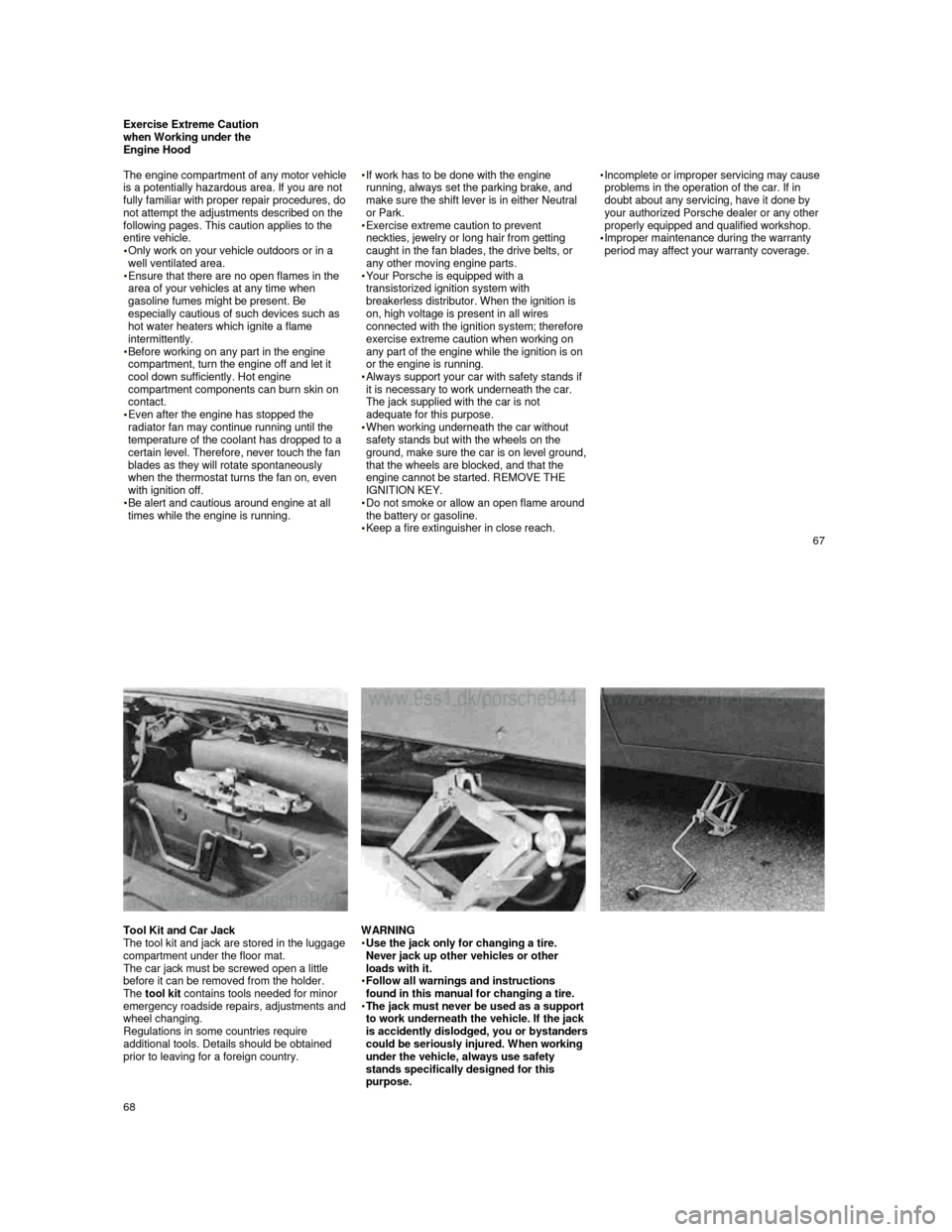
Tool Kit and Car Jack
The tool kit and jack are stored in the luggage
compartment under the floor mat.
The car jack must be screwed open a little
before it can be removed from the holder.
The tool kit contains tools needed for minor
emergency roadside repairs, adjustments and
wheel changing.
Regulations in some countries require
additional tools. Details should be obtained
prior to leaving for a foreign country.
WARNING
Use the jack only for changing a tire. Never jack up other vehicles or other loads with it. Follow all warnings and instructions found in this manual for changing a tire. The jack must never be used as a support to work underneath the vehicle. If the jack is accidently dislodged, you or bystanders could be seriously injured. When working
under the vehicle, always use safety
stands specifically designed for this
purpose.
68
Page 43 of 66
may not always be due to improper wheel
alignment. It can be the result of individual
driving habits such as cornering at high
speeds. If the tire pressure is not checked and adjusted regularly, abnormal tire wear can
also occur.
Tire care
WARNING
Avoid damaging tires and wheel rims. If you must drive over a curb or other obstacle,
drive slowly and at an obtuse angle.
Frequently check tires for uneven wear and
damage.
Remove imbedded material. Replace worn or damaged tires immediately. Replace missing valve dust caps. Keep oil, fuel, brake fluid, etc. away from
tires.
Keep tires inflated correctly.
Tire replacement
In the interest of maximum safety and best
all-around car handling, always buy
replacement tires that have the same
specifications with regard to tire size,
design, load carrying capacity, tread
pattern, tread depth etc. This also applies
to Porsche recommended alternate
replacement tires. If you do not use a
Porsche recommended replacement tire,
make sure that you purchase your new
tires from a reputable
tire specially dealer and that the dealer complies with all manufacturers warnings
for those tires.
In case of tire damage where it is uncertain
whether there is a break in the ply with all its consequences or, tire damage caused by
thermal or mechanical overloading due to a
loss of pressure or any other prior damage,
we recommend that the tire be replaced for safety reasons.
If one faulty tire on an axle is replaced it
should be noted that the difference in tread
depth on one axle must not be more than
30%.
Tire specifications are imprinted on the
sidewall of the tires. If in doubt, check with
your Porsche dealer.
When replacing tubeless tires, always install
new valve stems. When replacing tires
requiring an inner tube, always install new
tubes.
New tires do not possess maximum
traction. They tend to be slippery. Break
new tires in by driving at moderate speed
for the first 60-120 miles or 100-200
kilometers.
Wheel balancing
A wheel should always be balanced after a tire repair. Even with regular use a wheel can
get out of balance, and should therefore be
balanced from time to time. Unbalanced
wheels may affect car handling and tire life.
When balancing light alloy wheels, use only
adhesive balancing weights supplied through
the Porsche parts service.
Wheels
If you intend to use other than original
equipment wheels, be sure that they conform
to Porsche specifications for your model.
Check with your Porsche dealer regarding the
correct wheel specifications for type and
model year.
Removing and storing tires
The driving direction should be clearly marked on all tires before removing them for storage,
to make sure they are mounted and run in the
same direction as before. Store tires in a cool
and dry place. Tires without rims upright!
Avoid contact with oil, grease or gasoline. When remounting, put tires with the most
tread depth at the front.
Snow tires
For a better grip on snow and ice use radial M + S tires or snow tires with studs. Check with
your local Motor Vehicle Bureau for possible
restrictions.
Radial ply M+S tires should be inflated with
the same cold tire inflation pressures required
for the regular radial ply tires. However, do not exceed the maximum tire inflation pressure
listed on the tire sidewall.
Snow tires should have the same load
capacity as original equipment tires and
should be mounted on all four wheels. Snow
tires with studs should be run at moderate
speeds when new in order to give the studs
time to settle.
83
WARNING
Tires with badly worn treads and studs are
very dangerous. Make sure they are replaced
immediately.
Do not drive a vehicle equipped with snow
tires at prolonged high speed. Snow tires do
not have the same degree of traction on dry,
wet or snow free roads as a normal tire. Furthermore, snow tires wear rapidly under
these conditions.
Snow tires do not fulfill their purpose if the
tread depth is less than 5/32 in. / 4 mm.
Comply with all state and local laws
governing snow tire and tread depth
requirements.
Snow chains Should snow chains be necessary, they
must be mounted on the drive wheels
only.
Check with local authorities for possible
restrictions.
Use only Porsche-approved snow chains with
fine pitch links, so that enough
space remains between the chains and the inside of the wheel arches.
Drive wheels must rotate freely with chains
mounted to prevent damage to body, axle or
brake components. Follow instructions issued
by the supplier of the chains. Remove chains
as soon as roads are free of ice and snow.
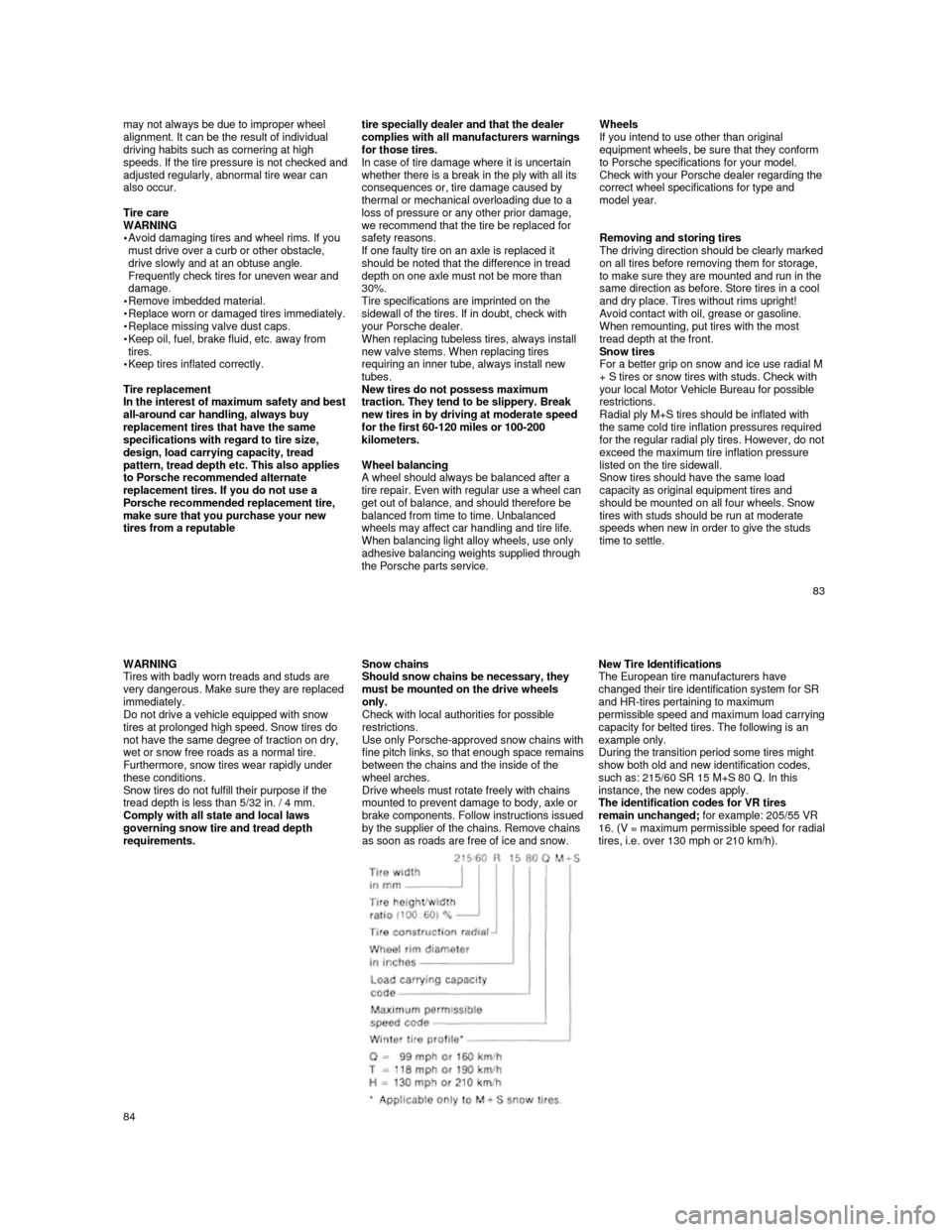
New Tire Identifications
The European tire manufacturers have
changed their tire identification system for SR
and HR-tires pertaining to maximum
permissible speed and maximum load carrying capacity for belted tires. The following is an
example only.
During the transition period some tires might
show both old and new identification codes,
such as: 215/60 SR 15 M+S 80 Q. In this
instance, the new codes apply.
The identification codes for VR tires
remain unchanged; for example: 205/55 VR
16. (V = maximum permissible speed for radial tires, i.e. over 130 mph or 210 km/h).
84
Page 54 of 66

Technical Data
105
Engine 944 Number of cylinders
4
Bore 3.94 in. / 100 mm
Stroke 3.11 in. / 78.9 mm
Displacement 151 cu. in. / 2479 cm
3
Compression ratio 9.7:1
SAE net-power 147 hp/ 110 kW at 5800 rpm
SAE net-torque 140 ft lb / 190 Nm at 3000 rpm
Output per liter 59,3 SAE net-hp / 44,4 SAE net-kW
Max. permissible rpm 6500
Fuel octane rating Unleaded fuel only 91 RON (87 CLC or AKI ((R+M)/2) rating on fuel pump s in U.S.A.)
Spark plugs Bosch WR 7 DC or
Champion RN 9 YC
Electrode gap 0.028 + 0.004 in. / 0.7 + 0.1 mm
Battery capacity 12 volts, 63 Ah
Alternator output 1610W/115A
Firing order 1-3-4-2
Ignition timing Self-adjusting DME (Digital-Motor-E lectronic)
Ignition Transistorized ignition system with breake r less distributor
Belt for alternator Polyrib K6 1000 Lw
Belt for servo pump 9.5 x 950 LA
Valve clearance Hydraulic valve clearance compensat ion
106
Page 55 of 66

Engine 944 S Number of cylinders
4
Bore 3.94 in. / 100 mm
Stroke 3.11 in. / 78.9 mm
Displacement 151 cu. in. / 2479 cm
3
Compression ratio 10.9:1
SAE net-power 188 hp/ 140 kW at 6000 rpm
SAE net-torque 170 ft lb / 230 Nm at 4300 rpm
Output per liter 75,8 SAE net-hp / 56,5 SAE net-kW
Max. permissible rpm 6800
Fuel octane rating Unleaded fuel only 95 RON (90 CLC or AKI ((R+M)/2) rating on fuel pump s in U.S.A.)
Spark plugs Bosch WR 7 DC
Electrode gap 0.028 + 0.004 in. / 0.7 + 0.1 mm
Battery capacity 12 volts, 63 Ah
Alternator output 1610W/115A
Firing order 1-3-4-2
Ignition timing Self-adjusting DME (Digital-Motor-E lectronic)
Ignition Transistorized ignition system with breake r less distributor
Belt for alternator Polyrib K6 1000 Lw
Belt for servo pump 9.5 x 950 LA
Valve clearance Hydraulic valve clearance compensat ion
107
Engine 944 Turbo
Number of cylinders
4
Bore 3.94 in. / 100 mm
Stroke 3.11 in. / 78.9 mm
Displacement 151 cu. in. / 2479 cm
3
Compression ratio 8.0:1
SAE net-power 217 hp/ 162 kW at 5800 rpm
SAE net-torque 243 ft lb / 330 Nm at 3500 rpm
Output per liter 87,5 SAE net-hp / 65,3 SAE net-kW
Max. permissible rpm 6500
Fuel octane rating Unleaded fuel only 90 RON (90 CLC or AKI ((R+M)/2) rating on fuel pump s in U.S.A.)
Spark plugs Bosch WR 7 DC
Electrode gap 0.028 + 0.004 in. / 0.7 + 0.1 mm
Battery capacity 12 volts, 63 Ah
Alternator output 1610W/115A
Firing order 1-3-4-2
Ignition timing Self-adjusting DME (Digital-Motor-E lectronic)
Ignition Transistorized ignition system with breake r less distributor
Belt for alternator Polyrib K6 1000 Lw
Belt for servo pump 9.5 x 950 LA
Valve clearance Hydraulic valve clearance compensat ion
108