1987 NISSAN PULSAR drain bolt
[x] Cancel search: drain boltPage 126 of 238

126
MANUAL TRANSAXLE AND DRIVE SHAFTS
SPECIFICATIONS
TRANSAXLE
Type .....................................Five speed, synchromesh
on all forward gears
Model .......................................................... RS5F31A
Gear ratios: 1.6 liter -
First .......................................................... 3.333:1
Second...................................................... 1.955:1
Third......................................................... 1.286:1
Fourth....................................................... 0.975:1
Fifth.......................................................... 0.810:1
Reverse .................................................... 3.417:1
1.8 liter -
First .......................................................... 3.063:1
Second...................................................... 1.826:1
Third......................................................... 1.286:1
Fourth ....................................................... 0.975:1
Fifth.......................................................... 0.810:1
Reverse .................................................... 3.417:1
Gear end float:
Fifth...............................................0.18-0.41 mm
Second, third and fourth................0.20-0.40 mm
First ...............................................0.18-0.31 mm
Synchro ring to gear clearance:
Standard ............................................ 1.0-1.3 mm
Minimum ................................................. 0.7 mm
Turning torque (new bearings):
Differential assembly ........................ 3.9-7.8 Nm
Total differential and mainshaft __ 5.9-13.7 Nm
Differential and final drive:
Type ........................ Helical ring gear and pinion
Ratio......................................................... 4.167:1
Lubricant:
Grade ............................................. 80W-90 GL-4
Capacity ..................................................2.7 liters
DRIVE SHAFTS
C.V. joint lubrication:
Lubricant ........ Valvoline Special Moly EP grease
Amount ................................................. 40 grams
TORQUE WRENCH SETTINGS
Transaxle case retaining bolts ........
Cover plate to transaxle case .......................... 8.3 Nm
Input shaft bearing retainer bolts ..................... 21 Nm
Control bracket bolts ...................................... 8.3 Nm
Reverse check plug.......................................... 25 Nm
Ring gear to differential case........................... 88 Nm
Filler and drain plugs....................................... 34 Nm
Reverse lamps switch ...................................... 29 Nm
Upper and centre clutch housing to engine…...49 Nm
Lower clutch housing to engine ...................... 21 Nm
1. MANUAL TRANSAXLE AND DRIVE
SHAFT
TROUBLE SHOOTING
DIFFICULT GEAR CHANGE
(1) Faulty clutch or clutch release mechanism:
Check and adjust or overhaul the clutch or the clutch
release mechanism. (2) Loose control bracket retaining bolts: Dis-
mantle the transaxle and tighten the control bracket
retaining bolts. Apply Loctite or an equivalent to the
bolt threads to prevent a repeat of the problem.
(3) Faulty gear lever assembly: Check and
renew
or repair the gear lever assembly. (4) Bent or worn gear lever control rod: Repair
or renew the faulty components. (5) Worn transaxle selector mechanism: Over-
haul the transaxle assembly. Renew components as
necessary.
.21 NmCheck the synchronizing teeth on the gears and synchro
rings for chipping or wear.
Page 140 of 238

140
AUTOMATIC TRANSAXLE
SPECIFICATIONS
Make .............................................. JATCO RL3F01A
Type .....................3 speed and reverse epicyclic gear
train with lock up torque converter
Operation .................................... Automatic hydraulic
Lubricant:
Type....................................................... Dexron IT
Capacity................................................. 6.3 liters
TORQUE WRENCH SETTINGS
Drive plate to crankshaft bolls ........................60 Nm
Drive plate to torque converter bolts ..............49 Nm
Convener housing to engine ...........................22 Nm
Converter housing to transaxle ........................23 Nm
Transaxle sump to transaxle ............................. 7 Nm
Oil cooler pipe to transaxle .............................49 Nm
Selector shaft locknut .......................................42 Nm
Transaxle filter bolts.........................................12 Nm
1. AUTOMATIC TRANSAXLE TROUBLE SHOOTING
NO DRIVE IN D RANGE
{1) Low fluid level in transaxle: Check the fluid
level in the transaxle and top up if required.
(2) Incorrectly adjusted selector cable: Check
and adjust the selector cable as detailed. (3) Incorrect or contaminated transaxle fluid:
Drain and refill with the recommend type and quan-
tity of transaxle fluid.
NOTE: Check the possible causes in the
order given.
NO REVERSE IN R RANGE
(1) Low fluid level in transaxle: Check the fluid
level and top up if required. (2) Incorrectly adjusted selector linkage: Check
the condition of the selector cable, selector quadrant
and selector arm for wear and damage. Adjust as
required.
Check the drive shaft oil seals as a likely leak source.
SLIPPING OR ROUGH UPSHIFT
(1) Incorrectly adjusted selector linkage: Check
and adjust the selector linkage. (2) Low fluid level in transaxle: Check the fluid
level and top up if required.
NO TRANSAXLE KICKDOWN
(1) Incorrectly adjusted throttle cable: Check
and adjust the cable as detailed in the Fuel and Engine
Management section.
Check the oil cooler hose connections for leaks if the
fluid level is low.
Page 154 of 238

154 Steering —
(2) Remove the air inlet duct from the air
cleaner and throttle body. (3) Position a container or a piece of cloth
beneath the steering pump reservoir and disconnect
the fluid return and power steering pump supply hose
from the reservoir.
(4) Loosen the steering pump drive belt as
described in the Engi ne Tune-up section.
(5) Loosen the return hose clamp and the supply
union and disconnect the hoses from the power
steering pump. Plug the hoses to prevent the loss of
fluid.
(6) Loosen the retaining bolts and withdraw the
pump. (7) Thoroughly clean the exterior of the steering
pump and inspect it for cracks, damage and signs of
leakage.
Installation is a reversal of the removal procedure
with attention to the following points:
(1) Install the pump and retaining bolts.
(2) Install the drive belt and adjust it as de-
scribed in the Engine Tune-up section. (3) Install the hoses to the power steering pump
and tighten securely. (4) Top up the pump reservoir and purge the
power steering system of air as previously described.
TO OVERHAUL
As specialist knowledge and equipment arc re-
quired to overhaul the power steering pump, it is
recommended that this operation be performed by an
authorized dealer or steering specialist.
6. POWER STEERING GEAR ASSEMBLY
Special Equipment Required:
To Renew Tie Rod Ball Housings — Large Still-
sons
TO REMOVE AND INSTAL
The procedures for removing and installing the
power steering gear are similar to those carried out in
the Manual Steering section under the Steering Gear
Assembly heading except fo r the following differences.
(1) Place a container under the pressure and
return pipes that are conn ected to the steering gear
valve housing. Remove the pipes and allow the fluid
to drain into the container. (2) Suitably seal the pipes and the steering gear
to prevent the entry of di rt whilst the pipes are
removed.
(3) Upon removal of the power steering gear,
thoroughly clean the steering gear except the tie rod
ends in a suitable solvent. Be careful not to allow the
solvent to enter the apertu res where the pressure and
return pipes were removed. (4) Check the pipes and co nnections for cracks,
damage or obstructions and renew as necessary.
Installed view of the power steering gear with the
engine removed.
Installation is a reversal of the removal procedure
with attention to the following points:
(1) Install the pressure and return pipes to the
steering gear valve housing and tighten securely. (2) Fill the power steering reservoir to the cor-
rect level and bleed the system as described previously
under the heading In Car Adjustments. Checks and
Minor Repairs. (3) Check all power steering pipe connections
for leaks and repair as necessary. (4) Check, and if necessary, adjust the front
wheel toe in as described in the Front Suspension
section. After adjustment ensure that the rubber boots
are not distorted or twisted and the rubber boot
clamps and clips are facing downward.
TO OVERHAUL
As specialist knowledge and equipment are re-
quired to overhaul the power steering gear, it is rec-
ommended that this opera tion be performed by an
authorized dealer or steering specialist.
TO RENEW TIE ROD BALL HOUSINGS
TRW Steering Gear
The renewal of the tie rod ball housings is the
same as for the manual steering gear. Refer to Part 2.
Manual Steering section.
PR24SA Steering Gear
(1) Remove the power steering gear assembly
from the vehicle as previously described.
(2) Carefully mount the power steering gear in a
vice equipped with soft jaws. Loosen the tie rod end
locknuts without disturbing the location of the tie rod
ends and unscrew the tie rod ends, taking note of the
number of turns required to remove them. Unscrew
and remove the locknuts from the tie rod. (3) Remove the clamps from the rubber boots
and remove the boots.
Page 175 of 238

Brakes 175
A pressure proportioning valve is incorporated in
each circuit to prevent premature locking of the rear
wheels during severe braking.
The four wheel hydraulically operated brakes
utilize disc brakes on each front wheel and disc brakes
or leading and trailing drum brake shoes on each rear
wheel.
The front disc brakes comprise a disc attached to
the hub assembly and a caliper bolted to the steering
knuckle.
The rear disc brakes comprise a disc and hub
assembly attached to the rear stub axle and a caliper
and anchor plate bolted to the backing plate.
The front and rear calipers are of the sliding type.
As pad wear takes place, the caliper piston is allowed
to slide outwards through the seal to take up a new
position in the caliper bore. Elastic deformation of the
seal takes place when the brakes are applied, which
returns the piston slightly when the brakes are re-
leased. Thus a constant clearance is maintained
between the pads and the disc when the brakes are in
the off position.
The disc brakes do not require periodical adjust-
ment in service to compensate for pad wear as they
are self adjusting.
The leading and trailing shoe drum brakes on the
rear wheels use a double ended wheel cylinder to
operate both brake shoes at the top. The lower end of
each brake shoe abuts a fixed anchor point. The brake
shoes are automatically adju sted when the brakes are
operated.
The handbrake operates the rear brakes via a
cable arrangement.
3. MASTER CYLINDER
Special Equipment Required:
To Install New Seals — Suitable machined drift
TO REMOVE
(1) Depress the brake pedal several times to
deplete the vacuum from the system.
(2) Raise the bonnet and install covers to
both
the front mudguards. Cover the areas of paintwork
beneath the master cylinder with absorbent cloth.
(3) Disconnect the wiring from the pressure
sensing switch. (4) Disconnect the brake pipes from the master
cylinder and plug the outlets and pipes to prevent the
loss of fluid and the ingress of dirt.
(5) Remove the nuts retaining the master cylin-
der to the brake servo unit and remove the master
cylinder from the vehicle.
TO DISMANTLE
(1) Remove the master cylinder as previously
described. (2) Remove the reservoir cap and diaphragm,
drain and discard the brake fluid from the reservoir. (3) Carefully remove the reservoir from the
master cylinder by pulling it from the reservoir
retainers by hand. Remove and discard the retainers
from the master cylinder. (4) Using internal snap ring pliers, remove the
snap ring from the primary reservoir port. (5) Remove the fast fill valve assembly and the
O ring from the port. Remove and discard the valve
washer from the fast fill valve.
(6) Remove the proportioning valve plugs and
the O rings. Discard the O rings. Withdraw the springs
and valve plungers from the master cylinder. Remove
and discard the seals from the valve plungers. (7) Remove the pressure sensing switch and
lever assembly from the master cylinder. {8) Remove the cylinder end plug from the
master cylinder. Remove and discard the O ring from
the plug.
(9) Carefully tap the front of the master cylinder
vertically on a block of wo od and remove the pressure
differential pistons from the master cylinder. Remove
and discard the O rings from the pistons. (10) Push the primary piston forward in the
cylinder with a blunt rod and while holding the
pressure, remove the stop pin from the master cylin-
der.
(11) The primary piston may now be withdrawn
from the cylinder bore. The secondary piston, retainer
and spring can also be withdrawn by carefully tapping
the master cylinder on a block of wood. (12) Prise the legs of the seal retainer upwards
and remove it from the primary piston. Remove the
seal and guide. Discard the seal and retainer.
NOTE: The secondary piston must no! be
dismantled by removing the screw. This
assembly has a factory p reset length and the
screw must not be altered in service.
(13) Remove the main seal and the guide from
the front of the secondary piston. Stretch the rear seal
from the groove and remove it from the piston. Take
Installed view of the master cylinder and servo unit. Air
duct removed for clarity. 1.8 liter model.
Page 179 of 238
Brakes 179
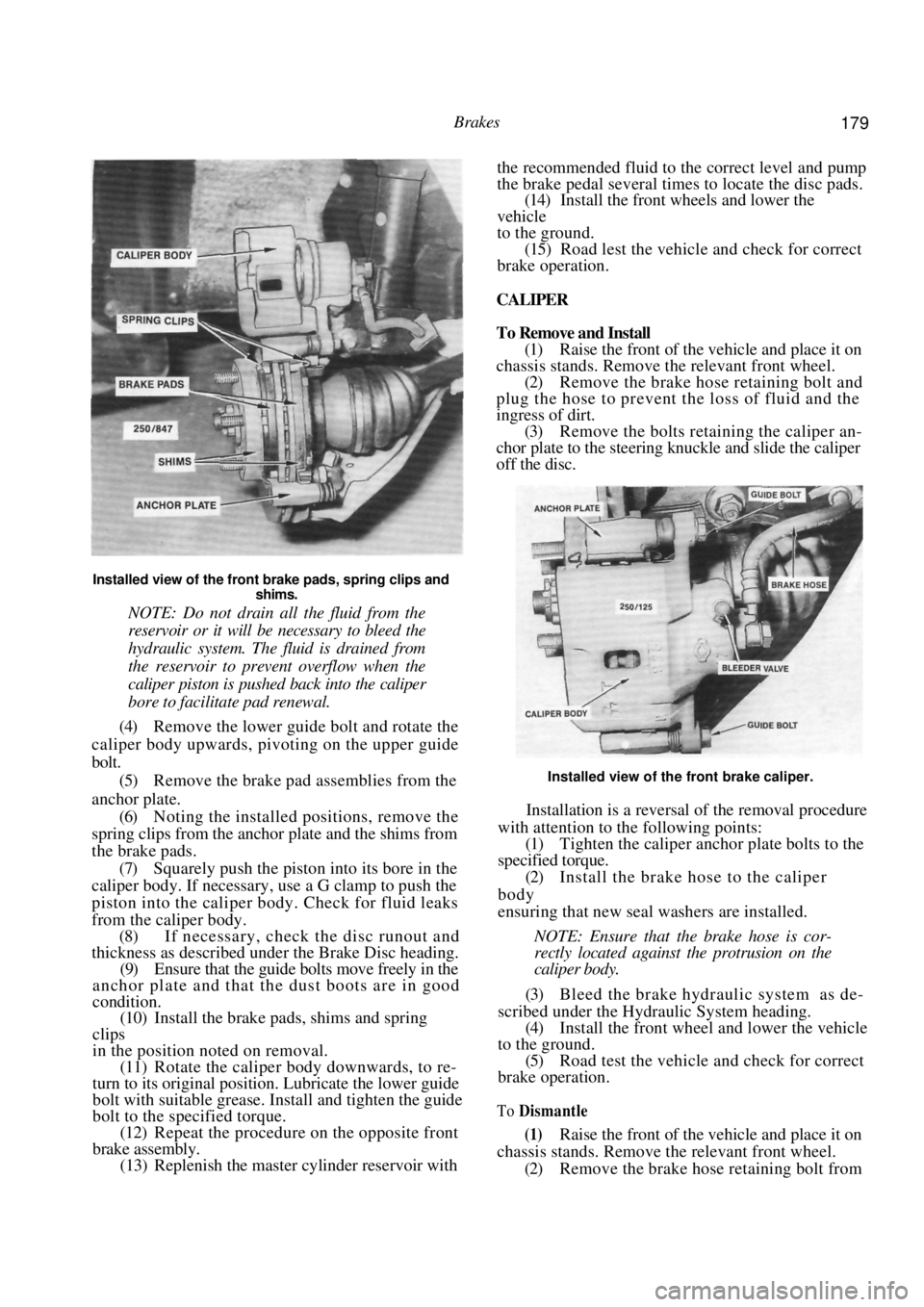
Installed view of the front brake pads, spring clips and shims.
NOTE: Do not drain all the fluid from the
reservoir or it will be necessary to bleed the
hydraulic system. The fluid is drained from
the reservoir to prevent overflow when the
caliper piston is pushed back into the caliper
bore to facilitate pad renewal.
(4) Remove the lower guide bolt and rotate the
caliper body upwards, pivoting on the upper guide
bolt.
(5) Remove the brake pad assemblies from the
anchor plate. (6) Noting the installed positions, remove the
spring clips from the anchor plate and the shims from
the brake pads.
(7) Squarely push the piston into its bore in the
caliper body. If necessary, us e a G clamp to push the
piston into the caliper b ody. Check for fluid leaks
from the calip er body.
(8) If necessary, check the disc runout and
thickness as described under the Brake Disc heading.
(9) Ensure that the guide bolts move freely in the
anchor plate and that the dust boots are in good
condition. (10) Install the brake pads, shims and spring
clips
in the position noted on removal. (11) Rotate the caliper body downwards, to re-
turn to its original position. Lubricate the lower guide
bolt with suitable grease. In stall and tighten the guide
bolt to the specified torque. (12) Repeat the procedure on the opposite front
brake assembly. (13) Replenish the master cylinder reservoir with the recommended fluid to the correct level and pump
the brake pedal several times to locate the disc pads.
(14)
Install the front wheels and lower the
vehicle
to the ground. (15) Road lest the vehicle and check for correct
brake operation.
CALIPER
To Remove and Install
(1) Raise the front of the vehicle and place it on
chassis stands. Remove the relevant front wheel. (2) Remove the brake hose retaining bolt and
plug the hose to prevent the loss of fluid and the
ingress of dirt. (3) Remove the bolts retaining the caliper an-
chor plate to the steering knuckle and slide the caliper
off the disc.
Installed view of the front brake caliper.
Installation is a reversal of the removal procedure
with attention to the following points:
(1) Tighten the caliper anch or plate bolts to the
specified torque.
(2) Install the brake hose to the caliper
body
ensuring that new seal washers are installed.
NOTE: Ensure that the brake hose is cor-
rectly located against the protrusion on the
caliper body.
(3) Bleed the brake hydraulic system as de-
scribed under the Hydraulic System heading. (4) Install the fron t wheel and lower the vehicle
to the ground. (5) Road test the vehicle and check for correct
brake operation.
To Dismantle
(1) Raise the front of the vehicle and place it on
chassis stands. Remove the relevant front wheel.
(2) Remove the brake hose retaining bolt from
Page 181 of 238
Brakes 181
chor plate to the steering knuckle and slide the caliper
off the brake disc. Suspend the caliper clear of the
work area using wire or cord.
(3) Suitably mark the location of the disc in
relation to the hub.
(4) Slide the disc off the hub. If the disc is
difficult to remove, install two M8 x 1.25 mm bolts in
the disc and by alternatively tightening the bolts,
remove the disc.
Do not use a hammer to remove the disc.
Installation is a reversal of the removal procedure
ensuring that the mating face s of the disc and hub are
clean and free from burrs and that the marks made on
removal are aligned.
To Inspect
(1) Inspect the machined faces of the disc for
scores, cracks, wear and signs of overheating. (2) Using a micrometer, measure the thickness
of the disc at several positi ons around the face of the
disc. Renew the disc if the minimum thickness is
below Specifications.
Inspect the brake discs for scoring and wear.
(3) If the disc thickness is satisfactory but the
disc is scored, machine equal amounts from the
machined face on each side of the disc, to restore the
serviceability of the disc.
NOTE: Disc machining is best entrusted to
a reliable brake specialist who can advise on
disc serviceability.
6. REAR DISC BRAKES
Special Equipment Required:
To Check Disc Runout — Dial gauge
To Check Disc Thickness — Micrometer
TO CHECK AND RENEW BRAKE PADS
( 1 ) Raise the rear of the vehicle and place it on
chassis stands. Remove the rear wheels.
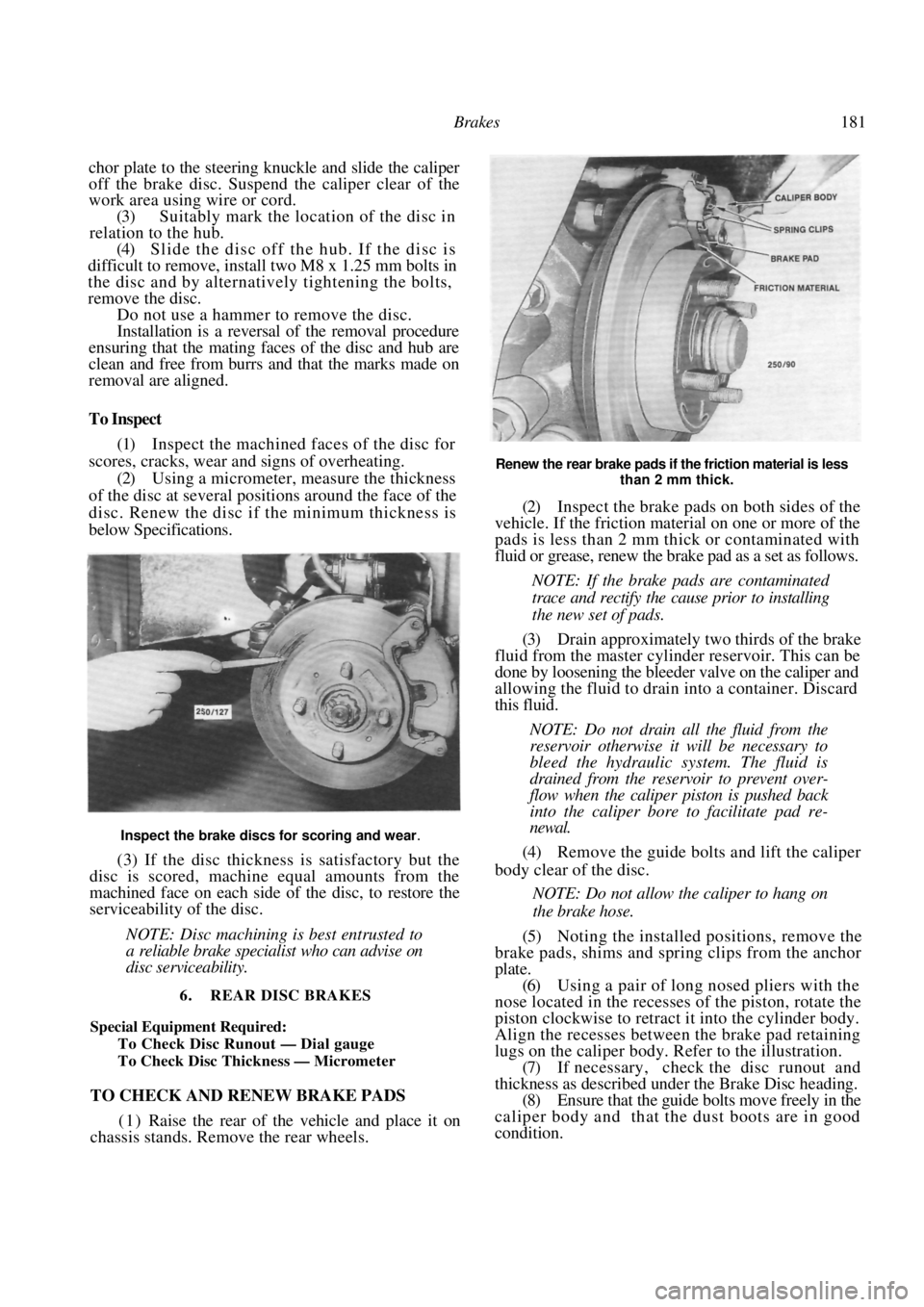
Renew the rear brake pads if the friction material is less
than 2 mm thick.
(2) Inspect the brake pads on both sides of the
vehicle. If the friction material on one or more of the
pads is less than 2 mm thick or contaminated with
fluid or grease, renew the brake pad as a set as follows.
NOTE: If the brake pads are contaminated
trace and rectify the cause prior to installing
the new set of pads.
(3) Drain approximately two thirds of the brake
fluid from the master cylinder reservoir. This can be
done by loosening the bleeder valve on the caliper and
allowing the fluid to drai n into a container. Discard
this fluid.
NOTE: Do not drain all the fluid from the
reservoir otherwise it will be necessary to
bleed the hydraulic system. The fluid is
drained from the reservoir to prevent over-
flow when the caliper piston is pushed back
into the caliper bore to facilitate pad re-
newal.
(4) Remove the guide bolts and lift the caliper
body clear of the disc.
NOTE: Do not allow the caliper to hang on
the brake hose.
(5) Noting the installed positions, remove the
brake pads, shims and spring clips from the anchor
plate.
(6) Using a pair of long nosed pliers with the
nose located in the recesses of the piston, rotate the
piston clockwise to retract it into the cylinder body.
Align the recesses between the brake pad retaining
lugs on the caliper body. Refer to the illustration. (7) If necessary, check the disc runout and
thickness as described under the Brake Disc heading.
(8) Ensure that the guide bolts move freely in the
caliper body and that the dust boots are in good
condition.
Page 197 of 238

Electrical System 197
Switch on all lamps and allow them to
illuminate for approximately five minutes to reduce
the charge of the battery and to apply a load to the
circuit.
Start the engine and gradually increase the
speed to approximately 2 500 rpm. The reading on
the ammeter should be approximately 75% of the
rated output of the altern ator. See Specifications.
Switch off all the lamps and run the engine at
1 500-2 000 rpm until the indicated charge is below
10 amps. The voltmeter should now read in excess of
13.6 volts.
NOTE: Should the alternator fail to reach
the specific output, the unit will have to be
removed and overhauled or a replacement
unit installed.
Should the voltage reading be above or
below Specifications, the regulator will have
to be renewed.
TO REMOVE AND INSTAL
Disconnect the negative battery terminal.
On 1.8 liter engines, remove the bolt secur-
ing the air cleaner intake duct and remove the air
cleaner intake duct. Drain the radiator by releasing the radiator
drain plug, located at the bottom of the radiator and
allow the coolant level to fall below the thermostat
housing level. NOTE: Refer to the Cooling and Heating
Systems section when refilling the radiator
coolant to its correct l
evel, failure to do so
could result in severe damage to engine
components.
Remove the retaining bolts securing the
thermostat housing, disconnect the hose from the
radiator and remove the thermostat housing and
radiator hose from the vehicle. Using a socket and extension bar, remove the
bolt securing the alternator to the drive belt tensioning
bar located under the alternator. On vehicles not equipped with air condition-
ing, remove the front splash guard from under the
front of the vehicle and remove the bolt securing the
alternator to the drive belt tensioning bar. Loosen the upper mounting bolts, slacken
the alternator drive belt and remove it from the
alternator pulley.
While supporting the alternator, remove the
upper mounting bolts and remove the alternator from
the vehicle. Installation is a reversal of the removal procedure
with attention to the following points:
Do not over tension the drive belt. Refer
to
the Engine Tune-up section for the correct belt
adjusting procedure. Ensure that the wiring and connectors are
securely located on the alternator.
Dismantled view of the Bosch alternator.
Page 237 of 238

Body 237
Installed view of the front seat mounting bolts.
Installation is a reversal of the removal procedure
with attention to the following points:
Lubricate the seat slides with multi-purpose
grease prior to installation of the seat.
Install all mounting bolts by hand prior to
tightening the mounting bolts securely.
REAR SEAT CUSHION
To Remove and Install
Firmly bump the lower front of the seat
cushion rearwards and up lo release the retaining clips
from the vehicle floor panel.
With the retaining clips released, lift the
front of the seat cushion and release the rear mounting
wires. (3) Lift the rear seat cushion out of the vehicle.
Installation is a reversal of the removal procedure
with attention to the following points:
Position the centre seat belts on top of the
rear seat cushion prior to in stallation of the cushion.
Ensure that the clips at the forward edge of
the seat cushion are proper ly engaged in the floor
panel.
REAR SEAT BACKREST
To Remove and Install
Fold the rear seat backrest forward.
Remove the outer seat backrest hinge bolts.
Pull each backrest to wards the door and off
the centre hinge pins. Remove the rear seat backrest from the
vehicle. Installation is a reversal of the removal procedure.
12. VEHICLE CLEANING
CLEANING THE EXTERIOR
In order to remove dirt and road grime and thus
preserve paint finish, vehicles in continuous use
should be washed at least once a week.
Before washing the paintwork, it is good policy to
first hose all dirt from the underbody and clean out
the drain holes in the doors and sill panels.
Hose the vehicle to remove as much grit as
possible and wash using a clean chamois or sponge,
ensuring that the chamois or sponge is free from dirt
or grit which could scratch the paint surface.
Avoid washing the vehicle in bright sunlight with
high temperature as this will give the paintwork a
streaky watermarked finish.
If necessary, wash the vehicle using a reputable
brand Wash and Wax liquid. The Wash and Wax
liquid will restore the paint luster and leave the
paintwork with a protective coating of wax.
After a period it may become necessary to polish
the vehicle in order to remove built up foreign matter
and give the paintwork maximum protection from
industrial fall-out and salt from sea air etc. Before
polishing the paintwork, always wash the surface to
remove as much road grime as possible. When
polishing follow the polishing instructions which come
with the polish.
NOTE: Grease, oil or tar on the paint
surface can be removed with a little kerosene
or white spirits. To prevent staining, wash
and polish the affected area as soon as the
grease, oil or tar is removed.
CLEANING VINYL TRIM
To maintain the vinyl interior trim in good
condition it should be regularly vacuumed to remove
loose dirt and then wiped with a dry or damp cloth.
If the trim is soiled or stained, the following
cleaning procedure is recommended:
Using warm water, cheese cloth and a mild
soap, thoroughly wash the affected areas.
Repeat the operation using damp cheese
cloth only.
To complete the cleaning operation wipe the
trim over with a dry piece of cheese cloth.
NOTE: If the interior trim is badly soiled or
stained, wash with a reputable brand of
upholstery cleaner care fully following the
makers instructions.
CLEANING CLOTH TRIM
Loose dirt and dust on cloth trim should be
removed with a vacuum cleaner or a very soft brush.
Do not use a whisk brush or any other type of coarse
brush or damage to the cloth could result. If the fabric
is soiled the following cl eaning procedure is recom-
mended.
Sponge the fabric ligh tly with warm water
containing a little detergen t and household ammonia.
After sponging, rub the fabric lightly. If
soiling is still apparent, re peat the sponging operation.
Use a clean dry cloth to soak up excess fluid.