8-198 AUDIO SYSTEM - Front Speaker / Rear Speaker
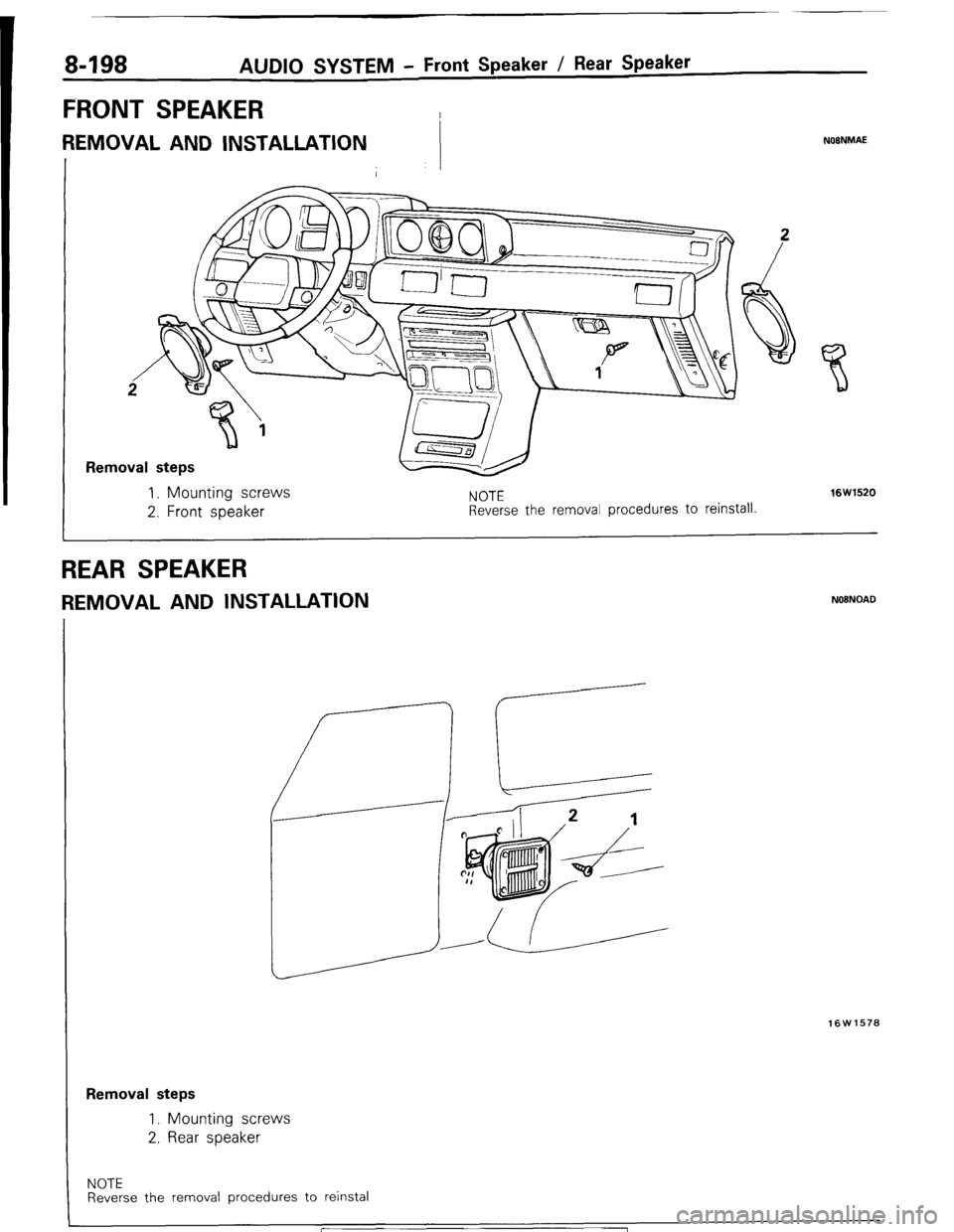
FRONT SPEAKER
REMOVAL AND INSTALLATION NOONMAE
Removal steps
1. Mounting screws
2. Front speaker
NOTE
Reverse the removal procedures to reinstall. 16W1520
REAR SPEAKER
REMOVAL AND INSTALLATION
16Wl570
Removal steps
1. Mounting screws
2. Rear speaker
NOTE
Reverse the removal procedures to reinstal
1 STB Revision
AUDIO SYSTEM - Antenna 8-199
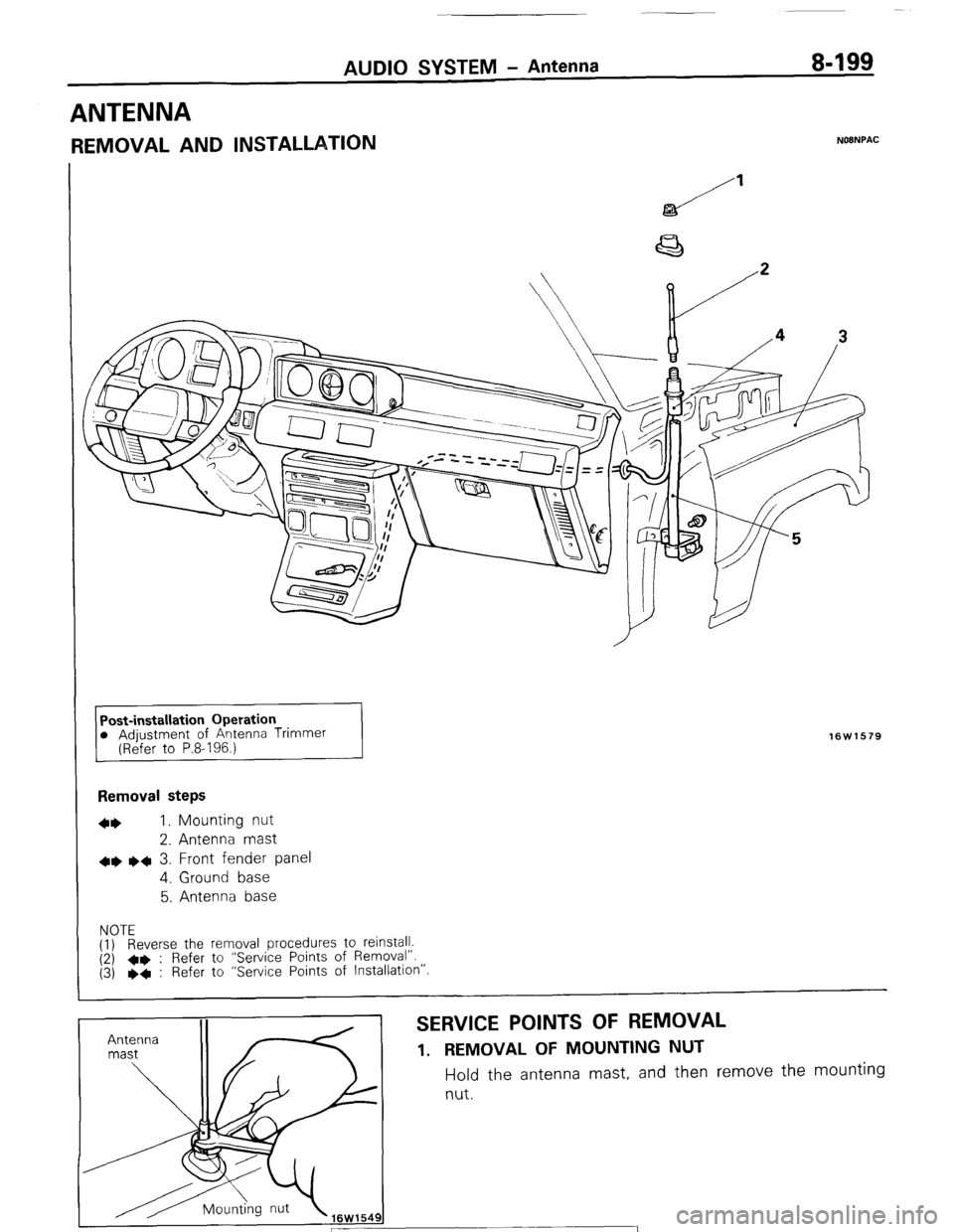
ANTENNA
REMOVAL AND INSTALLATION NOSNPAC
Removal steps
4* 1. Mounting nut
2. Antenna mast
+e w+ 3. Front fender panel
4. Ground base
5. Antenna base
NOTE
(1) Reverse the removal procedures to reinstall.
(2) +* : Refer to “Service Points of Removal”.
(3) l
* : Refer to “Service Points of Installation”
16W1579
SERVICE POINTS OF REMOVAL
1. REMOVAL OF MOUNTING NUT
Hold the antenna
mast, and then remove the mounting
8-200 AUDIO SYSTEM - Antenna/Noise Suppression
3. REMOVAL OF FRONT FENDER PANEL
Refer to GROUP 23 Body-Front Fender
SEFiVlCE ff OINTS OF INSTALLATION
3. IbSTALLATION OF FRONT FENDER PANEL
Refer to GROUP 23 Body-Front Fender.
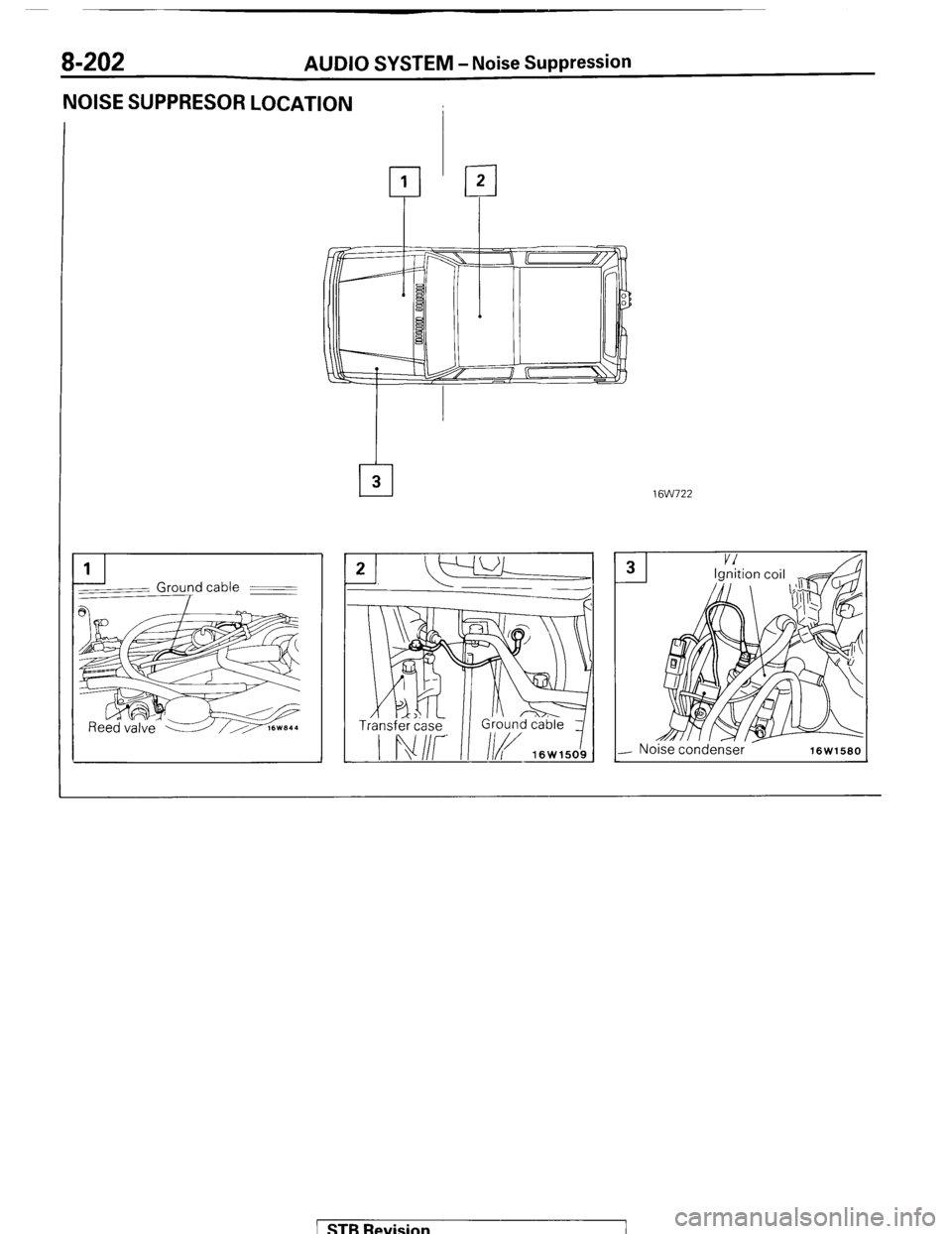
NOISE SWPRESSION N08NOAA
I. Noise interfering with radio reception may be roughly
classified as follows:
(1) Noise produced by the vehicle itself
Noise from the ignition circuit, alternator circuit, etc
(2) Noise generated in the radio itself
Thermal noise from transistors, IC, resistor, etc.
(3) Atmospheric noise
Noise from other cars, neon signs, etc.
2. The radio has devices to suppress noise of the radio itsel f
3. and atmospheric noise, but it is difficult to eliminate them
completely. Noise produced by the vehicle includes whin-
ing from the alternator system, and a strong, impulsive,
fast popping noise from the ignition system.
Before performing any checking or adjustments, first
confirm the following points.
Adjust the antenna trimmer completely.
Set the push buttons (tuning) properly.
Extend the antenna all the way.
PREVENTION OF IGNITION CIRCUIT NOISE
A resistance-equipped cable is used for the high-tension cable
in order to prevent noise; however, if any noise from the
ignition circuit does occur, check the tightness and ground
connection of the positive (+) terminal of the noise filter, and,
if necessary, check the noise filter.
Caution
Be careful not to connect the noise filter to the hightension
cable; doing so could damage the noise filter.
PREVENTION OF OTHER CIRCUIT NOISE
1. For other noises, take necessary corrective actions in
accordance with the following items and the NOISE
SUPPRESSION CHART.
2. Polish the grounding cable terminal, and connect it proper-
ly.
3. Polish the pillar antenna ground terminal, and connect it
properly.
4. Ground electric parts completely.
5. Keep the antenna cable and speaker lead wire away from
other electric wiring.
STB Revision
AUDIO SYSTEM - Noise Suppression 8-201
NOISE SUPPRESSION CHART
Symptom
Unusual noise related to
engine speed. ’ Remedy
Securely ground the engine, frame and/or body and engine
hood.
- Ground wire
16E71C
“Clatter” noise related to the
Turn signals
flashing of turn signal lights Connect a 0.5 FF noise-suppression capacitor to the 6 terminal
of the flasher unit.
Abnormal noise when
the horn is operated. Horn ?L - 0.5pF noise suppression
capacitor
16E71:
1. Connect a 0.5 FF noise-suppression capacitor to the + B
terminal of the horn.
2. For an FM radio, connect an LC filter to the horn terminals.
Noise when the wind-
shield washer oprates. Washer motor Horn LC filter
16E71:
1. Connect a 0.5 PF noise-suppression capacitor between
the terminal of the washer motor and the power source
wire.
2. For an FM radio, connect an LC filter between the terminal
of the washer motor and the power source wire.
Unusual noise when the
engine is started. Water tempera-
ture gauge unit Connect a 0.1 p,F noise-suppression capacitor to the terminal o
the water temperature gauge unit.
0.1 PF noise suppression
capacrtor
1 STB Revision