Page 852 of 1865

7A ASSEMBLY
8. Fit the crank lever in between the change arm and
the control end, and connect the crank lever shaft
to the crank lever.
9. Align the pin holes of the crank lever shaft and the
clutch housing, and insert the pin.
Note
Use a new O-ring for the crank lever shaft.
86U07A-113
10. Install the gate © and the shift rod ©, and tight-
en the gate mounting bolt.
Note
The mark (indicated by the arrow in the fig-
ure) and the gate mounting bolt hole must be
in the same direction.
76U07A-121
11. Install the reverse idle gear and the reverse idle
shaft.
12. Connect the magnet to the clutch housing.
13. Align the end of the interlock sleeve with the con-
trol lever indicated by the arrow, and, at the same
time, face the reverse idle shaft screw hole in the
direction shown in the figure.
76U07A-122
14. Apply a thin coat of sealant to the contact surfaces
of the clutch housing and transmission case, tight-
en the transaxle case installation bolts to the speci-
fied torque.
Tightening torque:
18—26 N m (1.8—2.7 m-kg, 13—18.8 ft-lb)
15. Insert the SST to driveshaft coupling hole.
7A-46
Page 868 of 1865
7B OUTLINE
OUTLINE
SPECIFICATIONS
Model G4A-EL (EC-AT) G4A-HL (4-speed) Model G4A-EL (EC-AT)
FE engine F8 engine
Torque converter stall torque ratio 1.710—1.900
: 1
1.900-2.100
: 1
Gear ratio
First 2.800
Gear ratio
Second 1.540
Gear ratio Third 1.000 Gear ratio
Fourth (OD) 0.700
Gear ratio
Reverse 2.333
Final gear ratio 3.700
Number
of
drive plates/ driven plates
Forward clutch 3/3
Number
of
drive plates/ driven plates
Coasting clutch 2/2
Number
of
drive plates/ driven plates 3-4 clutch 5/5 4/4 Number
of
drive plates/ driven plates
Reverse clutch 2/2
Number
of
drive plates/ driven plates
Low and reverse brake 3/3 4/4
Servo diameter (Piston outer dia./retainer inner dia.) mm (in) 78/53 (3.07/2.09) 78/49 (3.07/1.93) 78/56 (3.07/2.20)
Speedometer gear ratio (Driven/Drive gear) 20
: 25 or
21
: 25
Automatic transmission luid
Type Dexron
n or
MED
Automatic transmission luid Capacity
liters (US qt, Imp
qt)
6.8 (7.2, 6.0)
76G07B-002
7 B—2
Page 888 of 1865
7B TROUBLESHOOTING (G4A-EL)
STEP 2 (PRELIMINARY INSPECTION)
In this step, the fundamental points related to the automatic transaxle are checked. These points must
be kept in the correct condition at all times in order to assure proper operation of the automatic transaxle.
1. Automatic Transmission Fluid (ATF)
Check ATF level and condition. (Refer to page 7B—71)
2. Selector Lever
Check selector lever position and adjust if necessary. (Refer to page 7B—72)
76G07B-022
3. Throttle cable
(1) Check the inner and outer cable for damage.
(2) Make sure that the accelerator operates
smoothly.
76G07B-023
4. Idle Speed
Check idle speed. (Refer to Section 4B)
5. Tire Inflation Pressure
Check tire inflation pressure. (Refer to Section 12)
76G07B-024
6. Inhibitor Switch
Check the inhibitor switch for operation. (Refer to
page 7B—65)
76G07B-025
7B-22
Page 895 of 1865

TROUBLESHOOTING (G4A-EL) 7B
7. Perform the stall test for the following ranges in the same manner.
(1) D range (4) L range
(2) D range (Hold) (5) L range (Hold)
(3) S range (Hold)
Caution
Be sure to allow sufficient cooling time between each stall test.
Engine stall speed: D.S.L range 2170—2270 rpm
R range 2130—2230 rpm
Note
The stall test can be performed with the EC-AT Tester in place of a tachometer.
Drum stall speed indication: 0 rpm
76G0/B-029
Evaluation
Condition Possible cause
Above specification
In all ranges Insufficient line
pressure
Worn oil pump
Above specification
In all ranges Insufficient line
pressure Oil leakage from oil pump, control valve, and/or transmission case
Stuck pressure regulator valve
Above specification
In forward ranges Forward clutch slipping One-way clutch 1 slipping
Above specification
In D range One-way clutch 2 slipping
Above specification
In S (Hold) and L (Hold) ranges Coasting clutch slipping
Above specification In D (Hold) and S (Hold) ranges 2-4 brake band slipping Above specification
In R, L and L (Hold) ranges Low and reverse brake slipping
Above specification
In R range
Low and reverse brake slipping Reverse cluch slipping Perform road test to determine whether problem is low and reverse brake or reverse clutch
a) Engine brake applied in 1st ...Reverse clutch
b) Engine brake not applied in 1st ...Low and reverse brake
Within specification All shift control elements within transmission are func-
tioning normally.
Below specification
Engine out of tune
Below specification One-way clutch slipping within torque converter
86U07B-036
7B-29
Page 942 of 1865

7B ON-VEHICLE MAINTENANCE
Line pressure decreases
Line pressure increases
86U07B-483
Protector
-7 / Throttle cable
86U07B-080
(3) Adjust the locknuts in a counterclockwise direc-
tion until the line pressure decreases to the
specification. Tighten the locknuts.
Specified pressure: 432—450 kPa
(4.4—4.6 kg/cm2, 63—66 psi)
Note
Transmission in P range
5. Turn off the engine.
6. Reinstall the square head plug.
Tightening torque:
5—10 N m (50—100 cm-kg, 43—87 in-lb)
7. Fully open the throttle valve; then crimp the pin with
the protector installed as shown.
8. Remove the protector.
Adjustment (G4A-HL)
1. Remove the splash shield next to the left front tire.
2. Remove the square head plug T and install the
SST
3. Shift into P range and start the engine. Warm up
the engine to normal operating temperature, and
adjust the idle speed.
Idle speed: 900 -5o rpm
76G07B-096
3 tn tn
(1)
L
Counter- ^ clockwise
Throttle pressure
beeing to increase
I Adjusting point
Position of locknuts
Clockwise
4. Adjust locknuts as follows:
When the locknuts are moved, throttle pressure is
increased or decreased as shown. Adjust the lock-
nuts to the correct position using the following
procedure.
(1) Initially install the locknuts fully away from the
throttle cam. (Loosen the cable all the way)
(2) Adjust the locknuts in a clockwise direction as
viewed from the front of the vehicle until the
throttle pressure begins to increase above the
specification shown below.
76G07B-097
7B—76
Page 943 of 1865
ON-VEHICLE MAINTENANCE 7B
Line pressure decreases
Line pressure increases
76G07B-098
Protector
NAAA/V^
/NA/w^nJ
Throttle cable Crimp
86U07B-080
(3) Adjust the locknuts in a counterclockwise direc-
tion until the throttle pressure decreases to the
specification. Tighten the locknuts.
Specified pressure: 88—108 kPa
(0.9—1.1 kg/cm2, 13—16 psi)
Note
Transmission in P range
5. Turn off the engine.
6. Reinstall the square head plug.
Tightening torque:
5—10 N m (50—100 cm-kg, 43—87 in-lb)
7. Fully open the throttle valve; then crimp the pin with
the protector installed as shown.
8. Remove the protector.
CONTROL VALVE BODY
Note
Remove the control valve body only if
troubleshooting indicates a probable failure.
Removal
1. Remove the throttle cable. (Refer to 7B—73)
2. Disconnect the solenoid connector.
76G07B-099
3. Remove the control valve body.
Disassembly, Inspection and Assembly
Refer to control valve body section of INSPECTION
AND REPAIR.
86U07B-082
7B—77
Page 1376 of 1865
1 0 ELECTRICAL COMPONENTS OF ELECTRONICALLY-CONTROLLED POWER STEERING (ECPS)
76G10X-020
76G10X-021
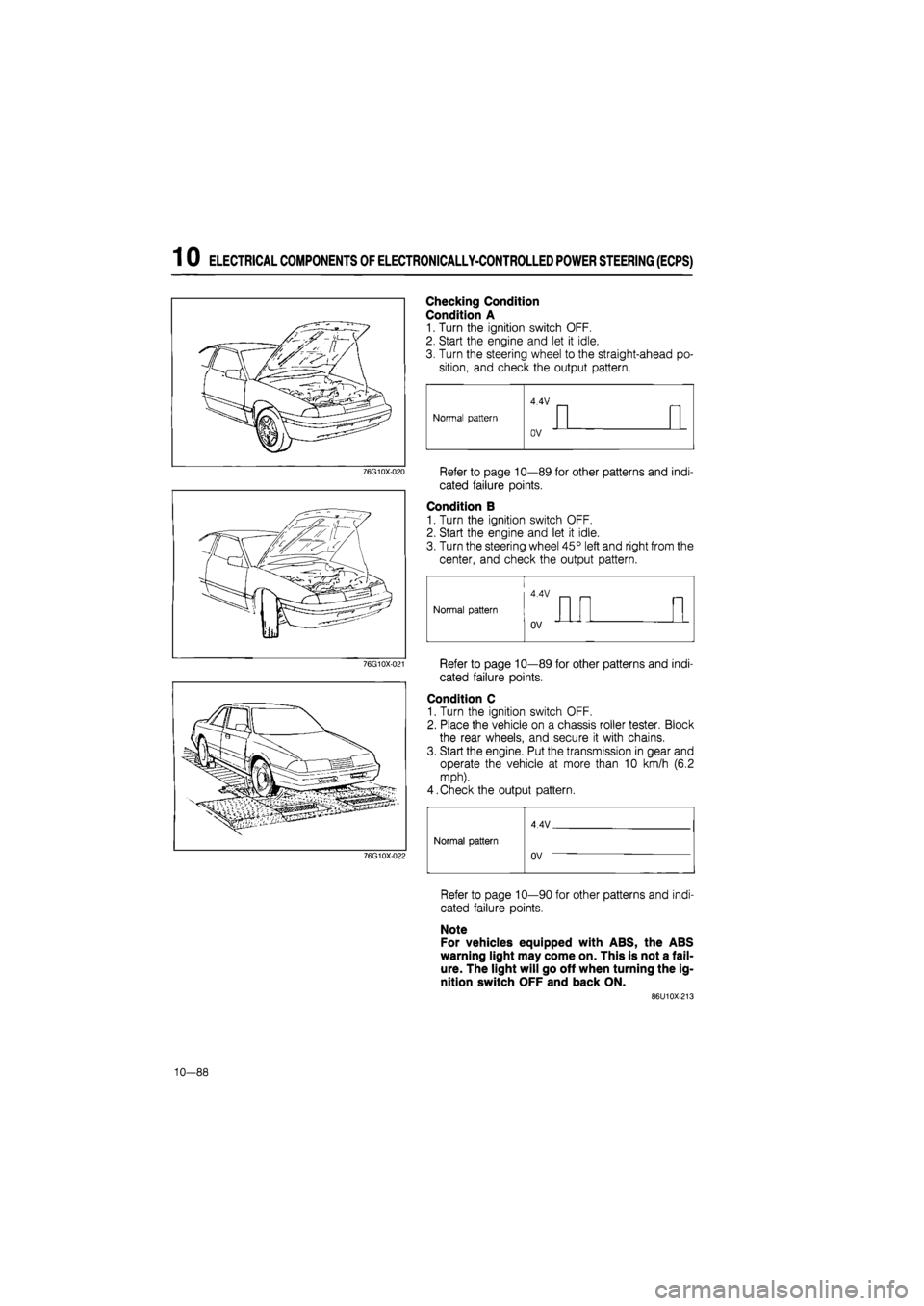
Checking Condition
Condition A
1. Turn the ignition switch OFF.
2. Start the engine and let it idle.
3. Turn the steering wheel to the straight-ahead po-
sition, and check the output pattern.
Refer to page 10—89 for other patterns and indi-
cated failure points.
Condition B
1. Turn the ignition switch OFF.
2. Start the engine and let it idle.
3. Turn the steering wheel 45° left and right from the
center, and check the output pattern.
Refer to page 10—89 for other patterns and indi-
cated failure points.
Condition C
1. Turn the ignition switch OFF.
2. Place the vehicle on a chassis roller tester. Block
the rear wheels, and secure it with chains.
3. Start the engine. Put the transmission in gear and
operate the vehicle at more than 10 km/h (6.2
mph).
4.Check the output pattern.
76G10X-022
Normal pattern
4 4V
Normal pattern Normal pattern
uV
Refer to page 10—90 for other patterns and indi-
cated failure points.
Note
For vehicles equipped with ABS, the ABS
warning light may come on. This is not a fail-
ure. The light will go off when turning the ig-
nition switch OFF and back ON.
86U10X-213
10—88
Page 1384 of 1865
1 0 ELECTRICAL COMPONENTS OF 4-WHEEL STEERING
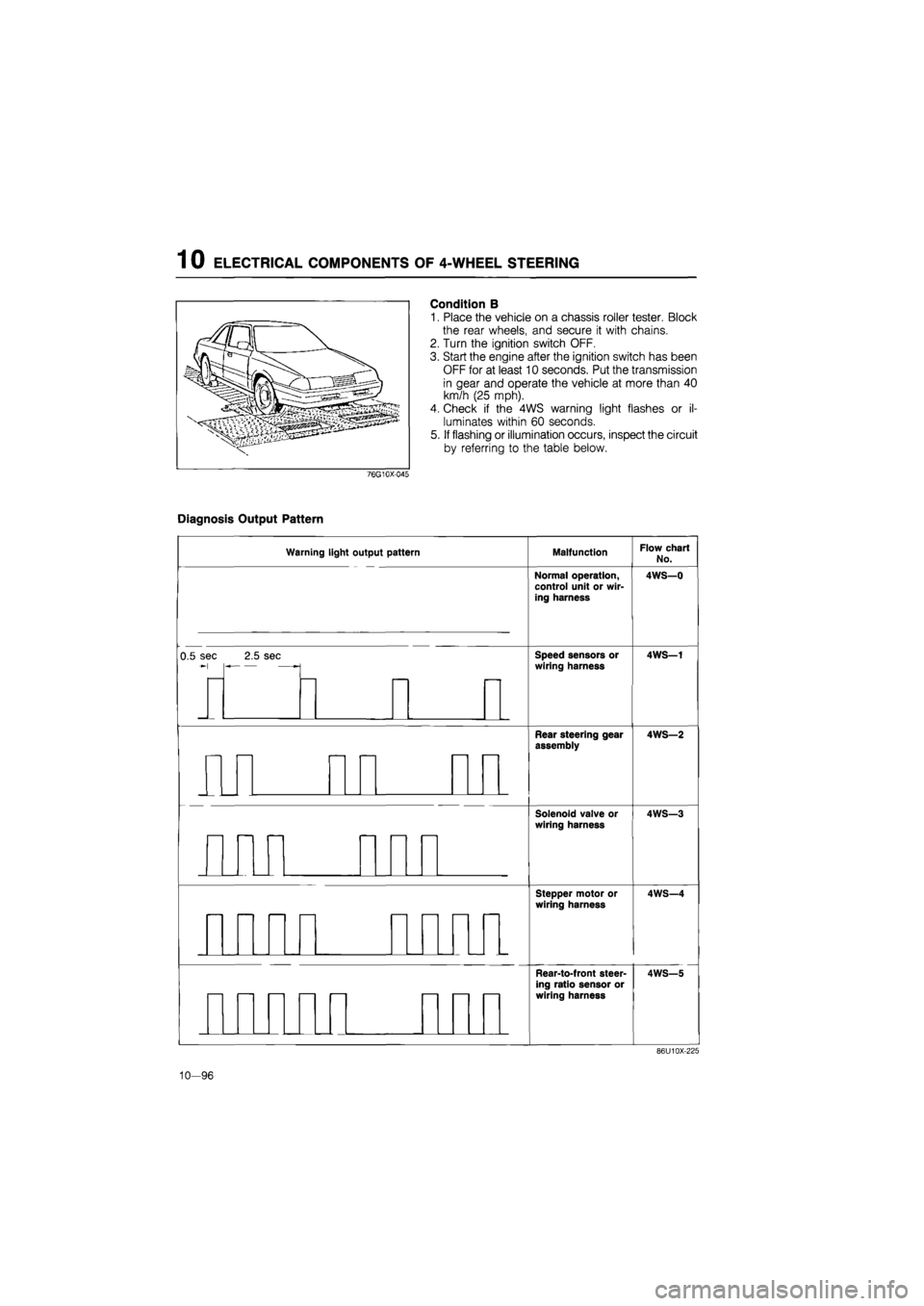
Condition B
1. Place the vehicle on a chassis roller tester. Block
the rear wheels, and secure it with chains.
2. Turn the ignition switch OFF.
3. Start the engine after the ignition switch has been
OFF for at least 10 seconds. Put the transmission
in gear and operate the vehicle at more than 40
km/h (25 mph).
4. Check if the 4WS warning light flashes or il-
luminates within 60 seconds.
5.
If
flashing or illumination occurs, inspect the circuit
by referring to the table below.
76G10X045
Diagnosis Output Pattern
Warning light output pattern
0.5 sec —i 2.5 sec
Malfunction
Normal operation, control unit or wir-ing harness
Speed sensors or
wiring harness
Flow chart
No.
4WS—0
4WS—1
Rear steering gear
assembly
Solenoid valve or wiring harness
Stepper motor or wiring harness
Rear-to-front steer-ing ratio sensor or wiring harness
4WS—2
4WS—3
4WS—4
4WS—5
86U10X-225
10-96