1986 CHEVROLET CORVAIR maintenance
[x] Cancel search: maintenancePage 4 of 56
Downloaded from www.Manualslib.com manuals search engine 1968 CORVAIR OWNER'S MANUAL
OPERATION & MAINTENANCE INSTRUCTIONS
TABLE OF CONTENTS
Page
Operating Instructions ....................... 7
Instruments .. . . . . . . . . . . . . . . . . . . . . . . • . . . .. 13
Controls ................................. 15
Cleaning Hints
............................ 30
Maintenance and Lubrication ........... . . . . . .. 32
Specifications ............................. 44
Minor Trouble Shooting Guide ................ 46
Minor Trouble Shooting Procedures ............. 47
Trailer Hauling ....................... :.... 50
Index ................................... 52
All information contained in this booklet is the latest product information available at the time of printing. The right is reserved to make changes at any time without notice.
CHEVROLET MOTOR DIVISION • GENERAL MOTORS CORPORATION
©General Motors Corporation 1967
DETROIT, MICHIGAN 48202
FIRST EDITION AUGUST, 1967 PART NO. 3927529
IMPORTANT
SAFETY
AND
ANTI-THEFT
INFORMATION TO HELP
YOIj
ENJOY
THE
MAXIMUM
IN
VEHICLE
SATISFACTION
Page 5 of 56
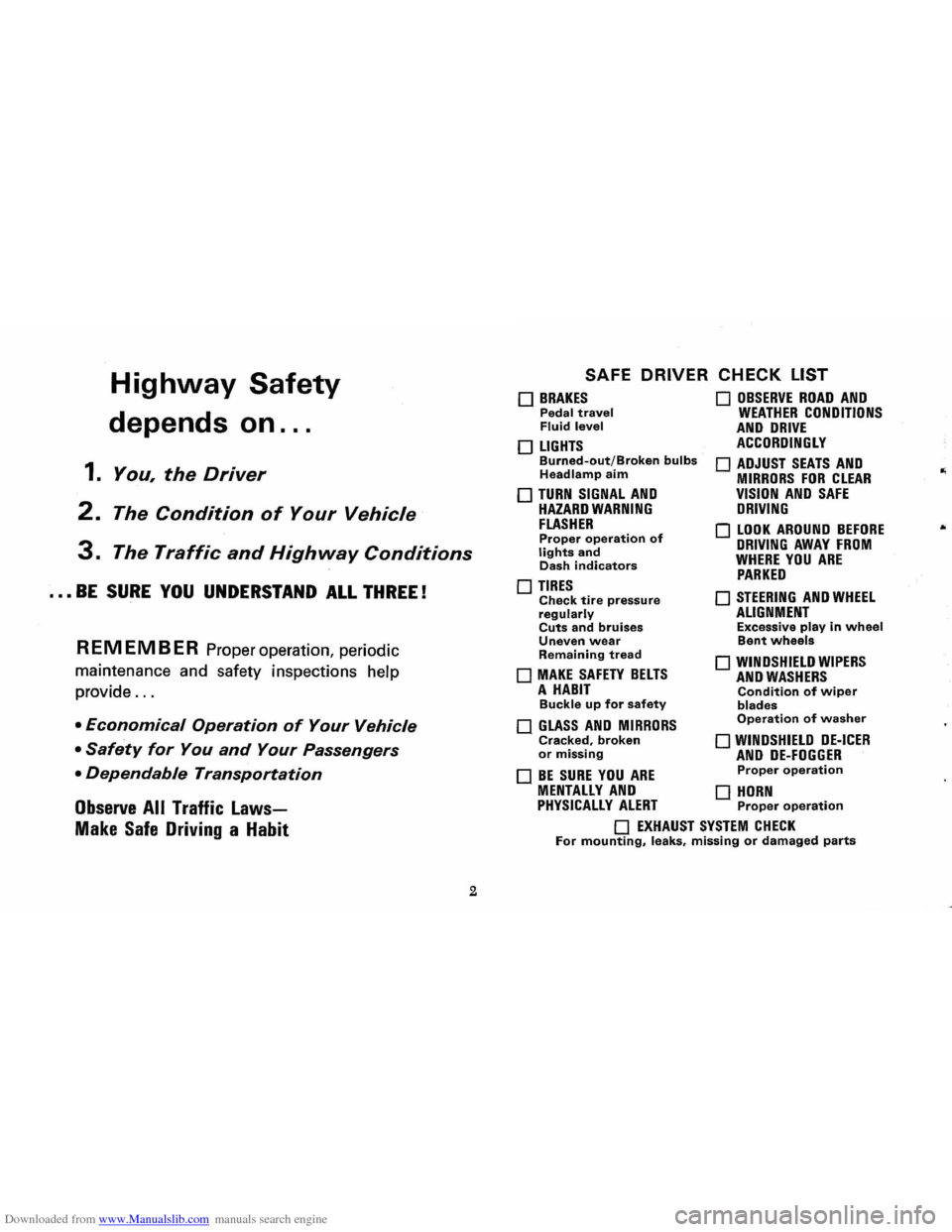
Downloaded from www.Manualslib.com manuals search engine Highway Safety
depends on ...
1. You, the Driver
2. The Condition of Your Vehicle
3. The Traffic and Highway Conditions
••• BE SURE YOU UNDERSTAND ALL THREE!
REMEMBER Proper operation, periodic
maintenance and safety inspections help
provide
...
• Economical Operation of Your Vehicle
• Safety for You and Your Passengers
• Dependable Transportation
Observe All Traffic Laws
Make Safe Driving a Habit
2
SAFE DRIVER CHECK LIST
o BRAKES Pedal travel Fluid level
o LIGHTS Burned-out/Broken bulbs Headlamp aim
o TURN SIGNAL AND HAZARD WARNING FLASHER Proper operation of lights and Dash indicators
o TIRES Check tire pressure regularly Cuts and bruises Uneven wear Remaining tread
o MAKE SAFETY BELTS A HABIT Buckle up for safety
o GLASS AND MIRRORS Cracked, broken or missing
o BE SURE YOU ARE
o OBSERVE ROAD AND WEATHER CONDITIONS AND DRIVE ACCORDINGLY
o ADJUST SEATS AND MIRRORS FOR CLEAR VISION AND SAFE DRIVING
o LOOK AROUND BEFORE DRIVING AWAY FROM WHERE YOU ARE PARKED
o STEERING AND WHEEL ALIGNMENT Excessive play in wheel Bent wheels
o WINDSHIELD WIPERS AND WASHERS Condition of wiper blades Operation of washer
o WINDSHIELD DE-ICER AND DE-FOGGER Proper operation
MENTALLY AND 0 HORN PHYSICALLY ALERT Proper operation
o EXHAUST SYSTEM CHECK For mounting, leaks, missing or damaged parts
Page 7 of 56
Downloaded from www.Manualslib.com manuals search engine A WORD ABOUT ... VEHICLE SAFETY AND THE INI
TIAL FEDERA~ MOTOR VEHICLE SAFETY STANDARDS
Chevrolet has for many years been a leader in the field
of automotive safety. Almost every advance in design and engineering since the jnception of the industry has contributed
to the safety, reliability and durability of our cars. Continua
tion of this important and vital trend is exemplified in your
1968 Chevrolet. Important safety advances are designed to
aid in avoiding accidents, and in reducing injuries during the accident and as a result of the accident.
But remember-it takes more than a safe car to avoid
accidents. Observe all traffic laws, make safe driving a habit and maintain your car in top condition.
Your
n!,)w 1968 Chevrolet conformed to all federal motor
vehicle safety standards applicable at time of manufacture.
Effectiveness of these safety features ~an best be continued
through periodic vehicle inspection and regular maintenance .
Th~ initial Federal Motor Vehicle Safety Standards encompass a number of systems on all passenger cars. To promote better understanding of these standards, listed are those
standards applicable to passenger cars, and the purpose and
scope of each.
Initial
Federal Motor Vehicle Safety Standards (Effective January 1, 1968*)
Amendment to certain of these
Standards and additional Standards that would apply to 1968 Model passenger cars
manufactured after January 1, 1968 , were under cons ideration by the National Highway Safety Bureau at the time this Owner's Manual was prepared. '
STANDARD NO. 101
Control Location and Identification
Purpose and Scope. This standard specifies the requirements
for location and identification of certain controls to facilitate
their selection and ensure their accessibility.
4
STANDARD NO. 102 Transmission Shift Lever Sequence, Starter Interlock, and Transmission Braking Effect Purpose and Scope. This standard specifies the requirements
for the transmission shift lever sequence, a starter interlock, and for a braking effect of automatic transmissions, to requce the likelihood of shifting errors, starter engagement with vehicle in drive position, and to provide supplemental braking at speeds below 25 miles per hour.
STANDARD NO. 103 Windshield Defrosting and Defogging Purpose lind Scope. This standard specifies requirements
for providing vision through the windshield during frosting and fogging conditions.
STANDARD NO. 104 Windshield Wiping and Washing Systems
Purpose and Scope. This standard specifies requirements
for windshi eld wiping and washing systems.
ST ANDARD NO. 105 Hydraulic Service Brake, Emergency Brake, and Parking Brake Systems
Purpose and Scope. This standard specifies requirements
for hydraulic service brake, emergency brake, and parking
brake systems intended to ensure adequate braking performance under normal and emergency conditions.
STANDARD NO. 106 Hydraulic Brake Hoses Purpose and Scope. This standard specifies requirements
for hydraulic brake hoses that will reduce brake failures due to fluid leakage.
STANDARD NO. 107 Reflecting Surfaces
Purpose and Scope. This standard specifies reflecting surface requir ements for certain vehicle components in the driver's field of view.
..
Page 9 of 56
Downloaded from www.Manualslib.com manuals search engine A WORD FROM CHEVROLET ...
This Owner's Manual contains important information regarding the operation
and maintenance of your Corvair.
In order to obtain maximum enjoyment and usage from your car, we sug
gest that you familiarize yourself with the contents of this booklet and follow
the recommendations outlined.
Your Chevrolet dealer has the trained personnel and specialized equipment
to properly service your Corvair. Have
him inspect your car and perform any
maintenance or adjustments required.
We would like to take this opportunity to thank you for choosing a Chevrolet
product-and assure you of our continuing interest in your motoring pleasure and
satisfaction.
6
Page 10 of 56
Downloaded from www.Manualslib.com manuals search engine OPERATING INSTRUCTIONS
I
YOUR CORVAIR'S FIRST FEW HUNDRED MILES OF DRIVING
Sound design and precision manufacturing methods
will permit you to operate your new Corvair without
adhering to a formal "break-in" schedule. However,
during the first few hundred miles of driving you can,
by observing a few simple precautions, odd to the future
performance and economy of your cor.
It is recommended that your speed during the first
500 miles be confined to a maximum of 60 MPH, but
do not drive for extended periods at anyone constant
speed,
either fast or slow. During this period, ovoid full
throttle starts and unnecessary, quick abrupt stops .
Gentle braking during the first few hundred miles of
operation will result in longer broke life and better
future performance. Avoid unnecessary, hard stops espe
cially during the first 200 miles of operation since broke
misuse during this period will destroy much future broke
efficiency.
Always drive at a moderate speed until the engine
has completely warmed up.
DRIVING FOR ECONOMY
Proper maintenance and wise operation will com
bine to help you achieve maximum fuel economy with
your Corvair. Your Authorized Chevrolet Dealer can
properly tune and maintain your car but wise operation
is your responsibility. Give the cor sufficient warm-up
time, do not make "Full Throttle" storts or unnecessary
severe stops,
and drive at reasonable speeds and as
steady as traffic permits to gain the benefits of all the
economy built into your Corvair.
CAUTION: Avoid inhaling exhaust gases especially in an enclosed area such as a garage. Exhaust gases
contain
a percentage of carbon monoxide which is a potentially lethal gas that, by itself, is tasteless, color
less, and odorless. The exhaust system should be inspected for proper mounting, leaks and missing or damaged
parts each time the vehicle is raised for lubrication or oil change service.
7
Page 35 of 56
Downloaded from www.Manualslib.com manuals search engine MAINTENANCE AND LUBRICATION
FUEL REQUIREMENTS
Your Corvair is designed to operate efficiently on
"Regular" or "Premium" grade fuels, commonly sold in
the United States and Canada, depending on the engine
installed in your car. The table below indicates the fuel
grade requirements for various Corvair engines.
ENGINE
95 H.P. TURBO-AIR
110 H.P. TURBO-AIR
140 H.P. TURBO-AIR
FUEL GRADE
Regular
Premium
Premium
Use
of a fuel which is too low in anti-knock quality
will result in "spark knock." Since the anti-knock quality
of all regular grade or of all premium grade gasolines
is not the same and factors such as altitude, terrain and
air temperature affect operating efficiency, knocking may
result even though you are using the grade of fuel rec
ommended for your engine. If persistent knocking is en
countered, it may be necessary to change to a higher
grade of gasoline and, If knocking continues, consult
your authorized Chevrolet Dealer.
In any case, continuous or excessive knocking may
result in engine damage and constitutes misuse of the en
gine for which the Chevrolet Motor Division is not re
sponsible under terms of the Manufacturer's New Vehicle
Warranty.
32
Operation in a Foreign Country
If you plan to operate your Corvair outside the con
tinental limits of the United States or Canada, there is
a possibility that the best fuels available are so low in
anti-knock quality that excessive knocking and serious
engine damage may result from their use. To minimize
this possibility,
write to Chevrolet Motor Division, Gen
eral Motors Corporation, Owner Relations Department,
Detroit,
Michigan 48202, giving: (1) The compression
ratio of your engine (see page 44 or obtain from your
dealer); (2) The vehicle identification number (see page
44); (3) The country or countries in which you plan to
travel.
You
will be furnished details of adjustments or
modifications which should be made to your engine by
your Chevrolet Dealer prior to your departure.
Failure to make the necessary changes in your car and
subsequent operation under conditions of continuous or
excessive knocking is considered misuse of the engine for
which the Chevrolet Motor Division is not responsible un
der terms of the Manufacturer's New Vehicle Warranty.
After arriving in a foreign country, contact the near
est authorized General Motors Dealer for brand names
of the best fuels available and advice as to where they
may be purchased.
Page 40 of 56
Downloaded from www.Manualslib.com manuals search engine PERIODIC MAINTENANCE AND LUBRICATION
The time or mileage intervals on the following pages
are intended as a general guide for establishing regular
maintenance and lubrication periods for your Corvair.
Sustained heavy duty or high speed operations or oper-
A WORD ABOUT VEHICLE EMISSIONS
All new 1968 Corvairs are certified by the United States Department of Health, Education and Welfare as
conforming to the requirements of the regulations for
the Control of Air Pollution from New Motor Vehicles
and New Motor Vehicle Engines.
General Motors has developed control systems which
are highly effective in reducing undesirable crankcase
and exhaust emissions. It is very important that the owner make certain that the engine is serviced regularly
in order to maintain its efficiency and to keep emissions
below maximum allowable limits.
The emission control system on
your 1968 Corvair is
relatively easy to maintain, requiring only specific serv
ices as recommended by Chevrolet. To function properly,
this system must be inspected periodically and engine
tune-up performed at specified intervals by qualified
repairmen. For ready reference, pertinent information regarding ignition timing and idle speed and fuel mix
ture specifications is shown on a sticker affixed under
the hood of your vehicle. Following the prescribed main-
37
ation under adverse conditions may necessitate more
frequent servicing. For specific recommendations for con
ditions under which you use your vehicle, consult your
authorized Chevrolet Dealer.
tenance services
will help assure cleaner air and will
provide better running, longer lasting engines for greater
all-around satisfaction, economy and performance.
POSITIVE CRANKCASE VENTILATION (P.C.V')
The Positive Crankcase Ventilation system, which is
standard equipment on your vehicle, prevents emission
of gases from the crankcase. The P .C.V. system connects
the crankcase and intake manifold of the engine and
crankcase gases are returned through this system to the
combustion
chamber where they are burned. Periodic
inspection
and required servicing of your P.C.V. system
assures a cleaner, better-performing, longer-lasting
engine. A plugged P.C.V. system results in a loss of
crankcase ventilation which can cause condensation of
blow-by gases in the crankcase, resulting in the forma
tion of acids, sludge build-up and oil dilution. This also
results in
an increase in exhaust emissions due to car
buretor enrichment. Every 12,000 miles or 12 months,
whichever occurs first, the PCV valve should be replaced.
Page 45 of 56
Downloaded from www.Manualslib.com manuals search engine AIR CLEANER
CAUTION: In addition to its function of filtering air
drawn into
the engine through the carburetor, the air
cleaner also acts as
a flame arrester in the event the
engine backfires. Because backfiring
may cause fire in
the engine compartment, the air cleaner should be in
stalled at all times unless its removal is necessary for
repair or maintenance services.
Paper Element Type
The oil-wetted paper element is a long-life efficient air
cleaner and should not require replacement before
24,000 miles except under extreme adverse condi
tions .
Inspect air cleaner at 12,000 miles for dust leaks,
holes
or other damage, replace if necessary . If
condition is satisfactory, rotate element 1800 from
originally installed position. Replace
at 24,000 miles.
Under extreme
adverse conditions inspect every 6,000 miles.
Oil Bath Type
Every 12,000 miles-Inspect and clean if necessary.
Refill with SAE 50 engine oil when lowest anticipated
temperature is above freezing; use SAE 20 if below
freezing.
BATTERY (ENERGIZER)
Every 6,000 miles-Clean and oil battery terminals and
oil felt washer. Check fluid level frequently. Keep
filled with distilled water to level of split ring in
42
vent tube. The electrolyte level indicator in the cap
of one cell will glow if the fluid level is low. In this
case each cell should be checked.
CAUTION: Since normal battery or Energizer
chemical action generates hydrogen gas which
is highly explosive when mixed with air, never
expose the battery to an open flame or electric
spark. Also, avoid getting battery fluid, which
is a sulfuric acid solution, on skin, on clothing
or other fabrics, or on painted surfaces . Eye
protection should
be worn while working on the
battery for
any reason.
DISTRIBUTOR CAM
LUBRICATOR
Every 12,000 miles
Rotate cam lubricator
180 degrees.
Replace lubricator at
24,000 mile intervals.
The cam lubricator should
not
be oiled; damage to
ignition points may result
if
proper lubricant is not
used
on cam. 8RE,AKEIt PlATE ATTACHtNG SCREWS