1984 NISSAN 300ZX engine
[x] Cancel search: enginePage 7 of 99
GENERAL SERVICE NOTICE
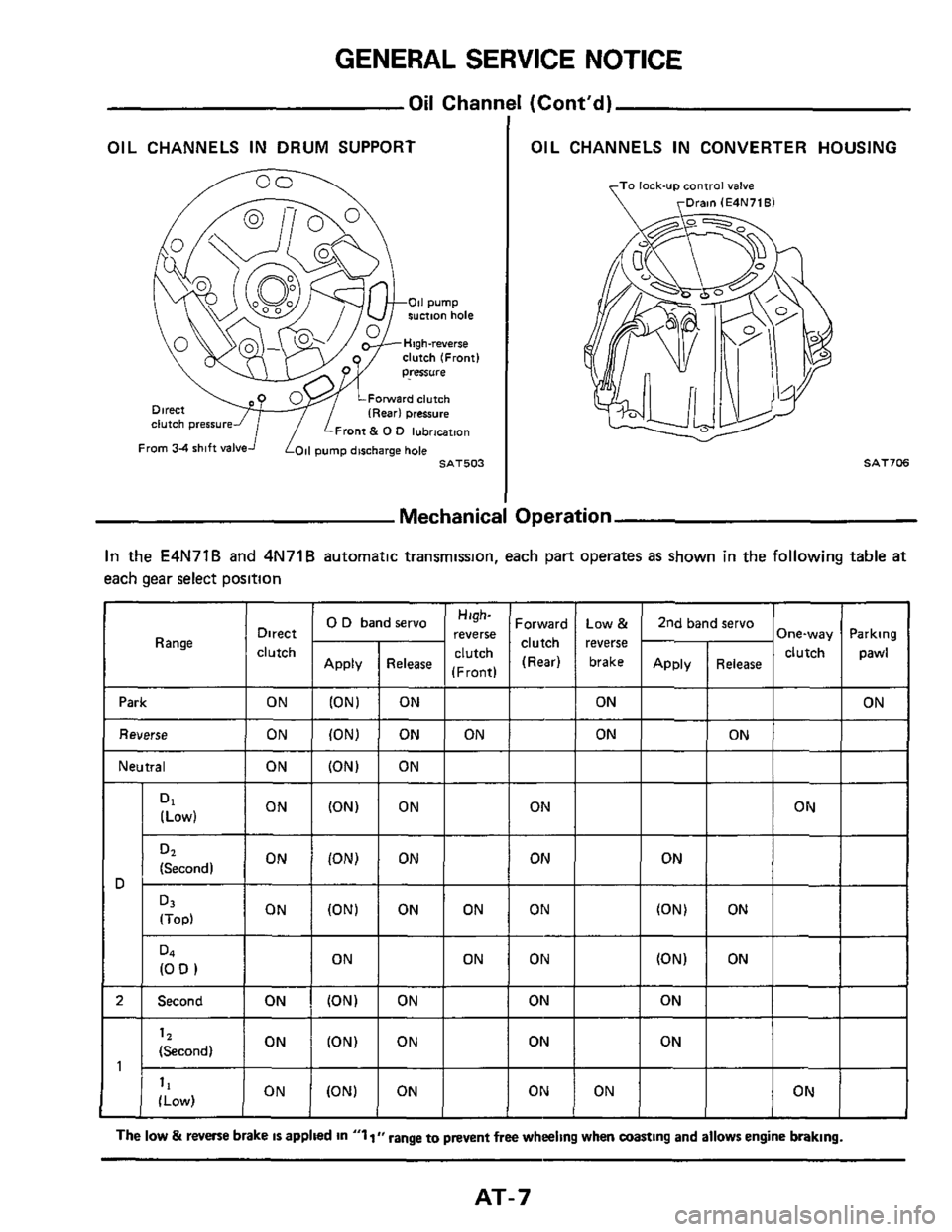
I (Cont'd) Oil Cham
OIL CHANNELS IN DRUM SUPPORT OIL CHANNELS IN CONVERTER HOUSING
To lock-up ~ontrol valve
rDrain (E4N71Bl
clutch (Front)
Forward clutch
clutch pressure Front & 0 0 lubrmtmn
SAT706
3peration Mechanic:
In the E4N71B and 4N71B automatic transmission, each part operates as shown in the following table at
each gear select position
'arking
pawl
Htgh-
'everse
Front) Forward clutch (Rear) 0 D band servo Direct
clutch Range -
Release
ON ON
1 Reverse 1 ON 1 ION) ON
+-
ON I
I Neutral I ON I (ON) ON
T-
ON
-
ON
-
ON
ON
JT
I ION
'34
(0 D 1 ON I ON
Second I ON I (ON) ON
1 ON I (ON) 12
(Second) ON ON I ON
ON ord ON I I ON
The low & reverse brake IS applied In "1 I" range to prevent free wheeling when coasting and allows engine braking.
AT-7
Page 19 of 99
REMOVAL AND INSTALLATION
installation (Cont'd)
Check inhibitor switch for operation
Check fluid level
in transmission.
Move selector lever through
all positions to be
sure that transmission operates correctly.
With parking brake applied, rotate engine
at
idling Move selector lever through "N" to
"D", to "2". to "1" and to "R" A slight shock
should
be felt by hand gripping selector each
time transmission
is shifted.
Check to be sure
that line pressure is correct.
To do this, refer to Line Pressure Test
Perform stall test.
AT-I 9,
Page 63 of 99
TROUBLE-SHOOTING AND DIAGNOSES
Preliminary Checks
(Prior to Road Testing)
FLUID LEAKAGE
To detect a fluid leak
1) Raise vehicle
2) Clean area suspected of leaking
3) Start engine, apply foot brake, place control
lever in drive, and wait a few minutes
4) Stop engine
5) Check for fresh leakage
FLUID CONDITION
Examine the AT F and note its color, texture,
and odor
1) Dark of Black Fluid
With a burned odor
- Worn friction material
2) Milky Pink Fluid Water Contamination
- Road water entering through filler
tube or breather
3) Varnished Fluid, light to dark brown and
tacky Oxidation
- Over or Underfilling
- Overheating
- Road Testing
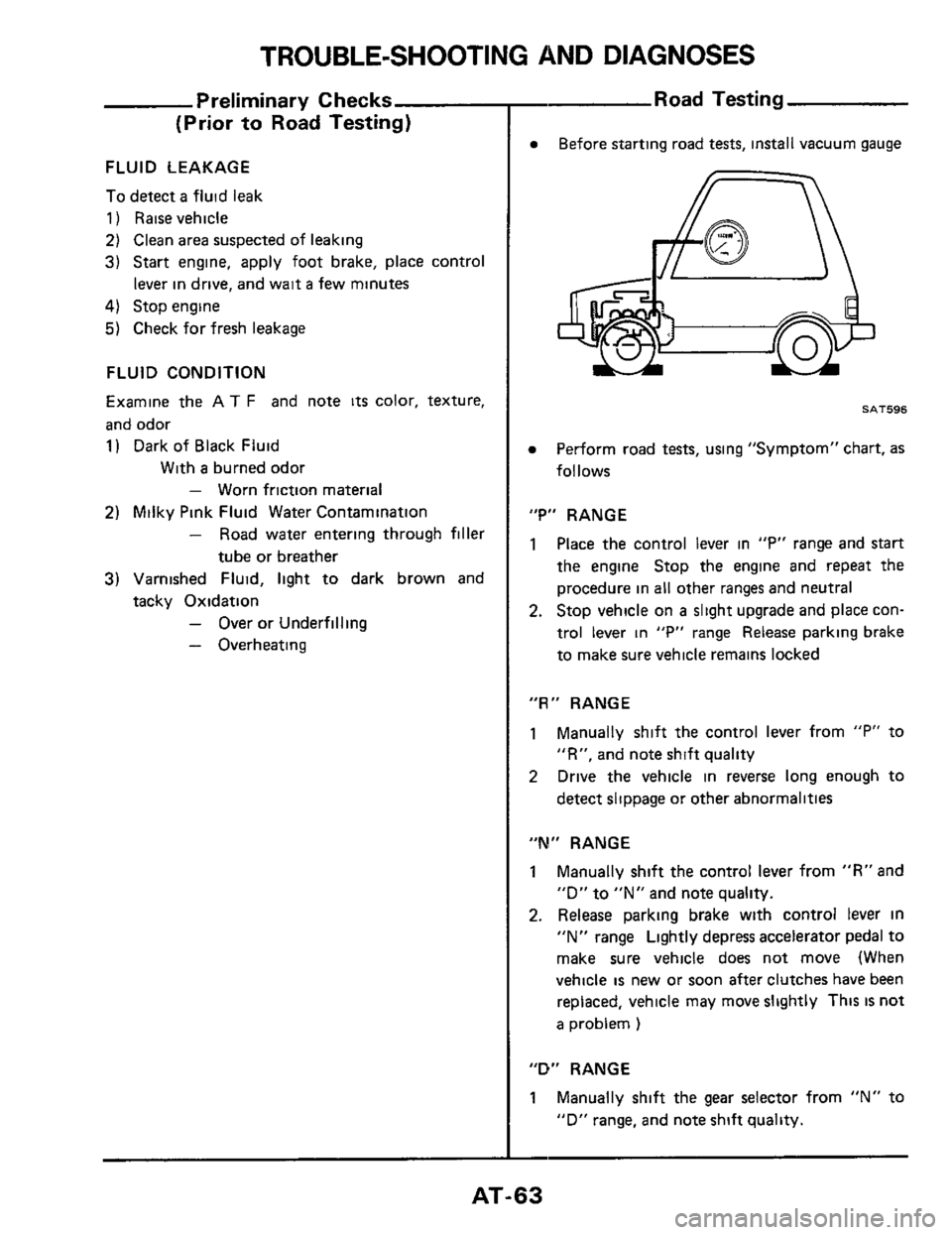
Before starting road tests, install vacuum gauge
SAT596
Perform road tests, using "Symptom" chart, as
follows
"P" RANGE
1 Place the control lever in "P" range and start
the engine Stop the engine and repeat the
procedure in all other ranges and neutral
2. Stop vehicle on a slight upgrade and place con-
trol lever
in "P" range Release parking brake
to make sure vehicle remains locked
"R" RANGE
1 Manually shift the control lever from "P" to
"R", and note shift quality
2 Drive the vehicle in reverse long enough to
detect slippage or other abnormalities
"M" RANGE
1 Manually shift the control lever from "R" and
"D"
to "N" and note quality.
2. Release parking brake with control lever in
"N" range Lightly depress accelerator pedal to
make sure vehicle does not move (When
vehicle
is new or soon after clutches have been
replaced, vehicle may move slightly This
IS not
a problem )
"D" RANGE
1 Manually shift the gear selector from "N" to
"D" range, and note shift quality.
-
AT-63
Page 64 of 99
TROUBLE-SHOOTING AND DIAGNOSES
Road Test
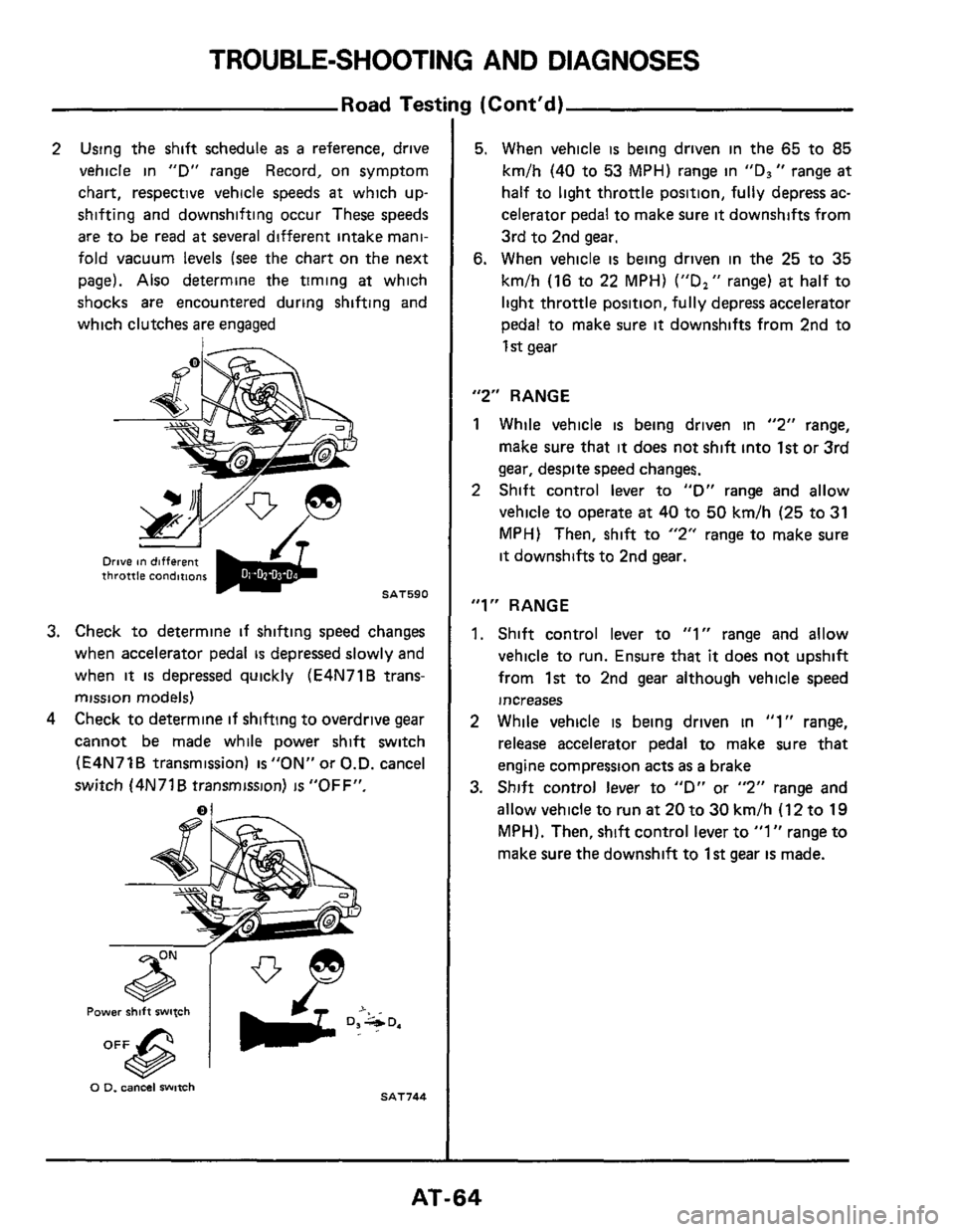
2 Using the shift schedule as a reference, drive
vehicle in
"D" range Record, on symptom
chart, respective vehicle speeds
at which up-
shifting and downshifting occur These speeds
are to be read at several different intake mani-
fold vacuum levels
(see the chart on the next
page). Also determine the timing
at which
shocks are encountered during shifting and
which clutches
are engaged
Drive on different throttle condirtom
SAT590
3. Check to determine if shifting speed changes
when accelerator pedal
is depressed slowly and
when
it is depressed quickly (E4N71B trans-
mission models)
4 Check to determine if shifting to overdrive gear
cannot be made while power shift switch
(E4N71B transmission) is"0N" or
O.D. cancel
switch (4N71
B transmission) is "OFF".
0 0. cancel witch SAT744
3 (Cont'd)
5. When vehicle is being driven in the 65 to 85
km/h (40 to 53 MPH) range in "Ds" range at
half to light throttle position, fully depress ac-
celerator pedal to make sure
it downshifts from
3rd to 2nd
gear.
6. When vehicle is being driven in the 25 to 35
km/h (16 to 22 MPH) ("D," range) at half to
light throttle position, fully depress accelerator
pedal to make sure
it downshifts from 2nd to
1 st gear
"2" RANGE
1 While vehicle is being driven in "2" range,
make sure that
it does not shift into 1st or 3rd
gear, despite speed changes.
2 Shift control lever to "D" range and allow
vehicle to operate
at 40 to 50 km/h (25 to 31
MPH) Then, shift to "2" range to make sure
it downshifts to 2nd gear.
"1" RANGE
1. Shift control lever to "1" range and allow
vehicle to run. Ensure
that it does not upshift
from 1st to 2nd gear although vehicle speed
increases
2 While vehicle is being driven in "1" range,
release accelerator pedal
to make sure that
engine compression acts
as a brake
3. Shift control lever to "D" or "2" range and
allow vehicle to run
at 20 to 30 km/h (12 to 19
MPH). Then, shift control lever to "1" range to
make sure the downshift to 1st gear is made.
AT-64
Page 65 of 99
TROUBLE-SHOOTING AND DIAGNOSES
Vehicle speed
Gearshift krn/h (MPH)
Road Testing (Cont'd)
I
Propeller shaft Line pressure
revolution rprn kPa (kg/cm2, psi)
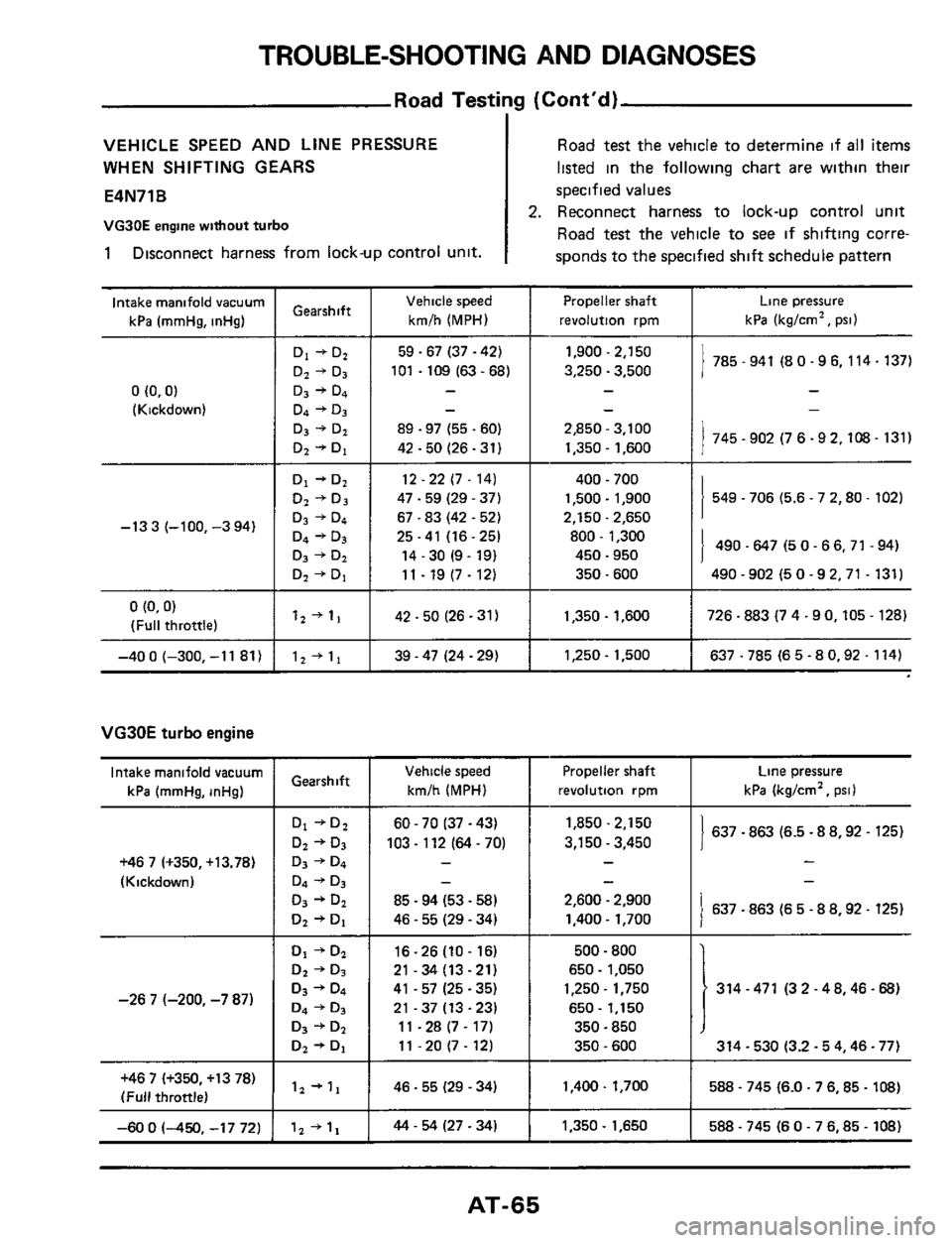
VEHICLE SPEED AND LINE PRESSURE
WHEN SHIFTING GEARS
E4N71B
VG3OE engine without turbo
1 Disconnect harness from lock-up control unit.
D4 +D3
D3 + D2
Dz + Di
Road test the vehicle to determine if all items
listed in the following chart are within their
specified values
2. Reconnect harness to lock-up control unit
Road test the vehicle to
see if shifting corre-
sponds to the specified
shift schedule pattern
490.647 (5 0- 66,71.94)
490 -902 (5
0 -92,71 - 131)
25.41 (16.25) 800 .1,300
14 .30 (9 - 19)
11
- 19 (7- 12)
450.950
350.600
Intake manifold vacuum
kPa (mrnHg, inHg)
I 1 785 - 941 (8 0.9 6, 114.137) DI+D2 1 59-67(37-42)
Dz + Da
1,900 - 2,150
3,250
- 3,500 101 . 109 (63 - 68) I
0 (0.0)
(Kickdown) ~-
1 745-902(76-92.108-131) 03 +& I 89 - 97 (55 - 60) 2,850 - 3,100
D2
+ Di 42.50 (26 -31) 1,350 - 1,600
12.22 (7. 14)
47 .59 (29 - 37)
67 .83 (42 - 52)
549.706 (5.6 - 7 2.80 - 102)
400 - 700
1,500
- 1,900
2.150.2.650
-13 3 (-100, -3 94)
0 (0.0)
(Full throttle) I 42-50(26-31) I 1,350.1,600 I 726 -883 (7 4.90,105 - 128) 12 + 11
-40 0 (-300, -1 1 81) 12+11 I 39-47(24-29) I 1,250-1.500 I 637-785(65-80.92-114)
VG30E turbo engine
Intake manifold vacuum
kPa (mmHg, inHg) Gearshift Vehicle speed
km/h (MPH)
60 - 70 I37 - 43)
103
- 112 (64 - 70)
-
-
85 - 94 (53 - 58)
46
- 55 (29 - 34)
Propeller shaft
revolution rpm
1,850.2.150
3,150
- 3,450
-
-
-
2,600 - 2,900
1.400- 1,700
Line pressure
kPa (kg/crnz, psi1
1 637.863 (6.5 - 8 8,92 - 125)
-
-
1 637.863 (6 5 - 8 8,92. 125)
+46 7 (+350, +13.78)
(Kickdown)
500.800
650
- 1,050
1,250
- 1,750
650
- 1,150
350 - 850
350.600
1,400
. 1,700
-
16-26(10-16)
21-34(13-21)
41
- 57 (25.35)
21-37(13-23) 1
1 - 28 (7 - 17)
11
- 20 (7 - 12)
46.55 (29 - 34)
314 -471 (3 2 -48.46-68)
314 - 530 (3.2.5 4.46.77)
-26 7 (-200, -7 87)
+46 7 (+350, +13 78)
(Full throttle) 588 - 745 (6.0.7 6,85 - 108)
-60 0 (-450. -17 72) 44 - 54 (27 - 34) 1,350 - 1,650 588 - 745 (6 0 - 7 6.85 - 108)
AT-65
Page 66 of 99
![NISSAN 300ZX 1984 Z31 Automatic Transmission Workshop Manual TROUBLE-SHOOTING AND DIAGNOSES
Road Testing (Contd)
SHIFT SCHEDULE
VG30E engine without turbo
[Standard pattern]
Upshift
: I
7
I
I
. Lock-up zone
-_.
10 20 30 40 50 60 70 80 90 100 110](/manual-img/5/563/w960_563-65.png "NISSAN 300ZX 1984 Z31 Automatic Transmission Workshop Manual TROUBLE-SHOOTING AND DIAGNOSES
Road Testing (Contd)
SHIFT SCHEDULE
VG30E engine without turbo
[Standard pattern]
Upshift
: I
7
I
I
. Lock-up zone
-_.
10 20 30 40 50 60 70 80 90 100 110")
TROUBLE-SHOOTING AND DIAGNOSES
Road Testing (Cont'd)
SHIFT SCHEDULE
VG30E engine without turbo
[Standard pattern]
Upshift
: I
7
I
I
. Lock-up zone
-_.
10 20 30 40 50 60 70 80 90 100 110 1M 130 19 150 160 l?O 180
110) (20) (30) 1401 150) (60) 170) 180) 190) 11001 111Ol
Vehicle speed kmlh IMPH)
Downshift
i
I 018
10 20 30 40 50 60 70 80 90 100 110 120 130 140 170 160 170 180
1101 120) 1301 140) 150) 160) 1701 18b) I&) (100) ciior
Vehicle speed kmlh 1MPH)
SAT746
SAT745
AT-66
Page 68 of 99
TROUBLE-SHOOTING AND DIAGNOSES
Road Testing (Cont'd)
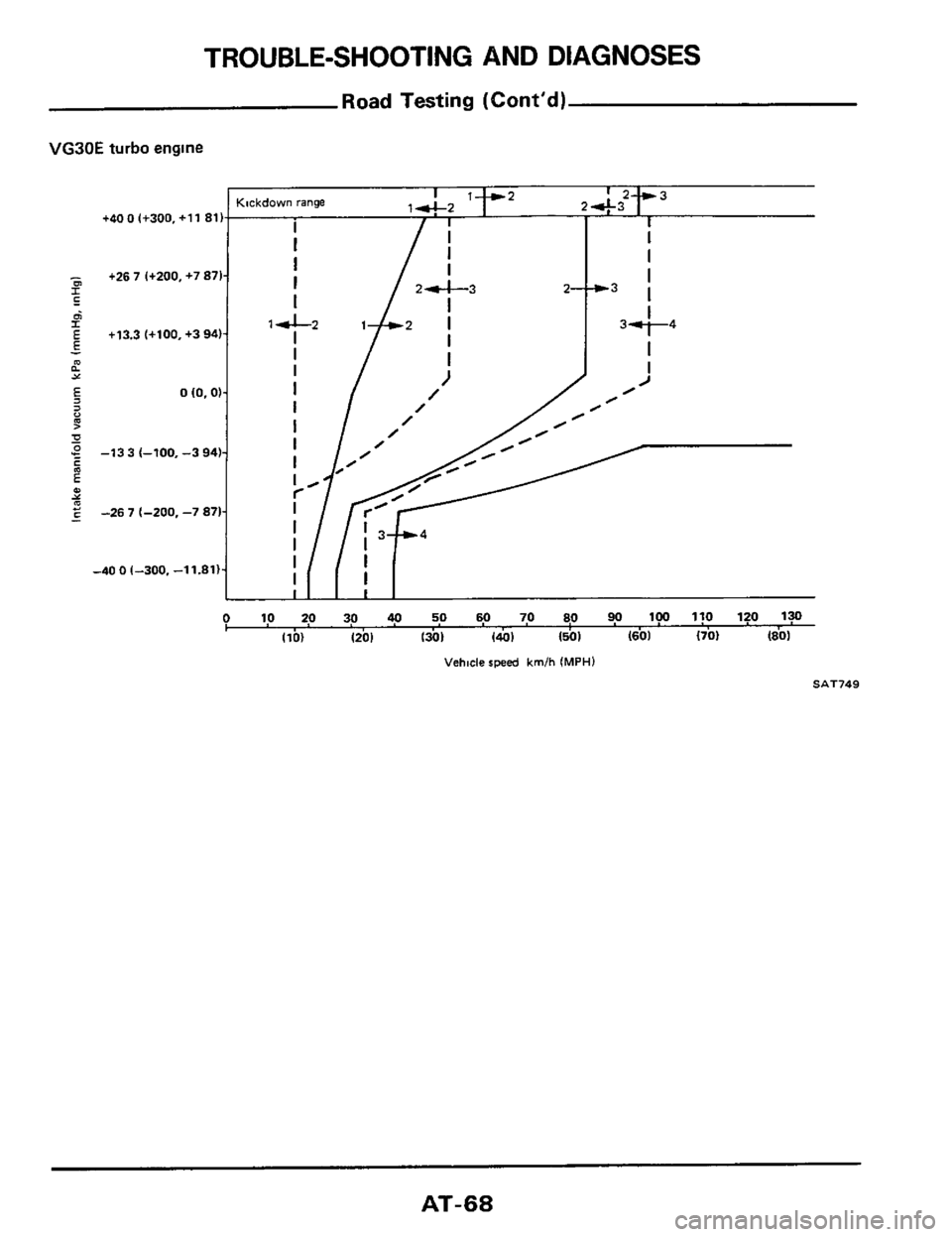
VG30E turbo engine
I 3 144-2 I I
I
I
Kckdown range
I
I
+400~+300.+ll 811-
I
I 2-
I I
- +26 7 (+ZOO, +7 871- m
2 I
$ 14-2 1 E +13.3 (+loo, +3 941- E I -
I
I
I
I .c3
34-4
I
0 10 20 30 40 50 60 70 80 90 100 110 120 130
1101 1201 130) 1401 1501 1601 1701 180)
Vehlcle sped kmlh IMPHI
SAT749
AT-68
Page 91 of 99
TROUBLE-SHOOTING AND DIAGNOSES
Pressure Testing ~ ~~
2
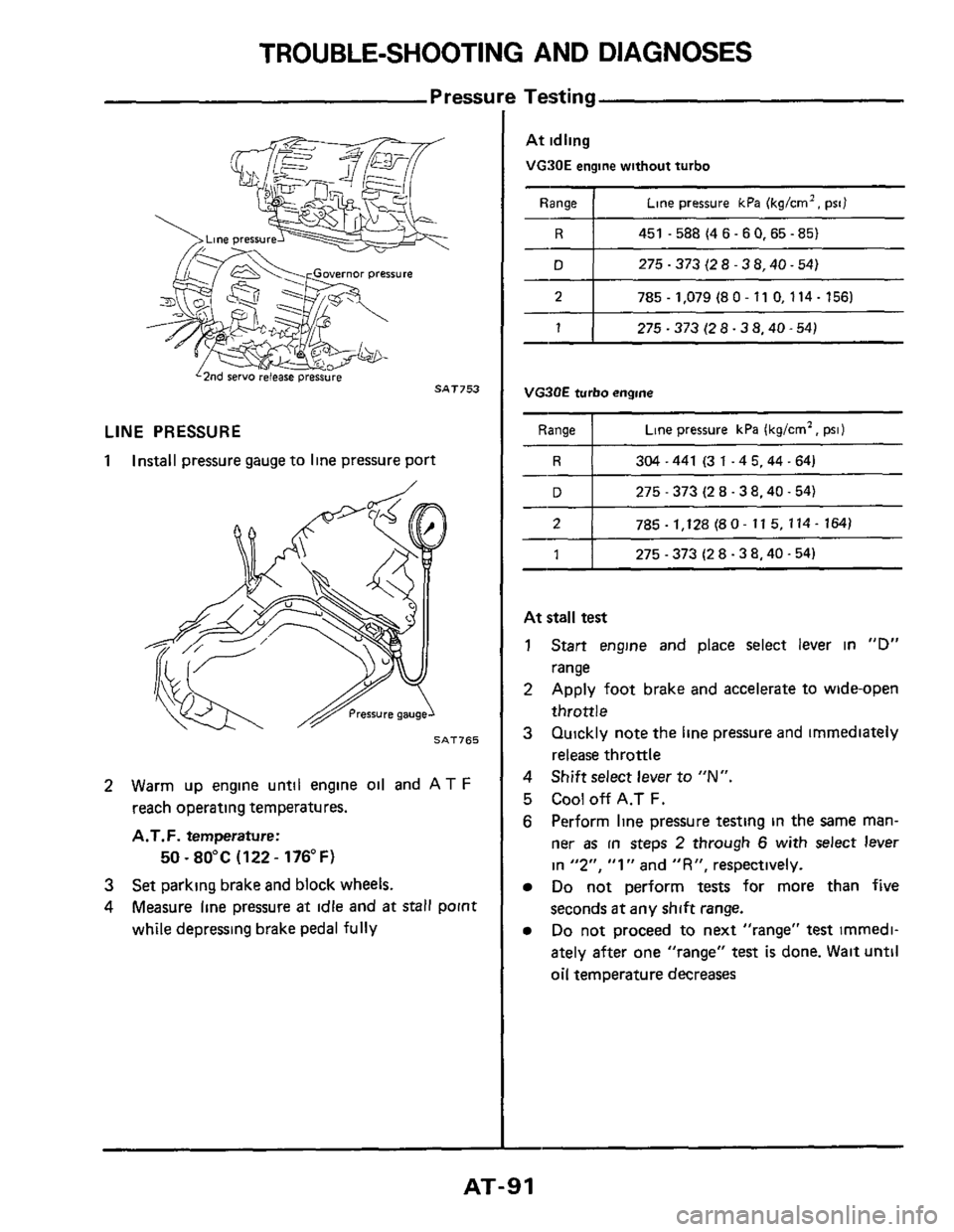
LINE PRESSURE
1 Install
pressure gauge to line pressure port
785 - 1,128 (8 0- 11 5, 114- 164)
SAT765
1
2 Warm up engine until engine oil and AT F
reach operating temperatures.
A.T.F. temperature:
3 Set parking brake and block wheels.
4 Measure line pressure at idle and at stall point
while depressing brake pedal
fully
50 ~ 80°C (122 - 176°F)
275 - 373 (2 8.3 8.40.54)
At idling
VG90E engine without turbo
Range 1 Line pressure kPa (kg/crn2. psi)
R I 451 -588(46-60,65-85)
D 1 275-373(28-38.40-54)
2 I 785.1,079 (80- 11 0,114- 156)
1 1 275-373(28-38.40-54)
VG3OE turbo engine
Range Line pressure kPa (kg/cm2, psi)
304-441 (31-45.44-64)
275
- 373 (2 8.38.40.54)
At stall test
1 Start engine and place select lever in "D"
range
2 Apply foot brake and accelerate to wide-open
throttle
3 Quickly note the line pressure and immediately
release throttle
4 Shift select lever to "N".
5 Cool off A.T F.
6 Perform line pressure testing in the same man-
ner as in steps 2 through 6 with select lever
in
"2". "1" and "R", respectively.
Do not perform tests for more than five
seconds
at any shift range.
Do not proceed to next "range" test imrnedi-
ately after one "range"
test is done. Wait until
oil temperature decreases
AT-91