1980 SKODA 105S lock
[x] Cancel search: lockPage 115 of 238

a
a
T Cr
o
s
2
sl
a(
fil
1,
al
(2
2.
PI
thr ler
to
dti
tht
Bush inside diometer
pin diometer
Cleoronce of moximum
king pin
ond bush weor 18J 0.018
Dimensionol
Correlotion
of King Pin ond Bushes
6.7 KING PIN The king pin is formed bodily by
its resilient bush. For pressing
the
out, use the MP 6--l-12 mondrel. The
cylindricol surfoce of the king pin
connot
be reconditioned.
Grinding or ony other mo-
chining is opt to destroy its speciol surfoce
finish. When worn, the king pin must be re-
ploced with o new one.
Fig.6.7l1 -
Pressing-in of King Pin
Resilient
Br"rsh Using MP 6-112
Mondrel
6.8 KING PIN SOCKET
It consists of the socket itself ond the resili-
ent bush. For pressing
the bush
in ond out, use
the MP 6-112 mondrrel os in the cose of the king
pin bushes.
The right-hond ond left-hond socket
con be
identified by the relotive position
of the hole
for the king pin
ond the chomfering of bosses
limiting the wheel lock positions.
Fig. 6.8/1 -
King Pin Socket
1 -
left-hond, 2 -
right-hond
the
pin
cnd
bush in crnd
1211
Fig 6.6i13 -
Pressing in
lJu:;hes U.sing MO 6 135 ond out King
Pin
Pressing Mondrel
Fig. 6.6i4 -
Reoming King
MP 6-1-14 Reomer oncl Pin Bushes
Using
its Pilot Toper
116
Page 121 of 238

(
t
t
s r
1
S
t S
n
o
fl
p
t\
e
g
tl
St
T
o
e
ir
h,
el
r€
re
5. Ploce
the steering
box with its bottom
boll
beoring resting on the MP 7-102 jig
ond press
the steering screw
with both beorings into the
iig. Extroct the
bottom beoring using
the MP
6-111 king pin
socket remover
ond push
the
steening screw with the top beoring oert of the
steering box. Support the beoring by the Mp
7-102 iig crnd
press
it out.
7.3 REASSEMBLING STEERING BOX
1. Press the dust cup with its seoling
ring
into the steering
box with the pressed-in
bush
ofter hoving thorouchly
cleorred the box. Now
pf oce the box on the MP 7-102
iig oncl
press-in
the bottom boll beorinct
using tlrei pressing
mandrel MP 7-103.
2. Fit the lower beoring
cop seoled
off with
o poper
gcsket
ond seoling compound, slip
lpring woshers
on to the bolts,
ond tighten the
bolts with o torque os per
Chopter t.6. f it the
wosher on the steering screw
with its deflec-
tion focing
the screw threod ond press
the
top beoring on the screw
using the Mp Z-103
pressing mondrel.
3. Then ploce
ogoin the steering box on the
MP7-102 iig ond
press
into it ond into the bot-
tom beoring the steering
screw with the pnessed-
-on top boll beoring,
using ogoin
the Mp7-103
pressing mondrel. For further ossembly, use the
vice ond the dummy brocket.
Fig. 7.311 -
Pressing-in Bottom
Beoring
on MP 7-102
Jig (support
plote)
Using
MP 7-103 Piressinq
Mondrel 4.
Meosure the height of the beoring pro-
truding from the steering box ond odiust it by
fitting shims interspoced with poper goskets
cooted with o seoling
compound.
Fosten down
the cop by tightening the bolts. Check the
steering screw for free rototion
ond the obsence
of ploy.
The beoring should be without o cleor-
once or there hos
to be o prestress
of up to
0.07 mm.
5. Remove the bolts of the cop, slip the rub-
ber seoling ring dipped in oil on to the shoft,
ond fit the dust cup on the cop. lnstoll spring
woshers on the bolts. Should the cup be over-
stroined due to the toleronce
of the recess for
the seoling ring or the ring itself
, instoll
o poper
gosket under it os under tlre ccrp.
6. Locote the steering nut on the screw fol-
lowecl by the rocker shoft with pin, spring,
spring pin, ond the licl gosket
cooted with
o seoling compound, ond fit the lid with bush
in position to close the steering
box. Instoll
spring woshers under the bolts orrd tighten the
bolts with o torque os per
Chopter 1.8. Screw
the set screw into the lid ond rnove
the steer-
ing geor
so thot the drop orrn is swivelled
through obout one holf of its trovel from the one
or the other extreme lock position.
Witlr the
drop ornr in this position,
screw down the set
screw os for os it will go
ond then bock it off
through obout 95 to '120'.
This will provide
for
on odequote cleoronce of the steering geor.
[.ock the set screw in position
with the re-
spective nut.
7. Drive the key on to the rocker shoft cone,
fit the drop orm ond hold it down lightly with
the nut. Clomp the drop orm in o vice, tighten
fully the nut (for
the tightening torque see
Chopter 1.8), ond secure tlre nut with o cotter
pi n.
8. Clomp ogoin the steering box by meons of
the dummy brocket ond moke sure
thot the dnop
orm con swivel from one extreme lock position
to the other. A certoin
resistonce should olwoys
be present,
but if the resistonce is too greot,
decreose it by o slight slockening of the set
screw in the lid. The
rototing resistonce of the
shaft should not exceed 20 Nm (O.2
kpm). Refer to
page 117/118 for testing
procedure.
9. Set the ossembled steering box in its fit-
ting position
(inclined
by obout 40o) ond pour
in oil through the hole in the bbx lid (cover)
till the oil level reoches the bottom edge of the
filling hole. Then
screw down the topered plug.
7.4 RELAY (TDLER)
LEVER
For its instollotion (ond
removing in reverse
order) ond ony pertinent porticulors
see the
Chopter 6.5, porogrophs
2 ond 3.
122
Page 123 of 238

7
.7-1.8
(
t
t
t
; (
(
b
tl
ir
tl
p il
o
tl
p
odiust,
if necessory, the driving dog of the di-
rection indicotor switch -
see Chopter 13.17.
Refit the steering wheel so thot its spokes
ore horizontol, lock it in position
with the nut
(for tightening torque, see
Chopter 1.8), ond
bolt down the spoke shroud.
7.8 STEERING WHEEL SHAFT AND SHAFT
BEARING
The steering wheel (column) shoft is built
up
of two ports
with the beoring in the uPPer port.
Usuolly, it is not necessory to disconnect the
two ports
of the shoft or to remove the beoring
ond steering lock. lt
con be removed from the
cor os o unit.
Removol 1. Remove the steering wheel -
see Chop-
ter 7.7. 2. Remove the screws on the lower port
of
the shoft cowling ond pull
the cowling off.After
removing two bolts, detoch the cluster switch
on the shoft from the upper port
of the shoft
cowling. 3. Remove two front screws of the upper
Port
of the cowling ond remove the cowling.
4. Disconnect the leods
from the switches
ond the switch box.
5. From under the cor, remove the bolt of the
coupling connecting the steering
column shoft
to the steering box ond detoch the dust boot
from the floor. Remove the
bolts of the shoft
beoring (from
under the shoft)
ond the bolts of
the steering lock (from
the front) fostening the
shoft to the body, ond pull
out the shoft.
Ref itting To ref it the steering column shoft
in the cor,
reverse the removing procedure. While reinstol-
ling the steering wheel (Chopter
7.7), do not
forget to check the direction indicotor switch
for correct function.
Use ploin
ond spring woshers under the bolts
of the steering lock
brocket. Reinstoll the shoft
beoring using spocing tubes, rubber bushes, ond
ploin woshers, ond secure the bolt of
the coup-
ling, connecting the steering
column shoft with
the steering box, with
o self-locking nut (for
tightening torque, see
Chopter 1.8).
To Disconnect Shofts
Remove the bolt
of the cross-pin
ioint con-
nection.
Connecting of Shofts
Fit o fostening sleeve on the tube
with the
shoft, dip the ring in oil ond slip
it on to the shoft end with
its wedge-shoped port
toword
the beoring, instoll the spring
ond the
ioint
socket of
the shoft bottom port.
Tighten
the
connection with the bolt with self-locking
nut
(tightening torque os per
Chopter 1.8).
The sleeve must be f irst built up if
the shoft
is refitted for the first time. Locote
both holves
of the sleeve on the tube ond fosten
them
lightly together by bending the tob of one holf
of ttre sleeve over the
other. The
sleeve must
on no occount clomp the tube tightly.
Bottom Port of Steering
Column Shoft
The shoft is provided
with cross-pin
ioints
ond connot be dismontled (token
oport). Before
fitting the shoft dust boot, smeor
it with
oil to
focilitote its slipping over the pcrrts
of the joint.
For this purpose,
it is clso odvisoble to wrop
the joint
in o plostic
foil or to moke o sleeve
with o pilot
cone.
Top Port of Steering Column
Shoft -
Beoring
Removol 1. l-ift owoy the fostening sleeve
ond check
whether the shoft rototes
freely in the tube. lf
it is not the cose, unlock the steering lock ond
press out the shoft proceedirrg
from the side
of its splined
end.
2. lf necessory, remove
the circlip of the shoft
ond lift owoy the beoring. The other beoring
hos to be driven out by topping it corefully
through the cut-outs in
the tube to ovoid domog-
ing it. 3. Remove the brocket with the steering
lock
- see Chopter 7.9.
Ref itting
1. Slip tlre beoring pocked
with greose
on to
the upper port
of the shoft, then the ring with
its wedge-shoped port
focing the beoring, ond
lock both ports
in position
with the circlip.
Press the shoft into the tube ond press-in
the
beoring (ogoin pocked
with greose)
from the
other end.
2. lnstoll the brocket with the steering lock -
see Chopter 7.9.
Shoft Beorings They hove to be thoroughly lubricoted
first,
since ofter their reossembly with the shoft od-
ditionol lubricotion is not possible.
lf there is
ony doubt concerning the greose
pocking,
re-
move the circlip f
rom the inner port
of the
beoring, toke the beoring oport, cleon it, ond
reossemble it ofter hoving pocked
it with the
recommended greose,
i. e., brond NH2 of Cze-
choslovok provenience
or one of the bronds
specif ied in Chopter 7.5, porogroph
3.
124
Page 127 of 238
Shr
C
cle,
the
1
fittr
bor
(Im(
2
wit
woI
pisl
wor
the loc<(11,
3.
obo (M(
I nst
rod
the
oil' into
4.
witt
Con
prot
Inod
On f(
Inodr
oll c(
Excer
on c(
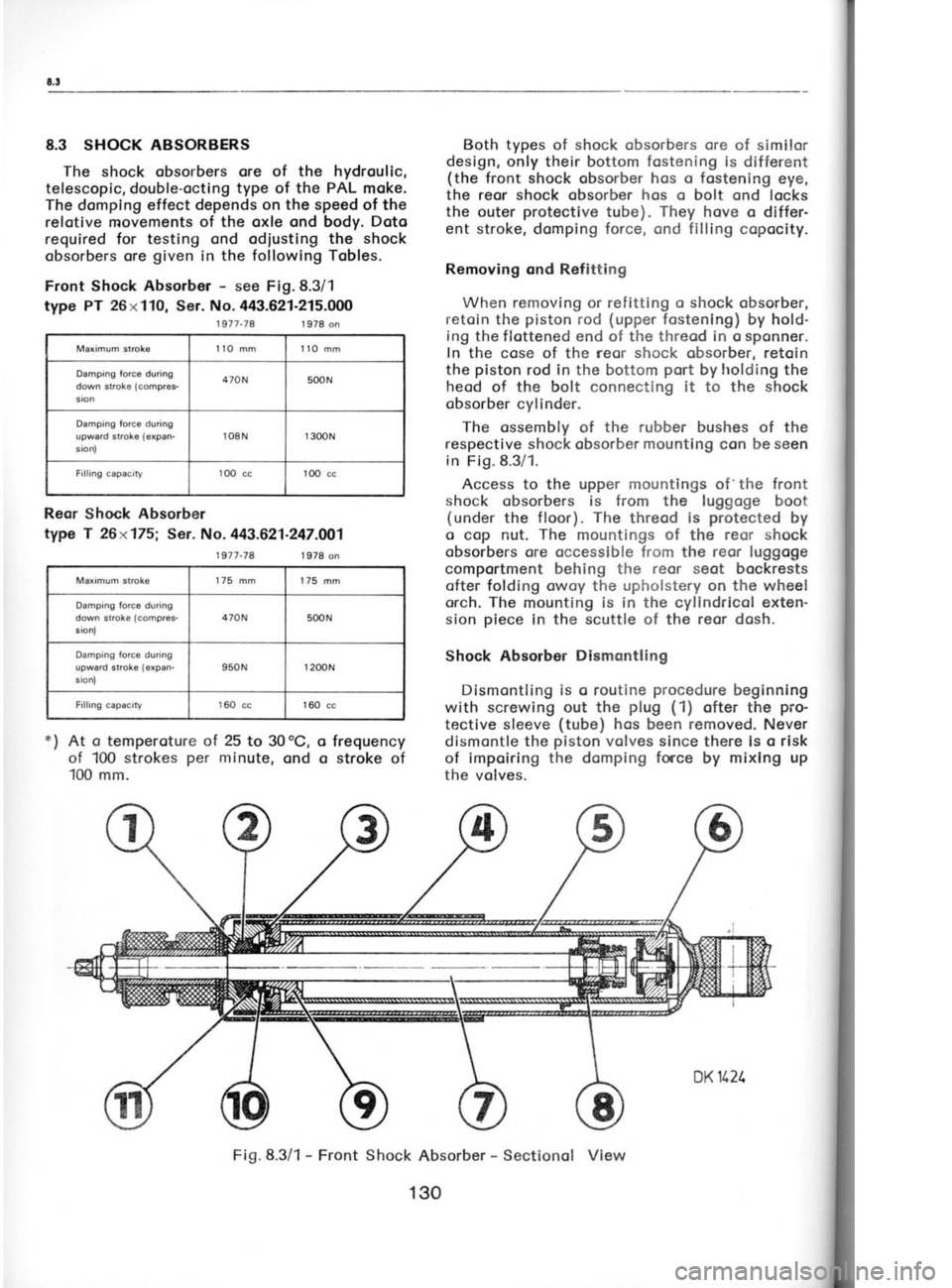
8.3 SHOCK ABSORBERS
The shock obsorbers ore of
the hydroulic,
telescopic, double-octing type of the PAL
moke.
The domping effect depends on the speed
of the
relotive movements of the oxle ond body. Doto
required for testing ond odiusting the shock
obsorbers ore given
in the following Tobles.
Front Shock Absorber -
see Fig.8.3/1
type PT 26x110,
Ser. No.443.621-215.000
1977-74 1 978 on
Maximum stroks llO mm 110 mm
Damping torce during
down stroke (compr€s-
sion 470N
500N
Damping force
during
upward stroke (expan-
sion) loSN
1
300N
Filling capacity lOO cc1OO
cc
Reor Shock Absorber
type T 26x175; Ser. No. 443.621.247.OO1
1977-78 1 978 on Both
types of shock obsorbers ore of similor
design, only their bottom fostening
is different
(the front shock obsorber hos o fostening eye,
the reor shock obsorber hos
o bolt ond locks
the outer protective
tube). They hove
o differ-
ent stroke, domping force, ond filling
copocity.
Removing ond Refitting When removing or refitting o shock
obsorber,
retoin the piston
rod (upper
fostening) by hold-
ing the flottened end of the threod in o sponner.
In the cose of
the reor shock cbsorber, retoin
the piston
rod in the bottom port
by holding the
heod of the bolt connecting it to the shock
obsorber cylinder.
The ossembly of the rubber bushes of the
respective shock obsorber mounting
con be seen
in Fig.8.3/1.
Access to the upper mountings of 'the
front
shock obsorbers is from the luggoge boot
(under the floor). The
threod is protected
by
o cop nut. The
mountings of
the reor shock
obsorbers ore occessible from the reor luggoge
comportment behing the reor seot bockrests ofter folding owoy the upholstery on the wheel
orch. The mounting is in the cyllndricol exten-
sion piece
in the scuttle
of the reor dosh.
Shock Absorbor Dismcntling
Dismontling is o routine procedure
beginning
with screwing out the plug
(1)
ofter the pro-
tective sleeve (tube)
hos been removed. Never
dismontle the piston
volves since there is o risk
of impoiring the domping force
by mixlng up
the volves.
o
o
*)
At o
temperoture ol 25
to 30oC,
of 100 strokes per
minute, ond
100 mm. frequency
stroke of
Fig.8.3/1 -
Front Shock Absorber -
Sectionol View
Maximum stroke
175 mm
175 mm
Damping force during
down stroke (compres-
ston, 470N
500N
Damping force during
upward stroke {expan-
sronl 950N
r
200N
Filling capacity 160
cc 160 cc
130
Page 129 of 238

Defect
Remedy
Jerky upword stroke Airlock
obove plston
Oil leokoge due to domoged
piston rod
Plug worked loose -
oil leoks
post the threod
Suction volve does not closc,
oil is forced Into reserve
tube -
oir is sucked
in obove
the plston Flll
shock obsorber
correctly
wlth oil
Renew piston
rod ond lobyrinth
seol -
check shock
obsorber
mountlng on cor
Reflll oil ond tighten plug
correctly
Remove foreign motter
from
suction volve -
renew suction
volve body lf volve seot
is domoged
Domping force increoses
on compression Excessive
oil filling Adiust to specificotio.ns
Shock obsorber knocks when
exponslon storts. Domping
force poor
ot first. loter rises
to normol Volve obove
piston
sticking Remove couse of
stlcklng, or
chlps -
renew volve, reflll shock
obsorber with oll
Check shock obsorbers for correct operotlon direct in position
in the cor uslng o diognostic
oppor'
otus or, ofter removol, on o
test bench in
complonce with molntenonce
instructlons.
132
Page 137 of 238

I
I
T
!
(
(
t I
t
t
t I
'l
(
r
o cc
fold
ot the moment of
the opplicotion of the
brokes, ond led
through o rubber hose (tube)
to
the booster.
Removol ond Refitting
The broke booster is held down on the pedol
brocket by nuts ond spring
woshers. The lug of
the control volve press
button connects it with
the broke pedol,
on which it is secured by o re-
toining ring. These
mounting ports
or the con-
nections of the vocuum supply
ore to be hondl-
ed only when removing
or refitting the broke
booster.
However, we odvise you
to hove this
iob done
in o speciolized
repoir shop properly
instructed
by the broke
monufocturer. All rubber ports (in
the terms of current mointenonce,
this is
procticolly the seol of the press
button control-
ling the moster cylinder)
must be protected
from the effects of the broke fluid or other
lubriconts. Use petrol
for cleoning the rubben
ports.
Adiustment 1. Adiust the cleononce
between the broke
booster press
button ond the cylinder piston
whenever the moster
cylinder or the'broke
booster ore reploced,
or whenever there is ony
doubt concerning
the correctness
of the os-
sembly of the moster cylinder
with the broke
booster. Meosure the distonce between the
cylinder bottom recess
ond the cylinder flonge
nroting surfoce os well os the length of the
press button protruding
over the moting surfoce
of the booster.
Compore the meosurings
ond
odiust the length of the press
button by rototing
its threoded
end to obtoin o cleoronce of 0.5 to
1 mm between the press
button ond the piston.
Still better, you
can use special
tools Mp6.
'14'lA.
Fit it on the
moster cylinder, push
its spindle into the cylinder till its rounded
end
rests ogoinst
the piston,
ond lock it in this po-
sitio-n with the respective
retoining screw.
Apply
the fixture to the booster
ond rotote the boostei press
button so thot it
iust touches the
lower
flot port
of the fixture spindle.
2. lf it is necessory
to level
the broke pedol
with the clutch pedol,
odiust the length
of the
contnol volve press
button lug.
Remove the broke
booster from the pedol
brocket, slip off the collor (cup),
connect the
booster with the pedol,
ond refit it tempororily
to the brocket.
Now rotote the hexogon on the
threods of the lug till both the clutch ond broke
pedol ore level. Remove once more the booster
from the pedol
ond pedol
brocket, neinstoll the
collor (cup),
ond complete the f inol reossembly.
9.7 BRAKE FLUID TANK, PIPING AND HOSES
Tonk ond Filling Hose
The broke fluid tonk is held in position
in its
brocket by o slip-over
clomp. Speciol rubber
hoses connect it with the broke ond clutch
moster cylinders.
Hose clips ore used to secure
the hoses on the tonk outlet sockets.
Both the
side ond centre outlet of the tonk ore con-
nected to the bnoke moster cylinder, the third
outlet being connected to the clutch moster
cylinder (see Fig. 12.111).
Pressure Piping ond Hoses
The rigid port
of the hydroulic line consists
of speciol steel pipes.
Their connections with
other ports of the line ore seoled off by clomp-
ing on the conicol surfoces-
lf these conicol surfoces
become domoged,
remove them ond form new ones by floring the
pipes. To do this, use the coulking holder,
type
MP 9-151. Clomp the pipe
in the holder so thot
it is level with its upper edge ond flore the pipe
with c coulking chisel. The holder is designed
to be clomped in o vice.
The holder
hos two drilled holes of 5 ond
6 mm in diometer so thot it con be used olso for
repoirs of pipes
of the clutch line. For dio.
5 mm holes, use the MP 9-152 ond for dio. 6 mm
holes, the MP 9-153 coulking chisel.
The flexiblepqrt
of the hydroulic line consists
of speciol hoses.
When fitting them to the reor
wheel cylinders, turn them in o position
which
will prevent
their contoct with ony ports
of the
cor in both extreme positions
of the cor sus-
pension. This is why the nipples ot the reor
wheels ore inclined
downword through on
ongle of 30 degrees from
the horizontol plone.
9.8 HAND BRAKE
The hond-broke
lever between the front seots
controls the tie-rod which octuotes the rocker
(see Fig.9.8/1). Cobles connected
to the rocker
Fig. 9.612
-
Broke Booster Press
Button
Adiusting Fixture
MP6 141A tx r5?2
140
Page 146 of 238

11.4-11.5
I
I
I
F
r
t'
on to the coolont tonk.
Hose
clips ore formed
either by metol strips
or lengths
of wire. When
tightening the wire clips, toke core not to
domoge the rubber of the hoses.
To Fosten Pipes ond
Hoses
A correct winding of the strip is importont
to ensure o self-locking clomping of the strip
clips -
see Fig. 11.411.
Fig.11.Al1- Diogrom showing
the threoding
of
the clip strip through
the clip closp ond
the
direction of rototion of
the tightening cotter
pin -
the diogrom hos generol
opplicobility
1 -
Strip clip,2 -
Closp, 3 -
Cotter pin
The moin pipeline
routed under the cor f loor
consists of front ond reor pipes.
They ore em-
bedded in o chonnel moulded in the floor
boords ond rest on on insuloting (polysterene)
podding. From below, they ore protected
by
o guord,
the copscrews of which ore locked
in
position by spring woshers.
Use pipe
holders (yokes) to fosten the pipe-
line to the floor. In
the front
ond reor port
of
the cor, tighten
the pipes
over the insulotion
lrod ond insert
spring ond ploin
woshers under
the nuts.
Do not use insulotion pods
for bends
forming the tronsition from
the front
ond reor
lower flot ports.
Use spring woshers under
the
heods of copscrews.
Before instolling the pipes, prepore
ouxiliory
yokes (or use lengths of wires ottoched to the
provisionolly screwed-in copscrews of the pipe-
line guord) to liold the pipes
in the moulded
chonnel in
the floor before
the finol fostening
of their guord.
The woter line runs
under the cor together
with other lines, pull-rods,
etc. For their mutuol
ref otive orrongement see Chopter 12.7. Removol
To moke the underbody occessible for hond-
ling the pipes,
ploce
the cor over o floor pit
or
on o romp. The minimum required cleoronce is
obout 650 mnr.
1. Remo.re the guords
of the pipes
ond the
fuel tonk, lift owoy the spore wheel, ond loosen
the yokes
holding the pipes
to the floor.
2. Remove droin screws to droin the coolont
from the pipes -
see the illustrotion in Chop-
ter 15.'13.
3. Remove one hose clip in the middle
of the
cor to disconnect
the pipes
(ottention -
the
remoining coolont will f low out), ond dis-
ossemble the line.
4. Disconnect the pipe
ends from the hoses,
ond detoch the pipes
from the floor or other
ports of the cor.
5. Pull out the reor pipes
possing
them core-
fully oround the vorious cor ports.
6. Pull out the front pipes.
Turn
the front
wheels into their left lock position,
disconnect
the steering linkoge from the steering
reloy
lever ond the steering knuckle orm of the
right-
hond wheel, ond push
the linkoge ogoinst the
oxle body. While removing the pipes,
rotote the
left-hond pipe clockwise (when
viewing the cor
front end), ond the right-hond pipe
onticlock-
wise.
Reinstollotion Reverse the dismontling procedure
when re-
instolling the woter line. While connecting the
steering linkoge, poy
ottention to the condition
of boll pin
seoling cups (fit
new cups if the old
ore domoged). Fill in the recommended
coolont
ond bleed the cooling system.
11.5 COOLANT TEMPERATURE CONTROL
Throughf low Thermostot
This thermostot shuts off the inlet of the
coolont into the rodiotor
during the engine
heoting-up period. lt is mounted on the engine
- see Chopter 2.3, por.
30.
The thermostot operotes within the following
volues:
it begins to open ot 80+2"C
it is fully open ot 90+4oC
its lift ot full opening
11 mm
When closed, it
is permitted
to let poss
o nroximum
of 0.5 litres
of coolont per
minute,
ond it must not be closed by o bock pressure
of 0.16 MPo (1.6
kg/cm2).
When removing the thermostot by rototing
tlre rivet in the volve disk, breok owoy sedi-
I i
i 152
Page 148 of 238

c
I'
b
o ir
fi$r
++$$
$$fr0$0$$$$$. $'$j,$,0$$$$+$
t'$'i$$0',$$$$ 0 0
Fig. 11.6/1 -
Section Through
Heoter
1- Cover, 2 -
Lower port
of cosing (iocket) -
two-port, 3- Heot exchonger, 4-
Heoter fan,
5 to 8-Control f lop volves, 9-Ponel with control
levers
the bowden tubing of the
bowden cobles ond
let the oil seep down olong
their entire length.
Check the heoter fon for foultless running.
With the switch in position
I, the fon must run
ot higher speed -
for its wiring refer
to Chopter
11.7 -
Electric Control. Fill
the cooling system
with coolont ond bleed the system.
Fit the grips (buttons)
on the levers observ-
ing the symbols on the grips:
left-hond lever -
white orrows upword ond
downword,
centre lever -
orrow downword,
right-hond lever -
red orrow upword, blud orrow
downword.
To open the flow through the lower inlet
socket, turn the lever in this socket so
thot it
coincides with its centre line. The socket
should be closed with
the flop only
when
testing the heoter, etc. Heoter Disossembly
ond Reossembly
o) Heot exchonger, volve,
flops, ond levers
with links.
1. Disconnect the control bowden
cobles
from the levers, remove the gosket
from the
heoter beoring surfoce, loosen the
locks of the
broces, ond lift owoy the broces together
with
the cover ond fon.
2. Unscrew the liquid flow control volve ond
detoch the hose from
the second
inlet of the
heot exchonger ond the bleed hose ofter hoving
removed the hose
clips. Do not detoch
the link
from the volve lever -
it will sove you
odiust'
ment on reossembly.
3. Detoch the link of the flops from the reor
side of the heoter cosing ond unlock the flops
in the cosing by removing lock rings, woshers,
ond levers.
154