1979 DATSUN 210 clutch
[x] Cancel search: clutchPage 287 of 548
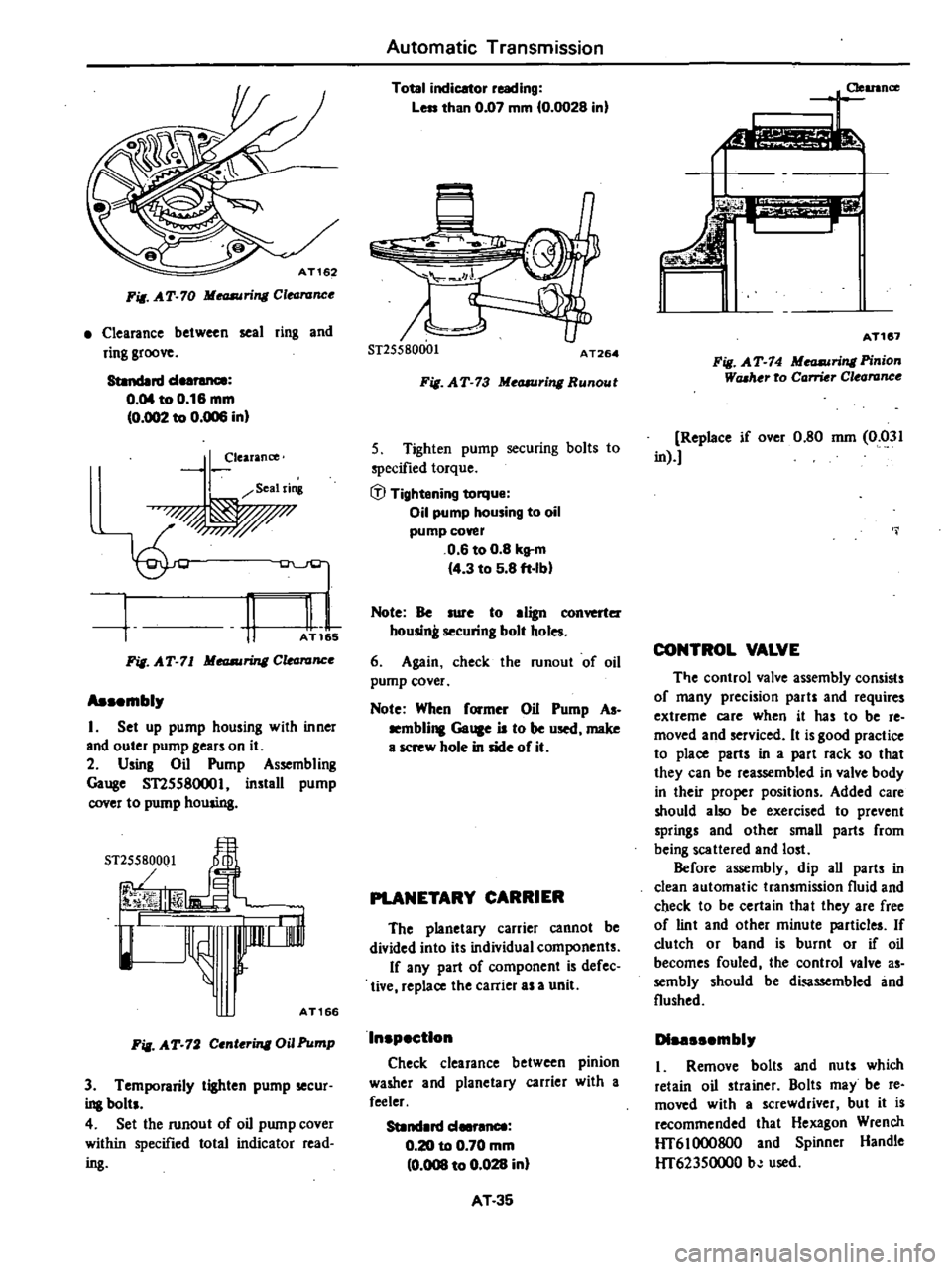
Fig
AT
70
MeG6Uring
Clearonce
Clearance
between
seal
ring
and
ring
groove
Stendard
0
04
to
0
16
mm
10
002
to
0
006
in
I
31earance
Seal
ring
w
I
J
7
r
11
AT1
5
II
Fig
AT
71
MeG6Uring
Clearance
As
mblr
L
Set
up
pump
housing
with
inner
and
outer
pump
gears
on
it
2
Using
Oil
Pump
Assembling
Gauge
ST2SS80001
instan
pump
cover
to
pump
houaing
AT166
Fig
AT
72
Centering
Oil
Pump
3
Temporarily
tighten
pump
secur
ing
bolts
4
Set
the
cunout
of
oil
pump
cover
within
specified
total
indicator
read
ing
Automatic
Transmission
Total
indicator
reading
Lell
than
0
07
mm
10
0028
inl
ST2SSBOOOl
AT264
Fig
AT
73
Me
ring
Runout
S
Tighten
pump
securing
bolts
to
specified
torque
r
Tightening
torque
Oil
pump
housing
to
oil
pump
cover
0
6
to
0
8
kg
m
14
3
to
5
8
ft
Ibl
Note
Be
sure
to
align
con
ter
housini
securing
bolt
holes
6
Again
check
the
runout
of
oil
pump
cover
Note
When
former
Oil
Pump
As
sembling
Gauge
is
to
be
used
make
a
screw
hole
in
side
of
it
PLANETARY
CARRIER
The
planetary
carrier
cannot
be
divided
into
its
individual
components
If
any
part
of
component
is
defec
tive
replace
the
carrier
as
a
unit
In
p
ctlon
Check
clearance
between
pinion
washer
and
planetary
carrier
with
a
feeler
Standard
d
0
20
to
0
70
mm
0
008
to
0
028
in
AT
35
uan
r
J
II
I
AT1S7
Fig
AT
74
MeG6Uring
Pinion
Waaher
to
CanUr
Clearance
Replace
if
over
0
80
mm
0
031
in
CONTROL
VALVE
Tlte
control
valve
assembly
consists
of
many
precision
parts
and
requires
extreme
care
when
it
has
to
be
re
moved
and
serviced
It
is
good
practice
to
place
parts
in
a
part
rack
so
that
they
can
be
reassembled
in
valve
body
in
their
proper
positions
Added
care
should
also
be
exercised
to
prevent
springs
and
other
small
parts
from
being
sca
ttered
and
lost
Before
assembly
dip
all
parts
in
clean
automatic
transmission
fluid
and
check
to
be
certain
that
they
are
free
of
lint
and
other
minute
particles
If
clutch
or
band
is
burnt
or
if
oil
becomes
fouled
the
control
valve
as
sembly
should
be
disassembled
and
flushed
DI
mblr
I
Remove
bolts
and
nuts
which
retain
oil
strainer
Bolts
may
be
re
moved
with
a
screwdriver
but
it
is
recommended
that
Hexagon
Wrench
lIT61000S00
and
Spinner
Handle
lIT623S0000
b
used
Page 291 of 548

Automatic
Transmission
TROUBLE
DIAGNOSIS
AND
ADJUSTMENT
Since
mo
automatic
transmission
troubles
can
be
repaired
by
simple
adjustment
do
not
disassemble
im
media
tely
Firstly
inspect
and
adjust
the
auto
D1
3tic
transmission
in
place
utilizing
the
Trouble
Shooting
Chart
If
the
trouble
can
not
be
solved
by
this
procedure
remove
and
disas
semble
the
automatic
tlllnsmission
It
is
advisable
to
check
overhaul
and
repair
each
part
in
the
order
listed
in
the
Trouble
Shooting
Chart
In
the
Trouble
Shooting
Chart
the
diagnosis
items
are
arranged
ac
cording
to
difficulty
from
easy
to
difficult
therefore
please
follow
these
items
The
tlllnsmission
should
riot
be
removed
unless
necessary
2
Tests
and
adjustments
should
be
inade
on
the
basil
of
standard
values
and
the
data
Should
be
recorded
INSPECTION
AND
ADJUSTMENT
BEFORE
TROUBLE
DIAGNOSIS
TESTING
INSTRUMENT
FOR
INSPECTION
I
Engine
t
chometer
2
Vacuum
gauge
3
Oil
pressure
gauge
It
is
convenieni
to
install
these
instruments
in
a
way
that
allows
meas
urements
to
be
made
from
the
driver
s
seat
CHECKING
OIL
LEVEL
In
checkIng
the
automatic
transmis
sion
the
oil
level
and
the
condition
of
oil
around
the
oil
level
gauge
should
be
examined
every
S
ooo
Ion
3
000
miles
This
is
an
easy
and
effective
trouble
shooting
procedure
since
some
changes
in
oil
condition
are
often
linked
with
developed
troubles
For
instance
Lack
of
oil
causes
defective
opera
tion
by
making
the
clutches
and
brakes
slip
resulting
in
severe
wear
This
is
because
the
oil
pump
sucks
air
causing
oil
foaming
thus
rapidly
deteriorating
the
oil
quality
and
pro
ducing
sludge
and
varnish
Excessive
oil
is
also
bad
because
of
oil
foaming
caused
by
the
gears
stirring
up
the
oil
During
high
speed
driving
excessive
oil
in
the
transmission
often
hlows
out
from
the
brealher
Me
urlns
011
level
To
check
the
nuid
leyel
sian
Ihe
engine
and
run
it
until
normal
operat
ing
temperatures
oil
temperature
SO
to
800C
122
to
1160F
Approxi
mately
ten
minute
of
operation
will
raise
the
temperature
to
this
range
and
engine
idling
conditions
are
stabi
lized
Then
apply
the
brakes
and
move
the
transmission
shift
lever
through
aU
drive
positions
and
place
it
in
park
P
position
In
his
inspec
tion
the
car
must
be
placc
d
on
a
level
surface
The
amount
of
the
oil
varies
with
the
temperature
As
a
rule
the
oil
level
must
be
measured
after
its
tempera
ture
becomes
sufficiently
high
I
Fill
the
oil
to
the
line
H
The
difference
of
capacities
between
both
H
and
L
is
approximately
0
4
liter
J
U
S
pt
Y
Imp
pt
and
therefore
do
not
fill
beyond
the
line
H
2
When
topping
up
and
changing
oil
care
should
be
taken
to
prevent
mixing
the
oil
with
dusl
and
water
In
pectlns
oU
condition
The
condition
of
oil
sticking
to
the
level
gauge
indicates
whether
to
OVOl
haul
and
repair
the
transmission
or
luok
for
Ihe
defective
part
If
the
oil
has
deteriorated
to
a
varnish
ike
quality
it
causes
the
con
trol
valve
to
stick
Blackened
oil
indi
cates
a
burned
clutch
brake
band
etc
AT
39
In
these
cases
the
transmission
must
be
repaired
CAUTION
I
In
checking
oil
IlVal
use
special
piper
Cloth
tohandla
the
18V81
llIugi
Ind
be
careful
not
to
let
the
scraps
of
paper
end
cloth
stick
to
the
IlIUp
b
U
lutomatic
transmission
fluid
having
OEXRON
ida
ons
only
in
the
3N71
B
eutomatic
trans
mission
c
Pay
IttBntion
blcau
the
oil
to
be
used
differs
from
that
used
in
the
Nissen
Full
Autometic
TllInsmis
sion
3N71A
N8V8r
mill
thl
oils
Note
Insert
the
gauge
fully
and
take
it
out
quickly
before
splesbing
oil
edheres
to
the
gauge
Then
observe
the
level
INSPECTION
AND
REPAIR
OF
OIL
LEAKAGE
When
oil
leakage
takes
place
the
portion
near
the
leakage
is
covered
with
oil
presenting
difficulty
in
detecting
the
spot
Therefore
the
places
where
oil
seals
and
gaskets
are
equipped
are
enumerated
below
Converter
housing
Rubber
ring
of
oil
pump
housing
Oil
seal
of
oil
pump
housing
Oil
seal
of
engine
crankshaft
Bolts
of
converter
housing
to
case
2
Transmission
and
rear
extension
Junction
of
transmission
and
rear
extension
Oil
cooler
tube
connectors
Oil
pan
Oil
pressure
inspection
holes
See
Fig
AT
81
Mounting
portion
of
vacuum
dia
phragm
and
downshift
solenoid
Breather
and
oil
charging
pipe
Speedometer
pinion
sleeve
Oil
seal
of
rear
extension
To
exactly
locate
Ihe
place
of
oil
leakage
proceed
as
follows
Page 293 of 548

with
the
pin
hole
of
the
internal
rotor
combined
with
the
manual
shaft
and
check
their
alignment
by
inserting
a
1
5
mm
0
059
in
diameter
pin
into
the
holes
If
the
alignment
is
correct
fasten
the
switch
body
with
the
bolts
pull
out
the
pin
tighten
up
the
screw
in
the
hole
and
fasten
the
selector
lever
as
before
Check
the
continuity
pin
with
the
lesler
If
Ihe
malfunc
tion
still
remains
replace
the
inhibitor
switch
STALL
TEST
The
purpose
of
this
test
is
to
check
the
transmission
and
engine
for
trou
ble
by
measuring
the
maximum
num
bers
of
revoiutions
o
the
cngine
while
vehicle
is
held
in
a
stalled
condition
The
carburetor
is
in
fullthrollle
opera
tion
with
the
selector
lever
in
ranges
1
2
and
I
respectively
Com
pale
the
measured
results
with
the
standard
values
Components
to
be
tested
and
test
itelJUl
I
Clutches
brake
and
band
in
trans
mission
for
slipping
2
Torque
converter
for
proper
func
tioning
3
Engine
for
overall
properly
STAU
TEST
PROCEDURES
Before
testing
check
the
engine
oil
and
torque
converter
oil
warm
up
the
engine
cooling
w
ter
to
suitable
tem
perature
by
running
at
1
200
rpm
with
the
selector
lever
in
the
range
P
for
sevcral
minutes
Warm
up
the
torque
converter
oil
to
suitable
temperature
60
to
lOOoC
140
to
2120F
I
Mount
the
engine
tachometer
at
a
location
that
allows
good
visibility
from
the
driver
s
seat
and
put
a
mark
on
specified
revolutions
on
the
meter
2
Secure
the
front
and
rear
wheels
with
chocks
and
apply
the
hand
brake
Be
SIIre
to
depress
the
brake
pedal
firmly
with
the
left
foot
before
de
pressing
the
accelerator
pedal
3
Throw
the
selector
lever
into
the
range
11
4
Slowly
depress
the
accelerator
pedal
until
the
throttle
valvc
is
fully
Automatic
Transmission
opened
Quickly
read
and
record
the
engine
revolution
when
the
engine
begins
to
rotate
steadily
and
then
release
the
accelerator
pedal
5
Shift
the
selector
lever
to
N
and
operate
the
engine
at
approxi
mately
1
200
rpm
for
more
than
one
minute
to
cool
down
the
torque
con
verter
oil
and
coolant
6
Make
similar
staU
tests
in
ranges
2
I
and
R
CAUTION
The
dill
test
operstion
81
specified
in
i18m
4
should
be
I118de
within
fiv
lIeonds
If
it
tBkes
too
long
the
oil
If
and
the
cluti
hn
blllke
and
b
nd
elll
ly
I
Suf
ficient
cooling
time
should
be
given
r
eech
test
for
the
four
IlInges
0
Z
1
end
R
JUDGEMENT
High
stall
revolution
more
than
staitdard
revolution
If
the
engine
levolulion
in
stall
condi
ion
is
higher
than
the
standard
values
it
indicates
that
onc
or
more
clutches
in
the
transmission
are
slipping
and
therefore
no
further
test
is
required
For
the
following
abnormalities
the
respective
causes
are
presumed
High
rpm
in
all
ranges
low
line
pr
ssure
High
rpm
in
0
2
and
I
and
normal
rpm
in
6R
Rear
clutch
slipping
High
rpm
in
D
and
2
and
normal
rpm
in
One
way
clutch
slipping
High
Ipm
in
R
only
Front
clutch
or
low
and
reverse
brake
slipping
To
determine
which
is
slipping
front
clutch
or
low
and
reverse
brake
a
road
test
is
needed
If
while
coasting
after
starting
with
the
levcr
in
I
range
engine
braking
does
not
work
properly
the
low
and
reverse
brake
is
slipping
Otherwise
the
front
clutch
is
slipping
Slipping
of
the
band
brake
is
diffi
cuJt
to
ascertain
However
jf
it
occurs
with
the
lever
in
1
range
engine
AT
41
revolution
increases
up
to
the
same
level
as
in
1st
range
It
is
impossible
to
check
it
in
the
stall
test
2
Standard
stall
rnoluiion
If
the
engine
revoluiion
in
stall
ondition
is
within
he
standard
values
the
control
elements
are
nOf
mally
operating
in
the
ranges
D
2n
I
and
R
Also
the
engine
and
one
way
clutch
of
the
torque
converter
are
norinal
in
performance
and
operation
The
one
way
clutch
of
the
torque
converter
however
sometimes
sticks
This
is
determined
in
the
road
test
3
Lower
stall
revolution
than
lIand
ard
revolution
If
the
engine
revolution
in
stall
condition
is
lower
than
the
standard
values
it
indicates
that
the
engine
is
in
abnormal
condition
or
the
torque
con
verter
s
one
way
clutch
is
slipping
4
O
hers
I
If
the
accelerating
performance
is
poor
until
vehicle
speed
of
approxi
mately
SO
kmfh
30
MPH
is
attained
and
then
normal
beyond
that
speed
it
can
be
judged
that
the
torque
con
verte
c
s
one
way
clutch
is
slipping
2
If
the
torque
converter
sane
way
dutch
sticks
vehicle
speed
can
not
exceed
approximately
80
kmfh
SO
MPH
in
the
road
tesl
In
such
a
case
the
torque
converter
oil
tem
perature
rises
abnormally
and
so
special
care
is
required
3
If
the
transmission
does
not
op
erate
properly
at
all
vehicle
speeds
it
indicates
poor
engine
performance
ROAD
TEST
An
accurate
knowledge
of
the
au
to
matic
transmission
is
required
for
an
exact
diagnosis
II
is
recommended
that
a
diagnosis
guide
chart
with
the
standard
vehicle
speeds
for
each
stage
of
the
up
and
down
shiftings
be
prepared
Measured
vehicle
speeds
are
to
be
filled
in
the
adjoining
column
after
each
testing
Also
it
is
advisable
to
mount
a
stopper
for
positioning
the
throttle
opening
Page 296 of 548

LlNE
PRESSURE
TEST
When
any
slipping
occurs
in
clutch
or
brake
or
the
feeling
during
a
speed
change
is
not
correct
the
line
pressure
must
be
checked
Measuring
line
pressure
is
done
by
a
pressure
gatqle
attached
to
pressure
measuring
holea
after
removing
blind
pluga
locate
d
at
transmission
case
The
line
pressure
measurement
is
begun
at
idling
and
taken
step
by
step
by
enlarging
the
throttle
opening
Automatic
Transmission
For
line
pressure
data
when
shift
ing
gem
refer
to
Road
Test
1
A
sharp
shock
in
up
shifting
or
too
high
changing
speeds
are
caused
mostly
by
too
high
throttle
pressure
2
Slipping
or
incaPability
of
opera
tion
is
mostly
due
to
oil
pressure
leakage
within
the
gear
trains
or
spool
valve
LINE
PRESSURE
GOVERNOR
FEED
PRESSURE
Non
Cellfornill
models
Seden
and
Halchbeck
At
idling
Range
At
stall
test
R
Une
pressure
kg
em
psi
Range
3
0
to
5
5
43
to
7S
3
0
to
4
0
43
to
57
6
0
to
12
0
S5to
171
o
2
R
D
3
0
to
4
0
43
to
57
2
snSOSSOOI
CD
AT454
1
Line
pressure
2
Governorpressure
3
Servo
release
prenure
Fig
AT
87
Mecuuring
Line
Pre
Line
pressure
kg
cm2
psi
14
0
to
16
0
199
to
22S
94
to
11
0
134
to
156
10
0
to
12
0
142
to
171
94
to
11
0
134
to
156
At
idling
California
models
All
models
end
Non
Callfornill
modela
Wa
on
At
stall
test
R
Line
pressure
kg
cm
psi
Range
Range
R
o
4
2
to
5
6
60
to
SO
3
2
to
3
S
46
to
54
D
2
6
0
to
II
7
S5
to
166
2
3
2
to
3
S
46
to
54
AT44
Une
pressure
kg
cm2
psi
143
to
16
2
203
to
230
9
9
to
11
1
141
to
15S
10
2
to
II
7
145
to
166
9
9
to
11
1
14110
15S
Page 297 of 548

JUDGEMENT
IN
MEASURING
LINE
PRESSURE
Low
idling
line
pressure
in
the
ranges
D
2
R
and
P
This
can
be
attributed
to
trouble
in
the
pressure
supply
system
or
too
low
output
of
power
caused
by
I
A
worn
oil
pump
2
An
oil
pressure
leak
in
the
oil
pump
valve
body
or
case
3
A
sticking
regulator
valve
2
Low
idling
line
pressure
i
n
cer
tain
ranges
only
This
is
presumably
caused
by
an
oil
leak
in
the
devices
or
circuits
con
nected
to
the
relevant
ranges
I
When
there
is
an
oil
leaJi
in
the
rear
clutch
and
governor
the
line
pressure
in
on
2
and
I
are
low
but
the
pressure
i
nonnal
in
R
2
When
an
oil
leak
occurs
in
the
low
and
reverse
brake
circuit
the
line
pressure
in
oR
and
P
are
low
b
t
the
pressure
is
normal
in
0
2
and
I
3
High
idling
line
pressure
Thi
is
presumably
caused
by
an
increased
aC
1ulT
t
rott
e
pr
ssure
owing
to
a
leak
in
the
vacuum
tube
or
diaphragin
or
by
an
increased
line
Automatic
Transmission
pressure
due
to
a
sticking
regulator
valve
Vacuum
leakage
is
checked
by
directly
measuring
the
negative
pres
sure
after
removing
the
vacuum
pipe
A
puncture
of
the
vacuum
dia
phragm
can
be
easily
ascertained
because
the
torque
converter
oil
is
absorbed
into
the
engine
and
the
exhaust
pipe
emits
white
smoke
4
Item
to
be
checked
when
the
Ii
e
pressure
is
increasing
In
this
c
1eck
the
line
pressure
should
be
measured
with
vacuums
of
300
mmHg
Il
SI
inHg
and
0
mmHg
0
inHg
in
accordance
with
the
staIl
test
procedure
i
If
the
line
pressure
does
not
in
crease
despite
the
vacuum
decrease
check
whether
the
vacuum
rod
is
i
corporated
2
If
the
line
pressure
does
not
meet
tile
standard
iUs
caused
mostly
by
a
sticking
pressure
regulating
valve
pres
sure
regulating
valve
plug
or
amplifier
TROUBLE
SHOOTING
CHART
INSPECTING
ITEMS
I
Inspection
with
automatic
trans
mission
on
vehicle
AT
45
A
Oil
level
B
Range
select
linkage
C
Inhibitor
switch
and
wiring
D
Vacuum
diaphragm
and
piping
E
Downshift
solenoid
kickdown
switch
and
wiring
F
Engine
idling
rpm
G
Oil
pressure
throttle
H
Engine
stall
rpm
I
Rear
lubrication
J
Control
valve
manual
K
Governor
valve
L
Band
servo
M
Transmission
air
check
N
Oil
quality
o
Ignition
switch
and
starter
motor
P
Engine
adjustment
and
brake
in
spection
2
Inspection
after
inspecting
auto
matic
transmission
on
vehicle
m
Rear
clutch
n
Front
clutch
q
Band
brake
r
Low
and
reverse
brake
s
Oil
pump
t
Leakage
of
oil
passage
u
One
way
clutch
of
troque
converter
v
One
way
clutch
of
transmission
w
Front
clutch
check
ball
x
Parking
linkage
y
Planetary
gear
Page 298 of 548

Automatic
Transmission
r
TROUBLE
SHOOTING
CHART
FOR
3N71B
AUTOMATIC
TRANSMISSION
he
number
shown
below
indicates
the
sequence
in
which
the
checks
should
be
taken
up
Trouble
ABeD
EFGH
I
J
K
L
MNOP
In
n
q
r
e
t
u
v
wxy
Engine
does
not
start
in
N
P
2
3
1
ranges
Engine
starts
in
other
lange
than
N
1
2
and
P
Sharp
shock
in
shifling
from
N
10
2
I
1
3
4
@
0
range
Vehicle
will
not
run
in
D
range
bul
1
2
3
@
runs
in
2
I
and
R
ranges
Vehicle
will
not
run
in
0
I
2
ranges
but
runs
in
R
ronge
1
2
4
5
6
3
7
@
@
C1u
ch
slips
Vcrypoor
acc
ler
t
n
Vehicle
will
nol
run
in
R
range
but
runs
in
Dn
2
and
I
ranges
1
2
3
5
6
4
@@
@
@
C1urch
slips
Very
poor
cceleralion
I
Vehicle
will
not
run
in
any
range
I
2
3
5
16
4
@
@
Clutches
or
brakes
slip
somewhat
I
2
6
3
5
7
4
1
@@
in
starting
Vehicle
runs
in
N
wnge
I
3
2
I@
Maximum
speed
not
attained
I
2
4
5
7
6
3
8
@@@lNl
Acceleration
poor
Vehicle
braked
when
shifting
into
312
I
@
@
@
OR
range
Ex
cessive
creep
I
I
I
I
No
creep
at
all
I
2
I
3
5
4
@@
@
Failure
In
dlilnge
gear
fHlIll
nd
I
2
3
5
6
7
4
@
@
to
3rd
Fililurc
10
l
h
mgc
gC
lr
frolll
ISf
I
2
3
5
6
817
4
@
@
@
III
2nd
Too
high
a
gear
change
point
from
15
to
2nd
from
2nd
to
I
2
3
5
6
4
3rd
Gear
change
directly
from
Ist
to
2
4
3
1
@
@
3rd
occurs
AT46
Page 299 of 548

Automatic
Transmission
Trouble
ABCDIEFGH
I
JKL
M
NO
P
mnqr
8
t
u
v
Iw
x
y
Too
sharp
a
shock
in
change
from
1
2
4
5
3
@
1st
to
2nd
Too
sharp
a
shock
in
change
from
1
2
3
3
5
4
ID
2nd
o
3rd
A1most
no
shock
or
clutches
slipping
in
change
from
1st
to
1
2
3
4
6
8
7
5
@
@
2nd
Almost
no
shock
or
slipping
in
@
@
@
change
from
2nd
to
3rd
1
2
3
4
6
8
7
5
Engine
races
extremely
Vehicle
braked
by
gear
change
from
2
I
1
@
Q
@I
ist
to
2nd
Vehicle
braked
by
gear
change
from
I
3
21
1
@
I
2nd
to
3rd
Failure
to
change
gear
from
1
3
4
6
5
2
@
@
3rd
to
2nd
Failure
to
change
gear
from
2nd
1
I
3
4
6
5
2
@I
to
htlt
or
from
3rd
to
1st
Gear
change
shock
felt
during
deceler
tion
by
releasing
1
2
3
4
5
6
V
accelerator
pedal
Too
high
change
point
from
V
3rd
to
2nd
from
2nd
to
1
2
3
4
5
6
list
Kickdown
does
not
operate
when
depressing
pedal
in
3rd
within
2
1
4
5
3
@
V
kickdown
vehicle
speed
Kickdown
operates
or
engine
over
runs
when
depressing
pedal
in
1
2
3
5
6
7
4
@
@
3rd
beyond
kickdown
vehicle
speed
limit
Races
extremely
or
slips
in
changing
V@
from
3rd
to
2nd
when
1
2
4
6
5
3
@
@
depressing
pedal
Failure
to
change
from
3rd
to
2nd
l
1
2
4
51
3
@
I
j
when
changing
lever
into
2
range
Gear
change
from
2nd
to
1st
or
from
2nd
to
3rd
in
2
1
2
3
range
AT
47
Page 302 of 548

Oldel
Others
Automatic
Transmission
Test
item
4
Shift
down
Or
O
O
5
Shift
down
Or
I
1
6
Shift
down
0
2
7
Shift
up
1
1
8
Shift
up
or
down
when
start
ing
in
2
ranae
9
Parking
Abnormal
shock
oil
leakage
Procedure
Check
vehicle
speeds
and
engine
rpm
in
shifting
down
from
3rd
2nd
1st
sequentiaUy
while
coasting
with
accelerater
pedal
released
in
0
range
and
engine
vacuum
pressure
of
about
450
mmHg
17
72
inHg
Check
for
shifti
ng
do
n
I
I
nd
engine
blaking
and
further
for
shifting
down
I
I
and
engine
braking
tel
shifting
the
leyer
into
I
range
with
the
accelerator
pedal
released
and
the
engine
vacuum
pressure
of
0
mmHg
0
inHg
while
driving
at
about
50
km
h
30
MPH
in
0
range
Check
for
quick
shifting
down
OJ
2
and
engine
braking
after
shifting
the
lever
into
2
range
while
driving
at
about
50
km
h
30
MPH
in
0
range
Further
chec
for
locking
of
the
transmission
i
2nd
gear
ratio
regardless
of
vehicle
sPeed
Check
for
failure
of
the
transmission
to
shift
up
during
acceleration
when
starting
in
range
Check
the
transmission
for
not
shifting
up
or
down
during
acceleration
or
deceleration
when
starting
in
2
range
Confirm
that
yehicle
will
notmoye
on
grade
when
shifting
to
pn
range
Enter
into
record
conditions
observed
durq
these
lests
such
as
gear
noise
abnormal
clutch
noise
and
acceleration
performance
AT
50