1979 DATSUN 210 Transmission
[x] Cancel search: TransmissionPage 286 of 548

CD
@
I
I
TL
@
@
AT290
Assembl
I
Prior
to
assembly
dip
all
parts
in
clean
automatic
transmission
fluid
Reverse
disassembly
procedure
to
assemble
brake
2
Use
extreme
care
to
avoid
dam
aging
rubber
ring
when
installing
seal
lace
3
Blow
compressed
air
from
apply
side
of
piston
to
test
for
definite
piston
operation
Fig
AT
67
Te
ling
Pi
ton
Apply
Side
4
With
apply
side
of
piston
plugged
with
thumb
blow
compressed
r
into
cylinder
from
release
side
If
retainer
is
raised
a
little
it
is
an
indication
that
attaching
bolts
are
loose
calling
for
retightening
Automatic
Transmission
I
Anchor
end
pin
2
Band
strut
3
Apply
4
Release
S
Return
spring
6
Band
servo
piston
stem
7
Band
servo
piston
8
Servo
retainer
9
Brake
band
usembly
10
Transmission
cue
Fig
A
T
66
Sectional
Voew
of
SenJo
PUlOn
Fig
AT
68
Te
ting
Pi
ton
Rele
ide
GOVERNOR
D1sessembl
I
Separate
governor
from
oil
dis
tributor
by
unscrewing
attaching
bolts
2
To
disassemble
secondary
gover
nor
remove
spring
seat
spring
and
secondary
governor
valve
from
valve
body
in
that
order
To
control
valve
Governor
preuure
IS
I
a
@
From
control
val
e
I
Line
preS
UJe
I
I
Primary
governor
2
Secondary
govern
r
3
Governor
valve
body
Fig
AT
69
Te
ling
SecondQry
Governor
AT090
4
Oil
dj
tributor
5
Output
shaft
AT
34
3
If
primary
governor
is
to
be
dis
assembled
for
any
purpose
remove
spring
seat
primary
governor
valve
spring
and
spring
seal
Inspection
I
Check
valve
for
defective
condi
tion
Replace
spring
if
found
weaken
ed
beyond
use
Defective
piston
should
also
be
replaced
with
a
new
one
2
Examine
to
see
if
primary
gover
nor
slides
freely
without
binding
3
To
determine
if
secondary
gover
nor
is
in
good
condition
blow
ir
under
light
pressure
into
hole
at
A
and
listen
for
noise
like
thaI
of
a
model
plane
Assembl
Reverse
disassembly
procedure
to
assemble
governor
Note
Do
not
confuse
spriDp
Sec
ondary
spring
is
than
1
governor
sprinS
Af
ter
insteIIation
check
thet
spring
is
not
deflected
OIL
PUMP
D1sessembl
I
Free
pump
cover
from
pump
housing
by
removing
allaching
bolts
2
Take
out
inner
and
ouler
gears
from
pump
housing
Note
Be
cerefnl
not
to
confuse
Ie
specti
sides
of
inner
end
outer
geon
Inspection
I
Inspect
for
wear
or
damage
to
gear
teeth
Replace
rub
bel
ring
if
found
damaged
beyond
use
2
Using
a
straight
edge
and
feelers
measure
pump
and
gear
clearances
as
follows
Clearance
between
inner
or
outer
gear
and
pump
cover
SUndin
deer1lnee
0
02
to
0
iJ4
mm
0
001
to
0
002
in
Replace
if
over
0
08
mm
0
00
11
in
Page 287 of 548
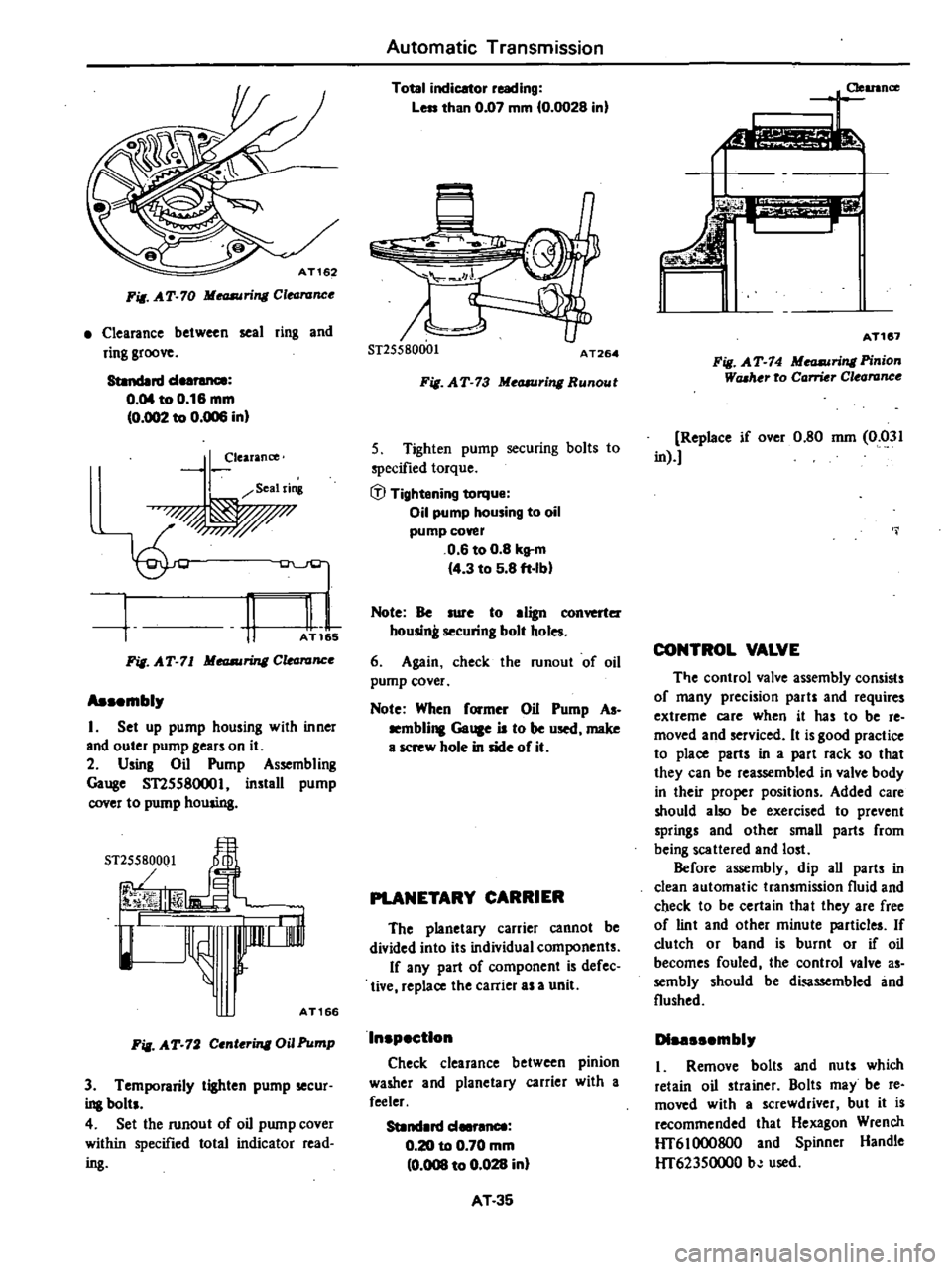
Fig
AT
70
MeG6Uring
Clearonce
Clearance
between
seal
ring
and
ring
groove
Stendard
0
04
to
0
16
mm
10
002
to
0
006
in
I
31earance
Seal
ring
w
I
J
7
r
11
AT1
5
II
Fig
AT
71
MeG6Uring
Clearance
As
mblr
L
Set
up
pump
housing
with
inner
and
outer
pump
gears
on
it
2
Using
Oil
Pump
Assembling
Gauge
ST2SS80001
instan
pump
cover
to
pump
houaing
AT166
Fig
AT
72
Centering
Oil
Pump
3
Temporarily
tighten
pump
secur
ing
bolts
4
Set
the
cunout
of
oil
pump
cover
within
specified
total
indicator
read
ing
Automatic
Transmission
Total
indicator
reading
Lell
than
0
07
mm
10
0028
inl
ST2SSBOOOl
AT264
Fig
AT
73
Me
ring
Runout
S
Tighten
pump
securing
bolts
to
specified
torque
r
Tightening
torque
Oil
pump
housing
to
oil
pump
cover
0
6
to
0
8
kg
m
14
3
to
5
8
ft
Ibl
Note
Be
sure
to
align
con
ter
housini
securing
bolt
holes
6
Again
check
the
runout
of
oil
pump
cover
Note
When
former
Oil
Pump
As
sembling
Gauge
is
to
be
used
make
a
screw
hole
in
side
of
it
PLANETARY
CARRIER
The
planetary
carrier
cannot
be
divided
into
its
individual
components
If
any
part
of
component
is
defec
tive
replace
the
carrier
as
a
unit
In
p
ctlon
Check
clearance
between
pinion
washer
and
planetary
carrier
with
a
feeler
Standard
d
0
20
to
0
70
mm
0
008
to
0
028
in
AT
35
uan
r
J
II
I
AT1S7
Fig
AT
74
MeG6Uring
Pinion
Waaher
to
CanUr
Clearance
Replace
if
over
0
80
mm
0
031
in
CONTROL
VALVE
Tlte
control
valve
assembly
consists
of
many
precision
parts
and
requires
extreme
care
when
it
has
to
be
re
moved
and
serviced
It
is
good
practice
to
place
parts
in
a
part
rack
so
that
they
can
be
reassembled
in
valve
body
in
their
proper
positions
Added
care
should
also
be
exercised
to
prevent
springs
and
other
small
parts
from
being
sca
ttered
and
lost
Before
assembly
dip
all
parts
in
clean
automatic
transmission
fluid
and
check
to
be
certain
that
they
are
free
of
lint
and
other
minute
particles
If
clutch
or
band
is
burnt
or
if
oil
becomes
fouled
the
control
valve
as
sembly
should
be
disassembled
and
flushed
DI
mblr
I
Remove
bolts
and
nuts
which
retain
oil
strainer
Bolts
may
be
re
moved
with
a
screwdriver
but
it
is
recommended
that
Hexagon
Wrench
lIT61000S00
and
Spinner
Handle
lIT623S0000
b
used
Page 288 of 548

HT6100800
Fig
AT
75
Dilaaumbling
ValwBady
2
Remove
attaching
bolts
With
bolts
removed
lower
valve
body
separate
plate
and
upper
valve
body
are
free
for
rem
wl
CAUTION
00
not
IIlow
orifice
c111C1l
VIlv8
end
weIn
spring
In
1
nIn
body
to
be
I
and
lost
wilen
removinglllp
aratll
plata
Automatic
Transmission
Sf
3
Pull
out
manual
valve
4
Remove
side
plate
Take
out
Ist
2nd
shift
dve
2nd
3rd
shift
valve
pressure
modifier
valve
and
Wee
valve
springs
Fig
AT
77
Remouing
Manual
Vallie
r
p
g
1
Prasur
e
ul8t
m
g
qrJ
0
ew
o
afW
e
f
rio
UIiltOi
SeccQdJock
V81V
AT171
HT61000800
Fig
AT
78
Remouing
Bide
Plote
CAUTION
00
not
work
it
off
With
rivers
To
syoid
damaging
m
in8
screws
do
not
work
it
off
with
screwdriver
5
Remove
side
plate
pull
out
pres
sure
regulator
valve
second
lock
valve
pressure
regulator
plug
and
two
valve
springs
6
Remove
side
plate
With
side
plate
removed
solenoid
downshift
valve
throttle
back
up
valve
vacuum
throttle
valve
2nd
3rd
timing
valve
and
three
valve
springs
are
free
for
removal
2ncr
3fiftiming
2
Jd
3rd
shift
WiIVeL
q
SOJe
nod
00
ibiIi
aMi
P
iWWi
m
d
fiii
va
iOtt
tii
jJ
v
Fig
AT
79
ComponentaPartaofeontrol
Value
AT
36
Page 289 of 548

Automatic
Transmission
Inspection
I
Check
valves
for
sign
of
burning
tension
if
necessary
replace
5
Check
oil
passages
in
valve
body
and
if
necessary
replace
4
Examine
for
any
sign
of
damage
for
sign
of
damage
and
other
condi
2
Check
to
be
certain
that
oil
or
score
marks
on
separate
plate
If
tions
which
might
interfere
with
prop
strainer
is
in
good
condition
If
found
left
unheerlcd
oil
will
bypass
correct
er
valve
operation
damaged
in
any
manner
discard
oil
passages
causing
many
types
of
6
Check
bolts
for
stripped
threads
3
Test
valve
springs
for
weakened
abnormalities
in
the
system
Replace
as
required
Valve
spring
chart
Mean
coil
Installed
Wiredia
No
of
Free
length
Valve
sprma
mm
in
dia
active
coil
mm
in
Length
Load
mm
in
mm
in
kg
lbl
Manual
detent
1
3
6
0
15
0
32
4
26
5
5
5
0
051
0
236
1
276
1
043
12
1
Pressure
regulator
1
2
10
5
13
0
43
0
23
5
2
8
0
047
0
413
1
693
0
925
6
2
Pressure
modifier
0
4
8
0
5
0
18
5
9
0
0
1
0
01
6
0
315
0
728
0
354
0
2
2nd
shift
0
6
6
0
f
16
0
32
0
16
0
0
625
1st
0
024
0
236
1
260
0
630
1
378
2nd
3rd
shift
0
7
6
2
18
0
41
0
17
0
1
40
0
028
0
244
1
614
0
669
3
09
2nd
3rd
timing
0
7
5
5
15
0
32
5
27
0
0
55
0
028
0
217
1
280
1
063
1
21
Throttle
back
up
0
8
6
5
14
0
36
0
18
8
1
92
0
031
0
256
1417
0
740
4
23
Solenoid
downshift
0
5
5
0
12
0
22
0
12
5
0
60
0
0217
0
197
0
866
0
492
1
32
Second
lock
0
55
5
0
16
0
33
5
21
0
0
60
0
0217
0
197
1
319
0
827
1
32
Throttle
relief
0
9
5
6
14
0
26
8
19
0
2
19
0
035
0
220
1
055
0
74g
4
83
Orifice
check
0
23
4
77
12
0
15
5
11
5
om
0
0091
0
lg78
0
610
0
453
0
02
Primary
governor
0
45
8
3
5
0
21
8
7
5
0
215
0
0177
0327
0
858
0
295
0
474
Secondary
governor
0
7
8
5
5
5
25
2
10
5
1
10
0
028
0
335
0
992
0
413
2
43
T
37
Page 291 of 548

Automatic
Transmission
TROUBLE
DIAGNOSIS
AND
ADJUSTMENT
Since
mo
automatic
transmission
troubles
can
be
repaired
by
simple
adjustment
do
not
disassemble
im
media
tely
Firstly
inspect
and
adjust
the
auto
D1
3tic
transmission
in
place
utilizing
the
Trouble
Shooting
Chart
If
the
trouble
can
not
be
solved
by
this
procedure
remove
and
disas
semble
the
automatic
tlllnsmission
It
is
advisable
to
check
overhaul
and
repair
each
part
in
the
order
listed
in
the
Trouble
Shooting
Chart
In
the
Trouble
Shooting
Chart
the
diagnosis
items
are
arranged
ac
cording
to
difficulty
from
easy
to
difficult
therefore
please
follow
these
items
The
tlllnsmission
should
riot
be
removed
unless
necessary
2
Tests
and
adjustments
should
be
inade
on
the
basil
of
standard
values
and
the
data
Should
be
recorded
INSPECTION
AND
ADJUSTMENT
BEFORE
TROUBLE
DIAGNOSIS
TESTING
INSTRUMENT
FOR
INSPECTION
I
Engine
t
chometer
2
Vacuum
gauge
3
Oil
pressure
gauge
It
is
convenieni
to
install
these
instruments
in
a
way
that
allows
meas
urements
to
be
made
from
the
driver
s
seat
CHECKING
OIL
LEVEL
In
checkIng
the
automatic
transmis
sion
the
oil
level
and
the
condition
of
oil
around
the
oil
level
gauge
should
be
examined
every
S
ooo
Ion
3
000
miles
This
is
an
easy
and
effective
trouble
shooting
procedure
since
some
changes
in
oil
condition
are
often
linked
with
developed
troubles
For
instance
Lack
of
oil
causes
defective
opera
tion
by
making
the
clutches
and
brakes
slip
resulting
in
severe
wear
This
is
because
the
oil
pump
sucks
air
causing
oil
foaming
thus
rapidly
deteriorating
the
oil
quality
and
pro
ducing
sludge
and
varnish
Excessive
oil
is
also
bad
because
of
oil
foaming
caused
by
the
gears
stirring
up
the
oil
During
high
speed
driving
excessive
oil
in
the
transmission
often
hlows
out
from
the
brealher
Me
urlns
011
level
To
check
the
nuid
leyel
sian
Ihe
engine
and
run
it
until
normal
operat
ing
temperatures
oil
temperature
SO
to
800C
122
to
1160F
Approxi
mately
ten
minute
of
operation
will
raise
the
temperature
to
this
range
and
engine
idling
conditions
are
stabi
lized
Then
apply
the
brakes
and
move
the
transmission
shift
lever
through
aU
drive
positions
and
place
it
in
park
P
position
In
his
inspec
tion
the
car
must
be
placc
d
on
a
level
surface
The
amount
of
the
oil
varies
with
the
temperature
As
a
rule
the
oil
level
must
be
measured
after
its
tempera
ture
becomes
sufficiently
high
I
Fill
the
oil
to
the
line
H
The
difference
of
capacities
between
both
H
and
L
is
approximately
0
4
liter
J
U
S
pt
Y
Imp
pt
and
therefore
do
not
fill
beyond
the
line
H
2
When
topping
up
and
changing
oil
care
should
be
taken
to
prevent
mixing
the
oil
with
dusl
and
water
In
pectlns
oU
condition
The
condition
of
oil
sticking
to
the
level
gauge
indicates
whether
to
OVOl
haul
and
repair
the
transmission
or
luok
for
Ihe
defective
part
If
the
oil
has
deteriorated
to
a
varnish
ike
quality
it
causes
the
con
trol
valve
to
stick
Blackened
oil
indi
cates
a
burned
clutch
brake
band
etc
AT
39
In
these
cases
the
transmission
must
be
repaired
CAUTION
I
In
checking
oil
IlVal
use
special
piper
Cloth
tohandla
the
18V81
llIugi
Ind
be
careful
not
to
let
the
scraps
of
paper
end
cloth
stick
to
the
IlIUp
b
U
lutomatic
transmission
fluid
having
OEXRON
ida
ons
only
in
the
3N71
B
eutomatic
trans
mission
c
Pay
IttBntion
blcau
the
oil
to
be
used
differs
from
that
used
in
the
Nissen
Full
Autometic
TllInsmis
sion
3N71A
N8V8r
mill
thl
oils
Note
Insert
the
gauge
fully
and
take
it
out
quickly
before
splesbing
oil
edheres
to
the
gauge
Then
observe
the
level
INSPECTION
AND
REPAIR
OF
OIL
LEAKAGE
When
oil
leakage
takes
place
the
portion
near
the
leakage
is
covered
with
oil
presenting
difficulty
in
detecting
the
spot
Therefore
the
places
where
oil
seals
and
gaskets
are
equipped
are
enumerated
below
Converter
housing
Rubber
ring
of
oil
pump
housing
Oil
seal
of
oil
pump
housing
Oil
seal
of
engine
crankshaft
Bolts
of
converter
housing
to
case
2
Transmission
and
rear
extension
Junction
of
transmission
and
rear
extension
Oil
cooler
tube
connectors
Oil
pan
Oil
pressure
inspection
holes
See
Fig
AT
81
Mounting
portion
of
vacuum
dia
phragm
and
downshift
solenoid
Breather
and
oil
charging
pipe
Speedometer
pinion
sleeve
Oil
seal
of
rear
extension
To
exactly
locate
Ihe
place
of
oil
leakage
proceed
as
follows
Page 292 of 548

Place
the
vehicle
in
a
pit
and
by
sampling
the
lealeed
oil
deiermine
if
it
is
the
torque
converter
oil
The
torque
converter
oil
has
a
color
like
red
wine
so
it
is
easily
distinguished
from
engine
oil
or
gear
oil
Wipe
off
the
lealeing
oil
and
dust
and
detect
the
spot
of
ill
lell8e
nonflammable
organic
solvent
such
as
carbon
tetrachloride
for
wiping
Raise
the
oil
tcmperature
by
op
erating
the
engine
and
shift
the
lever
to
D
to
increase
the
oil
pressure
The
sp
Q
of
o
1
1I8
u
J1en
be
found
more
easily
Note
As
oil
leakage
from
the
breath
er
does
not
talee
place
except
when
running
at
high
peed
it
iSimpos
sible
to
ate
this
lealcage
with
vehicle
stationary
CHECKING
ENGINE
IDLING
REVOLunON
The
engine
idling
revolution
should
be
properly
adjusted
If
the
engine
revolution
is
too
low
the
e
gine
does
not
operate
smoothly
and
if
too
high
a
strong
shocle
or
creep
develops
when
changing
over
from
ON
to
Dn
or
R
CHECKING
AND
ADJUSTING
KICK
WN
SWITCH
AND
DOWNSH
FT
SOLENOID
When
the
Ieickdown
operation
is
not
made
properly
or
the
speed
chang
ingpoint
is
too
high
check
the
kick
down
switch
downshift
solenoid
and
wiring
between
them
When
the
igni
tion
Ieey
is
po
iti
ned
at
the
1st
stage
and
the
accelerator
pedal
is
depressed
deeply
the
switch
contact
hould
be
closed
and
the
solenoid
should
clicle
If
it
does
not
click
it
indicates
a
defect
Then
check
each
part
with
the
testing
inatrumen15
Auto
lT1atic
Transmissiqn
Fi
J
A
T
84
Down
ltift
Sole
id
Note
Watch
for
oil
leekage
from
tnnsmission
case
INSPECTION
AND
ADJUSTMENT
OF
MANUAL
LINKAGE
The
adjustmcnt
of
manual
linkage
i
equany
important
as
Inspection
of
Oil
Level
for
the
automatic
transmis
sion
Therefore
great
care
should
be
cxercised
oecause
incorrect
adjustment
will
result
in
the
breakdown
of
the
transmission
Inspection
pun
the
selector
lever
toward
you
and
turn
it
as
far
as
p
to
range
where
clicks
will
be
ell
by
the
hand
This
is
the
detent
of
manual
valve
in
the
valve
body
and
indicates
the
corrett
position
of
the
lever
Inspect
whether
the
pointer
of
selector
dial
corresponds
to
this
point
and
also
whether
the
lever
comes
in
alignment
with
the
stepping
of
posi
iion
plate
when
itis
released
CHECKING
AND
ADJUSTING
INHIBITOR
SWITCH
The
inhibitor
switch
lights
the
re
verse
lamp
in
the
range
R
of
the
transmission
operation
and
also
rotates
the
starter
motor
in
the
ranges
N
and
P
AT
40
i
j
tI
IlV
@
@
AT
I
Inhibitor
switch
2
Manual
shaft
3
Washer
4
Nut
5
Manual
plate
Fi
J
AT
85
Comtruction
of
Inhibitor
Switch
6
Nut
1
Washer
8
Inhibitor
wilch
9
Ran
q
Iect
lever
Check
w
ethcr
he
leverse
lal
1p
and
the
starter
motor
operate
nonnal
Iy
in
these
ranges
If
there
is
any
trouble
first
check
the
inkage
If
no
defect
is
fo
nd
in
the
Ii
leage
check
tlie
inhibitor
Swi
ch
Separate
the
manual
lever
from
the
remote
control
selector
rod
and
turn
the
range
select
lever
to
N
Note
In
the
position
N
the
slot
of
the
manual
shaft
is
vertical
Using
the
tester
check
the
two
black
yellow
BY
wire
from
the
in
hibitor
switch
in
the
ranges
N
and
p
and
the
two
red
blacle
RB
wires
in
the
lange
R
for
continuity
Turn
range
select
lever
in
both
directions
from
each
lever
set
position
and
check
each
continuity
range
It
is
normal
if
the
electricity
is
on
while
the
lever
is
within
an
angle
of
about
30
on
both
sides
from
each
lever
set
line
How
ever
if
its
continuity
range
is
obvioUs
ly
u
nequal
on
both
sides
adjustment
is
required
If
any
malfunction
is
found
un
screw
the
fastening
nut
o
the
range
selector
lever
and
two
fastening
bolts
of
the
switch
body
and
then
remove
the
machine
screw
under
the
switch
body
Adjust
the
manual
shaft
correct
Iy
to
the
position
N
by
means
of
the
selector
leVer
When
the
slot
of
the
shaft
becomes
vertical
the
detent
worles
to
position
the
shaft
correctly
with
a
clicking
sound
Move
the
switch
slightly
aside
so
that
the
scie
hole
will
be
aligned
Page 293 of 548

with
the
pin
hole
of
the
internal
rotor
combined
with
the
manual
shaft
and
check
their
alignment
by
inserting
a
1
5
mm
0
059
in
diameter
pin
into
the
holes
If
the
alignment
is
correct
fasten
the
switch
body
with
the
bolts
pull
out
the
pin
tighten
up
the
screw
in
the
hole
and
fasten
the
selector
lever
as
before
Check
the
continuity
pin
with
the
lesler
If
Ihe
malfunc
tion
still
remains
replace
the
inhibitor
switch
STALL
TEST
The
purpose
of
this
test
is
to
check
the
transmission
and
engine
for
trou
ble
by
measuring
the
maximum
num
bers
of
revoiutions
o
the
cngine
while
vehicle
is
held
in
a
stalled
condition
The
carburetor
is
in
fullthrollle
opera
tion
with
the
selector
lever
in
ranges
1
2
and
I
respectively
Com
pale
the
measured
results
with
the
standard
values
Components
to
be
tested
and
test
itelJUl
I
Clutches
brake
and
band
in
trans
mission
for
slipping
2
Torque
converter
for
proper
func
tioning
3
Engine
for
overall
properly
STAU
TEST
PROCEDURES
Before
testing
check
the
engine
oil
and
torque
converter
oil
warm
up
the
engine
cooling
w
ter
to
suitable
tem
perature
by
running
at
1
200
rpm
with
the
selector
lever
in
the
range
P
for
sevcral
minutes
Warm
up
the
torque
converter
oil
to
suitable
temperature
60
to
lOOoC
140
to
2120F
I
Mount
the
engine
tachometer
at
a
location
that
allows
good
visibility
from
the
driver
s
seat
and
put
a
mark
on
specified
revolutions
on
the
meter
2
Secure
the
front
and
rear
wheels
with
chocks
and
apply
the
hand
brake
Be
SIIre
to
depress
the
brake
pedal
firmly
with
the
left
foot
before
de
pressing
the
accelerator
pedal
3
Throw
the
selector
lever
into
the
range
11
4
Slowly
depress
the
accelerator
pedal
until
the
throttle
valvc
is
fully
Automatic
Transmission
opened
Quickly
read
and
record
the
engine
revolution
when
the
engine
begins
to
rotate
steadily
and
then
release
the
accelerator
pedal
5
Shift
the
selector
lever
to
N
and
operate
the
engine
at
approxi
mately
1
200
rpm
for
more
than
one
minute
to
cool
down
the
torque
con
verter
oil
and
coolant
6
Make
similar
staU
tests
in
ranges
2
I
and
R
CAUTION
The
dill
test
operstion
81
specified
in
i18m
4
should
be
I118de
within
fiv
lIeonds
If
it
tBkes
too
long
the
oil
If
and
the
cluti
hn
blllke
and
b
nd
elll
ly
I
Suf
ficient
cooling
time
should
be
given
r
eech
test
for
the
four
IlInges
0
Z
1
end
R
JUDGEMENT
High
stall
revolution
more
than
staitdard
revolution
If
the
engine
levolulion
in
stall
condi
ion
is
higher
than
the
standard
values
it
indicates
that
onc
or
more
clutches
in
the
transmission
are
slipping
and
therefore
no
further
test
is
required
For
the
following
abnormalities
the
respective
causes
are
presumed
High
rpm
in
all
ranges
low
line
pr
ssure
High
rpm
in
0
2
and
I
and
normal
rpm
in
6R
Rear
clutch
slipping
High
rpm
in
D
and
2
and
normal
rpm
in
One
way
clutch
slipping
High
Ipm
in
R
only
Front
clutch
or
low
and
reverse
brake
slipping
To
determine
which
is
slipping
front
clutch
or
low
and
reverse
brake
a
road
test
is
needed
If
while
coasting
after
starting
with
the
levcr
in
I
range
engine
braking
does
not
work
properly
the
low
and
reverse
brake
is
slipping
Otherwise
the
front
clutch
is
slipping
Slipping
of
the
band
brake
is
diffi
cuJt
to
ascertain
However
jf
it
occurs
with
the
lever
in
1
range
engine
AT
41
revolution
increases
up
to
the
same
level
as
in
1st
range
It
is
impossible
to
check
it
in
the
stall
test
2
Standard
stall
rnoluiion
If
the
engine
revoluiion
in
stall
ondition
is
within
he
standard
values
the
control
elements
are
nOf
mally
operating
in
the
ranges
D
2n
I
and
R
Also
the
engine
and
one
way
clutch
of
the
torque
converter
are
norinal
in
performance
and
operation
The
one
way
clutch
of
the
torque
converter
however
sometimes
sticks
This
is
determined
in
the
road
test
3
Lower
stall
revolution
than
lIand
ard
revolution
If
the
engine
revolution
in
stall
condition
is
lower
than
the
standard
values
it
indicates
that
the
engine
is
in
abnormal
condition
or
the
torque
con
verter
s
one
way
clutch
is
slipping
4
O
hers
I
If
the
accelerating
performance
is
poor
until
vehicle
speed
of
approxi
mately
SO
kmfh
30
MPH
is
attained
and
then
normal
beyond
that
speed
it
can
be
judged
that
the
torque
con
verte
c
s
one
way
clutch
is
slipping
2
If
the
torque
converter
sane
way
dutch
sticks
vehicle
speed
can
not
exceed
approximately
80
kmfh
SO
MPH
in
the
road
tesl
In
such
a
case
the
torque
converter
oil
tem
perature
rises
abnormally
and
so
special
care
is
required
3
If
the
transmission
does
not
op
erate
properly
at
all
vehicle
speeds
it
indicates
poor
engine
performance
ROAD
TEST
An
accurate
knowledge
of
the
au
to
matic
transmission
is
required
for
an
exact
diagnosis
II
is
recommended
that
a
diagnosis
guide
chart
with
the
standard
vehicle
speeds
for
each
stage
of
the
up
and
down
shiftings
be
prepared
Measured
vehicle
speeds
are
to
be
filled
in
the
adjoining
column
after
each
testing
Also
it
is
advisable
to
mount
a
stopper
for
positioning
the
throttle
opening
Page 294 of 548

Automatic
Transmission
CAR
SPEED
AND
LINE
PRESSURE
WHEN
SHIFTING
GEARS
Non
callfornia
models
Sedan
and
tletchback
Intake
manifold
Car
speed
Propeller
shaft
vacyum
pearshift
mmHg
inHg
km
h
MPH
rpm
o
O2
49
to
62
30
to
39
1
840
to
2
340
1
0
0
Kickdown
O2
03
89
to
102
55
to
63
3
340
to
3
840
o
O2
92
to
79
57
to
49
3
460
to
2
960
3
o
0
48
to
34
30
to
21
I
790
to
1
290
2
01
O2
9
to
22
6to
14
330
to
830
200
7
87
O2
03
46to
59
29
to
37
1
720
to
2
220
03
O2
36
to
23
22io
14
1
350
to
850
O2
01
19
I
2
700
Max
o
0
Full
throttle
12
I
50
to
36
31
to
22
1
860
to
1
360
1
450
I7
72
12
I
50
to
36
31
to
22
I
860
to
I
360
1
Celilornia
models
All
models
and
Non
calilornill
models
Wagon
Intake
manifold
vacuum
mmHg
inHg
o
0
Kickdown
100
3
94
0
0
Full
throttle
300
I
1
81
Gearshift
Car
speed
Propeller
shaft
Ion
h
MPH
rpm
o
O2
52
to
59
32
to
37
1
970
to
2
220
1
O2
03
93
to
99
58
to
62
3
480
to
3
730
0
O2
84
to
91
52
to
57
3
160
to
3
410
3
O2
Dl
39
to
46
24
to
29
1
470
to
1
720
01
O2
20
to
27
12
to
17
750
to
1
000
O2
03
54
to
61
34
to
38
2
040
to
2
290
03
O2
28
to
35
I7
to
22
I
050
to
I
300
O2
01
9
to
16
6
to
10
350
tq
600
12
I
40
to
47
25
to
29
1
500
to
1
750
I
12
I
40
to
47
25
to
29
1
500
to
1
750
1
Line
pressure
kg
cm2
psi
54
to
6
6
77
to
94
4
4
to
5
4
63
to
77
4
4
to
7
8
63
to
III
5
8
to
7
1
82
to
101
5
8
to
7
I
82
to
101
Line
pressure
kg
cm2
Psi
5
4
to
7
0
77
to
100
4
5
10
6
1
64
to
87
5
6
to
7
2
80
to
102
5
6
to
7
2
80
to
102
Reduce
the
speed
by
shifting
to
I
range
from
0
range
output
shaft
2
000
rpm
Car
speed
can
be
calcuiated
by
the
following
formula
V
2
xrxNpx6O
RF
x
1
000
where
V
Car
speed
Ion
h
Np
Propeller
shaft
revolution
rpm
RF
Final
gear
ratio
r
Tire
effective
adius
m
The
ratio
of
ciIcumfe
ence
of
a
circle
to
its
diameter
3
14
Note
RF
3
889
r
0
27S
m
lSS
13
6
lS
13
4PR
lSSSR13
or
17S
7OSR13
AT
42