1976 CHEVROLET VEGA mileage
[x] Cancel search: mileagePage 5 of 87
Downloaded from www.Manualslib.com manuals search engine YOUR VEGA'S FIRST
FEW HUNDRED MILES OF DRIVING
You can operate your new car
from its very first mile without ad
hering to a formal
"break-in" sched
ule. However, during the first
few
hundred miles of driving you can,
by observing a few simple precau
tions , add to the future performance
and economy of your car.
It is recommended that your speed
during the first
500 miles
be confined to a maximum of 55
M.P.H., but do not drive for ex
tended periods at
anyone constant
speed, either fast
or slow. Dur
ing this period , avoid full throttle
starts and, if possible, avoid hard
stops especially during the first
200
miles of operation since brake mis- use
during this period will destroy
much future brake efficiency.
Always drive at moderate speed
until the engine has completely
warmed up.
If you plan to use your new
car for trailer hauling see additional
information on page 1-9.
SEE PAGE 5-21 FOR ADDITIONAL INFORMATION
ON HOW TO IMPROVE YOUR GAS MILEAGE.
ii
Page 59 of 87
Downloaded from www.Manualslib.com manuals search engine SERVICE AND MAINTENANCE
The time or mileage intervals on
the following pages are intended
as a guide for establishing regular
maintenance and lubrication per
iods for your car. Sustained heavy
duty or high speed operations
or
operation under adverse conditions
may necessitate more frequent ser
vicing .
To determine specific rec
ommendations for conditions un-
Fuel
Requirements
Your Chevrolet engine is de
signed to operate only on unleaded
gasoline. Unleaded gasoline
is essen
tial for proper emission control
system operation, and it will mini
mize spark plug fouling. The
use of der
which you
.use your car, con
sult your authorized Chevrolet
Dealer.
Maintenance Schedule
For owner convenience, a sepa
rate maintenance folder has been
provided with your car which con
tains a complete schedule
and brief
explanation of the safety , emission
"-leaded gasoline can damage or
severely reduce the effectiveness of
the emission control system and
re
sult in loss of warranty coverage.
Use unleaded gasoline meeting
the minimum octane specifications
established
by the Federal govern
ment. In compliance with Federal
regulations, pumps dispensing such
gasoline are labeled with the word
5-1
control, lubrication and general
maintenance it requires. The main
tenance folder information
is sup
plemented
by this section of the
Owner's Manual, as well as a
Warranty Information folder also
furnished with your car. Read all
three publications for a full under
standing of vehicle maintenance
requirements.
UNLEADED and are equipped
with dispensing nozzles which
fit
the filler neck of your car's gaso
line tank.
Supplementary gasoline addi
tives which contain lead and or
phosphorus should not
be used
under any circumstances: Such
additives can severely reduce the
effectiveness of your catalytic con
verter.
Page 72 of 87
Downloaded from www.Manualslib.com manuals search engine TIRES
The factory installed tires on
your vehicle, shown in the Tire
Usage Chart, are engineered to pro
vide a proper balance of these per
formance characteristics for normal
vehicle operation:
• Endurance
• Handling
• Noise
• Ride
• Road Hazard Resistance
• Rolling Resistance
• Traction
• Tread Mileage
This section contains some tips
on how you can obtain maximum
benefit from these tires and your
investment in them.
Vehicle Loading
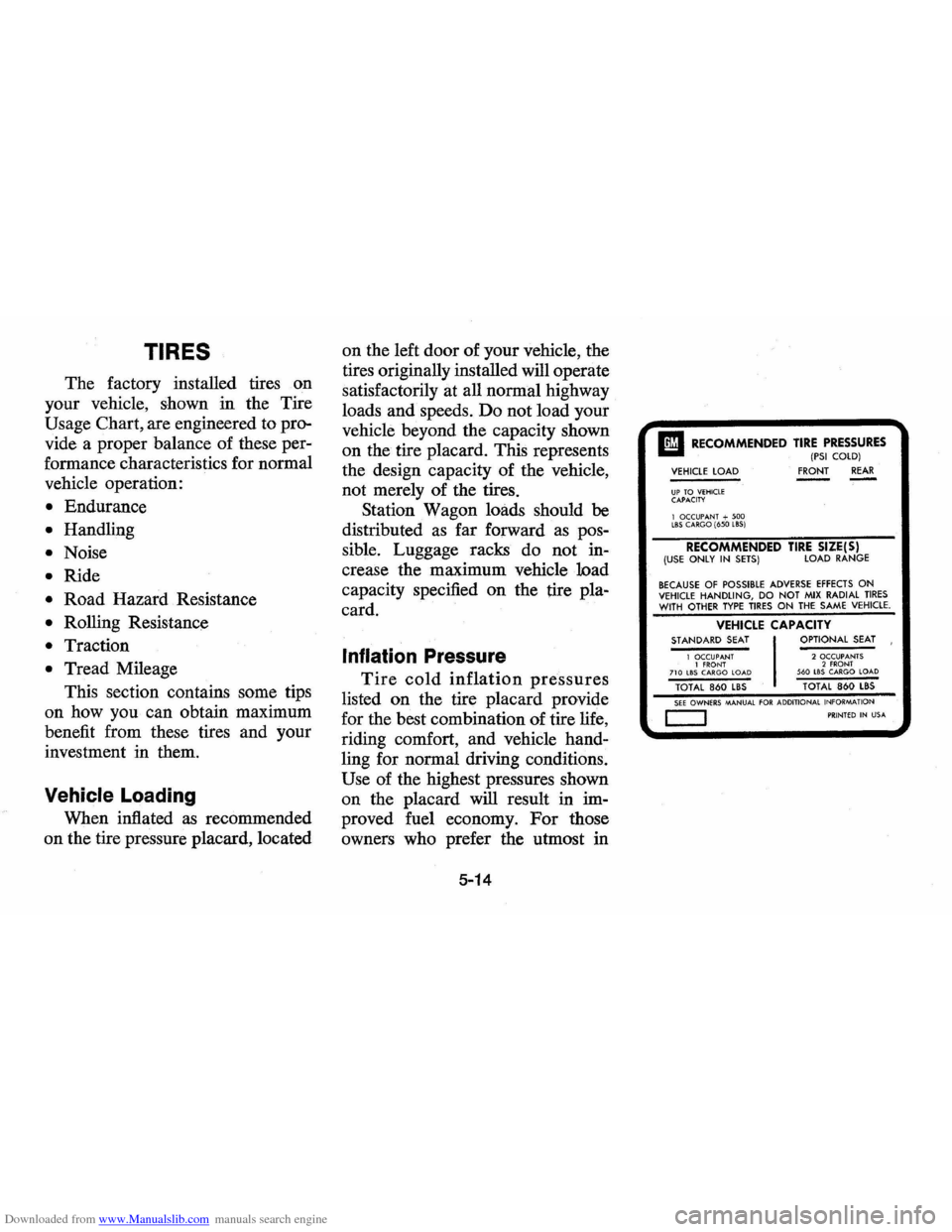
When inflated as recommended
on the tire pressure placard, located on
the left door of your vehicle,
the
tires originally installed will operate
satisfactorily at all normal highway
loads and speeds. Do not load your
vehicle beyond the capacity shown
on the tire placard. This represents
the design capacity of the vehicle,
not merely of the tires.
Station Wagon loads should
be
distributed as far forward as pos
sible. Luggage racks do not in
crease the maximum vehicle load
capacity specified on the tire pla
card.
Inflation Pressure
Tire cold inflation pressures
listed on the tire placard provide
for the best combination of tire life,
riding comfort, and vehicle hand
ling for normal driving conditions.
Use of the highest pressures shown
on the placard will result in
im
proved fuel economy. For those
owners who prefer the utmost in
5-14
II RECOMMENDED TIRE PRESSURES (PSI COlD) VEHICLE lOAD FRONT REAR ----UP TO VEHICLE CAPACITY
1 OCCUPANT + 500 lBS CARGO (650 lBS)
RECOMMENDED TIRE SIZE(S) (USE ONLY IN SETS) LOAD RANGE
BECAUSE OF POSSIBLE ADVERSE EFFECTS ON VEHICLE HANDLING, DO NOT MIX RADIAL TIRES WITH OTHER TYPE TIRES ON THE SAME VEHICLE.
VEHICLE CAPACITY STANDARD SEAT OPTIONAL SEAT
1 OCCUPANT 2 OCCUPANTS 1 fRONT 2 FRONT 710 lBS CARGO LOAD 560 LBS CARGO LOAD TOTAL 860 lBS TOTAL 860 lBS SEE OWNERS MANUAL FOR ADDITIONAL
INFORMATION
c::J PRINTED IN USA
Page 78 of 87
Downloaded from www.Manualslib.com manuals search engine belted, or radial) as originally in
stalled on your vehicle. Use of any
other size
or type tire may seriously
affect ride, handling, speedometer /
odometer calibration, vehicle
ground clearance, and tire clear
ance to the body and chassis.
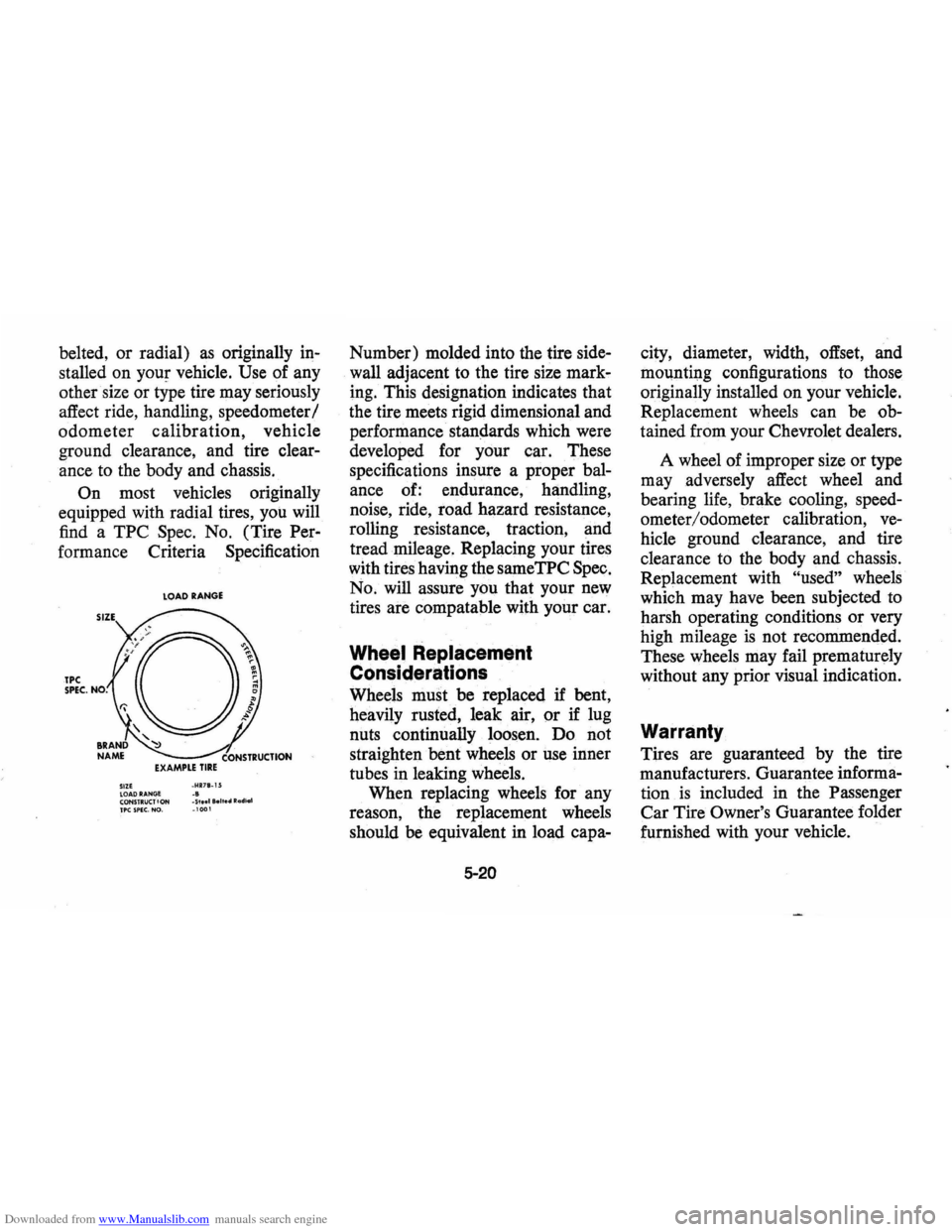
On most vehicles originally
equipped with radial tires,
you will
find a
TPC Spec. No. (Tire Per
formance Criteria Specification
LOAD RANGE
TPC SPEC. NO.
SItE _HUI_ U LOAD RANG! .8 CONSTRUCT' ON _5, .. 1 a.lt •• Radle.! TPC SPEC. NO. _ 1 00 1
Number) molded into the tire side
wall adjacent to the tire size mark.,.
ing. This designation indicates that
the tire meets rigid dimensional and
performance standards which were
developed for your car. These
specifications insure a proper
bal
ance of: endurance, handling,
noise, ride,
road hazard resistance,
rolling resistance, traction,
and
tread mileage. Replacing your tires
with tires having the sameTPC Spec.
No. will assure you that your new
tires are compatable with your car.
Wheel Replacement
Considerations
Wheels must be replaced if bent,
heavily rusted, leak air,
or if lug
nuts continually loosen.
Do not
straighten
bent wheels or use inner
tubes in leaking wheels.
When replacing wheels for any
reason, the replacement wheels
should
be equivalent in load capa-
5-20
city, diameter, width, offset, and
mOllnting configurations to those
originally installed
on your vehicle.
Replacement wheels
can be ob
tained from your Chevrolet dealers.
A wheel
of improper size or type
may adversely affect wheel and
bearing life, brake cooling, speed
ometer/odometer calibration,
ve
hicle ground clearance, and tire
clearance to the body
and chassis.
Replacement with
"used" wheels
which may have been subjected to
harsh operating conditions
or very
high mileage is
not recommended.
These wheels
may fail prematurely
without any prior visual indication.
Warranty
Tires are guaranteed by the tire
manufacturers. Guarantee informa
tion
is included in the Passenger
Car Tire Owner's Guarantee folder
furnished with your vehicle.
Page 79 of 87
Downloaded from www.Manualslib.com manuals search engine IMPORTANT FACTS YOU SHOULD KNOW ABOUT GASOLINE MILEAGE
How you drive, where you drive,
and when you drive all have an
effect on how many miles you can
get from a gallon of gasoline. The
careful attention you give your car
as far as maintenance and repairs
are concerned will also contribute
importantly to fuel economy.
Fuel Selection
Your vehicle is designed to op
erate
only on unleaded gasoline of
at least 87 average octane num
ber (Research octane plus Motor
octane divided by two). This gaso
line should have a Research octane
number of at least 91, and a
Motor octane number of
at least
83. Unleaded gasoline
is essential
for proper emission control system
operation, and it will minimize
spark plug fouling. The use of
... AND HOW TO IMPROVE IT
leaded gasoline can damage or
severely reduce the effectiveness of
the emission control system and re
sult in loss of warranty coverage.
"Jackrabbit" Starts
Gasoline can be conserved (and
engine and tire life prolonged) by
avoiding unnecessarily rapid accel
eration away from lights and stop
signs.
Stop-And-Start Driving
Frequent stops and starts during
a trip really cut down on your miles
per gallon.
Plan even your short
shopping trips to take advantage of
through streets to avoid traffic
lights.
Pace your driving like the
professional drivers to avoid
un
necessary stops.
5-21
Excessive Idling
An idling engine uses gasoline,
too.
If you're faced with more than
a
few minutes wait and you're not
in traffic, it may be better to
"turn
off"
and start again later.
Sudden Stops
Sudden stops themselves don't
waste gasoline , but energy
is
wasted as heat in braking . Energy
in the form of gasoline
is also
needed to accelerate back to driv
ing speed.
Lubricants
A properly lubricated vehicle
means less friction between moving
parts. Consult this manual and the
maintenance schedule for the
proper lubricants to use and the
lubrication intervals.
Page 80 of 87
Downloaded from www.Manualslib.com manuals search engine Air Cleaner
Your car receives its power from
a mixture of gasoline and air. The
air
is taken in to the system through
the air cleaner
so it's important to
replace the air cleaner at required
intervals. A dirty air cleaner re
duces engine efficiency.
Properly Tuned Engine
Overall tuning (a check on tim
ing, spark plugs, emission control
devices, etc.) can improve your
car's gas mileage. You just can't
expect an
"out-of-tune" engine to
give you good gas mileage and
cleaner air.
Excess Weight
Fuel economy is related to the
work the engine must do. The
heavier the load, the more power it
takes. Keep excess weight to a
minimum by removing any per
sonal effects or luggage from the
car or trunk when they are not
needed.
Tire Inflation
Underinfiation not only causes
needless wear of the tires, but can
also waste gasoline. It's a good
idea to check tire pressures
regularly.
Wheel Alignment
Incorrect "toe in" or "toe out" can
have the effect
of dragging your
front tires sideways and may cause
premature tire wear.
It takes power
to carry this extra load and that
takes gas from your tank.
Catalytic Converter
The catalytic converter IS an
emission control device added to
5-22
the exhaust system to reduce hy
drocarbon and carbon monoxide
pollutants from the exhaust gas
stream.
The converter contains
beads which are coated with a cata
lytic material containing platinum
and palladium.
Use of the catalytic converter
has the advantage of allowing the
engine to be re-tuned for improved
fuel economy and driveability.
The catalytic converter requires
the use
of unleaded fuel only.
Unleaded gasoline is used to re
duce combustion chamber deposits,
corrosion and
to prevent lead con
tamination of the catalyst that
would render it ineffective.
The use
of leaded fuel will cause the cata
lytic converter to
become ineffec
tive as an emission control device.
Page 87 of 87
Downloaded from www.Manualslib.com manuals search engine • Your name, address, telephone
number
• Vehicle Identification number*
• Dealer's name and location
• Vehicle's delivery date and
mileage
• Nature of problem
STEP THREE -Contact the
Customer Services Manager,
Chevrolet Central Office, Chev
rolet Motor Division, Detroit,
Michigan
48202 (313-556-5219)
(or in Canada contact the
Owner Relations Manager,
Oshawa, Ontario 416-644-6624).
If after an additional review of all
facts involved he feels that some
further action can be taken, he will
so instruct the Zone. In any case,
your contact will be acknowledged
providing Chevrolet's position in
the matter.
When contacting the Zone
or
Central Office, please bear in mind
that ultimately your problem likely will
be resolved in the dealership,
utilizing the dealer's facilities,
equipment and personnel. It is sug
gested, therefore, that you follow
the above steps in sequence when
pursuing a problem.
Your purchase of a Chevrolet
product
is greatly appreciated by
both your dealer and Chevrolet
Motor Division.
It is our sincere
desire to assist you in any
way pos
sible to assure your complete satis
faction with your vehicle.
* Available from vehicle registration, title
or plate attached to left top of instrument panel and visible through
the windshield.
6-6