Page 70 of 86
DRIVING
STARTING
Anti-theft, Ignition, Starter
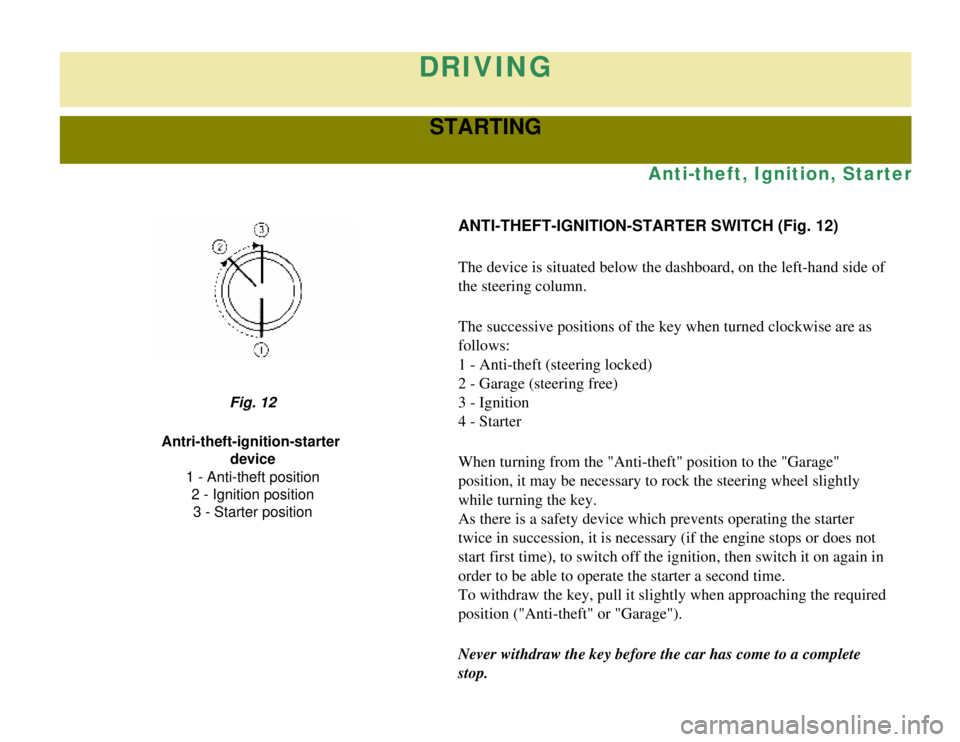
ANTI-THEFT-IGNITION-STARTER SWITCH (Fig. 12)
The device is situated below the dashboard, on the left-hand side of
the steering column.
The successive positions of the key when turned clockwise are as
follows:
1 - Anti-theft (steering locked)
2 - Garage (steering free)
3 - Ignition
4 - Starter
When turning from the "Anti-theft" position to the "Garage"
position, it may be necessary to rock the steering wheel slightly
while turning the key.
As there is a safety device which prevents operating the starter
twice in succession, it is necessary (if the engine stops or does not
start first time), to switch off the ignition, then switch it on again \
in
order to be able to operate the starter a second time.
To withdraw the key, pull it slightly when approaching the required
position ("Anti-theft" or "Garage").
Never withdraw the key before the car has come to a complete
stop.
Fig. 12
Antri-theft-ignition-starter device
1 - Anti-theft position 2 - Ignition position3 - Starter position
Page 71 of 86

CHOKE CONTROL (Fig. 13 - Mark 3)
The choke must not be used unless the engine is cold (3).
Click here for instructions on using the starting handle.
BEFORE STARTING THE ENGINE
A quick check at the "Pre-start check list" can avoid an oversight.
Fig. 13
LHD Starting the engine 1 - Engine oil pressure warning lamp(2 CV6)
2 - Anti-theft-ignition-start 3 - Choke control
STARTING THE ENGINE (Do not run the engine in an
enclosed space)
After a long stop or when the temperature is very cold, first ?free?
the engine using the starting handle without switching on the
ignition or using the choke.
Make sure that the gear lever is in neutral and that the handbrake is
fully on.
Turn the ignition key as far as possible: the ignition is on. On "2
CV6" model the oil pressure warning lamp lights up (Fig. 13, mark
1).
If the engine is cold:
Do not touch the accelerator pedal. Pull the choke control out fully.
Operate the starter until the engine starts to run. Release the
controls a few seconds after the engine starts (the choke control will \
automatically return to its mid-way position). Let the engine warm
up for a few minutes in neutral without racing it.
If the engine is hot:
Do not touch the choke control. Depress the accelerator pedal fully
and do not release it. Switch on the ignition, operate the starter until\
the engine starts to run then leave your foot off the accelerator pedal \
progressively.
In mountainous areas after a short stop:
Page 72 of 86
Operate the starter without depressing the accelerator. If the engine
starts to run and dies, accelerate progressively to avoid stalling. If
the engine does not start at idling speed, pull the choke out to its
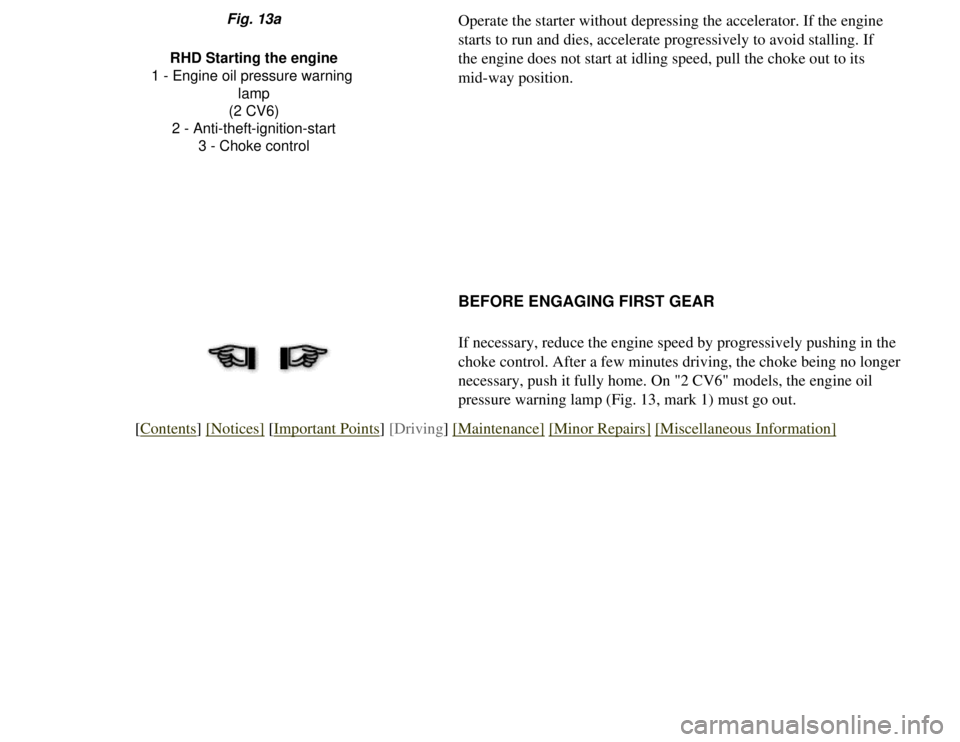
mid-way position.Fig. 13a
RHD Starting the engine
1 - Engine oil pressure warning lamp
(2 CV6)
2 - Anti-theft-ignition-start 3 - Choke control
BEFORE ENGAGING FIRST GEAR
If necessary, reduce the engine speed by progressively pushing in the
choke control. After a few minutes driving, the choke being no longer
necessary, push it fully home. On "2 CV6" models, the engine oil
pressure warning lamp (Fig. 13, mark 1) must go out.
[Contents] [Notices] [Important Points] [Driving] [Maintenance] [Minor Repairs] [Miscellaneous Information]
Page 73 of 86
DRIVING
Driving
Gears, clutch, brakes
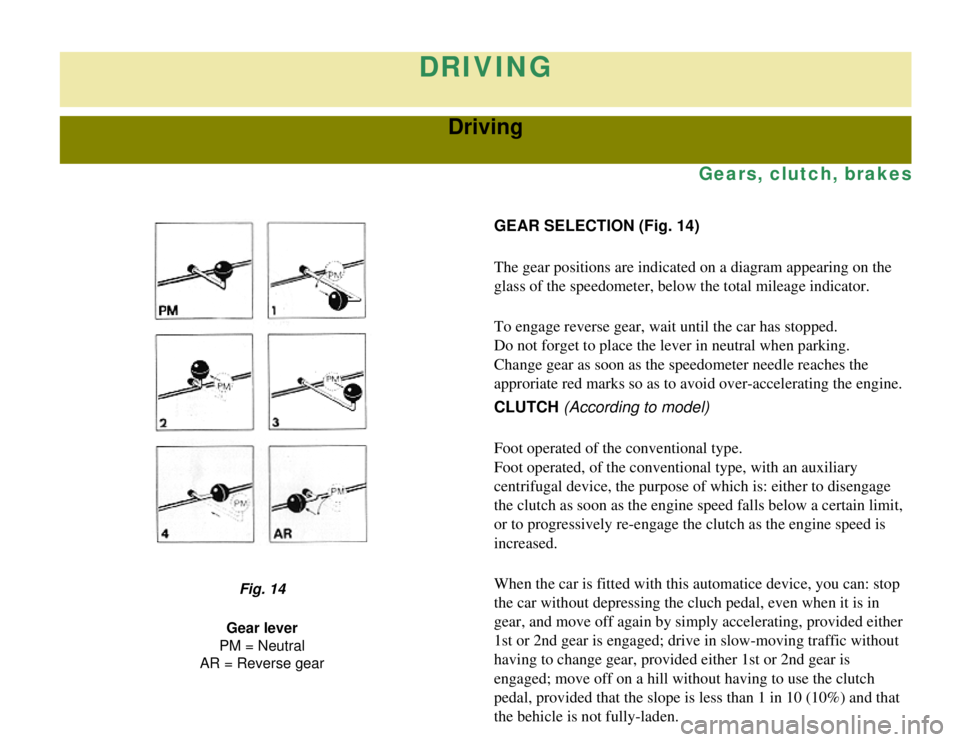
GEAR SELECTION (Fig. 14)
The gear positions are indicated on a diagram appearing on the
glass of the speedometer, below the total mileage indicator.
To engage reverse gear, wait until the car has stopped.
Do not forget to place the lever in neutral when parking.
Change gear as soon as the speedometer needle reaches the
approriate red marks so as to avoid over-accelerating the engine.
CLUTCH (According to model)
Foot operated of the conventional type.
Foot operated, of the conventional type, with an auxiliary
centrifugal device, the purpose of which is: either to disengage
the clutch as soon as the engine speed falls below a certain limit,
or to progressively re-engage the clutch as the engine speed is
increased.
When the car is fitted with this automatice device, you can: stop
the car without depressing the cluch pedal, even when it is in
gear, and move off again by simply accelerating, provided either
1st or 2nd gear is engaged; drive in slow-moving traffic without
having to change gear, provided either 1st or 2nd gear is
engaged; move off on a hill without having to use the clutch
pedal, provided that the slope is less than 1 in 10 (10%) and that
the behicle is not fully-laden.
Fig. 14
Gear lever
PM = Neutral
AR = Reverse gear
Page 85 of 86

l Changing a fuse
l Changing a sparking plug
l Changing a wheel
l Charge indicator
l Chassis number
l Chassis number stamping
l Choke
l Clutch
l Controls and accessories (LH) (RH)
D
l Dashboard
l Defrosting
l Demisting
l Dimensions, main
l Direction indicators
l Doors, opening
l Driving position
E
l Engine, data
l Engine, number plate
l Engine, oil level
l Engine, oil, warning lamp
F
l Fuel, filling up
l Fuel gauge
l Fuse boxes
l Fuses
l Rear floor
l Rear hammock for parcels
l Rear-view mirrors
l Reverse gear
l Replacement parts, orders
l Running-costs
l Running-in
S
l Seat belts
l Seats
l Seats, backrest adjustment
l Service at 600 miles
l Signalling
l Sparking plugs and gaps
l Speedometer
l Spots on upholstery
l Starting engine
l Starting engine with handle
l Steering wheel (cleaning)
l Stopping the engine
T
l Tar, removal
l Technical data
l Temperature, interior
l Touching-up paintwork
l Towing the car
l Towing a trailer
l Transmission
l Travelling abroad
l Tyre pressures
Page:
< prev 1-8 9-16 17-24