Page 50 of 86

This card must be signed for you to benefit from the guarantee.
INFLUENCE OF DRIVING TECHNIQUES ON RUNNING
COSTS
The manner in which a car is driven affects its running costs,
particularly as far as fuel, oil, and tyre expenses are concerned.
Running costs increase notably with:
-speed,
-frequent and prolonged use of low gears,
-accelerating and braking too often or too fiercely,
unnecessary use of the accelerator pedal,
-leaving the choke out,
-taking bends at high speeds,
-tyre inflated to incorrect pressures.
Oil consumption, which varies a great deal with the use of the car,
is also influenced when running in the engine, and you are advised
to pay particular attention to this point as well as to the oil change
section in the Maintenance Guide.
TOWING A TRAILER
If you intend to tow a caravan or trailer, consult your Citroën deale\
r
first, who will give you all the necessary advice, especially in so far \
as the legal requirements are concerned.
The maximum towing weights are, in France:
- Trailer without brake: 270 kg (595 lbs)
- Trailer with overrun brake: 400 kg (881 lbs)
IDENTIFICATION
Positions
Manufacturer's plate:Under the bonnet on the scuttle panel, RH
side.
Page 62 of 86
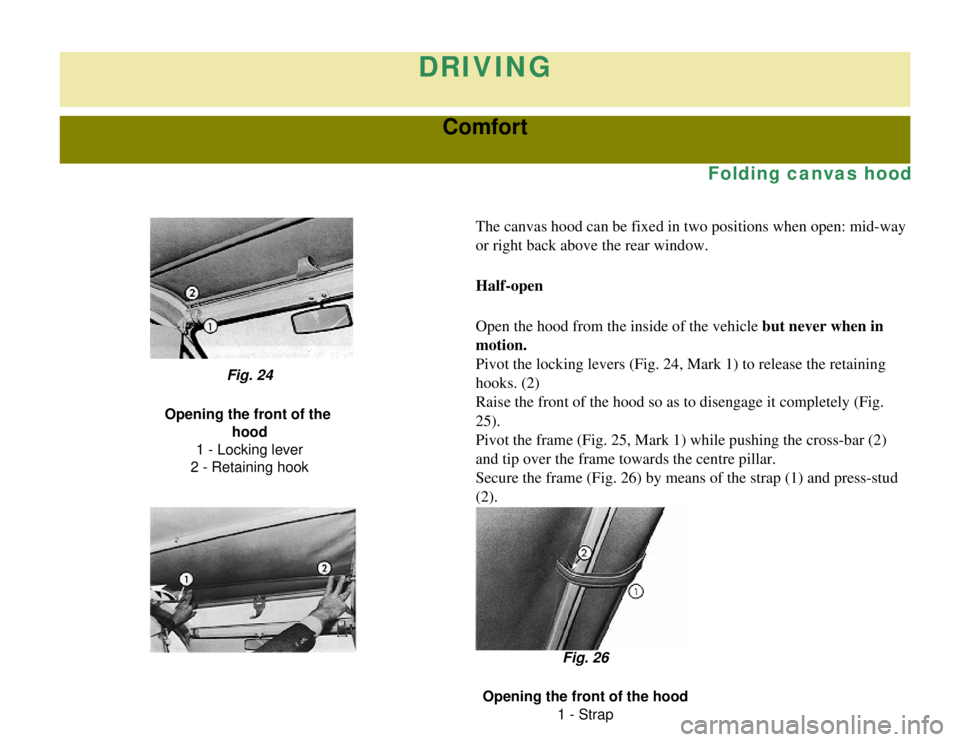
WEIGHTSSaloon (Sedan)
"Commercial" version
lbs kg lbs kg
Unladen weight,
running order
-at front
-at rear 1234
560 1267 575
723 328 753 343
509 232 509 232
Max. authorized laden
weight
-at front
-at rear 1973
895 1973 895
992 450 992 450
1102 500 1102 500
Max. towing weight
-without overrun brake
-with continuous brake 595
270 595 270
881 400 881 400
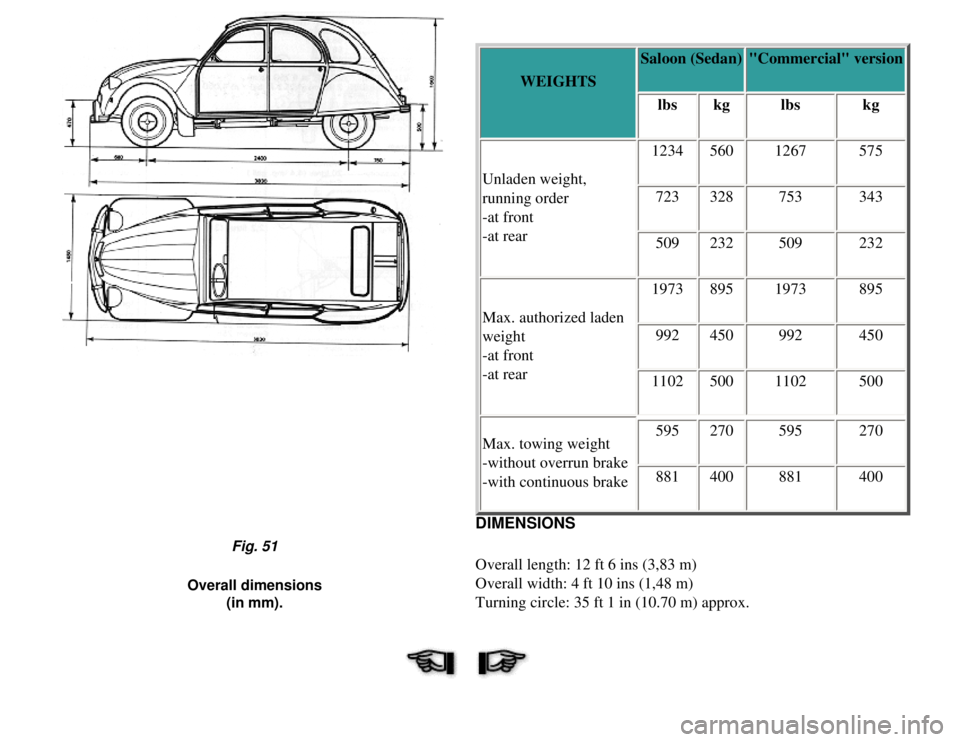
DIMENSIONS
Overall length: 12 ft 6 ins (3,83 m)
Overall width: 4 ft 10 ins (1,48 m)
Turning circle: 35 ft 1 in (10.70 m) approx.
Fig. 51
Overall dimensions (in mm).
Page 67 of 86
DRIVING
DRIVING POSITION
Seats, Rear-view Mirrors, Seat Belts
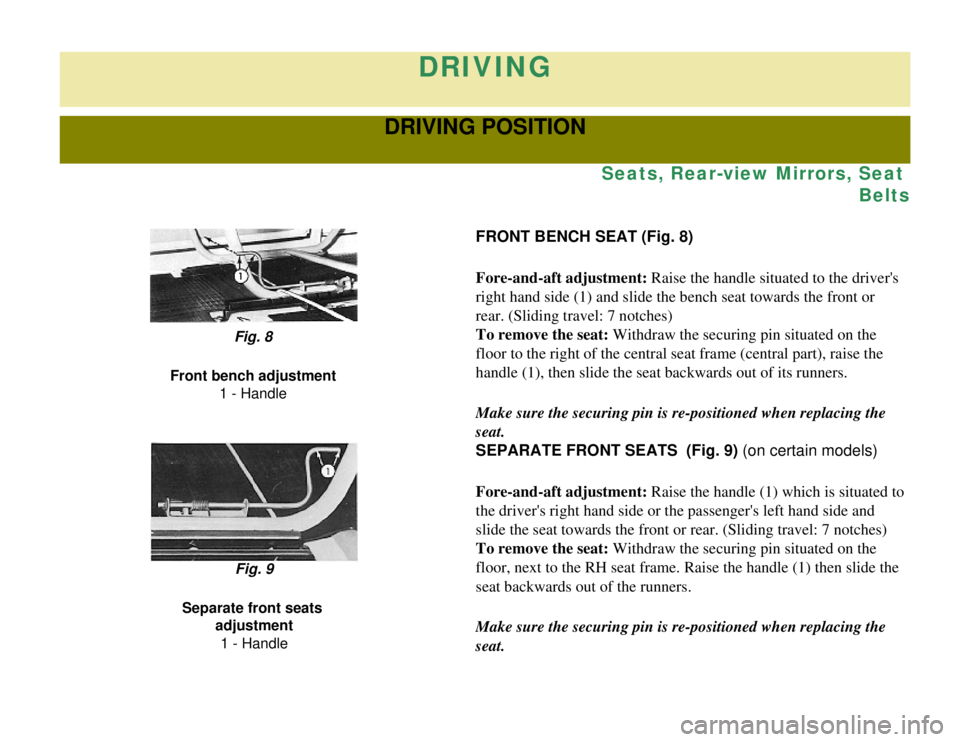
FRONT BENCH SEAT (Fig. 8)
Fore-and-aft adjustment: Raise the handle situated to the driver's
right hand side (1) and slide the bench seat towards the front or
rear. (Sliding travel: 7 notches)
To remove the seat: Withdraw the securing pin situated on the
floor to the right of the central seat frame (central part), raise the\
handle (1), then slide the seat backwards out of its runners.
Make sure the securing pin is re-positioned when replacing the
seat.
Fig. 8
Front bench adjustment 1 - Handle
SEPARATE FRONT SEATS (Fig. 9) (on certain models)
Fore-and-aft adjustment: Raise the handle (1) which is situated to
the driver's right hand side or the passenger's left hand side and
slide the seat towards the front or rear. (Sliding travel: 7 notches)
To remove the seat: Withdraw the securing pin situated on the
floor, next to the RH seat frame. Raise the handle (1) then slide the \
seat backwards out of the runners.
Make sure the securing pin is re-positioned when replacing the
seat.
Fig. 9
Separate front seats adjustment
1 - Handle
Page 68 of 86
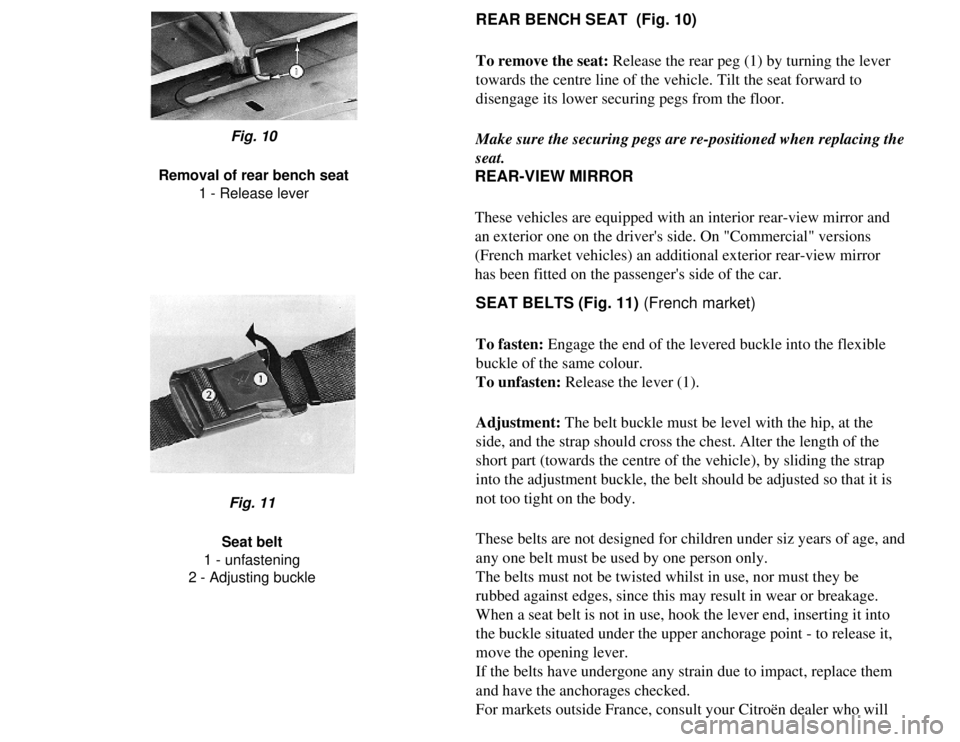
REAR BENCH SEAT (Fig. 10)
To remove the seat: Release the rear peg (1) by turning the lever
towards the centre line of the vehicle. Tilt the seat forward to
disengage its lower securing pegs from the floor.
Make sure the securing pegs are re-positioned when replacing the
seat.
Fig. 10
Removal of rear bench seat 1 - Release lever
REAR-VIEW MIRROR
These vehicles are equipped with an interior rear-view mirror and
an exterior one on the driver's side. On "Commercial" versions
(French market vehicles) an additional exterior rear-view mirror
has been fitted on the passenger's side of the car.
SEAT BELTS (Fig. 11) (French market)
To fasten: Engage the end of the levered buckle into the flexible
buckle of the same colour.
To unfasten: Release the lever (1).
Adjustment: The belt buckle must be level with the hip, at the
side, and the strap should cross the chest. Alter the length of the
short part (towards the centre of the vehicle), by sliding the strap
into the adjustment buckle, the belt should be adjusted so that it is
not too tight on the body.
These belts are not designed for children under siz years of age, and
any one belt must be used by one person only.
The belts must not be twisted whilst in use, nor must they be
rubbed against edges, since this may result in wear or breakage.
When a seat belt is not in use, hook the lever end, inserting it into
the buckle situated under the upper anchorage point - to release it,
move the opening lever.
If the belts have undergone any strain due to impact, replace them
and have the anchorages checked.
For markets outside France, consult your Citroën dealer who will
Fig. 11
Seat belt
1 - unfastening
2 - Adjusting buckle
Page 78 of 86
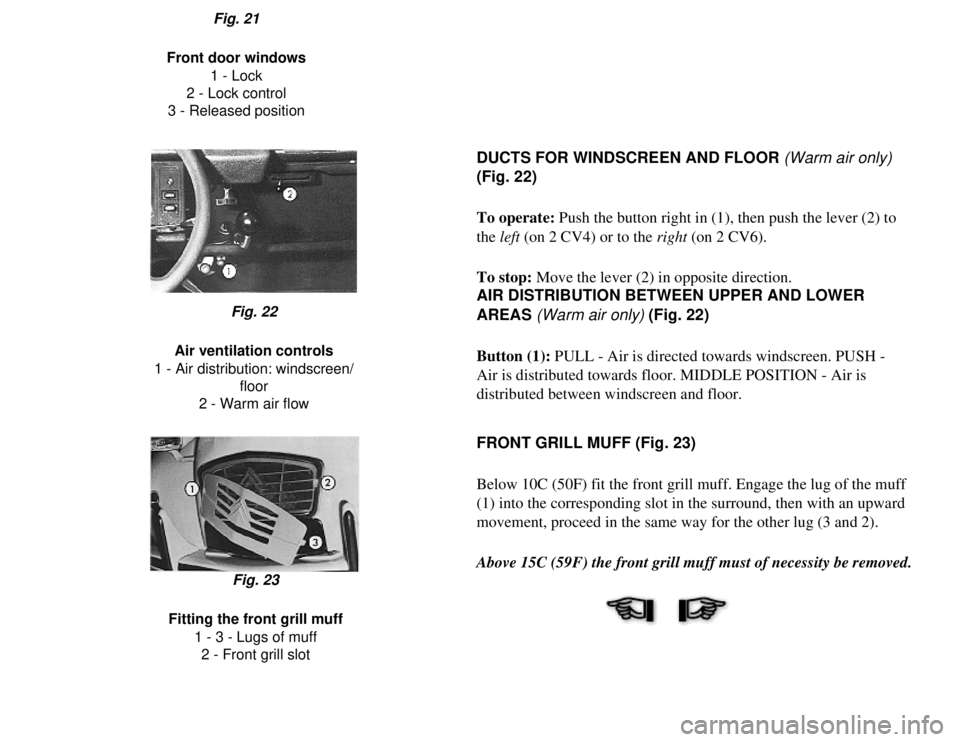
Fig. 21
Front door windows 1 - Lock
2 - Lock control
3 - Released position
DUCTS FOR WINDSCREEN AND FLOOR (Warm air only)
(Fig. 22)
To operate: Push the button right in (1), then push the lever (2) to
the left (on 2 CV4) or to the right (on 2 CV6).
To stop: Move the lever (2) in opposite direction.
AIR DISTRIBUTION BETWEEN UPPER AND LOWER
AREAS (Warm air only) (Fig. 22)
Button (1): PULL - Air is directed towards windscreen. PUSH -
Air is distributed towards floor. MIDDLE POSITION - Air is
distributed between windscreen and floor.
Fig. 22
Air ventilation controls
1 - Air distribution: windscreen/ floor
2 - Warm air flow
FRONT GRILL MUFF (Fig. 23)
Below 10C (50F) fit the front grill muff. Engage the lug of the muff
(1) into the corresponding slot in the surround, then with an upward
movement, proceed in the same way for the other lug (3 and 2).
Above 15C (59F) the front grill muff must of necessity be removed.
Fig. 23
Fitting the front grill muff 1 - 3 - Lugs of muff2 - Front grill slot
Page 80 of 86
DRIVING
Comfort
Folding canvas hood
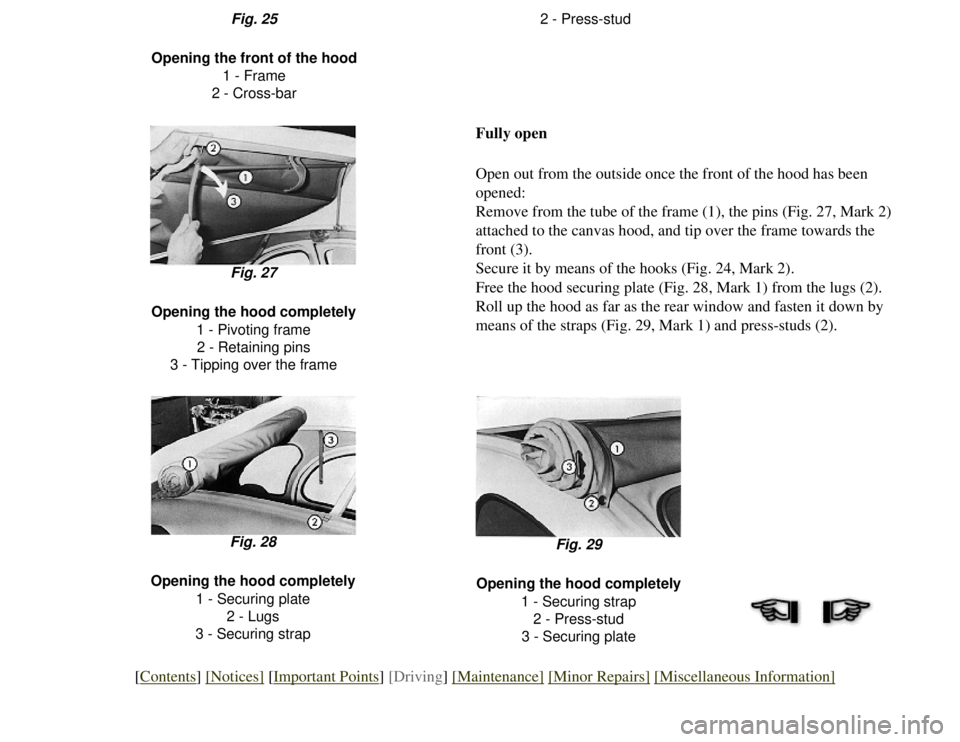
The canvas hood can be fixed in two positions when open: mid-way
or right back above the rear window.
Half-open
Open the hood from the inside of the vehicle but never when in
motion.
Pivot the locking levers (Fig. 24, Mark 1) to release the retaining
hooks. (2)
Raise the front of the hood so as to disengage it completely (Fig.
25).
Pivot the frame (Fig. 25, Mark 1) while pushing the cross-bar (2)
and tip over the frame towards the centre pillar.
Secure the frame (Fig. 26) by means of the strap (1) and press-stud \
(2).
Fig. 24
Opening the front of the hood
1 - Locking lever
2 - Retaining hook
Fig. 26
Opening the front of the hood 1 - Strap
Page 81 of 86
2 - Press-stud
Fig. 25
Opening the front of the hood 1 - Frame
2 - Cross-bar
Fully open
Open out from the outside once the front of the hood has been
opened:
Remove from the tube of the frame (1), the pins (Fig. 27, Mark 2)
attached to the canvas hood, and tip over the frame towards the
front (3).
Secure it by means of the hooks (Fig. 24, Mark 2).
Free the hood securing plate (Fig. 28, Mark 1) from the lugs (2).
Roll up the hood as far as the rear window and fasten it down by
means of the straps (Fig. 29, Mark 1) and press-studs (2).
Fig. 27
Opening the hood completely 1 - Pivoting frame2 - Retaining pins
3 - Tipping over the frame
Fig. 28
Opening the hood completely 1 - Securing plate2 - Lugs
3 - Securing strap Fig. 29
Opening the hood completely 1 - Securing strap2 - Press-stud
3 - Securing plate
[Contents] [Notices] [Important Points] [Driving] [Maintenance] [Minor Repairs] [Miscellaneous Information]
Page 85 of 86

l Changing a fuse
l Changing a sparking plug
l Changing a wheel
l Charge indicator
l Chassis number
l Chassis number stamping
l Choke
l Clutch
l Controls and accessories (LH) (RH)
D
l Dashboard
l Defrosting
l Demisting
l Dimensions, main
l Direction indicators
l Doors, opening
l Driving position
E
l Engine, data
l Engine, number plate
l Engine, oil level
l Engine, oil, warning lamp
F
l Fuel, filling up
l Fuel gauge
l Fuse boxes
l Fuses
l Rear floor
l Rear hammock for parcels
l Rear-view mirrors
l Reverse gear
l Replacement parts, orders
l Running-costs
l Running-in
S
l Seat belts
l Seats
l Seats, backrest adjustment
l Service at 600 miles
l Signalling
l Sparking plugs and gaps
l Speedometer
l Spots on upholstery
l Starting engine
l Starting engine with handle
l Steering wheel (cleaning)
l Stopping the engine
T
l Tar, removal
l Technical data
l Temperature, interior
l Touching-up paintwork
l Towing the car
l Towing a trailer
l Transmission
l Travelling abroad
l Tyre pressures