1974 CHEVROLET CAMARO checking oil
[x] Cancel search: checking oilPage 52 of 85
Downloaded from www.Manualslib.com manuals search engine Checking Oil Level
The engine oil should be main
tained at proper level. The best
time to check it
is before operating
the engine or
as the last step in a
fuel stop. This will allow the oil ac
cumulation in the engine to drain
back in the crankcase.
To check
the level, remove the oil guage rod
(dip stick), wipe it clean and rein
sert
it firmly for an accurate read
ing. The oil gauge rod
is marked
"FULL" and "ADD." The oil level
should be maintained in the safety
margin, neither going above the
"FULL" line nor below the "ADD"
line. Reseat the gauge firmly after
taking the reading.
Supplemental Engine Oil
Additives
The regular use of supplemental
additives
is specifically not recom
mended and will increase operat
ing costs. However, supplemental additives
are available that can
effectively and economically solve
certain specific problems without
causing other difficulties.
For ex
ample, if higher detergency
is re
quired to reduce varnish and
sludge deposits resulting from
some unusual operational diffi
culty, a thoroughly tested and ap
proved additive -
"Super Engine
Oil Supplement" -is available at
your Chevrolet dealer.
In the event
of an operational problem, consult
your dealer for advice before
us
ing supplemental additives.
Drive Belts
Every 6,000 miles or 4 months
inspect drive belts for wear , fray
ing, cracking , and tension. Belts
which are in poor condition should
be replaced immediately.
Check tension by applying mod
erate thumb pressure midway be
tween pulleys.
If the center-to-
49
center distance between pulleys is
13 to 16 inches, the belt should
deflect
1;2 inch . If the center-to
center distance
is 7 to 10 inches,
the belt should deflect
1;4 inch.
Loose belts should be retensioned
to give the correct deflection.
It is recommended that belts be
replaced every 24 months or
24,000
miles , whichever occurs first.
Air Cleaner
CAUTIOH:Donot remo.vElfhe f1ngl,,~ al,. cleaner unlesstempo,ary removall$.nec~ essarrdur;ng repair ormaintenal1ce ot the vehicle; When t"ealrC/f1aneri$/~emoved backtlringcan cause tire in the engine
compartment. .',' . '
Flame Arrester -Every 12,000
miles-Clean the arrester (located
in the base of the air cleaner) with
kerosene or a suitable solvent. Dry
with compressed air.
Rear Axle
Standard -Every 4 months or
6,000 miles, whichever occurs
Page 70 of 85
Downloaded from www.Manualslib.com manuals search engine The chart on the previous page, and the information on the pages which follow, contains information designed to aid the average driver to discover, and possibly correct, conditions resulting in minor
mechanical difficulties in his car. The chart, designed to point out
possible solutions to several of the most common automotive malfunctions and point out a logical checking sequence, will lead step by step to the most likely causes and corrective procedures. If, after making the checks and adjustments suggested, the source of the trouble has not been found and corrected, it is strongly recom
mended that an Authorized Chevrolet Dealer insp~ct the vehicle and make whatever repairs or adjustments are necessary.
;iA~>~I/~,~.#Y'T~~hiri~~:e~It.;ne;CC2i'~6p'4~cl~.;.'Ii~;~;,;(i '~i.. . .....•.. l'for",;tlgC;(lnY;tlspec';o~;1J1 ainfenCJn.c:~ ..
If the ignition switch will cause the engine to "turn over" or "crank" but the car will not start, check Steps A through 0 below. NOTE : If continual "flooding" of the carburetor is evidenced by a carburetor wet with
fuel or black exhaust smoke,
perform the operation sug
gested in paragraph D only .
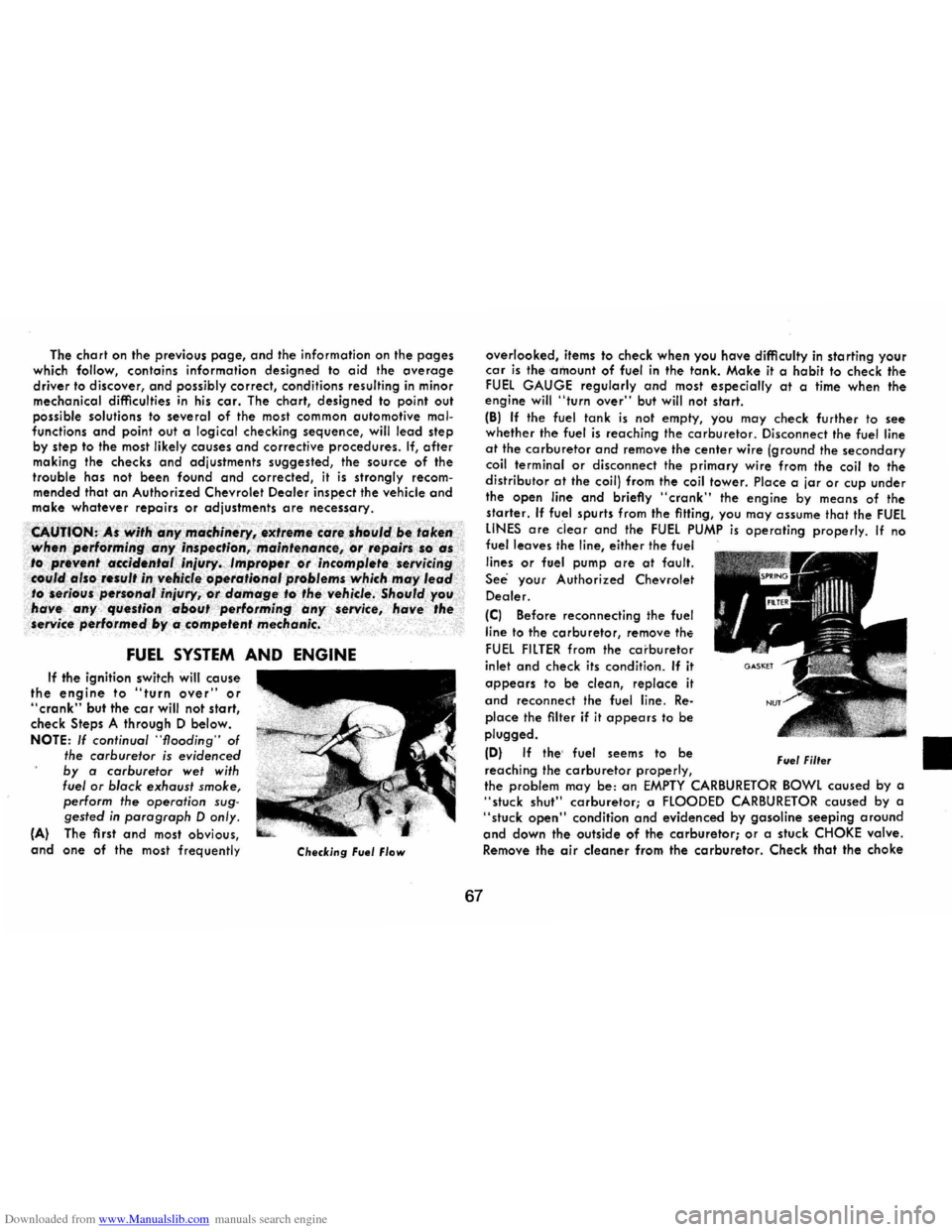
(A) The first and most obvious, and one of the most frequently Checking Fuel Flow
67
overlooked, items to check when you have difficulty in starting your car is the 'amount of fuel in the tank. Make it a habit to check the FUEL GAUGE regularly and most especially at a time when the engine will "turn over" but will not start.
(B) If the fuel tank is not empty, you may check further to see whether the fuel is reaching the carburetor. Disconnect the fuel line at the carburetor and remove the center wire (ground the secondary coil terminal or disconnect the primary wire from the coil to the
distributor at the coil) from the coil tower. Place a jar or cup under the open line and briefly "crank" the engine by means of the starter. If fuel spurts from the fitting, you may assume that the FUEL LINES are clear and the FUEL PUMP is operating properly. If no fuel leaves the line, either the fuel
lines or fuel pump are at fault ,
See your Authorized Chevrolet
Dealer.
(C) Before reconnecting the fuel
line
to the carburetor, remove the
FUEL FILTER from the carbu retor
inlet and check its condition . If it
appears to be clean, replace it
and reconnect the fuel line. Re
place the filter if it appears to be plugged.
(0) If the' fuel seems to be
reaching the carburetor properly, Fuel Filter
the problem may be: an EMPTY CARBURETOR BOWL caused by a "stuck shut" carburetor; a FLOODED CARBURETOR caused by a "stuck open" condition and evidenced by gasoline seeping around and down the outside of the carburetor; or a stuck CHOKE valve. Remove the air cleaner from the carburetor. Check that the choke
•
Page 72 of 85
Downloaded from www.Manualslib.com manuals search engine as each spark plug cable for
tightness.
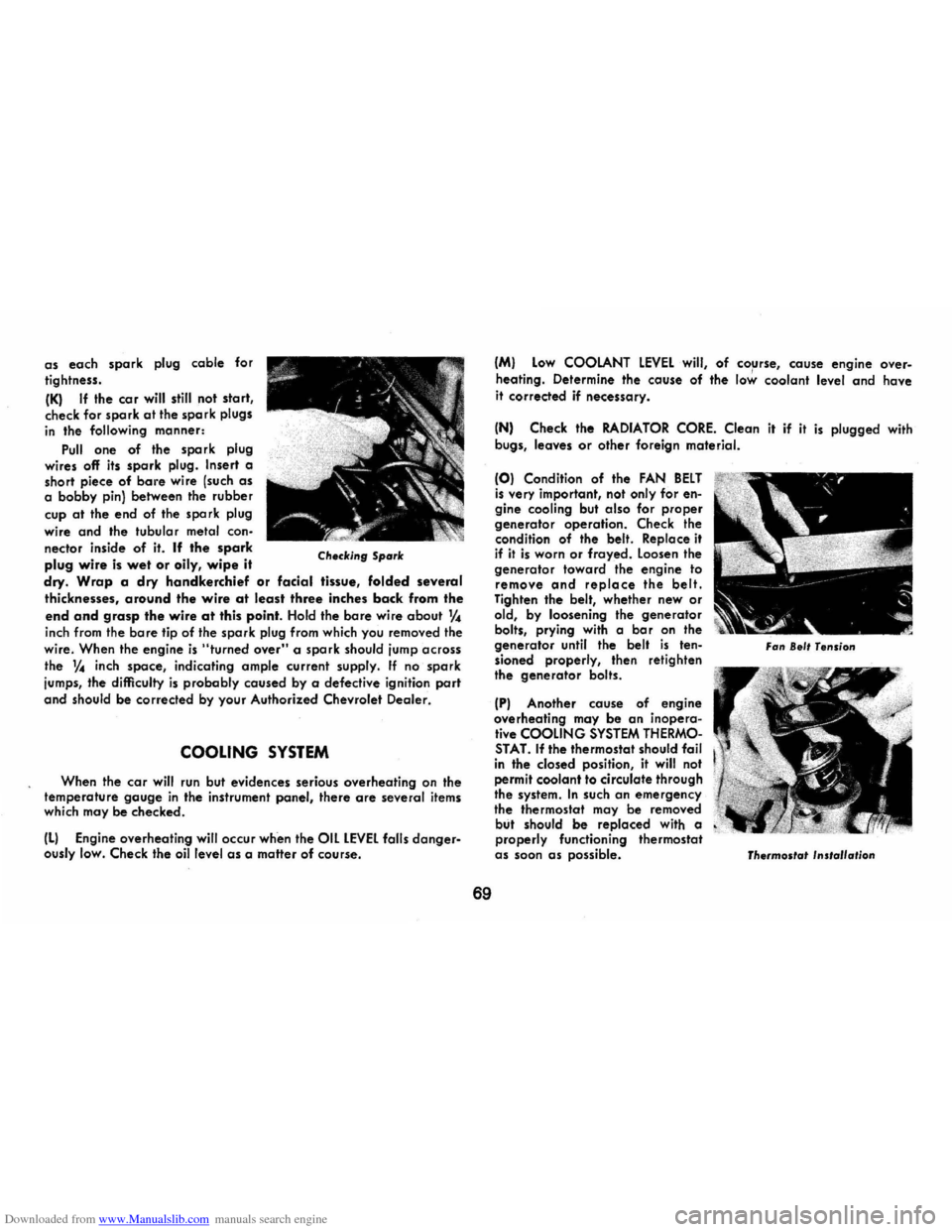
(K) If the co r will still not sta rt, check for spark at the spark plugs in the following manner:
Pull one of the spark plug
wires off its spark plug. Insert a
short piece of bare wire (such as a bobby pin) between the rubber
cup
at the end of the spark plug
wire
and the tubular metal connector inside of it. If the spark
plug wire is wet or oily, wipe it Checking Spark
dry. Wrap a dry handkerchief or facial tissue, folded several
thicknesses, around the wire at least three inches back from the
end and grasp the wire at this point. Hold the bare wire about 1f ..
inch from the bare tip of the spark plug from which you removed the
wire. When the engine is "turned over" a spark should jump across
the
~ inch space, indicating ample current supply. If no spark
jumps, the difficulty
is probably caused by a defective ignition part
and should be corrected by your Authorized Chevrolet Dealer.
COOLING SYSTEM
When the car will run but evidences serious overheating on the
temperature gauge in the instrument panel, there are several items
which may be checked.
(L) Engine overheating will occur whim the OIL LEVEL falls dangerously low. Check the oil level as a matter of course.
69
(M) Low COOLANT LEVEL will, of co~rse, cause engine over
heating. Determine the cause of the low coolant level and have
it corrected if necessary.
(N) Check the RADIATOR CORE. Clean it if it is plugged with
bugs, leaves or other foreign material.
(0) Condition of the FAN BELT is very impartant, not only for engine cooling but also for proper generator operation. Check the
condition of the belt. Replace it if it is worn or frayed. Loosen the generator toward the engine to remove and replace the belt. Tighten the belt, whether new or old, by loosening the generator bolts, prying with a bar on the generator until the belt is tensioned properly, then retighten
the generator bolts.
(P) Another cause of engine
overheating may be an inopera
tive COOLING SYSTEM THERMOSTAT. If the thermostat should fail in the closed position, it will not
permit coolant to circulate through
the system. In such on emergency
the thermostat may be removed but should be replaced with a
properly functioning thermostat
as soon as possible.
Fan 8e/f Tension
ThermoS/of Insfallafion
Page 83 of 85
Downloaded from www.Manualslib.com manuals search engine Harness, Safety (See Seat Belts) Hazard VVarning Flasher ............... 36 Headlamp
High Beam Dimmer Switch .......... 22
High Beam Indicator ................ 26
Light and Instrument Panel
Switch ........................... 26
Heater Operation ..................... 30 High Speed Operation
During Break-In.. . . . . . . . . . . . . . . . . . . 2 Tires .............................. 56 Hitches, Trailer... . . . . . . . . . . . . . . . . . . .. 11 Hood Latch Maintenance.. . . . . . . . . . . . . . . .. 53 Release ........................... IBC Horn ................................ 20 "HOT" Light (See Engine
Temperature Light)
How To Improve Your Gas Mileage. . . ... . . . . . . . . . . . . . . . . .. 64 Hub Caps, Replacing.. . . . . . . . . . . . . . . .. 39 Hydroplaning. . . . . . . . . . . . . . . . . . . . . . .. 61 Identification Numbers
Body .............................. 70 Engine ............................ 70 Vehicle ............................ 70 Ignition Keys ............................. 3,14 Lock .............................. 14 In Case Of Emergency ............ , . . .. 36 Indicator Lights
Brake ............................. 25 Electrical Charging (Generator) ....... 25 Engine Temperature. . . . . . . . . . . . . . . .. 25 Oil Pressure .......•................ 24
Infant Restraining Methods. . . . . . . . . . .. 9
Infant Safety Carrier. . . . . . . . . . . . . . . . .. 9
Inflation Pressure, Tires..... . . . . . . . . . .. 57 Inlets,
Ventilation
System .............. 29
Inside Rearview Mirror.. . . . . . . . . . . . . . . 5 Instrument Panel. . . . . . . . . . . . . . . . . . . .. 23 Interior Appearance Care .............. 41 Jack Operation .......................... 39 Storage ............................ 39 Jump Starting VVith Booster Battery ..... 37 Key Buzzer System .................... 14 Keys................................ 3 Knocking Engine (See Fuel)
Recommendations)
Lacquer,
J\crylic Care ................. 44 Lane Changer and Turn Signal. . . . . . . .. 18 Lap and Shoulder Belts...... .. .. .... .. 7 Latches Door.............................. 4 Folding Seat Back. . . . . . . . . . .. . . . . .. 4 Hood ............................. IBC
Lighter, Cigarette ....•................ 28
Lights ............................. 23,73 Backup ............................. 73 Brake VVarning ..................... 25 Bright Beam Indicator ............... 26
Bright Beam Switch ................. 22
Bulb Chart. ........................ 73 Courtesy ........................... 73 Engine Temperature Indicator. . . . . . .. 25 Generator Indicator ................. 25 Hazard Flasher.. . . . . . . . . . . . .. . . . . .. 36 Headlamp Circuit Breaker. . . . . . . . . .. 73 Headlamps. . . . . . . . . . . . . . . . . . . . . . . .. 73 Oil Pressure Indicator. . . . . . . . . . . . . .. 24
Sidemarker. . . . . . . . . . . . . . . . . . . . . . .. 73 Switch ............................. 26
Tail and Brake. . . . . .. . . . . . . . . . . . ... 73 Turn Signal Indicator ............... 18 Turn Signals. . . . . . . . . . . . . . . . . . . . . .. 18
80
Lining; Brake. . . . . . . . . . . . . . . . . . . . . . .. 22
Liquid Tire Chain. . . . . . . . . . . . . . . . . . .. 61 Load, Full Rated (See Tires)
Locks
Door.............................. 4 Glove Box. . . . . . . . . . . . . . . . . . . . . . . .. 23
Ignition ........................... 14 Steering Column .................... 14 "Low" (L) Transmission Range. . . . . . .. 17 Lubrication Oils ............................... 47
Recommendations. . . . . . . . . . . . . . . . .. 48
Luggage Compartment, Driving
VVhile Open ........................ 13 Luggage Or Cargo Caution. . . . . . . . . . .. 13
Maintenance
Appearance
Care. . . . . . . . . . . . . . . . . .. 41 Schedule. . . . . . . . . . . . . . . . . . . . . . . . .. 46 Manual Transmission. . . . . . . . . . . . . . . .. 18
Master Cylinder, Brake ................ 52
Metal Cleaners. . . . . . . . . . . . . . . . . . . . . .. 44
Methods Of Restraining Children. .... .. 9
Mirrors, Rear View
Inside, Adjustment Up or Down.... .. 5 Inside, Day/Night.... . . . ... . . . . . . . .. 5 Mountainous Terrain
Driving Down Grades ............... 18
Transmission Fluid Change Interval. " 50 "Neutral" (N) Transmission Range ..... 17 New Car Break-In.................... 2 Oil Additives. . . . . . . . . . . . . . . . . . . . . . . . .. 49
Change Interval, Engine ............. 47
Checking Engine Oil Level. . . . . . . . . .. 49
Engine ............................ 47
Filter .............................. 47 Pressure Indicator Light/Gauge. . . . . .. 27
Page 85 of 85
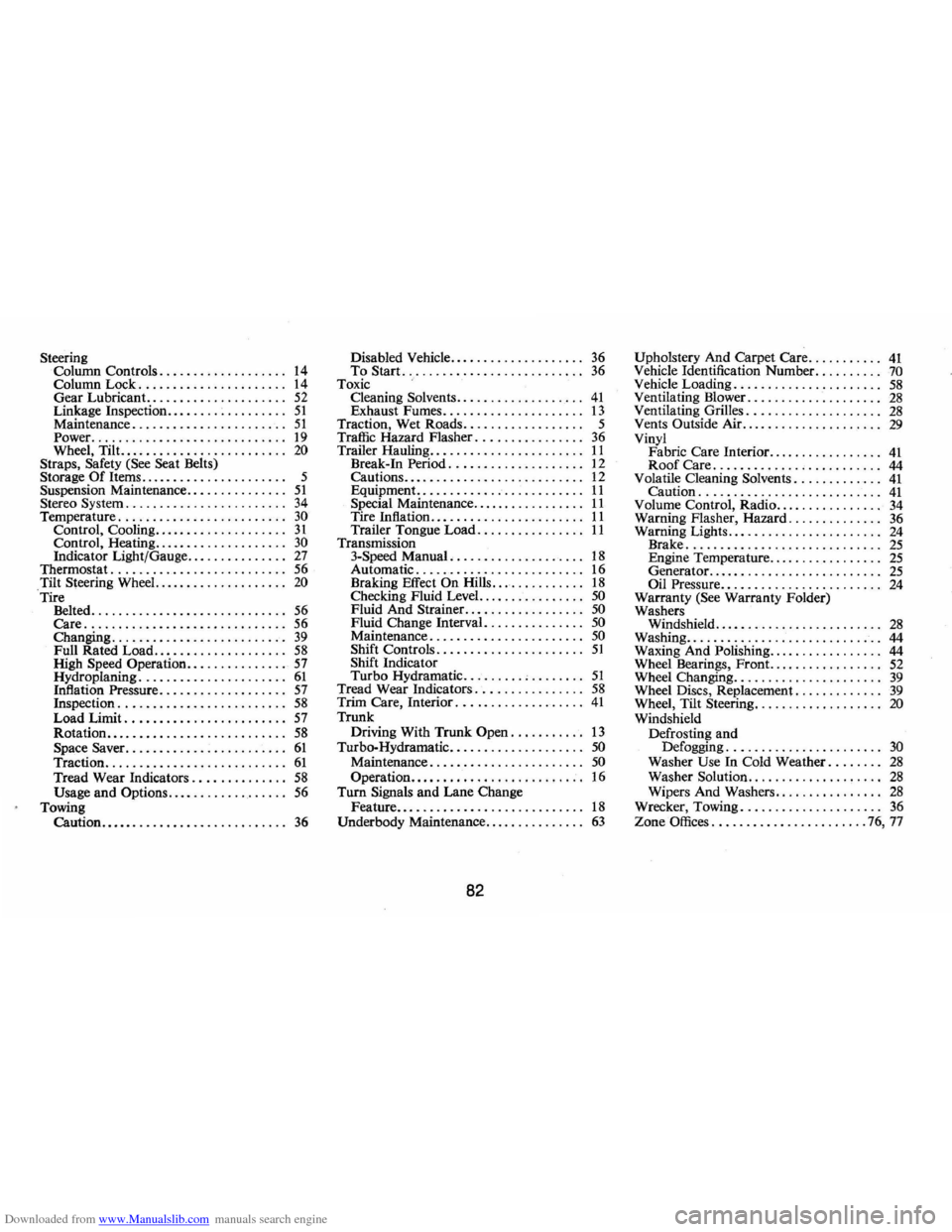
Downloaded from www.Manualslib.com manuals search engine Steering Disabled Vehicle .................... 36 Upholstery And Carpet Care ........ ... 41 Column Controls ................... 14 To Start. .......................... 36 Vehicle Identification Number .... ...... 70 Column Lock ...................... 14 Toxic Vehicle Loading ...................... 58 Gear Lubricant. .................... 52 Cleaning Solvents ......... .. ........ 41 Ventilating Blower ................. ... 28 Linkage Inspection .................. 51 Exhaust Fumes ............. ........ 13 Ventilating Grilles .................... 28 Maintenance ....................... 51 Traction, Wet Roads .................. 5 Vents Outside Air .................. '" 29
Power ... ............... ........... 19 Traffic Hazard Flasher. ............... 36 Vinyl Wheel, Tilt. ........................ 20 Trailer Hauling ....................... 11 Fabric Care Interior ................. 41 Straps, Safety (See Seat Belts) Break-In Period .................... 12 Roof Care ......................... 44 Storage Of Items ............ .......... 5 Cautions ........................... 12 Volatile Cleaning Solvents ............. 41 Suspen sion Maintenance ............... 51 Equipment ......... ................. 11 Caution ........................... 41 Stereo System ........................ 34 Special Maintenance ................. 11 Volume Control, Radio ......... ... .... 34 Temperature ................. ........ 30 Tire Inflation ....................... 11 Warning Flasher, Hazard .............. 36 Control , Cooling .................... 31 Trailer Tongue Load .... .......... .. 11 Warning Lights ....................... 24 Control , Heating .................... 30 Transmission
Brake ....................... ...... 25 Indicator Light/Gauge ... ............ 27 3-Speed Manual .................... 18 Engine Temperature ............... .. 25 Thermostat ...... .. .................. 56 Automatic ....................... .. 16 Generator .......................... 25 Tilt Steering Wheel.. .................. 20 Braking Effect On Hills .............. 18 Oil Pressure ........................ 24 Tire Checking
Fluid Level. ............... 50 Warranty (See Warranty Folder)
Belted ......... .................. .. 56 Fluid And Strainer ................ .. 50 Washers
Care ........... .................. . 56 Fluid Change Interval. .............. 50 Windshield ............. ......... ... 28 Changing .. .............. .......... 39 Maintenance .............. ....... .. 50 Washing .......... ................... 44 Full Rated Load .................... 58 Shift Controls ...................... 51 Waxing And Polishing ................. 44 High Speed Operation ............... 57 Shift Indicato r
Wheel Bearings, Front. ................ 52 Hydroplaning ...................... 61 Turbo Hydramatic ......... ; ........ 51 Wheel Changing ...................... 39 Infla tion Pressure . . . . . . . . . . . . . . . . . . . 57 Tread Wear Indicators ................ 58 Wheel Discs, Replacement ............. 39 Inspection ....... .................. 58 Trim Care, Interior ................... 41 Wheel, Tilt Steering ................... 20 Load Limit ........................ 57 Trunk
Windshield
Rotation ........ ................... 58 Driving With Trunk Open ........... 13 Defrosting and Space Saver .. .......... : . .......... 61 Turbo-Hydramatic .............. ...... 50 Defogging ................. ...... 30 Traction ............. .............. 61 Maintenance .... .... ...... ......... 50 Washer Use In Cold Weather ........ 28 Tread Wear Indicators .............. 58 Operation .......................... 16 Washer Solution .................... 28 Usage and Options .................. 56 Turn Signals and
Lane Change Wipers And Washers ................ 28 Towing Feature ..................
.......... 18 Wrecker , Towing ....... .............. 36 Caution .................. .... ...... 36 Underbody Maintenance ......... ...... 63 Zone Offices ................. ...... 76, 77
82