1974 CHEVROLET CAMARO light
[x] Cancel search: lightPage 39 of 85
Downloaded from www.Manualslib.com manuals search engine I n Case of Emergency
Four-Way Hazard
Warning
Flasher
• Use the warning flasher to warn
other drivers any time your
vehicle becomes a traffic hazard,
day
or night.
• Avoid stopping on the roadway
if possible.
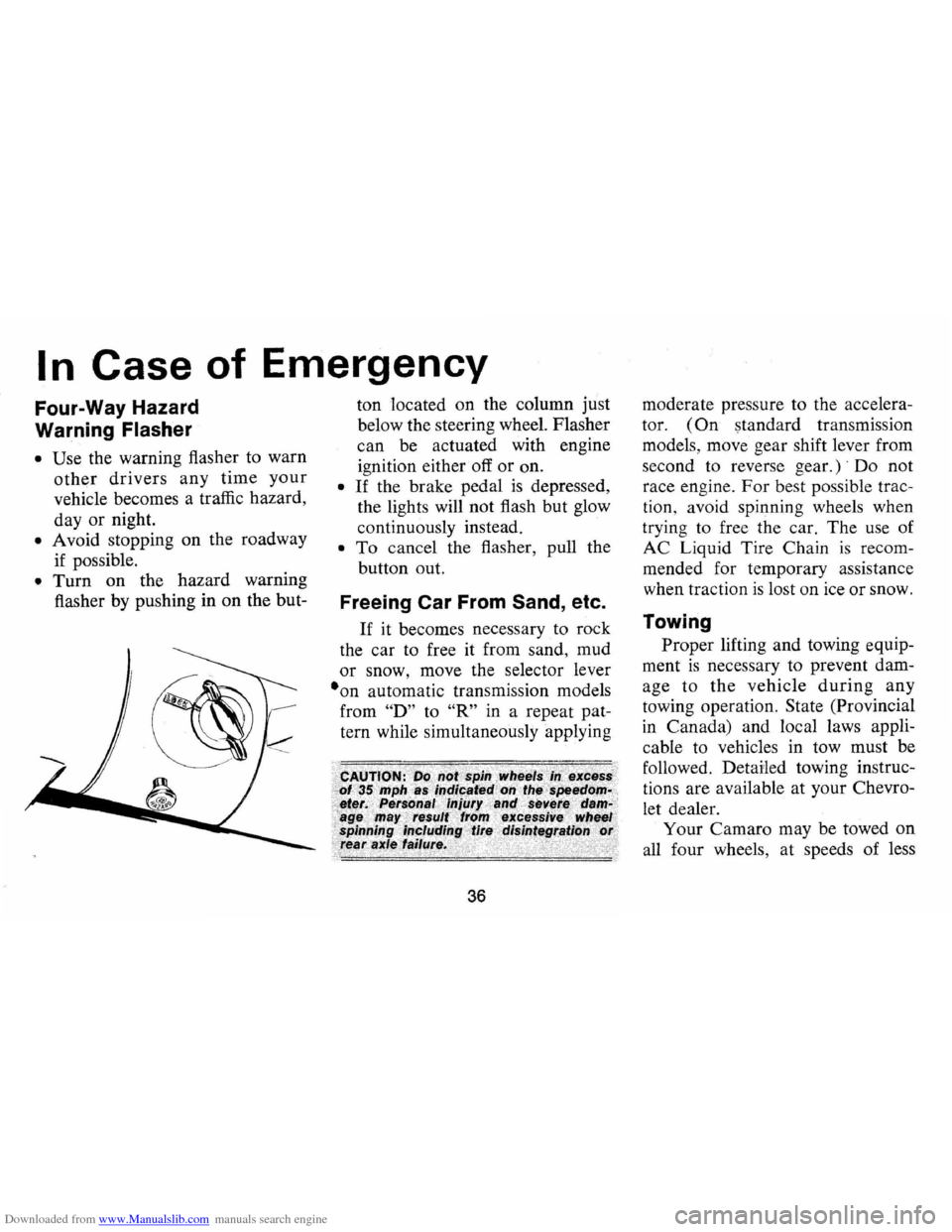
• Turn on the hazard warning
flasher by pushing in on the but- ton
located on the column just
below the steering wheel. Flasher
can be actuated with engine
ignition either off
or on.
• If the brake pedal is depressed,
the lights will not flash but glow
continuously instead.
• To cancel the flasher, pull the
button out.
Freeing Car From Sand, etc.
If it becomes necessary to rock
the car to free it from sand, mud
or snow, move the selector lever
·on automatic transmission models
from
"D" to "R" in a repeat pat
tern while simultaneously applying
36
moderate pressure to the accelera
tor.
(On standard transmission
models, move gear shift lever from
second to reverse
gear.)' Do not
race engine.
For best possible trac
tion, avoid spinning wheels when
trying to free the car. The use of
AC Liquid Tire Chain
is recom
mended for temporary assistance
when traction
is lost on ice or snow.
Towing
Proper lifting and towing equip
ment
is necessary to prevent dam
age to
the vehicle during any
towing operation. State (Provincial
in Canada) and local laws appli
cable to vehicles in tow must be
followed. Detailed towing instruc
tions are available at your Chevro
let dealer.
Your Camaro may be towed on
all four wheels, at speeds of less
Page 40 of 85
Downloaded from www.Manualslib.com manuals search engine than 35 mph, for distances up to
50 miles, provided the drive-line,
axle, transmission, and steering
system are otherwise normally op
erable.
Use only towing equipment
specifically designed for this pur
pose following the instructions of
the towing equipment manufac
turer. A separate safety chain sys
tem must be used.
For such towing
the steering must be unlocked,
transmission in neutral and the
parking brake released. Attach
ments must be made to main struc
tural members of the car. Do not
attach to bumpers
or associated
brackets. Remember that power
brake and power steering assists
will not be available when engine
is inoperative.
Emergency Starting
• Engines in vehicles with auto
matic transmissions cannot be started
by pushing
or towing the
car.
• Never tow a manual transmis
sion-equipped
car to start be
cause the surge forward when
the engine starts could cause a
collision with the tow vehicle.
• A car with a discharged battery
may be started by transferring
electrical power from a battery
in another car -called
"jump
starting."
Jump Starting
37
• The battery in the other vehicle
must be of the
same nominal
voltage
(12 volts), and must be
negatively grounded. (All Gen
eral Motors cars, light trucks
(10,000 GVWR and under),
and motor homes use 12-volt,
negatively grounded electrical
systems and
can be used to jump
start one another.) The nominal
voltage and grounding of the
other vehicle's battery may be
determined by checking the spec
ifications
in its owner's manual.
Use of a booster battery of a
higher nominal voltage,
or which
is positively grounded may re
sult
in serious personal injury or
property damage.
• The battery in your car must be a
Delco battery (the original,
or a
replacement) which
is equipped
with flame arrestor type filler/
vent caps
on all filler openings, or
a sealed-type battery which does
Page 41 of 85
Downloaded from www.Manualslib.com manuals search engine not have filler openings or caps.
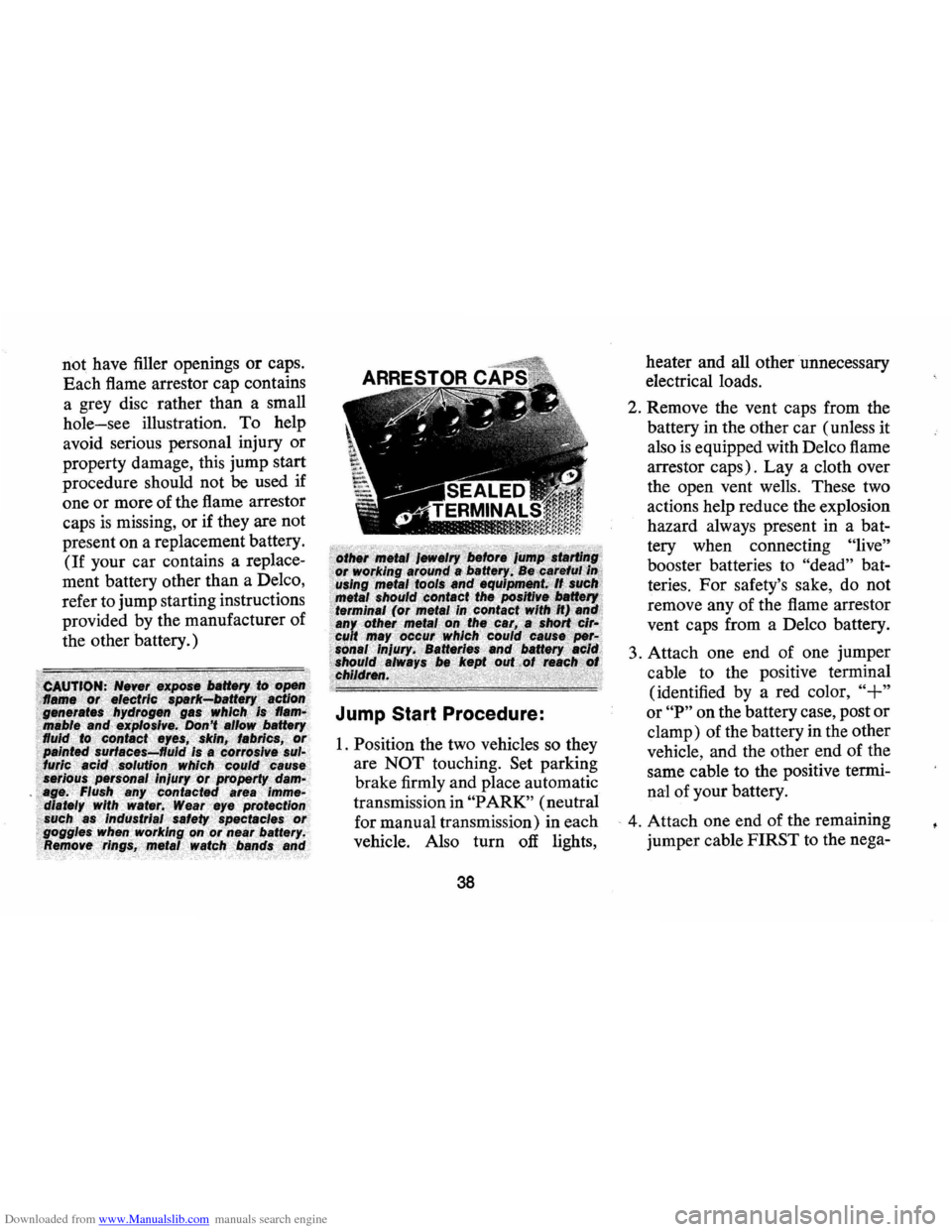
Each flame arrestor cap contains
a grey disc rather than a small
hole-see illustration. To help
avoid serious personal injury or
property damage, this jump start
procedure should not
be used if
one or more of the flame arrestor
caps
is missing, or if they are not
present on a replacement battery.
(If your car contains a replace
ment battery other than a Delco,
refer to jump starting instructions
provided by the manufacturer of
the other battery.)
Jump Start Procedure:
1. Position the two vehicles so they
are
NOT touching. Set parking
brake firmly and place automatic
transmission in
"PARK" (neutral
for manual transmission) in each
vehicle. Also turn
off lights,
38
heater and all other unnecessary
electrical loads.
2. Remove the vent caps from the
battery in the other car (unless it
also
is equipped with Delco flame
arrestor caps). Lay a cloth over
the open vent wells. These two
actions help reduce the explosion
hazard always present in a bat
tery when connecting
"live"
booster batteries to "dead" bat
teries.
For safety's sake, do not
remove any of the flame arrestor
vent caps from a Delco battery.
3. Attach one end of one jumper
cable to the positive terminal
(identified by a red color,
"+"
or "P" on the battery case, post or
clamp) of the battery in the other
vehicle, and the other end of the
same cable to the positive termi
nal of your battery.
- 4. Attach one end of the remaining
jumper cable FIRST to the nega-
Page 43 of 85
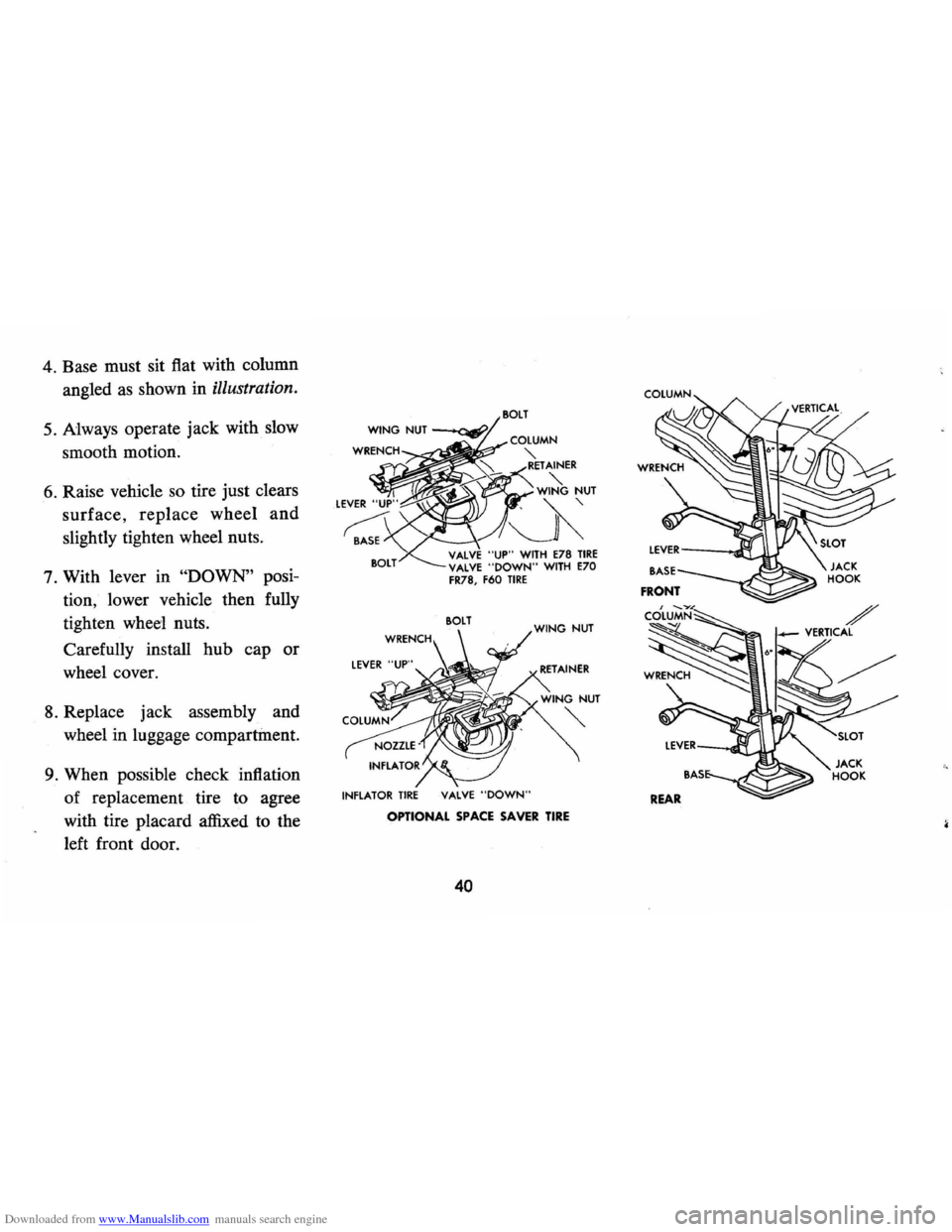
Downloaded from www.Manualslib.com manuals search engine 4. Base must sit flat with column
angled
as shown in illustration.
5. Always operate jack with slow
smooth motion.
6. Raise vehicle so tire just clears
surface,
replace wheel and
slightly tighten wheel nuts.
7. With lever in
"DOWN" posi
tion, lower vehicle then fully
tighten
wheel nuts.
Carefully install hub cap or
wheel cover.
8. Replace jack assembly and
wheel in luggage compartment.
9. When possible check inflation
of replacement tire to agree
with tire placard affixed to the
left front door.
COlUMN
;:>;;;Om~r?' ';;ErAINER
"'-WING NUT
~~
VALVE "UP" WITH E78 TIRE VALVE "DOWN" WITH E70 FR78, F60 TIRE
SOLT
INFLAT07
INFLATOR TIRE VALVE "DOWN"
OPTIONAL SPACE SAVER TIRE
40
COLUMN
JACK
HOOK
Page 45 of 85
Downloaded from www.Manualslib.com manuals search engine The above cleaners are EXCEL
LENT CLEANERS when used
properly according to directions on
containers and are available
through the G.M. Parts System.
Never use gasoline, nail polish
remover
or acetone, lacquer thin
ners, bleaches, etc.
Some basic
steps should be remembered before
the cleaning
is attempted:
1. Remove stains as quickly as pos
sible before they become
"set."
2. Use a clean cloth or sponge and
change to a clean area fre
quently. ( A
soft brush may be
used
if stains persist.)
3. Use solvent type cleaners in a
well ventilated area, also, do not
saturate the stained area.
4. If a ring should form after spot
cleaning, the entire area of the
trim assembly should be cleaned
immediately.
5. Follow instructions on the label
> of the cleaner.
Cleaning General Soilage or
Water
Spots from Fabric
Type Trim with Foam Type
Cleaner .
G.M. Multi-Purpose Powdered
Cleaner
is excellent for this type
cleaning and for cleaning a panel
section where a minor cleaning
ring may be left from spot cleaning.
Vacuum area thoroughly to re
move excess loose dirt.
AL WAYS
clean a full trim assembly or com
plete trim section-mask adjacent
trim along stitch
or welt lines. Mix
Multi-Purpose Powdered Cleaner
in strict accordance with directions
on label of container-mix propor
tionally for smaller quantities.
USE
SUDS ONLY
ON A .CLEAN
SPONGE or SOFT BRISTLE
BRUSH-DO NOT WET FAB
RIC
EXCESSIVELY OR RUB
HARSHLY WITH BRUSH. IM
MEDIATELY
AFTER CLEAN
ING WIPE
OFF ANY CLEANER
42
RESIDUE WITH SLIGHTLY
DAMP ABSORBENT TOWEL
OR CLOTH.
IMPORTANT-IM
MEDIA TEL Y AFTER WIPING,
FORCE-DRY FABRIC WITH
AIR
HOSE, HEAT DRYER OR
HEAT LAMP. (Use caution with
heat dryer or heat lamp to prevent
damage to fabric.) When trim ma
terials with a sheen or luster finish
are dry, wipe fabric lightly with a
soft,
dry clean cloth to restore
sheen or luster.
Spot Cleaning Fabric Type
Trim
Materials with Solvent
Type Cleaner
Before attempting to remove
spots or stains from fabric, deter
mine
as accurately as possible the
nature and age of the spot or stain.
Some spots or stains can be re
moved satisfactorily with water
or
mild soap solution (refer to ac
companying
"Removal of Specific
Stains"). For best results , spots or
Page 46 of 85
Downloaded from www.Manualslib.com manuals search engine stains should be removed as soon
as possible. Some types of stains
or soilage such
as lipsticks, some
inks, certain types of grease etc.,
are extremely difficult and, in some
cases, impossible to completely re
move. When cleaning this type
of'
stain or soi'lage, care must be taken
not to enlarge the soiled area.
It is
sometimes more desirable to have
a small stain than an enlarged stain
as a result of careless cleaning.
G.M. Fabric Cleaner (Solvent
Type)
is excellent for spot cleaning
stains containing grease, oil or fats
from fabric type trim. Excess stain
should be gently scraped off trim
material with a clean
DULL knife
or scraper.
USE VERY LITTLE
CLEANER, light pressure, and
clean cloths (preferably cheese
cloth). Cleaning action should be
, from outside of stain FEATHER
ING towards center of stain and
constantly changing to a clean sec- tion
of cloth. When stain
is cleaned
from fabric, immediately dry area
with an air hose, heat dryer or
heat lamp to help prevent a clean
ing ring (use caution with heat
dryer or heat lamp to prevent dam
age to fabric material).
If a ring
forms,
immediately repeat the
cleaning operation over a slightly
larger area with special emphasis
on
FEATHERING towards center
of area.
If ring still persists, mark
off adjacent trim sections and clean
entire affected trim panel section
with G.M. Multi Purpose Pow
dered Cleaner as previously de
scribed under
"cleaning general
soilage
or water spots with foam
type
cleaner."
Removal of Specific Stains
Grease or Oil Stains -In
cludes grease, oil, butter, marga
rine,
shoe· polish, coffee with
cream, chewing gum, cosmetic
43
creams, vegetable oils, wax crayon,
tar and asphalts. Carefully scrape
off excess stain; then use Fabric
Cleaner (Solvent Type)
as pre
viously described.
Shoe polish, wax
crayons, tar and asphalts will stain
if allowed to remain on trim; they
should be removed
as soon as pos
sible-use caution
as cleaner will
dissolve them and may cause them
to bleed.
Non-Greasy Stains-Includes
catsup, coffee (black), egg, fruit,
fruit juice, milk, soft drinks,
wine,
vomit and blood. Carefully scrape
off excess stain; then sponge stain
with cool water.
If stain remains
use
Multi-Purpose Powdered
Cleaner (Foam Type) as previ
ously described.
If odor persists
after cleaning vomitus or urine,
treat area with a water-baking soda
solution
(1 teaspoon baking soda
to 1 cup of tepid water)-finally, if
necessary, clean lightly with fabric
Page 56 of 85
Downloaded from www.Manualslib.com manuals search engine "HOT" MARK
"COLD" MARK
>-f.. __ "AOO"
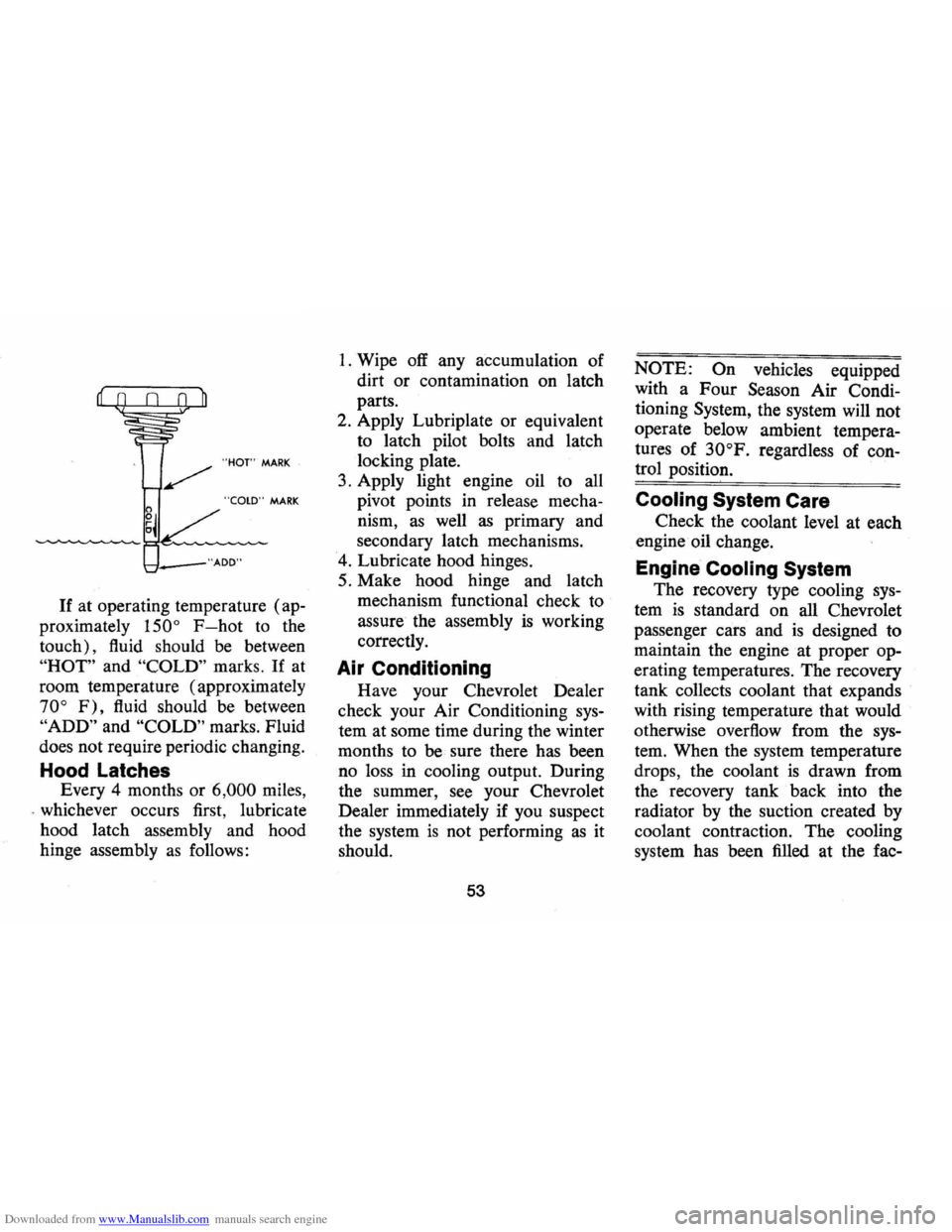
If at operating temperature (ap
proximately
150° F-hot to the
touch), fluid should be between
"HOT" and "COLD" marks. If at
room temperature (approximately
70° F), fluid should be between
"ADD" and "COLD" marks. Fluid
does not require periodic changing.
Hood Latches
Every 4 months or 6,000 miles,
. whichever occurs first, lubricate
hood latch assembly and hood
hinge assembly
as follows:
1. Wipe off any accumulation of
dirt or contamination on latch
parts.
2. Apply Lubriplate or equivalent
to latch pilot bolts and latch
locking plate.
3. Apply light engine oil to all
pivot points in release mecha
nism,
as well as primary and
secondary latch mechanisms.
4. Lubricate hood hinges.
5. Make hood hinge and latch
mechanism functional check to
assure the assembly
is working
correctly.
Air Conditioning
Have your Chevrolet Dealer
check your Air Conditioning
sys
tem at some time during the winter
months to
be sure there has been
no loss in cooling output. During
the summer,
see your Chevrolet
Dealer immediately if you suspect
the system
is not performing as it
should.
53
NOTE: On vehicles equipped
with a Four Season Air Condi
tioning System, the system will not
operate below ambient tempera
tures of
30°F. regardless of con
trol position.
Cooling System Care
Check the coolant level at each
engine · oil change.
Engine Cooling System
The recovery type cooling sys
tem is standard on all Chevrolet
passenger cars and
is designed to
maintain the engine at proper op
erating temperatures.
The recovery
tank collects coolant that expands
with rising temperature that would
otherwise overflow from the
sys
tem. When · the system temperature
drops, the coolant
is drawn from
the recovery tank back into the
radiator by the suction created by
coolant contraction. The cooling
system has been filled at the fac-
Page 67 of 85
Downloaded from www.Manualslib.com manuals search engine Important Facts You Should
Know About Gasoline
Mileage and How to
Improve It
How you drive, where you drive,
and when you drive
all have an
effect on how many miles you can
get from a gallon of gasoline. The
careful attention you give your car
as far as maintenance and repairs
are concerned will also contribute
importantly to fuel economy.
Fuel Selection
Your vehicle is designed to op
erate on unleaded or low-lead fuels
>of at least 91 Research Octane.
These fuels minimize spark plug
fouling and emission system
de
terioration. Your engine does not
require premium fuel. Therefore,
its use would be an unnecessary
additional expense.
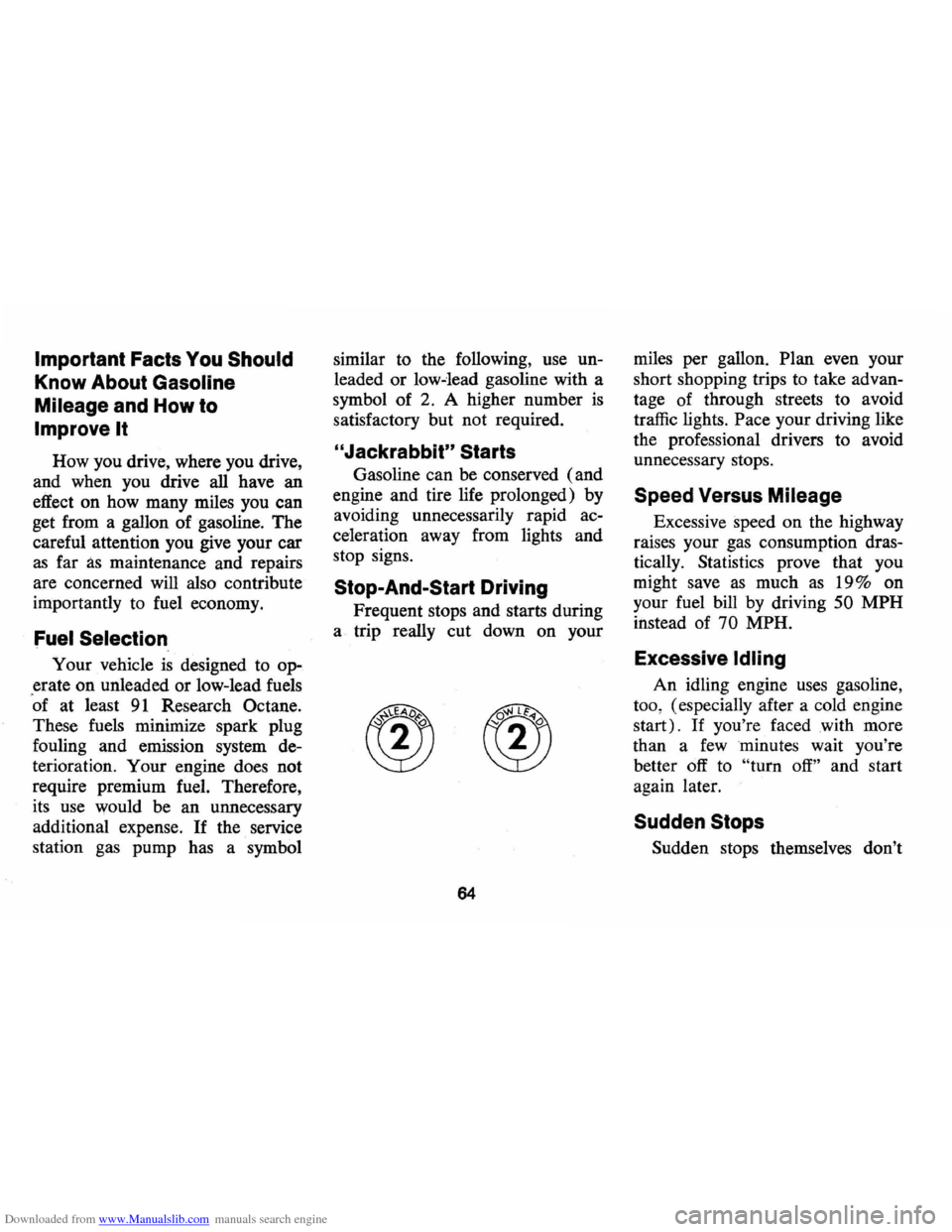
If the service
station gas pump has a symbol similar
to the following, use
un
leaded or low-lead gasoline with a
symbol of 2. A higher number
is
satisfactory but not required.
"Jackrabbit" Starts
Gasoline can be conserved (and
engine and tire life prolonged) by
avoiding unnecessarily rapid
ac
celeration away from lights and
stop signs.
Stop-And-Start Driving
Frequent stops and starts during
a. trip really cut down on your
64
miles per gallon. Plan even your
short shopping trips to take
advan
tage of through streets to avoid
traffic lights.
Pace your driving like
the professional drivers to avoid
unnecessary stops.
Speed Versus Mileage
Excessive speed on the highway
raises your gas consumption
dras
tically. Statistics prove that you
might save
as much as 19% on
your fuel bill by driving
50 MPH
instead of 70 MPH.
Excessive Idling
An idling engine uses gasoline,
too, (especially after a cold engine
start).
If you're faced with more
than a
few minutes wait you're
better
off to "turn off" and start
again later.
Sudden Stops
Sudden stops themselves don't