1973 OPEL MANTA gear
[x] Cancel search: gearPage 199 of 625

3D- 321973 OPEL SERVICE MANUAL
Figure 3D-13 Steering Gear Housing With Rack
Check to insure that three air channels of sintered
metal bushing (See Figure 3D-17) are not obstructed
by lubricant. If air channels are blocked, a vacuum
condition in the bellows may result during operation
of the gear assembly. Under such circumstances, the
bellows will be drawn inward and jam into the rack
teeth.
3. Reassemble pinion shaft into gear assembly so that
spline in pinion shaft meshes with twelfth tooth of
the rack. Use pinion mounting sleeve J-21712 during
installation of pinion shaft to avoid damage to “0”
ring in pinion bushing. When reassembling pinion
shaft into gear housing, be sure that pinion is so
positioned that bolt hole in pinion shaft flexible cou-
pling is on top and parallel to the rack. See Figure3D- 14..~.. ~. ..~.IN FLEXIBLE
COUPLING PARALLEL ORRIZONTAL WITH R
._..-_ - -._..-
Figure 3D-14 Installing Pinion Shaft
4. Reassemble special washer, flat washer, and new
pinion nut onto pinion shaft. Torque pinion nut to 11
Ib.ft. Do not exceed torque due to possibility ofjam-
ming gear.
5. Place sintered bronze shell into steering gear hous-
ing and fill adjusting hole with Calcium Soap No. 2.
6. Reassemble thrust spring, adjuster screw and lock-
nut on gear assembly.
Final adjustment of adjuster screw is performed after
gear assembly and tie rods are installed in car. See
Maintenance and Adjustments in this section for ad-
justment of steering gear.
7. Place rubber bellows, clamps, and new lock plates
on ball stud portion of tie rods; and screw ball studs
into rack while holding bent tab of lock plate against
flat
ton rack. Torque ball studs 43 lb.ft. See Figure
3D-9. It is important that rack be held secure with
open end wrench to prevent damage to rack teeth.
8. Bend round edges of lock plate over flat on ball
stud to lock ball stud in position. See Figure
3D-15.Figure 3D-15 Bending Lock Plate Over Ball Stud
9. Properly position rubber bellows and clamps over
tie rod and gear housing and adjust clamps so that
ends are pointing same direction as adjusting screw.
Check that bellows is not twisted and will compress
and expand properly.
Reassembly (Opel 1900 - Manta)1. Clamp steering gear housing in a soft jaw vise and
reassemble new “0” rings onto retainer and pinion
shaft bushing. Also, install thrust washer onto pinion
bushing.
Coat all moving parts during reassembly with suita-
Page 200 of 625

STEERING GEAR ASSEMBLY30.33ble steering gear lubricant. Fill long end of housingbly. Under such circumstances, the bellows will be
with approximately 1 3/4 oz. steering gear lubricant.
drawn inward and jam into the rack teeth.
3. Reassemble pinion shaft into gear assembly so that
spline in pinion shaft meshes with twelfth tooth of
the rack. Use pinion mounting sleeve J-21712 during
installation of pinion shaft to avoid damage to “0”
ring in pinion bushing. When reassembling pinion
shaft into gear housing, be sure that pinion is so
positioned that bolt hole in pinion shaft flexible cou-
pling is on top and parallel to the rack. See Figure
3D-16.2. Insert long toothless end of rack into short end of
housing until rack ends (A) protrude equally out of
both ends of housing. See Figure
3D-16.Figure 3D-16
- Steering Gear Housing With Rack
Check to insure that three air channels of sintered
metal bushing are not obstructed by lubricant. If air
channels are blocked, a vacuum condition in the bel-
lows may result during operation of the gear assem-
SPECIFICATIONS
Tightening Specifications
PartLocation
BoltBolt
Nut
NutNut
Bolt
Bolt
NutNut
Nut4. Reassemble special washer, flat washer, and new
pinion nut onto pinion shaft. Torque pinion nut to 11
lb.ft. Do not exceed torque due to possibility of jam-
ming gear.
5. Place sintered bronze shell into steering gear hous-
ing and till adjusting hole with suitable steering gear
lubricant.
6. Reassemble thrust spring, adjuster screw and lock-
nut on gear assembly. Torque locknut to 43
Ib.ft.7. Screw ball stud of the axial joint together with stop
plate onto both ends of the rack. Torque to 47
lb.ft.Counterhold rack with open-end wrench.
8. Slide rubber bellows onto axial joint and steering
gear housing. Attach rubber bellows with loose
clamp and clamping wire. Check that rubber bellows
is not twisted.
FlexibleCouplingClamp(GT)
Flexible Coupling Clamp (1 900
- Manta) _....,,,,,,....._...,,,,Tie
RodBall-Connects toRack (GT). . . . . .
BallStud - Axial Joint toRack (1900 - Manta)
Tie
RodLockNut(1900-Manta). . . . . .
Steering Gear Housing to Front Suspension
Crossmember (GT)
,,....._.._.................................................Steering Gear Housing to Front Suspension
Crossmember (1 900
- Manta) _...........................,...........Adjusting Screw Lock Nut.
.._.._....................................Pinion
. . . .._............_.......,,,,,.........................................,,,,..........,,Tie Rod to Steering Arm. .
.._.....................................
Torque
Lb.Ft..-
;“2
43
4749
18
29
43
:i
Page 201 of 625
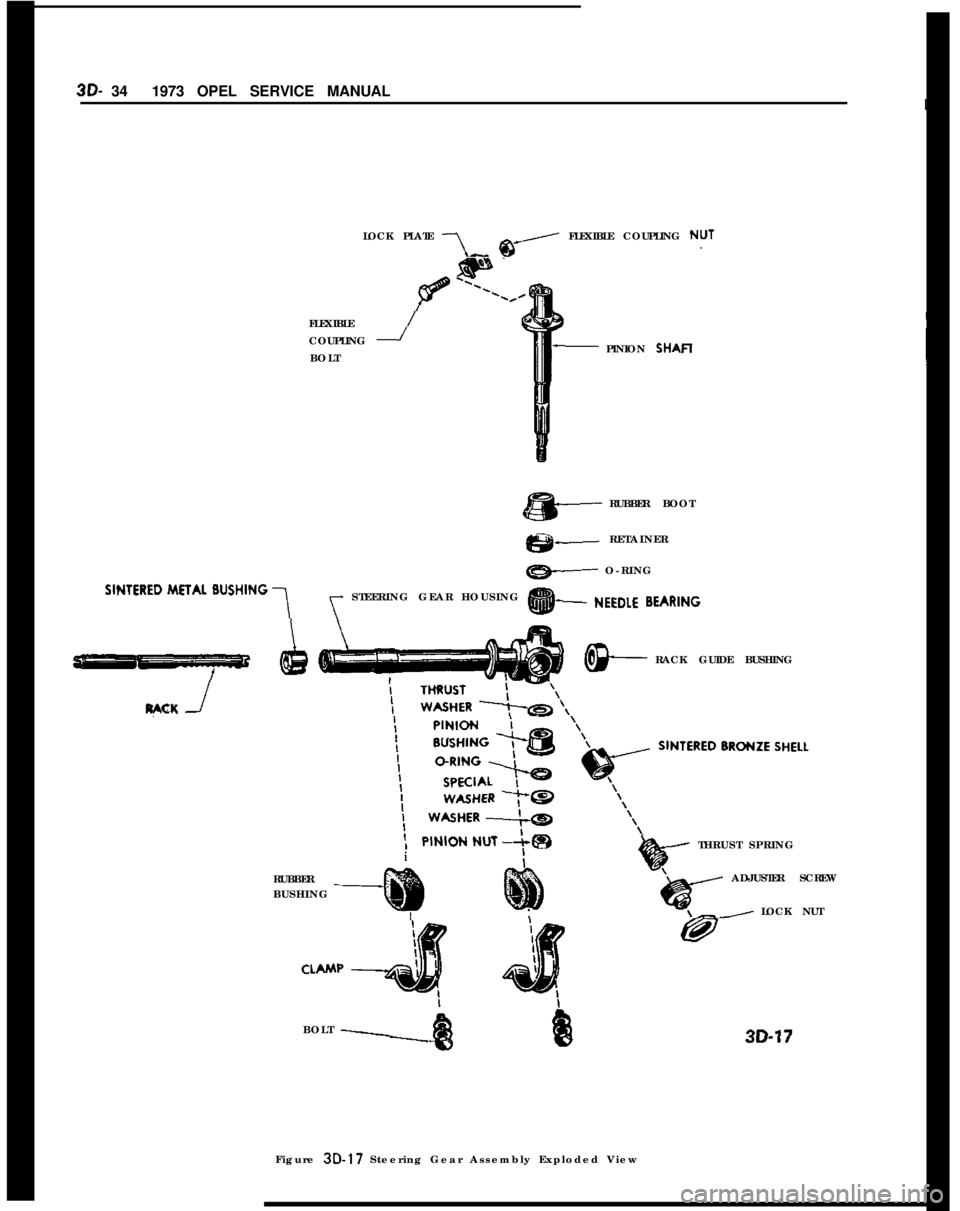
3D- 341973 OPEL SERVICE MANUALILOCK PLATE
7, @-, FLEXIBLE COUPLING NUTFLEXIBLE
COUPLING
-/BOLTPINION SHAFI
RUBBER BOOT
es+--RETAINER
ew O-RING
‘lNTERED METAL BUSHING 1y STEERING GEAR HOUSING @+ NEEDLE
BEARlNG
y-7RACK GUIDE BUSHING
RACK
he---THRUST SPRINGiRUBBERADJUSTER SCREW
BUSHING
ILOCK NUT
BOLT
\Figure 3D-17 Steering Gear Assembly Exploded View30-17
Page 204 of 625

OPEL 1900 AND MANTA STEERING COLUMN ASSEMBLY3E- 37
Figure 3E-5 Steering Column Assembly With Gear
replacement of steering column or steering ignition
lock parts.
Removal (Opel 1900 . Manta)1. Disconnect battery.
2. From underside of car, remove clamp screw of
upper steering mast out of universal joint flange. See
Figure
3E-6.Figure
3E-6 Upper Steering Mast Clamp Screw
3. Remove hex nut from steering mast jacket attach-
ment at front of dash panel. See Figure
3E-7.Figure
3E-7 - Steering Mast Jacket Attachment
4. Pull off signal switch, as well as steering and igni-
tion lock wire sets.
5. Unscrew slide-off base from underside of instru-
ment panel and remove steering column assembly
from car. See Figure
3E-8. Carefully put down as-
sembly. Avoid impacts and blows to steering column
assembly.
Figure
3E-8 - Slide-Off Base Attaching Nuts
Installation (Opel 1900. Manta)
CAUTION:
Fasteners are important attaching parts in
that they could affect the performance of
vital com-
Page 205 of 625

3E- 38 ,1973 OPEL SERVICE MANUAL
ponents and systems, and/or could result in major
repair expense. They must be replaced with one or
the same part number or with
an equivalent part if
replacement becomes necessary. Do not use a
re-
placement part of lesser quality or substitute design.
Torque
values must be used as specified during reas-
sembly to assure proper retention of these parts.On installation, make sure steering wheel spokes
point downwards and steering gear is in high point.
1. Carefully insert steering mast into universal joint
flange.
2. Loosely attach slide-off base attaching nuts at un-
derside of instrument panel.
3. Attach steering mast jacket at front of dash, using
a notched hex nut.
4. Torque nuts at slide-off base to II
lb.ft.5. Tighten screw at steering mast clamp to 22
lb.ft.6. Reconnect wires to directional signal switch and
ignition switch.
7. Reconnect battery.
REMOVAL AND INSTALLATION OF
STEERING WHEELThis procedure may be performed with the steering
column assembly either removed or installed in the
car.
Removal
1. Disconnect battery.
2. Pry off horn cap and remove wires from cap. See
Figure
3E-3.3. Bend lockplate tabs down and take off steering
shaft nut and lockplate.
4. Install steering wheel remover J-21686 as shown
in Figure
3E-9 and pull off steering wheel.
Installation1. Before installing steering wheel, lubricate return
pin and sliding area on directional signal switch re-
turn cams and horn contact ring.
2. Make sure that clamp bolt in steering shaft flange
is on top.
3. Make sure notch on steering shaft face is in hori-
zontal position.Figure
3E-9 Removing Steering Wheel
4. With the steering wheel centered, place the steer-
ing wheel onto the steering shaft.
5. Install steering wheel lockplate and nut. Torque to
11
lb.ft.
CAUTION:
This steering wheeI to steering shaft fas-
tener is an important attaching part in that it could
affect the
performance of vital components and sys-
tems, and/or could result in major repair expense. It
must be repked
with one of the same part number
or with an equivalent part if replacement becomes
necessary. Do not use a replacement part of lesser
quality or substitute design. Torque
values must be
used as specified during reassembly to assure proper
retention of this part.6. Bend lockplate tabs up, connect horn cap wires
and replace cable and cap.
7. Reconnect battery.
REMOVAL AND REPLACEMENT OF HORN
CONTACT RING
1. Remove steering wheel.
2. Cut off defective contact ring at wire.
3. Strip wire approximately
l/8”.4. Install new part and solder connection with resin
core solder.
5. Lubricate contact ring with lubriplate, or equiva-
lent.
6. Reinstall steering wheel.
Page 211 of 625

3E. 441973 OPEL SERVICE’MANUAL
Figure 3E-17 Steering Column Bracket
installed in a car it is no more susceptible to damage
through usage than an ordinary column; however,
when the column is removed, special care must be
taken in handling this assembly.Only the speufied
wheel puller should be used.When the column is removed from the car, such
actions as a sharp blow on the end of the steering
shaft laying things across or on top of the column
assembly, leaning on the column assembly, or drop-
ping of the assembly could shear or loosen the plastic
fasteners that maintain column rigidity or possibly
bend the assembly causing a binding condition.
It is
therefore important that the removal and installation
and the disassembly and reassembly procedures be
strictly followed when servicing this assembly.The steering column assembly is attached with a
bracket (A) at four points to the connecting brace
below the instrument panel. See Figure
3E-17. The
two upper bolts are designed as tear-lock-bolts. A
bolt (B) is welded to the bracket which engages in an
narrowing elongated hole. The same applies to the
upper bolt (C) of the steering column lower bearing
attachment which engages in a hole of the connect-
ing brace.
As soon as a sufficiently large secondary energy
becomes effective, the steering mast jacket slides to-
wards the front whereby the bolt (B) as well as the
bolt head (C) is additionally pushed into the respec-
tive narrowing elongated holes. Both elongated holes
are arranged so that the primary energy cannot push
the steering mast assembly into the passenger com-
partment.
The GT steering column incorporates two universaljoints to allow
~for the offset between the steering
column and the gear assembly.
The upper steering column assembly is connected to
the center steering shaft with one universal joint,
while the lower universal joint connects the center
steering shaft to the steering gear pinion shaft.
REMOVAL AND INSTALLATION
REMOVAL AND INSTALLATION OF STEERING
WHEELThis procedure may be performed with the steering
column assembly either removed or installed in the
car.Removal
1. Disconnect battery.
2. Remove horn cap.
3. Bend lockplate tabs down and remove steering
wheel nut, lockplate and washer.
4. Mark shaft and wheel hub for reassembly align-
ment.
5. Remove steering wheel using steering wheel puller
J-21686. Do not rap on end of puller in order to free
wheel from shaft as this would very likely loosen
plastic injections that maintain steering shaft rigid-
ity. Striking of underside of steering wheel to jar it
Page 238 of 625

REAR AXLE
CONTENTS
SubjectPage No.
DESCRIPTION AND OPERATION:
Rear Axle Description. . . . . . . . . . . . . . . . . . . . . . . . . . . . . . . . . . . . . . . . . . . . . . . . . . . . . .4B- 7
DIAGNOSIS:
RearAxleTroubleDiagnosis. . . . . . . . . . . . . . . . . . . . . . . . . . . . . . . . . . . . . . . . . .4B- 8
MAINTENANCE AND ADJUSTMENTS: (Not Applicale)
MAJOR REPAIR:
Removal and Installation of Rear Axle Assembly
Removal and Installation of Axle Shaft Assembly
Disassembly and Assembly of Differential
.* . . . . . . . . . . . .SPECIFICATIONS:
DifferentialSpecifications
. . . . . . . . . . . . . . . . . . . . . . . . . . . . . . . . . . . . . . . . . . . . . .4B- 94B-10
48-l 1
4B-22
DESCRIPTION AND OPERATION
REAR AXLE DESCRIPTIONThe Opel rear axle is a semi-floating type that carries
car weight through the axle shafts by way of ball
bearings which are located on the outer ends of each
axle shaft. The rear axle assembly is attached to the
under body by way of the shock absorbers, track rod,
central joint support, and lower control arms. A sta-
bilizer rod is used on all Wagons, as well as Fast
Backs and Sedans. The GT is not equipped with a
stabilizer rod. The rear springs have a progressive
spring rate which is attained by a gradual reduction
of coil thickness. The springs are arranged between
the spring seats welded onto the rear axle tubes and
the under body side members. The upper and lower
ends are seated in profiled rubber dampening rings.
The differential housing is a malleable iron casting
with tubular axle housings pressed into the sides to
form a complete assembly. An oil feed passage to the
pinion bearings and an oil return hole are provided
to allow lubricant to circulate. A removable steel
cover is bolted on the rear of the differential housing
to permit service of the differential without removing
the rear axle assembly from the vehicle. A breather
fitting is located on top of the right axle tube.Within the differential carrier, the differential case is
supported by two tapered roller side bearings. These
side bearings are preloaded by shims located between
the bearing inner races and differential case. During
installation, varying the shim thickness from side to
side also determines the ring gear to pinion backlash.
The differential case houses two side gears meshed
with two pinions. The pinions and side gears are
backed by thrust washers. The pinion gears are held
in place by a pinion shaft which is anchored in the
differential case by a lock pin.
The inner end of the axle shafts engage and extend
through the splines of the side gears with a floating
tit.
The axle shafts have an enlarged diameter from mid-
shaft to the flange end.
A ball bearing and oil seal are used on all models, and
are pressed onto the outer end of the axle shaft as an
assembly.The drive pinion is mounted in two roller bearings in
the rear axle housing. Pinion setting is established by
shims located between the differential carrier and therear’pinion bearing outer race.
Page 239 of 625

4S- 91973 OPEL SERVICE MANUAL
DIAGNOSIS
DIFFERENTIAL TROUBLE DIAGNOSISConditionPossible Cause
1. Noise is the same in1. a) Road noise.
“Drive” or “Coast”.b) Tire noise.
c) Front wheel bearing noise.
d) Front or rear U-joint angle
too great.
2. Noise changes on a2. a) Road noise.
different type of road.b) Tire noise.
3. Noise lowers tone as3. Tire noise.
car speed is lowered.
4. Similar noise is pro-4. a) Engine noise.duced with car standingb) Transmission noise.
and driving.c) Driveline angle.
5. Vibration5. a) Rough rear wheel bearing.
b) Tire unbalance.
c) Worn universal joint in
propeller shaft.
d) Front or rear U-joint angle
too great.
e) Mis-indexed, propeller shaft
at companion flange.
tJ Companion flange runout too
6. A knock or click6. A brinelled rear wheel bearing
approximately every two (2)
revolutions of rear wheel.
7. Noise most pronounced on7. Differential side gear and pin
turns.
8. A continuous low pitch8. Pinion bearing.
whirring or scraping noise
starting at relatively low
speed.9. Drive noise, coast9. Ring and pinion gear.
noise or float noise.
10. Clunk on accelera-
10. a) Worn differential cross sha
tion or deceleration.in case.
11. Groan in “Forward” or11. Wrong lube in differential.
“Reverse”.
12. Clunk or knock on12. a) Excessive end play of axle
rough road operation.to differential cross shaft
b) Excessive differential gear
clearance.