1973 CHEVROLET MONTE CARLO tire type
[x] Cancel search: tire typePage 49 of 86
Downloaded from www.Manualslib.com manuals search engine Cleaning Fabrics with
Cleaning
Fluid
This type of cleaner should be
used for cleaning stains containing
grease, oil or fats. Excess stain
should be gently scraped off with
a clean dull knife or scraper.
Use
very little cleaner, light pressure,
and clean cloths (preferably cheese
cloth). Cleaning action with
cloth should be from outside of
stain towards center and constantly
changing to a clean section of
cloth. When stain
is cleaned from
fabric, immediately wipe
area
briskly with a clean absorbent
towel or cheese cloth to help dry
area and prevent a cleaning ring.
If ring forms, immediately clean
entire area or panel section of the
trim assembly.
NOTE: Sometimes a difficult spot
may require a second application
of cleaning fluid followed immedi
ately by a soft brush to completely
remove the spot.
Cleaning Fabrics with
Detergent Foam Cleaners
This type of cleaner is excellent
for cleaning general soilage from
fabrics and for cleaning a panel
section where a minor cleaning
ring may be left from spot clean
ing. Vacuum area to remove ex
cess loose dirt. Always clean at
least a full trim panel or section
of trim. Mask adjacent trim along
stitch or weld lines. Mix detergent
type foam cleaners in strict ac
cordance with directions on label
of container.
Use foam only on a
clean sponge or soft bristle brush
-Do not wet fabric excessively or
47
rub harshly with brush. Wipe clean
with a slightly damp absorbent
towel or cloth. Immediately after
cleaning fabric, dry fabric with a
dry towel or hair dryer. Rewipe
fabric with dry absorbent towel or
cloth to restore luster of the trim
and to eliminate any dried residue.
Seat Belt Care
• Clean only with mild soap solu
tion and lukewarm water.
• Do not bleach or dye belts since
this may severely weaken belts.
Removal of Specific Stains
Candy-Chocolate, use cloth soak
ed in lukewarm water; other than
chocolate, use very hot water. Dry.
If necessary, clean lightly with
fabric cleaning fluid.
Chewing Gum-Harden gum with
ice cube and scrape off with dull
knife. Moisten with fabric cleaning
fluid and scrape again,
Page 51 of 86
Downloaded from www.Manualslib.com manuals search engine Polishing and Waxing
Your Car
Although acrylic paint on your
car
is durable, you may wish to
wax or polish for added protection.
Your Chevrolet Dealer offers many
polishes and waxes now available
which have proven of real value
in
maintaining a good paint finish.
When using a tar and road oil
remover, be certain it
is safe for
use on acrylic painted surfaces.
Protection of Exterior
Bright
Metal Parts
Bright metal parts should be
cleaned regularly to maintain
luster. Washing with water is all
that
is usually required. However,
G.M. Chrome
Polish may be used
on CHROME or STAINLESS
STEEL
trim if necessary.
Use special care with ALU
MINUM trim. Never use auto or
chrome polish, steam or any caustic
soap to clean aluminum.
A coating of wax, rubbed to a
high polish,
is recommended for
all bright metal parts.
Cleaning White Sidewall
Tires
Use a tire cleaner which will
not harm aluminum trim. A stiff
brush may be used with the cleaner
to remove road grime and dirt
from white sidewall tires.
Cleaning the Optional
Vinyl
Top
The top should be washed fre
quently with neutral soap suds,
lukewarm water and a brush with
soft bristles. Rinse top with
suffi
cient quantities of clear water to
remove all traces of soap.
If the top requires additional
cleaning after using soap and
water, a mild foaming cleanser
can be used. Rinse the whole top
with water; then apply a mild
49
foaming type cleanser on an area
of approximately
--two square feet.
Scrub area with a small soft bristle
hand brush adding water
as neces
sary until the cleanser foams to
a soapy consistency. Remove the
first accumulated soilage with a
cloth or sponge before it can be
ground into the top material.
Apply additional cleanser to the
area and scrub until the top
is
clean. Care must be exercised to
keep the cleanser from running
onto body finish
as it may cause
streaks
if allowed to run down
and dry. After the entire top
has been cleaned, rinse generously
with clear water to remove all
traces of cleanser.
Do not use
volatile cleaner or household
bleaching agents on the top
material.
I
Page 62 of 86

Downloaded from www.Manualslib.com manuals search engine • Maintain cooling system freeze
protection at
.;...200 F or below
to ensure protection against
corrosion and loss of coolant
from boiling , even though freez
ing temperatures are not
ex
pected.
• Add ethylene glycol base cool
ant that meets GM Specification
1899-M when coolant additions
are required because of coolant
loss or to provide additional
protection against freezing at
temperatures lower than
_200 F
(_320 F in Canada).
NOTE: Alcohol or methanol base
coolants or plain water are not
recommended for your Monte
Carlo at any time.
Radiator Pressure Cap
The radiator cap, a 15 lb. pres
sure type, must be installed tightly,
otherwise coolant may be lost and
damage to engine may result from
overheating. Radiator pressure caps
should be checked periodically for
proper operation.
If replacement is
required specify AC.
Thermostat
The cooling system is protected
and controlled by a thermostat in
stalled in the engine coolant outlet
to maintain a satisfactory operating
temperature of the engine. This
thermostat
is designed for continu
ous use through both winter and
summer and need not be changed
seasonally . When replacement
is
necessary, Delco parts are recom
mended.
60
Tires
The factory installed tires on
your car
as shown on the following
Tire Usage chart are designed to
provide the best all around per
formance for normal vehicle op
eration. When inflated
as recom
mended on the tire pressure plac
ard, located on the left door of
your vehicle, they have the load
carrying capacity to operate satis
factorily at all normal highway
speeds.
Tire Care
Tires should be checked regu
larly for proper inflation pressure,
wear, and damage. The following
information will assist you in prop
erly caring for your tires:
Page 63 of 86
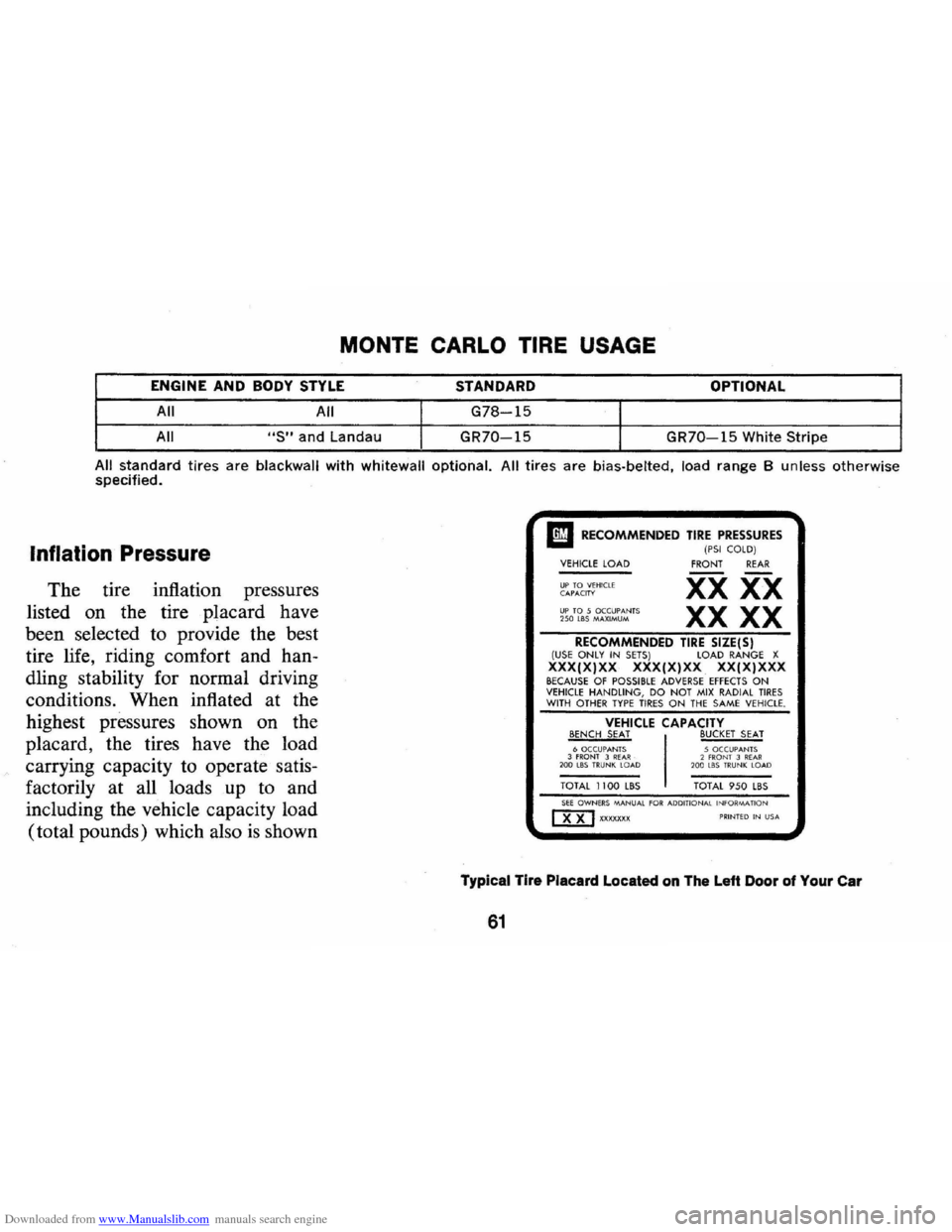
Downloaded from www.Manualslib.com manuals search engine MONTE CARLO TIRE USAGE
ENGINE AND BODY STYLE STANDARD OPTIONAL
All All
G78-15
All "S" and Landau GR70-15
GR70-15 White Stripe
All standard tires are blackwall with whitewall optional. All tires are bias·belted, load range B unless otherwise specified.
Inflation Pressure
The tire inflation pressures
listed on the tire placard have
been selected to provide the best
tire life, riding comfort and han
dling stability for normal driving
conditions. When inflated at the
highest pressures shown on the
placard, the tires have the load
carrying capacity to operate satis
factorily at all loads up to and
including the vehicle capacity load
(total pounds) which also
is shown
I!I RECOMMENDED TIRE PRESSURES (PSI COLD) VEHICLE LOAD
UP TO VEHICLE C APACIH UP TO 5 OCCU PANTS 250 185 MAX IMUM
FRONT REAR
xx XX
XX XX
RECOMMENDED TIRE SIZE(S) (USE ON LY IN SETS ) LOAD RANGE X XXX(X)XX XXX(X)XX XXIX)XXX BECAUSE OF POSSIBLE ADVERSE EFFECTS ON VEHICLE HANDLING, DO N O T MIX RADIAL TIRES WITH OTHER TYPE TIRES ON THE SA ME VEHICLE.
VEHICLE CAPACITY BENCH SEAT BUCKET SEAT 6 OCCUPANTS 3 fR ONT 3 REAR· 200 lBS TRUNK LOAD
TOTAL 1100 LBS
5 OCCUPAN TS 2 fR ONT 3 R EA R 200 U1S TRU NK LOA D
TOTAL 950 LBS SEE OWNERS MANUAL fOR ADD ITIONAL INfORMAflON mJ XXXXXXX PRINTED IN USA
Typical Tire Placard Located on The Left Door of Your Car
61
Page 65 of 86
Downloaded from www.Manualslib.com manuals search engine Underinftation, incorrect toe or
camber and fast cornering produce
different types of abnormal wear
which
can be diagnosed by your
dealer.
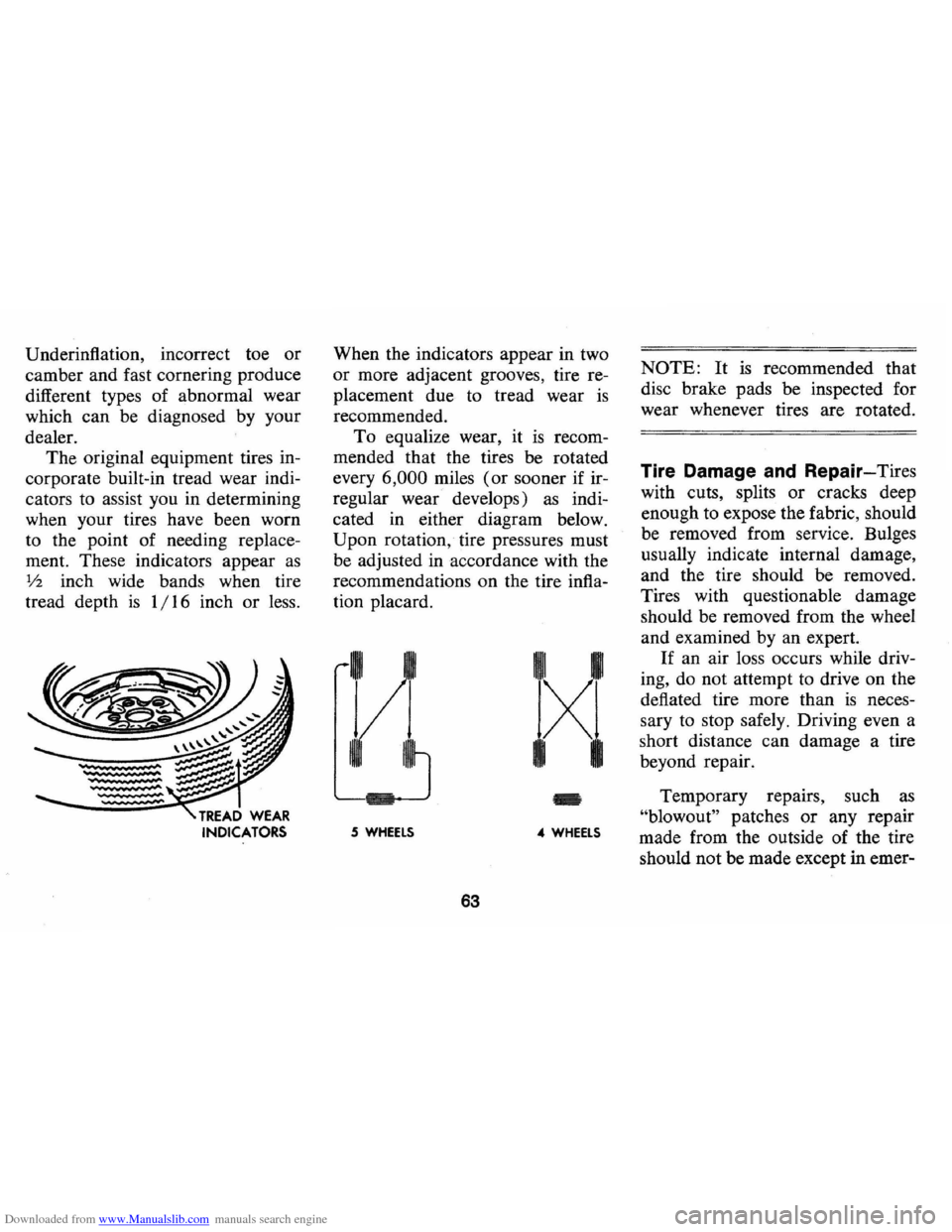
The original equipment tires in
corporate built-in tread wear indi
cators to assist you in determining
when your tires have been worn
to the point of needing replace
ment. These indicators appear
as
V2 inch wide bands when tire
tread depth
is 1/16 inch or less. When
the indicators appear in two
or more adjacent grooves, tire re
placement due to tread wear
is
recommended.
To equalize wear, it is recom
mended that the tires be rotated
every
6,000 miles (or sooner if ir
regular wear develops)
as indi
cated in either diagram below.
Upon rotation, tire pressures must
be adjusted in accordance with the
recommendations
on the tire infla
tion placard.
II I
Vi
..
5 WHEELS 4 WHEELS
63
NOTE: It is recommended that
disc brake pads be inspected for
wear whenever tires are rotated.
Tire Damage and Repair-Tires
with cuts, splits or cracks deep
enough to expose the fabric, should
be removed from service. Bulges
usually indicate internal damage,
and the tire should be removed.
Tires with questionable damage
should be removed from the wheel
and examined by an expert.
If an air loss occurs while driv
ing, do not attempt to drive on the
deflated tire more than
is neces
sary to stop safely. Driving even a
short distance
can damage a tire
beyond repair.
Temporary repairs, such as
"blowout" patches or any repair
made from the outside of the tire
should not be made except in emer-
Page 66 of 86
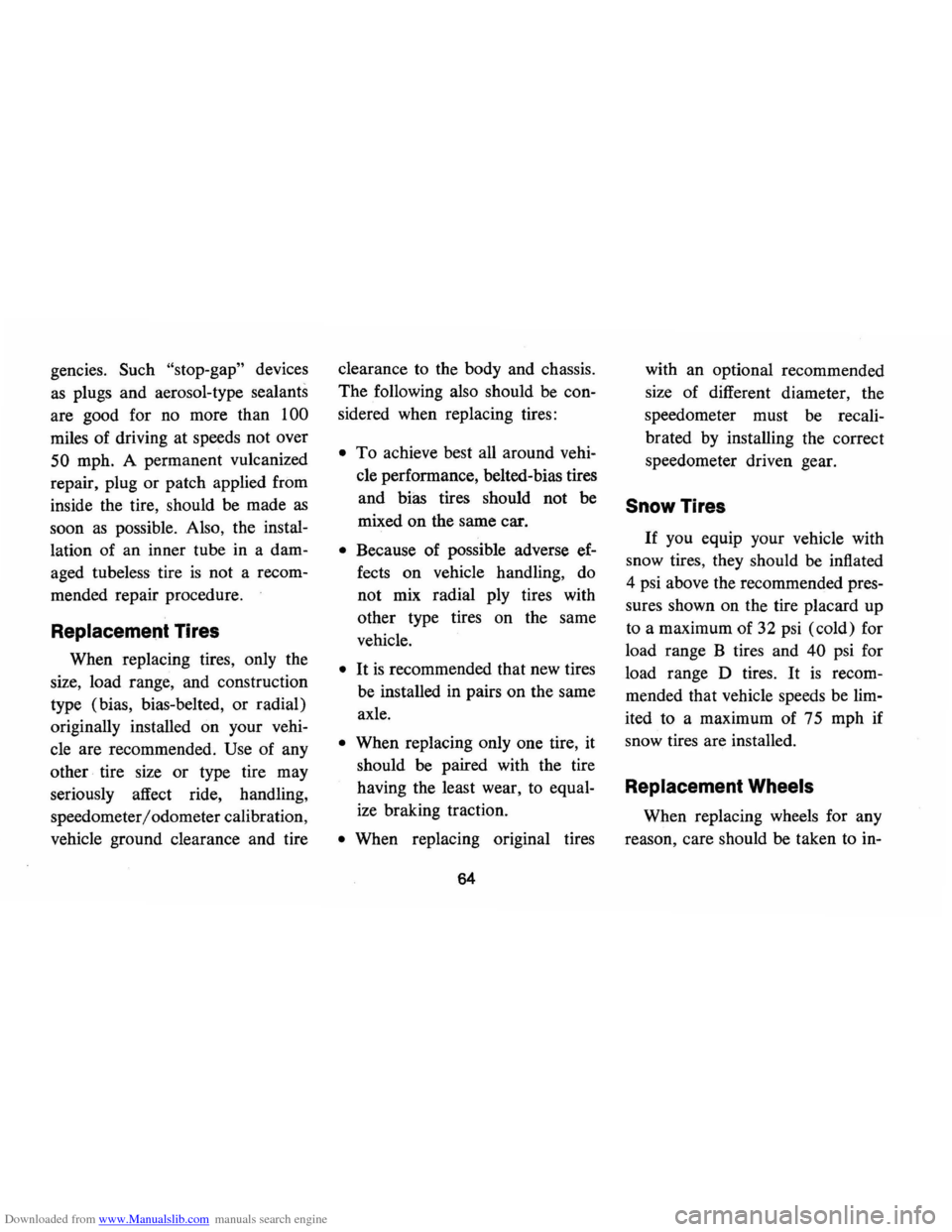
Downloaded from www.Manualslib.com manuals search engine gencies. Such "stop-gap" devices
as plugs and aerosol-type sealants
are good for no more than
100
miles of driving at speeds not over
50 mph. A permanent vulcanized
repair, plug or patch applied from
inside the tire, should be made
as
soon as possible. Also, the instal
lation of an inner tube in a dam
aged tubeless tire
is not a recom
mended repair procedure.
Replacemeot Tires
When replacing tires, only the
size, load range, and construction
type (bias, bias-belted ,
or radial)
originally installed on your vehi
cle are recommended.
Use of any
other tire size
or type tire may
seriously affect ride, handling ,
speedometer / odometer calibration,
vehicle ground clearance and tire clearance
to the body and chassis.
The following also should be con
sidered when replacing tires:
• To achieve best all around vehi
cle performance, belted-bias tires
and
bias tires should not be
mixed on the same car.
• Because of possible adverse ef
fects on vehicle handling , do
not mix radial ply tires with
other type tires on the same
vehicle.
• It is recommended that new tires
be installed
in pairs on the same
axle.
• When replacing only one tire, it
should be paired with the tire
having the least wear, to equal
ize braking traction.
• When replacing original tires
64
with an optional recommended
size of different diameter, the
speedometer must be recali
brated
by installing the correct
speedometer driven gear.
Snow Tires
If you equip your vehicle with
snow tires, they should be inflated
4 psi above the recommended pres
sures shown on the tire placard up
to a maximum of 32 psi (cold) for
load range B tires and
40 psi for
load range D tires.
It is recom
mended that vehicle speeds be lim
ited to a maximum of 75 mph if
snow tires are installed.
Replacement Wheels
When replacing wheels for any
reason , care should be taken to in-
Page 74 of 86
Downloaded from www.Manualslib.com manuals search engine SPECIFICATION
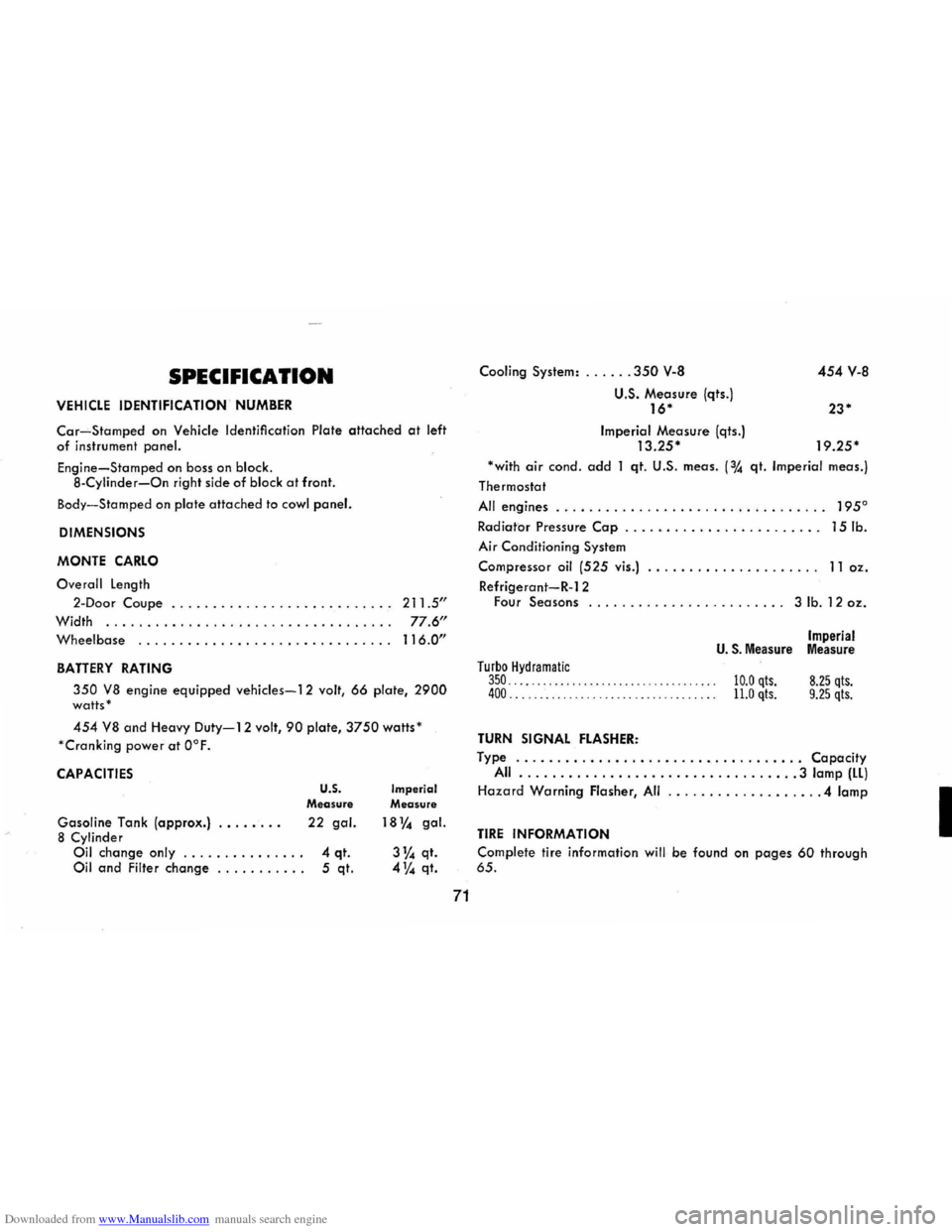
VEHICLE IDENTIFICATION NUMBER
Car-Stamped on Vehicle Identification Plate attached at left of instrument panel.
Engine-Stamped on boss on block .
8 -Cylinder-On right side of block at front.
Body-S tamped o n plate attached to cowl panel.
DIMENSIONS
MONTE
CARLO
O ve rall length
2-Door Coupe ...
.. . . . . . . . . . . . . . . . . . . . . . . 211.5"
Width ... ......... ......... ............ . . 77.6"
Wheelbase ............................... 116.0"
BATTERY RATING
350 VB engine equipped vehicles-12 volt, 66 plate, 2900 watts '
454 VB and Heavy Duty-12 volt, 90 plate, 3750 watts'
' Cranking
powe r at O°F.
CAPACITIES
Gasoline Tank (approx.) ....... . B Cylinder
Oil change only ... ... .... .... . Oil and Filter change .......... .
U.S. Measure
22 gal.
4 qt. 5 qt.
Imperial Measure
18% gal.
3% qt. 4% qt.
71
Cooling System: ...... 350 v-a
u.s. Measure (qts.) 16*
Imperial Measure (qts.) 13.25*
454 v-a
23*
19.25*
'with air cond o add 1 qt. U.S. meas. (% qt. Imperial meas.)
Thermostat
All engines . . . . . . . . . . . . . . . . . . . . . . . . . . . . . . . .. 195°
Radiator Pressure Cap . . . . . . . . . . . . . . . . . . . . . . .. 15 lb.
Air Condit ioning System
Compressor oil (525 vis .) .............. ... .... 11 oz.
Refrigerant-R-12 Four Seasons ........................ 3 lb. 12 oz.
Turbo Hydramatic 350 ........... .......... .. ... ........ . . 400 .. ................... .. ... .... .. .. .
TURN SIGNAL FLASHER:
Imperial U. S. Measure Measure
10.0 qts. 11.0 qts. 8.25 qts. 9.25 qts.
Type ................................... Capacity All ..... ..... ........................ 3 lamp (ll)
Hazard Warning Flasher, All .. , ............... . 4 lamp
TIRE INFORMATION
Complete
tire information will be found on pages 60 through 65.
I