1973 CHEVROLET MONTE CARLO battery
[x] Cancel search: batteryPage 22 of 86
Downloaded from www.Manualslib.com manuals search engine Turn Signal and Lane
. Change Features
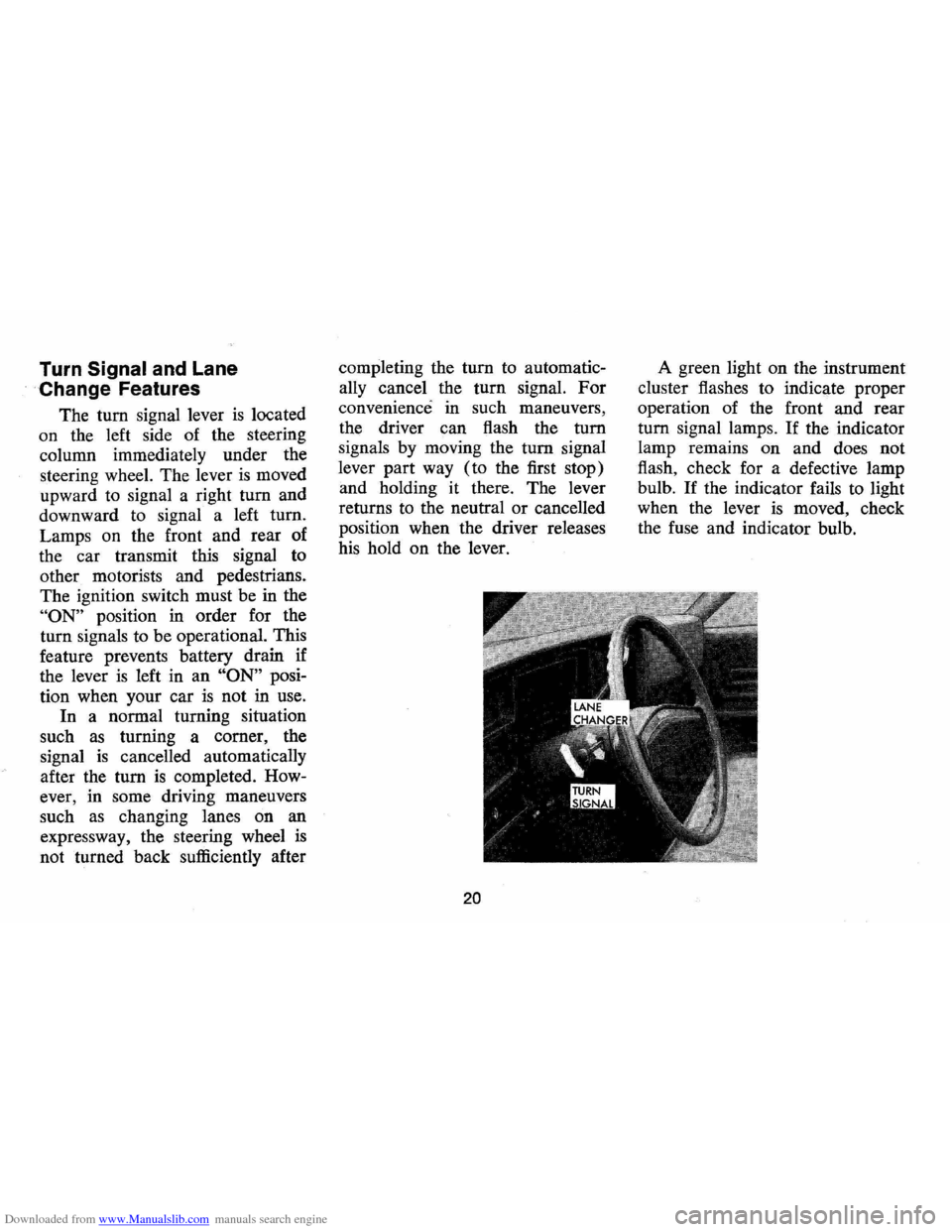
The tum signal lever is located
on the left side of the steering
column immediately under the
steering wheel. The lever
is moved
upward to signal a right
tum and
downward to signal a left tum.
Lamps on the front and rear of
the car transmit this signal to
other motorists and pedestrians.
The ignition switch must be in the
"ON" position in order for the
turn signals to be operational. This
feature prevents battery drain if
the lever
is left in an "ON" posi
tion when your car
is not in use.
In a normal turning situation
such
as turning a comer, the
signal
is cancelled automatically
after the tum
is completed. How
ever, in some driving maneuvers
such
as changing lanes on an
expressway, the steering wheel
is
not turned back sufficiently after completing
the
tum to automatic
ally cancel the turn signal.
For
convenience in such maneuvers,
the driver can flash the
tum
signals by moving the tum signal
lever part way (to the first stop)
and holding it there. The lever
returns to the neutral
or cancelled
position when the driver releases
his hold on the lever.
20
A green light on the instrument
cluster flashes to indicate proper
operation of the front and rear
tum signal lamps. If the indicator
lamp remains on and does not
flash, check for a defective lamp
bulb.
If the indicator fails to light
when the lever
is moved, check
the fuse and indicator bulb.
Page 32 of 86
Downloaded from www.Manualslib.com manuals search engine I I
' /
D C
4 t '
AMPS
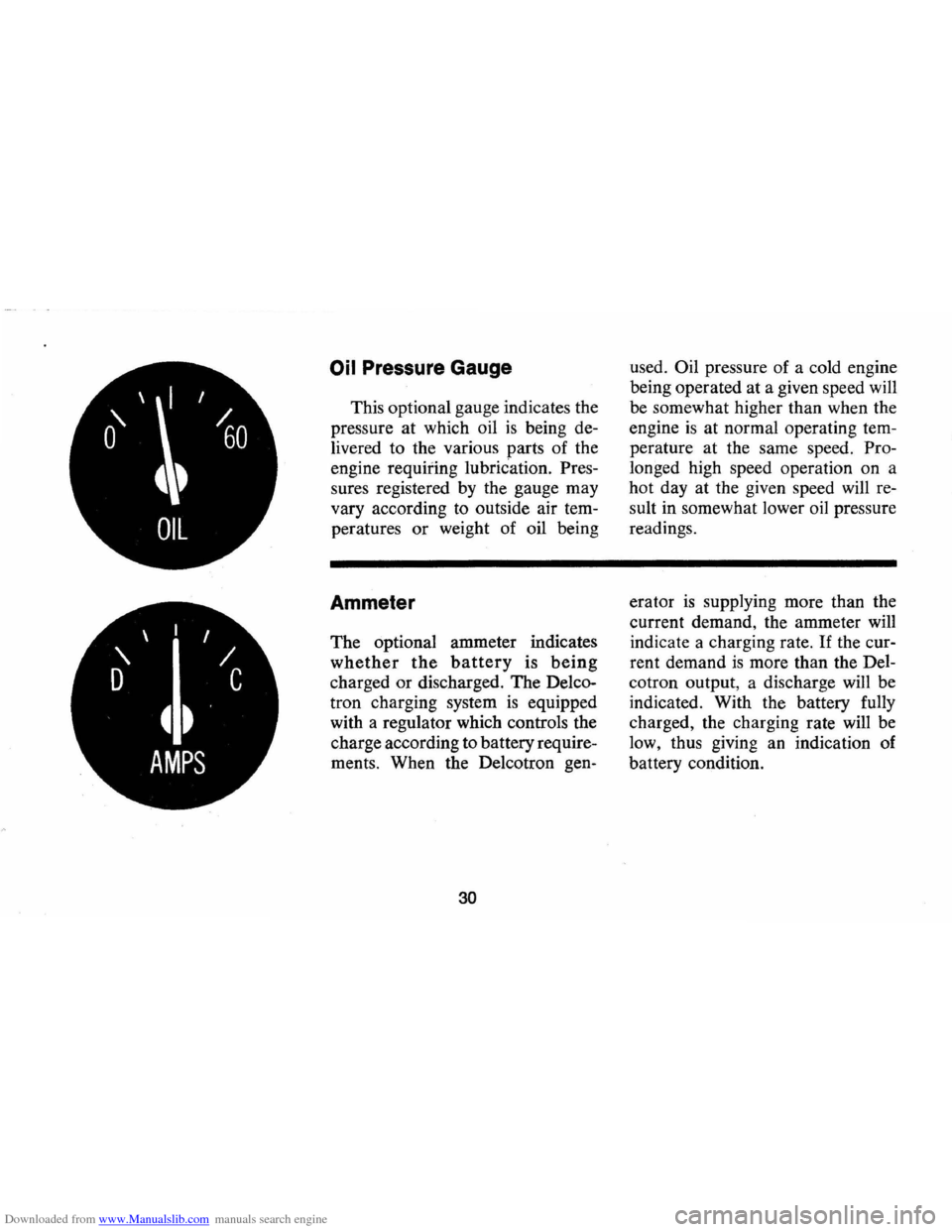
Oil Pressure Gauge
This optional gauge indicates the
pressure at which oil
is being de
livered to the various parts of the
engine
requiting lubriCation. Pres
sures registered by the gauge may
vary according to outside air tem
peratures
or weight of oil being
Ammeter
The optional ammeter indicates
whether the battery is being
charged or discharged. The Delco
tron charging system
is equipped
with a regulator which controls the
charge according to battery require
ments . When the Delcotron gen-
30
used. Oil pressure of a cold engine
being operated at a given speed will
be somewhat higher than when the
engine
is at normal operating tem
perature at the same speed. Pro
longed high speed operation on a
hot day at the given speed will re
sult in somewhat lower oil pressure
readings.
era tor
is supplying more than the
current demand, the ammeter
will
indicate a charging rate. If the cur
rent demand
is more than the Del
cotron output, a discharge will be
indicated. With the battery fully
charged, the charging rate will be
low, thus giving an indication of
battery condition.
Page 44 of 86
Downloaded from www.Manualslib.com manuals search engine 50 miles, provided driveline, axle
and transmission are otherwise
nor
mally operable.
Use only towing equipment spe
cifically designed for this purpose,
following the instructions of the
equipment manufacturer. Also, a
safety chain system must be used.
For such towing, the vehicle park
ing brake must be released, trans
mission must be in neutral and
igni
tion lock turned to OFF position.
Remember that power brake and
steering assists will not be available
when engine
is inoperative.
Emergency Starting
• Never tow the car to start be
cause the surge forward when
the engine starts could cause a
collision with the tow vehicle.
• Engines in vehicles with auto
matic transmissions cannot be
started
by towing or pushing
the car.
ENGINE COOLANT
• To start the car when the Ener
gizer (battery) is discharged, use
a single auxiliary battery or
Energizer of the
same nominal
voltage
(12 volts) as the dis
charged battery, with suitable
jumper cables.
• Make connections as set forth
below under
"J ump Starting
with Auxiliary (Booster)
bat
tery"
to lessen the chance of
personal injury or property
damage.
Do
not use these instructions in
connection with any vehicle having
a positive-ground electrical system
42
-either to start your vehicle or the
other
one-an explosion may result
which could cause personal injury
Page 45 of 86

Downloaded from www.Manualslib.com manuals search engine or property damage. All General
Motors cars have negative-ground
electrical systems and can be used
to jump start one another.
If you
cannot determine how the other
vehicle
is grounded (by checking
specifications in the owner's man
ual, etc.) we recommend that you
attempt no jump starting with that
vehicle.
Jump Starting with
Auxiliary (Booster) Battery
Both booster and discharged
battery should be treated carefully
when using jumper cables. Follow
exactly the procedure outlined be
low, being careful not to cause
sparks:
1.
Set parking brake and place
automatic transmission in
"PARK" (neutral for manual
transmission).
Turn off lights,
heater and other electrical loads. 2.
Remove vent caps from both
the booster and the discharged
batteries. Lay a cloth over the
open vent wells of each battery.
These two actions help reduce
the explosion hazard always
present in either battery when
connecting
"live" booster bat
teries to
"dead" batteries.
3. Attach one end of one jumper
cable to the positive terminal of
the booster battery (identified
by a red color,
"+" or "P" on
the battery case, post or clamp)
and the other end of same cable
to positive terminal of discharged
battery. Do
NOT permit cars to
touch each other,
as this could
'establish a ground connection
and counteract the benefits of
this procedure.
4. Attach one end of the remaining
negative cable to the negative
terminal (black color,
"-" or
"N") of the booster battery, and
43
the other end to the' de1cotron
mounting bracket (see illustra
tion) of your 1973 Monte Carlo
(do not connect directly to neg
ative post of dead battery) -
taking care that clamps from
one cable do not inadvertently
touch the clamps on the other
cable. Do not lean over the
battery when making this con
nection.
Reverse this sequence exactly
when removing the jumper cables.
Re-install vent caps and throw
cloths away
as the cloths may have
corrosive acid on them.
Page 68 of 86
Downloaded from www.Manualslib.com manuals search engine the complete underbody be in
spected and flushed at least once
each year, preferably after a win
ter's exposure. Particular attention
should be given to cleaning out
underbody members where dirt
and other foreign materials may
have collected.
If desired, your Chevrolet deal
er can perform this service for you.
In addition, he can provide recom
mendations on undercoating ma-terials
which will help protect
your
vehicle from corrosion.
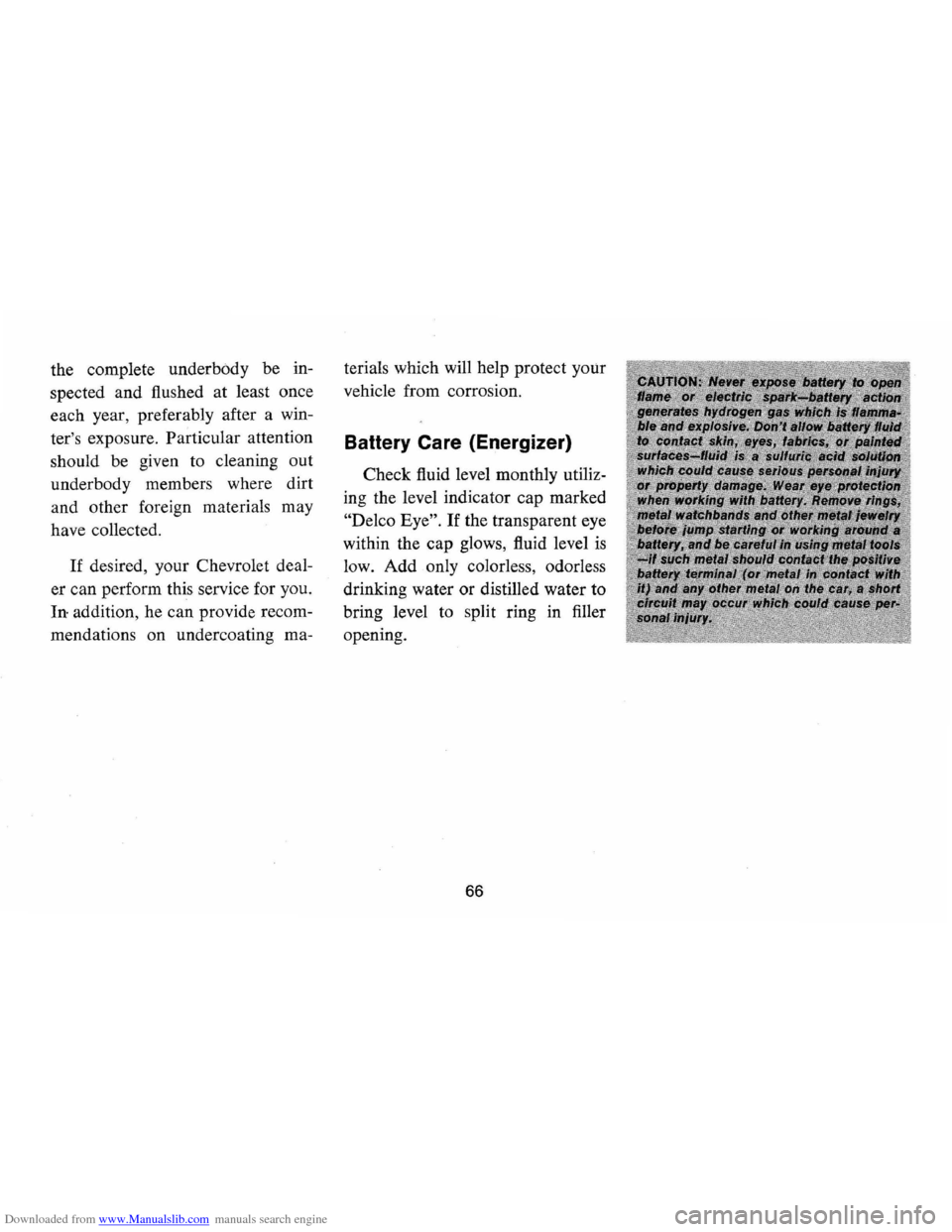
Battery Care (Energizer)
Check fluid level monthly utiliz
ing the level indicator cap marked
"Delco Eye". If the transparent eye
within the cap glows, fluid level
is
low. Add only colorless, odorless
drinking water or distilled water to
bring level to split ring in filler
opening.
66
Page 69 of 86
Downloaded from www.Manualslib.com manuals search engine the complete underbody be in
spected and flushed at least once
each year, preferably after a win
ter's exposure. Particular attention
should be given to cleaning out
underbody members where dirt
and other foreign materials may
have collected.
If desired, your Chevrolet deal
er can perform this service for you.
In addition, he can provide recom
mendations on undercoating ma-terials
which will help protect
your
vehicle from corrosion.
Battery Care (Energizer)
Check fluid level monthly utiliz
ing the level indicator cap marked
"Delco Eye". If the transparent eye
within the cap glows, fluid level
is
low. Add only colorless, odorless
drinking water or distilled water to
bring level to split ring in filler
opening.
66
Page 72 of 86

Downloaded from www.Manualslib.com manuals search engine as a screwdriver handle or pliers. Replace the oir cleaner and attempt to start the engine in the normal manner. (E) If the car will start but stalls when hot or has a rough idle, you can suspect a faulty IDLE ADJUSTMENT, a malfunctioning AUTOMATIC CHOKE or an extremely dirty and blocked AIR CLEANER ELEMENT. Replace paper element air cleaner if necessary. Idle adjustment or automatic choke service (other than that outlined in paragraph 0 above) should be performed by your Chevrolet
Dealer. If the above Fuel System checks and the checks suggested under
the Electrical System following do not correct the malfunction, it is recommended that you turn to your Authorized Chevrolet Dealer
for further checks, adjustments or repairs. ELECTRICAL SYSTEM If when the ignition key is turned to "Start", the engine will not turn' over, yOu have good reason to suspect electrical trouble. NOTE: Never'remove Delcotron bat lead without first disconnecting battery ground cable. IF) When there is no response at all to attempts to start the car,
check the obvious-your AUTOMATIC TRANSMISSION SELECTOR LEVER must be in Neutral or Park position (manual transmission
must have clutch depressed all the way to floor) before the engine
can be starfed. Turning the IGNITION SWITCH rapidly back and forth several times will sometimes correct a poor internal switch
contact.
(GI The BATTERY may be discharged. If so, lights will be dim and the horn will have a poor tone if it will blow at all.
Usually a garage recharge will be necessary to return the battery to operation. Occasionally, however, a long drive will recharge the battery. . , •
NOTE: If the baHery is determined to be dead, and for no apparent reason, have your :Aflthori~ed Chevrolet Dealer check the baHery, the GENERATOR and the VOLTAGE REGULATOR.
GENERATOR trouble shqiJld already have been indicated by
69
the generator indicator light on the instrument panel.
POOR BATTERY CONNECTIONS may be suspected if the car has operated properly a short time before and now not even the horn will operate. Check both ends of both battery cables. If the connections are corroded, a car may sometimes be restored to operation by removing all cable ends, scraping all contacting surfaces
clean with a pen knife, and reassembling. If the cables are broken,
they must be replaced. The power supply should now be restored unless-the battery is dead.
(HI If, however, the lights and horn work properly but the starter will still not turn over, check the STARTER connections. A "click" from the starter solenoid indicates that the wiring to the starter is properly installed. If the wiring seems to be clean and tightly installed, the trouble is probably in the starter itself and should be referred to your Authorized Chevrolet Dealer.
When the engine will "turn over" but will not start, the following
items may be checked along with the Fuel Systems Checks listed previously.
(II With a clean dry cloth wipe the ce-amic portions of the spark plugs dry. In particularly damp or rainy weather dampness may be the cause of not starting, espe
cially when the engine is cold.
(JI Check the cables at the top
of the distributor and coil as well as each spark plug cable for
tightness.
(KI If the car will still not start,
check for spark at the spark plugs in the following manner: Pull one of the spark plug
wires off its spark plug. Insert a
short piece of bare wire (such as Distributor and Coli Cables
Page 74 of 86
Downloaded from www.Manualslib.com manuals search engine SPECIFICATION
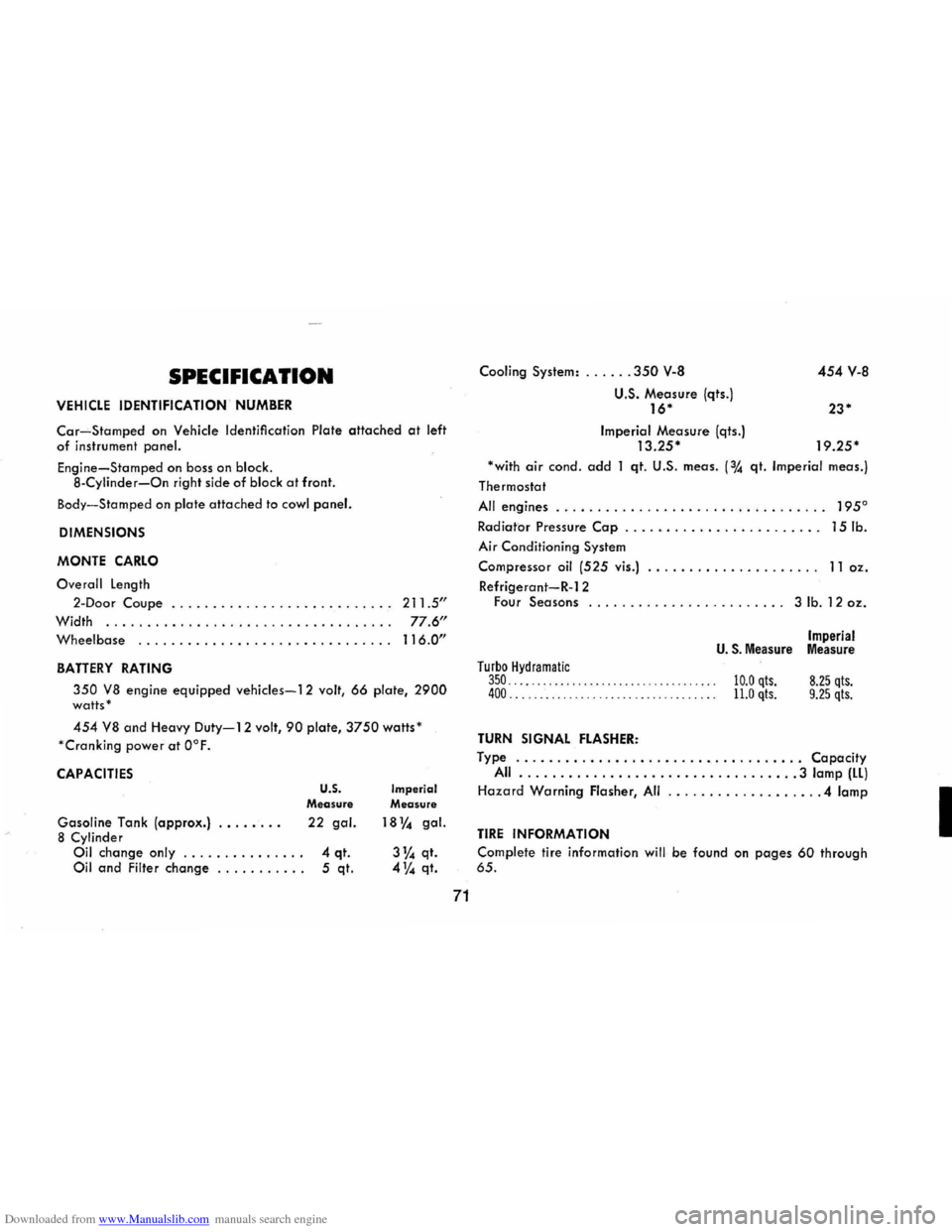
VEHICLE IDENTIFICATION NUMBER
Car-Stamped on Vehicle Identification Plate attached at left of instrument panel.
Engine-Stamped on boss on block .
8 -Cylinder-On right side of block at front.
Body-S tamped o n plate attached to cowl panel.
DIMENSIONS
MONTE
CARLO
O ve rall length
2-Door Coupe ...
.. . . . . . . . . . . . . . . . . . . . . . . 211.5"
Width ... ......... ......... ............ . . 77.6"
Wheelbase ............................... 116.0"
BATTERY RATING
350 VB engine equipped vehicles-12 volt, 66 plate, 2900 watts '
454 VB and Heavy Duty-12 volt, 90 plate, 3750 watts'
' Cranking
powe r at O°F.
CAPACITIES
Gasoline Tank (approx.) ....... . B Cylinder
Oil change only ... ... .... .... . Oil and Filter change .......... .
U.S. Measure
22 gal.
4 qt. 5 qt.
Imperial Measure
18% gal.
3% qt. 4% qt.
71
Cooling System: ...... 350 v-a
u.s. Measure (qts.) 16*
Imperial Measure (qts.) 13.25*
454 v-a
23*
19.25*
'with air cond o add 1 qt. U.S. meas. (% qt. Imperial meas.)
Thermostat
All engines . . . . . . . . . . . . . . . . . . . . . . . . . . . . . . . .. 195°
Radiator Pressure Cap . . . . . . . . . . . . . . . . . . . . . . .. 15 lb.
Air Condit ioning System
Compressor oil (525 vis .) .............. ... .... 11 oz.
Refrigerant-R-12 Four Seasons ........................ 3 lb. 12 oz.
Turbo Hydramatic 350 ........... .......... .. ... ........ . . 400 .. ................... .. ... .... .. .. .
TURN SIGNAL FLASHER:
Imperial U. S. Measure Measure
10.0 qts. 11.0 qts. 8.25 qts. 9.25 qts.
Type ................................... Capacity All ..... ..... ........................ 3 lamp (ll)
Hazard Warning Flasher, All .. , ............... . 4 lamp
TIRE INFORMATION
Complete
tire information will be found on pages 60 through 65.
I