1973 CHEVROLET CAMARO wheel
[x] Cancel search: wheelPage 43 of 84
Downloaded from www.Manualslib.com manuals search engine • Activate hazard warning flasher.
• Block both the front and back
of the wheel diagonally opposite
the jack position.
Remove
hubcap or wheel cover
with flat end of wheel
nut wrench
and loosen wheel nuts slightly.
Set
lever on jack to UP position.
Properly position load rest which
engages bumper by moving base of
NOTE: Base of jack column
should be slightly angled in toward
car since it will straighteri
as car is
raised.
jack slightly under car and engage
tang of
bracket in bumper notch,
then bring jack base back toward
upright position. Check that
l~ad
rest is positioned before operatmg
jack.
40
Jack Operation
After jack is positioned as noted
above use
wheel nut wrench as . ,
jack handle and raise car until tire
clears ground. Remove wheel nuts
and wheel, install spare and tighten
wheel nuts. Move jack lever to
DOWN and install hub cap or
wheel cover.
Page 54 of 84
Downloaded from www.Manualslib.com manuals search engine Front Wheel Bearings
Every 24,000 miles-clean and
repack with a high melting point
wheel bearing lubricant.
Use wheel
bearing lubricant GM Part No.
1051344 or equivalent. This is a
premium high melting point lubri
cant. When replacement is neces
sary specify Delco parts.
Brakes
Brake linings should. be periodi
cally inspected for wear by a quali
fied technician. The frequency of
thi s inspection depends upon driv
ing conditions such
as traffic or
terrain, and also the driving tech
niques of individual owners.
Your
Chevrolet Dealer is best qualified
to advise you
as to how often this inspection
should be performed.
When replacement
is required ,
specify
GM and Delco parts.
Master Cylinder -Every 6,000
miles or 4 months -Check fluid
level in each reservoir and main
tain
1;4" below lowest edge of each
filler opening with Delco Hydrau
lic Brake Fluid,
Supreme No. 11.
Parking Brake Pulley, Cables
and Linkage-Every 6,000 miles
or 4 months-Apply water resist
ant EP Chassis Lubricant which
meets
GM Specification 6031 M, to
parking brake cable at cable guides
and at all operating links and
levers.
Standard Steering Gear
The steering gear is factory
filled with steering gear lubricant.
Seasonal change of this lubricant
should not be performed and the
housing should not be
drained-no
51
lubrication is required for the life
of the steering gear.
Every 36,000 miles, the gear
should be inspected for seal leak
age (actual solid
grease-not just
oily film) .
Ifa seal is replaced or
the gear is overhauled, the gear
housing should be refilled with
Part No.
105 1052 (13 oz. con
tainer) Steering Gear Lubricant
which meets GM Specification GM
4673M, or
its equivalent.
NOTE: Do not use EP Chassis
Lube, meeting
GM Specification
GM 603 I M, to lubricate the gear.
DO NOT OVER-FILL the gear
housing.
Power Steering System
Check the fluid level in the
pump reservoir at each oil change
period. Add GM Power Steering
Fluid
(or DEXRON Automatic
Page 60 of 84
Downloaded from www.Manualslib.com manuals search engine and increased susceptibility to
damage by road impacts.
Tire pressures should be
checked when the tires are
"cold"
at least once a month (and pref
erably oftener) or before long
trips
or when heavily loaded. The
following points should be ob
served when checking and setting
tire pressures:
1. Cold tire pressure ratings are applic
able when a vehicle has been inopera
tive for 3 hours or more, or driven less than 1 mile.
2. Tire Inflation pressure may increase as
much as 6 pounds per square inch (psi)
when hot (after
vehicle has been driven 10 miles or at speeds of more than 60 miles per hour). Do not "bleed" or re
duce pressures when tires are hot from
driving.
3. For continuous high speed operation
(over 75 mph), Increase tire Inflation pressure 4 psi above the recommended
pressures up to a maximum of 32 psi cold pressure for load range B tires, or 40 psi for 0 load range tires. Sustained
speeds above 75 mph are not recommended when the 4 psi adjustment ,
would require pressures greater than
the above maximum pressures.
4. Always use a tire pressure gauge when
checking pressures as t,he appearance of a tire can be deceiving. For example,
radial ply fires, In comparison with bias ply tires at the same pressure, may have
the appearance of being under-inflated.
Vehicle Loading -Do not load
your vehicle beyond the vehicle
capacity (total pounds) shown on
the tire placard. This figure repre
sents the design capacity of the
ve
hicle, not merely of the tires.
When towing trailers, the allow
able pasenger and cargo load
must be reduced by an amount
equal to the trailer tongue load on
the trailer hitch.
(See "Trailer
Hauling"
in Section 1 of this man
ual.) Station wagon loads should
be distributed
as far forward as
possible. Vehicles equipped with
luggage racks do not have a
ve
hicle load capacity greater than
specified on the tire placard.
57
Tire Wear and Rotation -Un
even or abnormal tire wear is usu
ally the result of incorrect inflation
pressure, improper wheel align
ment, wheels being out-of-balance,
or poor driving habits. Underin
flation, incorrect toe or camber
and fast cornering produce differ
ent types of abnormal wear which
can be diagnosed by your dealer.
The original equipment tires in
corporate built-in tread wear
in
dicators to assist you in determin
ing when your tires ,have been
worn to the point of needing re
placement. These indicators ap
pear
as Ij2 inch wide bands when
tire tread depth
is 1/16 inch or
less. When the indicators appear
in two or more adjacent grooves,
tire replacement due to tread wear
is recommended.
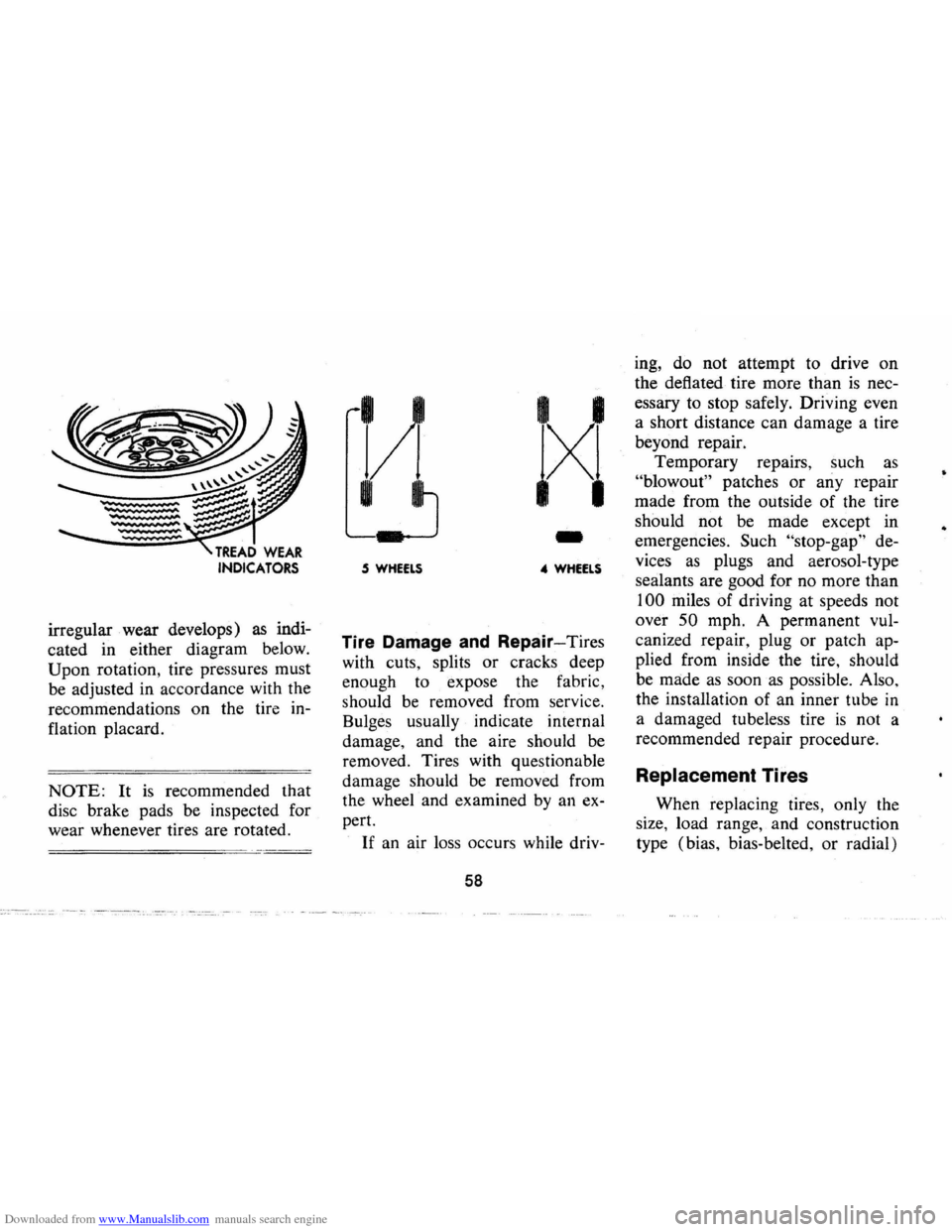
To equalize wear, it
is recom
mended that the tires be rotated
every
6,000 miles (or sooner if
Page 61 of 84
Downloaded from www.Manualslib.com manuals search engine ... ... ... ...
---",,"'"
-..... .
irregular . wear develops) as indi
cated in either diagram below.
Upon rotation, tire pressures must
be adjusted in accordance with the
recommendations on the tire in
flation placard.
NOTE: It is recommended that
disc brake pads be inspected for
wear whenever tires are rotated.
)11
I I
~Xl l.j
-.5 WHEELS 4 WHEELS
Tire Damage and Repair-Tires
with cuts, splits or cracks deep
enough to expose the fabric,
should be removed from service.
Bulges usually indicate internal
damage , and the aire should be
removed. Tires with questionable
damage should be removed from
the wheel and examined
by an ex
pert.
H an air loss occurs while driv-
58
ing, do not attempt to drive on
the deflated tire more than
is nec
essary to stop safely. Driving even
a short distance can damage a tire
beyond repair.
Temporary repairs, such as
"blowout" patches or any repair
made from the outside of the tire
should not be made except in
emergencies.
Such "stop-gap" de
vices
as plugs and aerosol-type
sealants are good for no more than
100 miles of driving at speeds not
over
50 mph. A permanent vul
canized repair, plug or patch ap
plied from inside the tire, should
be
made as soon as possible . Also,
the installation of an inner tube
in
a damaged tubeless tire is not a
recommended repair procedure.
Replacement Tires
When replacing tires, only the
size, load range , and construction
type (bias, bias-belted, or radial)
•
Page 62 of 84
Downloaded from www.Manualslib.com manuals search engine originally installed on your vehi
cle are recommended.
Use of any
other tire size or type tire may
seriously affect ride, handling ,
speedometer / odometer calibration
vehicle ground clearance and tire
clearance to the body and chassis.
The following also should be con
sidered when replacing tires:
• To achieve best all around ve
hicle performance, belted-bias
tires and bias tires should not
be mixed
on the same car.
• Because of possible adverse ef
fects on vehicle handling, do
not mix radial ply tires with
other type tires on the same
vehicle.
• It is recommended that new
tires be installed in pairs on the
same axle.
.. When replacing only one tire, it
should be paired with the tire having
the least wear, to equal
ize braking traction.
• When replacing original tires
with an optional recommended
size of different diameter, the
speedometer must be recali
brated by installing the correct
speedometer driven gear.
Snow Tires
If you equip your vehicle with
snow tires, they should be inflated
4 psi above the recommended
pressures shown on the tire pla
card up to a maximum of 32 psi
( cold) for load range B tires and
40 psi for load range D tires. It is
recommended that vehicle speeds
be limited to a maximum of 75
mph if snow tires are installed.
Replacement Wheels
When replacing wheels for any
reason, care should be taken to in-
59
sure that the wheels are equiva
lent to those removed in diameter,
rim width and off-set.
Warranty
Tires are warranted by the tire
manufacturers
as covered in the
New Vehicle Warranty and Policy
on Owner Service folder furnished
with your vehicle. However, for
the added convenience of owners,
many Chevrolet dealers are
equipped to handle tire warranty
adjustments
on certain makes of
tires provided
on 1973 Chevrolet
cars.
Tire Traction
A decrease in driving, corner
ing, and braking traction occurs
when water, snow, ice, gravel,
or
other material is on the road sur
face. Driving practices and car
speed should be adjusted to the
road conditions.
Page 63 of 84
Downloaded from www.Manualslib.com manuals search engine When driving on wet or slushy
roads, it
is possible for a wedge of
water to build up between the tire
and road surface. This phenom
enon, known
as hydroplaning.
may cause partial
or complete loss
of traction, which adversely affects
vehicle control and stopping abil
ity.
To reduce the possiblity of
traction loss, the following precau
tions should be observed:
1. Slow down during rainstorms or
when roads are slushy.
2. Slow down if road has standing
water
or puddles.
3. Replace tires when tread wear
indicators are visible .
4. Keep tires properly inflated.
For temporary assistance when
traction
is lost on ice or snow. the
use of AC Liquid Tire Chain is
recommended.
Inflation Instructions for
Space Saver Spare Tire
I. Install deflated space saver
spare
on car with valve stem at
the bottom and tighten all
five
lug nuts.
2. Remove valve qp and make
sure valve core is screwed tight
in valve stem.
3. Remove plastic cap from
in
flator.
4 . Place inflator over valve
stern
and push onto stem until sound
of gas entering tire can
be
heard .
5 . Keep pressure against valve and
hold can upright against wheel
to ensure complete draining of
fluid.
60
6 . Hold the inflator in position one
minute. After sound stops. then
remove inflator for disposal
in
proper receptacle.
7 . Replace valve cap.
NOTE: It is recommended that
the inflation pressure be checked
and adjusted to 28 psi
(Space
Saver Spare
only), as soon as pos
sible after installing tire on car.
To stow , deflate tire by remov
ing tire valve stem core with tool
on end of valve cap. Flatten tire
and replace core and cap. Do not
inhale gas.
Store tire in trunk com
partment. The
Space Saver Spare tire has
an approximate tread life of
2,000
miles; therefore, its continued use
other than for emergency purposes
is not recommended. The Space
Saver Spare
has the same warranty
as all original equipment tires.
Page 69 of 84
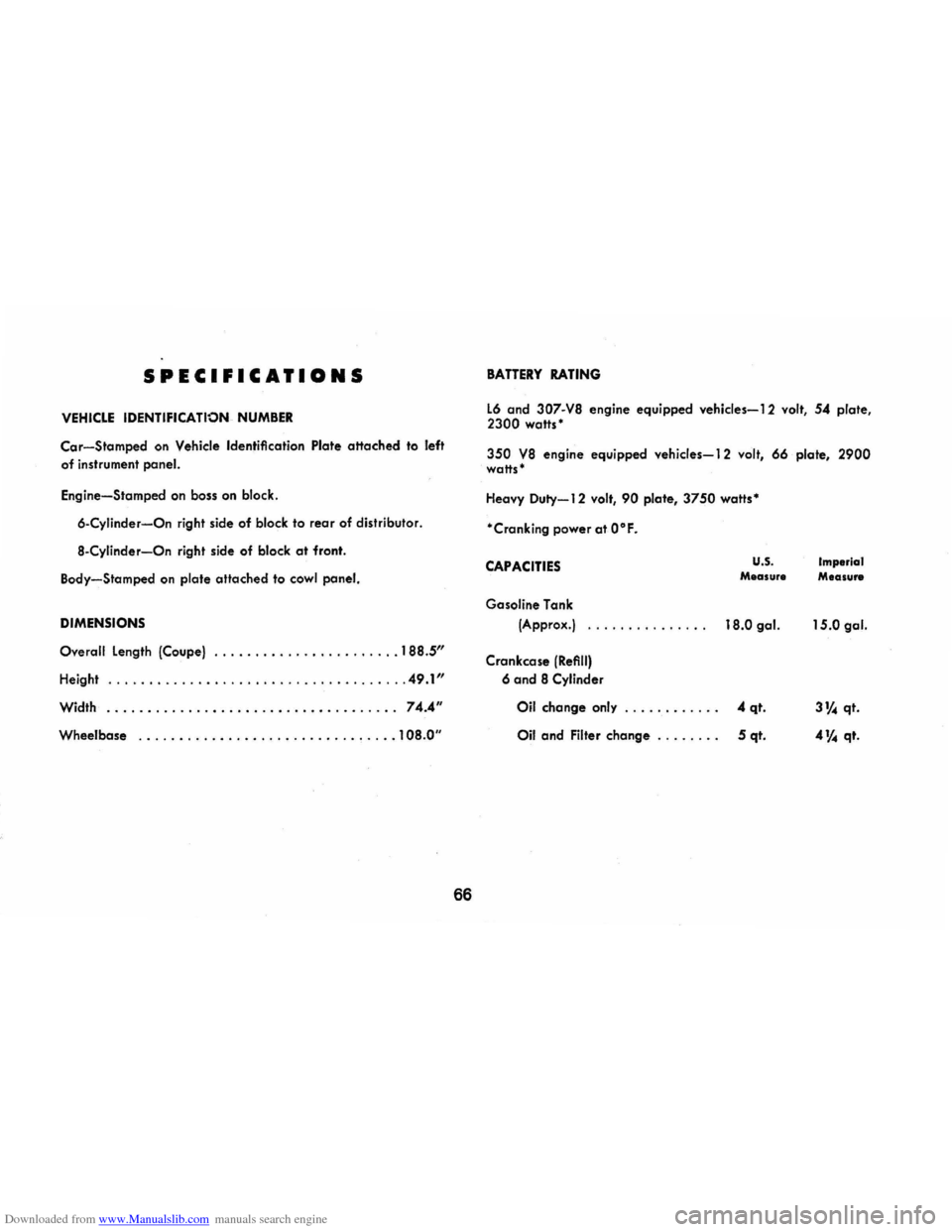
Downloaded from www.Manualslib.com manuals search engine SPECIFICATIONS
VEHICLE IDENTIFICATION NUMBER
Car-Stamped on Vehicle Identification Plate attached to left
of instrument panel.
Engine-Stamped on boss on block.
6-Cylinder-On right side of block to rear of distributor.
S-Cylinder-On right side of block at front.
Body-Stamped
on plate attached to cowl panel.
DIMENSIONS
Overall Length (Coupe) ....................... 1 SS.5"
Height ..................................... 49.1"
Width .............•............•......... 74.4"
Wheelbase ................................ 10S.0"
66
BATTERY RATING
L6 and 307-VS engine equipped vehicles-I 2 volt, 54 plate, 2300 watts'
350 VS engine equipped vehicles-12 volt, 66 plate, 2900 watts'
Heavy Duty-I 2 volt, 90 plate, 3750 watts'
'Cranking power at O°F.
CAPACITIES
Gasoline Tank
(Approx.)
Crankcase
(Refill)
6 and S Cylinder
U.S. Measure
IS.O gal.
Oil
change only . . . . . . . . . . .. 4 qt.
Oil and Filter change . . . . . . .. 5 qt.
Imperial Measure
15.0 gal.
3% qt.
4% qt.
Page 77 of 84
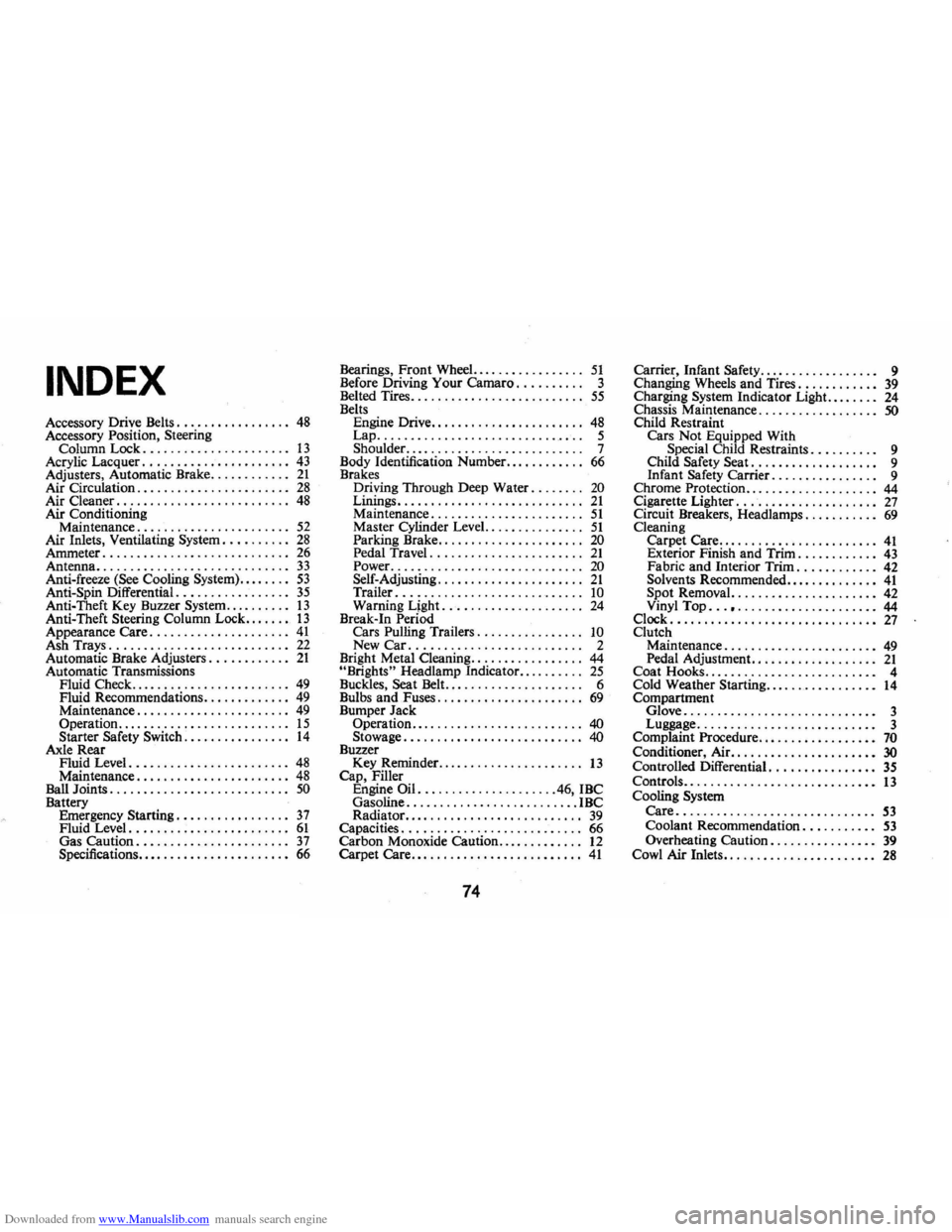
Downloaded from www.Manualslib.com manuals search engine INDEX
Accessory Drive Belts. . . . . . . . . . . . . . . .. 48 Accessory Position, Steering
Column Lock. .. . . . . .. . . .. . .. .. .... 13 Acrylic Lacquer. . . . . . . . . . . . . . . . . . . . .. 43 Adjusters, Automatic Brake ............ 21 Air Circulation . . . . . . . . . . . . . . . . . .. . ... 28 Air Cleaner. . . . . . . . . . . . . . . . . . . . . . . . .. 48 Air Conditioning
Maintenance. . . . . . . . . . . . . . . . . . . . . .. 52 Air Inlets, Ventilating System .......... 28 Ammeter ............................ 26 Antenna ................ ............. 33 Anti-freeze (See Cooling System). . . . . . .. 53 Anti-Spin Differential. . . . . . . . . . . . . . . .. 35 Anti-Theft Key Buzzer System .......... 13 Anti-Theft Steering Column Lock ....... 13 Appearance Care ..................... 41 Ash Trays. . . . . . . . . . . . . . . . . . . . . . . . . .. 22 Automatic Brake Adjusters. . . . . . . . . . .. 21 Automatic Transmissions
Fluid Check ........................ 49 Fluid Recommendations ............. 49 Maintenance. . . . . . . . . . . . . . . . . . . . . .. 49 Operation .......................... 15 Starter Safety Switch. . . . . . .. . . . . . ... 14 Axle Rear
Fluid Level. . . . . . . . . . . . . . . . . . . . . . .. 48 Maintenance. . . . . . . . . . . . . . . . . . . . . .. 48 Ball Joints ........................... 50 Battery
Emergency Starting. . . . . . . . . . . . . . . .. 37 Fluid Level. . . . . . . . . . . . . . . . . . . . . . .. 61 Gas Caution ....................... 37 Specifications. . . . . . . . . . . . . . . . . . . . . .. 66 Bearings,
Front Wheel.
................ 51 Before Driving Your Camaro . . . . . . . . . . 3
Belted Tires .......................... 55 Belts
Engine Drive. . . . . . . . . . . . . . . . . . . . . .. 48 Lap ................................ 5 Shoulder............ . .............. 7 Body Identification Number ............ 66 Brakes
D.riying Through Deep Water. . . . . . .. 20 Lmmgs ............................ 21 Maintenance ....................... 51 Master Cylinder Level. .............. 51 Parking Brake ...................... 20 Pedal Travel. . . . . . . . . . . . . . . . . . . . . .. 21 Power. .............. .............. 20 Self-Adjusting. . . . . . . . . . . . . . . . . . .. .. 21 Trailer ............................ 10 Warning Ljght. .. . . . . . . .. . . . . . . . . .. 24 Break-In Period Cars Pulling Trailers. . . . . . . . . . . . . . .. 10 New Car.......................... 2
Bright Metal Cleaning .......... '" .... 44 "Brights" Headlamp Indicator .......... 25 Buckles, Seat Belt.. . . . . . . . . . . . . . . . . . .. 6
Bulbs and Fuses . . . . . . . . . . . . . . . . . . . . .. 69 Bumper Jack
Operation ...... " .................. 40 Stowage ........................... 40 Buzzer Key Reminder.. .. .. .. .. .. . .. .. .. ... 13 Cap, Filler
Engine Oil. .................... 46, IBC
Gasoline .......................... IBC
Radiator. . . . . . . . . . . . . . . . . . . . . . . . . .. 39 Capacities. . . . . . . . . . . . . . . . . . . . . . . . . .. 66
Carbon Monoxide Caution ............. 12 Carpet Care .......................... 41
74
Carrier, Infant Safety.... . . . . . . .. .. . . .. 9
Changing Wheels and Tires. . . . . . . . . . .. 39 Charging System Indicator Light. . . . . . .. 24
Chassis Maintenance . . . . . . . . . . . . . . . . .. 50 Child Restraint
Cars Not Equipped With
Special Child Restraints. . . . . . . . . . 9
Child Safety Seat. . . . . . . . . . . . . . . . . . .
9 Infant Safety Carrier. . . . . . . . . . . . . . .. 9 Chrome Protection .................... 44
Cigarette Lighter. . . . . . . . . . . . . . . . . . . .. 27 Circuit Breakers, Headlamps. . . . . . . . . .. 69 Cleaning
Carpet Care. . . . . . . . . . . . . . . . . . . . . . .. 41 Exterior Finish and Trim. . . . . . . . . . .. 43 Fabric and Interior Trim ............ 42
Solvents Recommended .............. 41 Spot Removal. . . . . . . . . . . . . . . . . . . . .. 42 Vinyl Top ... , . . . . . . . . . . . . . . . . . . . .. 44
Clock ............................... 27 Clutch Maintenance. . . . . . . . . . . . . . . . . . . . . .. 49 Pedal Adjustment ................... 21 Coat Hooks........ ...... ........ .... 4
Cold Weather Starting ................. 14 Compartment
Glove ............................. 3
Luggage. .......... ................ 3
Complaint Procedure .................. 70 Conditioner, Air ...................... 30 Controlled Differential. . . . . . . . . . . . . . .. 35 Controls ............................. 13 Cooling System
Care ........... ................... 53 Coolant Recommendation. . . . . . . . . .. 53 Overheating Caution. . . . . . . . . . . . . . .. 39 Cowl Air Inlets ....................... 28