1969 FORD MUSTANG lock
[x] Cancel search: lockPage 275 of 413

06-02-06
Ford Design Three Speed Transmission
06-02-06
SPEEDOMETER DRIVE
GEAR
SPRING CLIP
FRONT
C2052-A
FIG. 10—Speedometer Drive Gear Installation—New Design
TOOL-T52T
6500-DJD
C1564-A
FIG. 11—Rotating Second and Third-Speed Shift Rail
PARTS REPAIR
OR
REPLACEMENT
SHIFT LEVERS
AND
SEALS
1.
Remove
the nut,
lock washer,
and flat washer that secure each shift
lever (Fig.
14) to the
lever
and
shaft
in
the transmission case. Lift
the
levers
off
the
shaft. Slide each lever
and
shaft
out of the
case. Discard
the CD-
ring from each shaft.
2.
Lubricate
the new
seals with
transmission lubricant
and
install
them
on the
shafts.
3.
Install
the
lever
and
shafts
in the
case.
4.
Position
a
shift lever
on
each
shaft
and
secure them with
a
flat
washer, lock washer,
and nut.
INPUT SHAFT BEARING
1.
Remove
the
snap ring securing
the input shaft bearing
(Fig. 15), and
press
the
input shaft
out of the
bear-
ing.
2.
Press
the
input shaft bearing
onto
the
input shaft with
the
tool
shown
in Fig. 16, and
install
the
snap
ring
on the
shaft.
SYNCHRONIZERS
1.
Push
the
sychronizer
hub
from
each synchronizer sleeve.
2.
Separate
the
inserts
and
insert
springs from
the
hubs.
Do not mix the
parts from
the
second
and
third-speed
synchronizer with
the
first
and
reverse
synchronizer (Figs.
17 and 18).
3.
Install
the
rear insert spring
in
the groove
of the
first
and
reverse
syn-
SHAFT AND LEVER
0-RING
SHIFT
LEVER
C 1845-A
FIG. 74—Shift Lever and Shafi
Disassembled
REVERSE
IDLER GEAR THRUST
WASHER ROLL
PIN
REVERSE IDLER
GEAR SHAFT
C1799-A
FIG. 72—Reverse Idter Shaft
Disassembled
BLOCKING RING SPEEDOMETER DRIVE GEAR
OUTPUT SHAFT
BLOCKING RINGS
SNAP RING
REAR BEARING
SYNCHRONIZER
THRUST WASHER
REVERSE GEAR
AND SLEEVE
C2072-A
FIG. 13—Output Shaft Disassembledprocarmanuals.com
Page 276 of 413

06-02-07
Ford Design Three Speed Transmission
06-02-07
SNAP RINGS
FIG. 15—Input Shaft Gear Disassembled
C1802-
A
REMOVAL
INSTALLATION
C1O25-B
FIG. 76—Replacing Input Shaft
Bearing
chronizer
hub.
Make sure that
the
spring covers
all
insert grooves. Start
the
hub in the
sleeve making sure that
the alignment marks
are
properly
in-
dexed. Position
the
three inserts
in the
hub making sure that
the
small
end is
over
the
spring
and
that
the
shoulder
is
on the
inside
of the hub.
Slide
the
sleeve
and
reverse gear onto
the hub
until
the
detent
is
engaged. Install
the
front insert spring
in the hub to
hold
the inserts against
the hub. Be
sure
the spring humps
of the
rear spring
cover different inserts than
the
front
spring humps (Fig.
20).
BLOCKING RING
SLEEVE
AND
REVERSE GEAR
C1803-
A
FIG. 17—First
and
Reverse Synchronizer Disassembled
INSERT
HUB AND
SLEEVE ALIGNMENT MARKS
SPRING
BLOCKING m$ERTS
RING
INSERT SPRING
C1804-
A
FIG. 18—Second
and
Third Synchronizer Disassembled
4.
Install
one
insert spring (Fig.
18)
into
a
groove
of the
second
and
third
speed synchronizer
hub,
making sure
that
all
three insert slots
are
fully cov-
ered. With
the
alignment marks
on
the
hub and
sleeve aligned, start
the
hub into
the
sleeve. Place
the
three
in-
serts
on top of the
retaining spring
and push
the
assembly together.
In-
stall
the
remaining insert spring
so
that
the
spring ends cover
the
same
slots
as
does
the
other spring.
Do not
stagger
the
springs. Place
a
synchro-
nizer blocking ring
on
each
end of the
synchronizer sleeve.
COUNTERSHAFT GEAR
BEARINGS
1.
Remove
the
dummy shaft, fifty
roller bearings,
and the two
bearing
retainer washers from
the
countershaft
gear (Fig.
21).
2.
Coat
the
bore
in
each
end of the
countershaft gear with grease.
3.
Hold
the
dummy shaft
in the
gear
and
install
the
twenty-live roller
bearings
and a
retainer washer
in
each
end
of the
gear.
4.
Position
the
countershaft gear,
dummy shaft,
and
roller bearings
in
the case.
5.
Place
the
case
in a
vertical posi-
tion. Align
the
gear bore
and the
thrust washers with
the
bores
in the
case
and
install
the
countershaft.
6. Place
the
case
in a
horizontal
position
and
check
the
countershaft
gear
end
play with
a
feeler gauge.
The
end play should
be
within specifica-
tion.
If not
within specification,
re-
place
the
thrust washers.
7.
After establishing
the
correct end
play, install
the
dummy shaft
in the
countershaft gear
and
allow
the
gear
to remain
at the
bottom
of the
case
until
the
output
and
input shafts have
been installed.
GEAR SHIFT LEVER
AND
CONTROL ASSEMBLY
REMOVAL
AND
INSTALLATION—
FLOOR-MOUNTED
1.
Remove
the
four screws attach-
ing
the
lower boot
to the
floor
pan.
2.
Remove
the two
bolts attaching
the gear shift lever
to the
control
as-
sembly.
3.
Remove
the two
piece lock nuts
that connect
the
shift rods
to the con-
trol assembly.
4.
Remove
the
three bolts retaining
the shift control assembly
to the ex-
tension housing. Allow
the
back-up
light switch
to
hang free.procarmanuals.com
Page 277 of 413
06-02-08
Ford Design Three Speed Transmission
06-02-08
FIRST-REVERSE
SELECTOR LEVER
SELECTOR LEVER
SHAFT
SUPPORT BRACKET
SECOND-THIRD
SELECTOR LEVER
C
2053-A
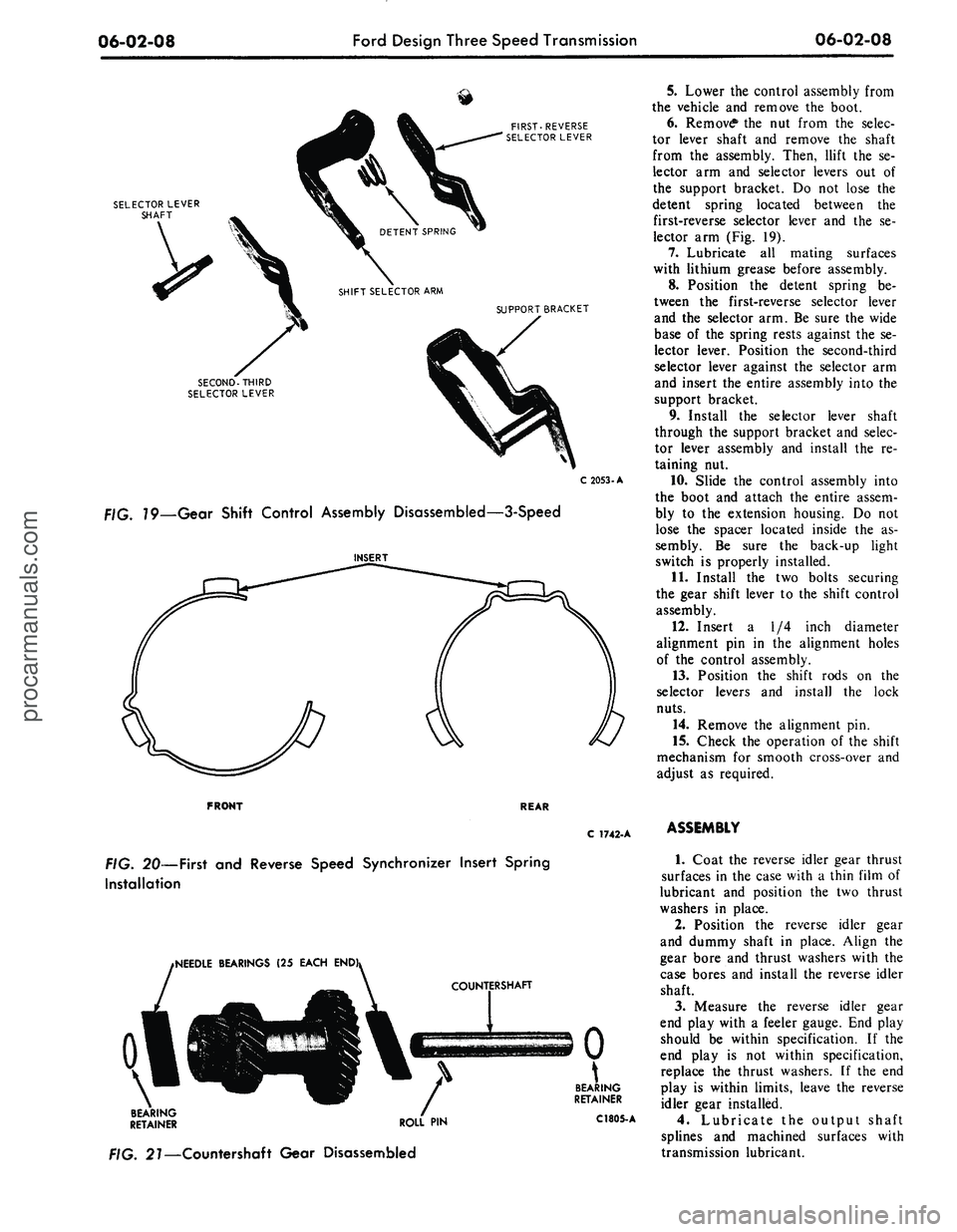
79—Gear Shift Control Assembly Disassembled—3-Speed
5.
Lower the control assembly from
the vehicle and remove the boot.
6. Remove* the nut from the selec-
tor lever shaft and remove the shaft
from the assembly. Then, llift the se-
lector arm and selector levers out of
the support bracket. Do not lose the
detent spring located between the
first-reverse selector lever and the se-
lector arm (Fig. 19).
7.
Lubricate all mating surfaces
with lithium grease before assembly.
8. Position the detent spring be-
tween the first-reverse selector lever
and the selector arm. Be sure the wide
base of the spring rests against the se-
lector lever. Position the second-third
selector lever against the selector arm
and insert the entire assembly into the
support bracket.
9. Install the selector lever shaft
through the support bracket and selec-
tor lever assembly and install the re-
taining nut.
10.
Slide the control assembly into
the boot and attach the entire assem-
bly to the extension housing. Do not
lose the spacer located inside the as-
sembly. Be sure the back-up light
switch is properly installed.
11.
Install the two bolts securing
the gear shift lever to the shift control
assembly.
12.
Insert a 1/4 inch diameter
alignment pin in the alignment holes
of the control assembly.
13.
Position the shift rods on the
selector levers and install the lock
nuts.
14.
Remove the alignment pin.
15.
Check the operation of the shift
mechanism for smooth cross-over and
adjust as required.
FRONT
REAR
C 1742-A
FIG.
20—First
and
Reverse Speed Synchronizer Insert Spring
Installation
iNEEDLE BEARINGS
(25
EACH
END
\
BEARING
RETAINER ROLL
PIN
. 27—Countershaft Gear Disassembled
BEARING
RETAINER
C1805-
A
ASSEMBLY
1.
Coat the reverse idler gear thrust
surfaces in the case with a thin film of
lubricant and position the two thrust
washers in place.
2.
Position the reverse idler gear
and dummy shaft in place. Align the
gear bore and thrust washers with the
case bores and install the reverse idler
shaft.
3.
Measure the reverse idler gear
end play with a feeler gauge. End play
should be within specification. If the
end play is not within specification,
replace the thrust washers. If the end
play is within limits, leave the reverse
idler gear installed.
4.
Lubricate the output shaft
splines and machined surfaces with
transmission lubricant.procarmanuals.com
Page 278 of 413
06-02-09
Ford Design Three Speed Transmission
06-02-09
PRESS
RAM
OUTPUT SHAFT
SYNCHRONIZER
PRESS
RAM
OUTPUT SHAFT
Tool-T63P7025-A
SYNCHRONIZER
HUB
REMOVAL INSTALLATION c 1718-A
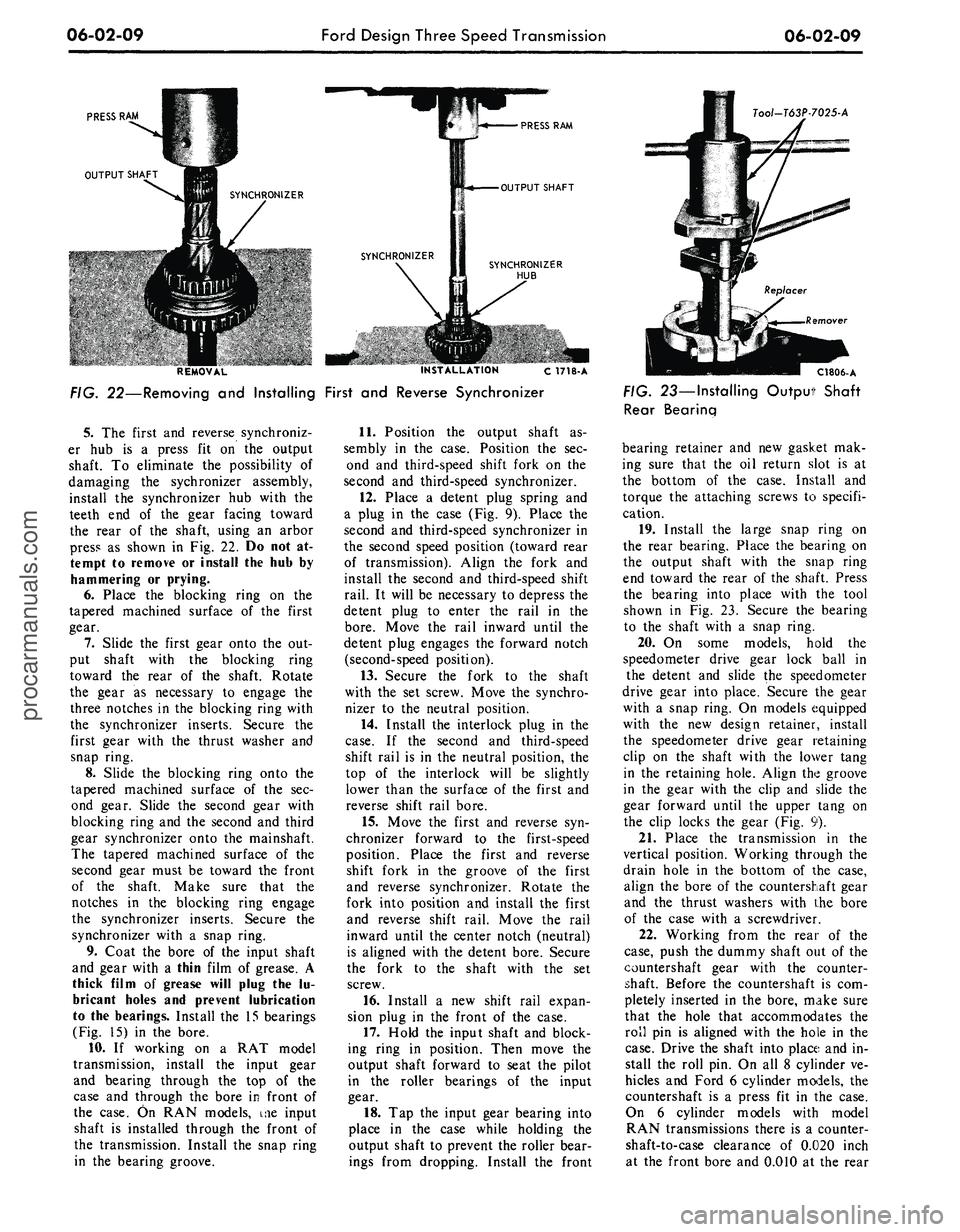
FIG. 22—Removing
and
Installing First
and
Reverse Synchronizer
5.
The
first
and
reverse synchroniz-
er
hub is a
press
fit on the
output
shaft.
To
eliminate
the
possibility
of
damaging
the
sychronizer assembly,
install
the
synchronizer
hub
with
the
teeth
end of the
gear facing toward
the rear
of the
shaft, using
an
arbor
press
as
shown
in Fig. 22. Do not at-
tempt
to
remove
or
install
the hub by
hammering
or
prying.
6. Place
the
blocking ring
on the
tapered machined surface
of the
first
gear.
7.
Slide
the
first gear onto
the out-
put shaft with
the
blocking ring
toward
the
rear
of the
shaft. Rotate
the gear
as
necessary
to
engage
the
three notches
in the
blocking ring with
the synchronizer inserts. Secure
the
first gear with
the
thrust washer
and
snap ring.
8. Slide
the
blocking ring onto
the
tapered machined surface
of the sec-
ond gear. Slide
the
second gear with
blocking ring
and the
second
and
third
gear synchronizer onto
the
mainshaft.
The tapered machined surface
of the
second gear must
be
toward
the
front
of
the
shaft. Make sure that
the
notches
in the
blocking ring engage
the synchronizer inserts. Secure
the
synchronizer with
a
snap ring.
9. Coat
the
bore
of the
input shaft
and gear with
a
thin film
of
grease.
A
thick film
of
grease will plug
the lu-
bricant holes
and
prevent lubrication
to
the
bearings. Install
the 15
bearings
(Fig.
15) in the
bore.
10.
If
working
on a RAT
model
transmission, install
the
input gear
and bearing through
the top of the
case
and
through
the
bore
in
front
of
the case.
On RAN
models,
me
input
shaft
is
installed through
the
front
of
the transmission. Install
the
snap ring
in
the
bearing groove.
11.
Position
the
output shaft
as-
sembly
in the
case. Position
the sec-
ond
and
third-speed shift fork
on the
second
and
third-speed synchronizer.
12.
Place
a
detent plug spring
and
a plug
in the
case
(Fig. 9).
Place
the
second
and
third-speed synchronizer
in
the second speed position (toward rear
of transmission). Align
the
fork
and
install
the
second
and
third-speed shift
rail.
It
will
be
necessary
to
depress
the
detent plug
to
enter
the
rail
in the
bore.
Move
the
rail inward until
the
detent plug engages
the
forward notch
(second-speed position).
13.
Secure
the
fork
to the
shaft
with
the set
screw. Move
the
synchro-
nizer
to the
neutral position.
14.
Install
the
interlock plug
in the
case.
If the
second
and
third-speed
shift rail
is in the
neutral position,
the
top
of the
interlock will
be
slightly
lower than
the
surface
of the
first
and
reverse shift rail bore.
15.
Move
the
first
and
reverse
syn-
chronizer forward
to the
first-speed
position. Place
the
first
and
reverse
shift fork
in the
groove
of the
first
and reverse synchronizer. Rotate
the
fork into position
and
install
the
first
and reverse shift rail. Move
the
rail
inward until
the
center notch (neutral)
is aligned with
the
detent bore. Secure
the fork
to the
shaft with
the set
screw.
16.
Install
a new
shift rail expan-
sion plug
in the
front
of the
case.
17.
Hold
the
input shaft
and
block-
ing ring
in
position. Then move
the
output shaft forward
to
seat
the
pilot
in
the
roller bearings
of the
input
gear.
18.
Tap the
input gear bearing into
place
in the
case while holding
the
output shaft
to
prevent
the
roller bear-
ings from dropping. Install
the
front
C1806-A
FIG. 23—Installing Output Shaft
Rear Bearing
bearing retainer
and new
gasket
mak-
ing sure that
the oil
return slot
is at
the bottom
of the
case. Install
and
torque
the
attaching screws
to
specifi-
cation.
19.
Install
the
large snap ring
on
the rear bearing. Place
the
bearing
on
the output shaft with
the
snap ring
end toward
the
rear
of the
shaft. Press
the bearing into place with
the
tool
shown
in Fig. 23.
Secure
the
bearing
to
the
shaft with
a
snap ring.
20.
On
some models, hold
the
speedometer drive gear lock ball
in
the detent
and
slide
the
speedometer
drive gear into place. Secure
the
gear
with
a
snap ring.
On
models equipped
with
the new
design retainer, install
the speedometer drive gear retaining
clip
on the
shaft with
the
lower tang
in
the
retaining hole. Align
the
groove
in
the
gear with
the
clip
and
slide
the
gear forward until
the
upper tang
on
the clip locks
the
gear
(Fig. 9).
21.
Place
the
transmission
in the
vertical position. Working through
the
drain hole
in the
bottom
of the
case,
align
the
bore
of the
countershaft gear
and
the
thrust washers with
the
bore
of
the
case with
a
screwdriver.
22.
Working from
the
rear
of the
case,
push
the
dummy shaft
out of the
countershaft gear with
the
counter-
shaft. Before
the
countershaft
is com-
pletely inserted
in the
bore, make sure
that
the
hole that accommodates
the
roll
pin is
aligned with
the
hole
in the
case.
Drive
the
shaft into place
and in-
stall
the
roll
pin. On all 8
cylinder
ve-
hicles
and
Ford
6
cylinder models,
the
countershaft
is a
press
fit in the
case.
On
6
cylinder models with model
RAN transmissions there
is a
counter-
shaft-to-case clearance
of
0.020 inch
at
the
front bore
and 0.010 at the
rearprocarmanuals.com
Page 279 of 413
06-02-10
Ford Design Three Speed Transmission
06-02-10
bore.
On these 6 cylinder models, in-
stall a new expansion plug in the
countershaft bore at the front of the
case.
23.
Coat a new extension housing
gasket with sealer and position it on
the case.
24.
Install lock washers on the five
attaching screws. Dip the threads of
the cap screws in sealer. Secure the
housing to the case and torque the
cap screws to specification.
25.
Install the filler and drain plugs
(if equipped) in the case. Make sure
that the magnetic plug is installed in
the bottom of the case.
7.6. Place the transmission in gear.
Pour lubricant over the entire gear
train while rotating the input or out-
put shaft.
27.
Install the remaining detent
plug in the case. Install the long
spring (which is retained by the case)
to secure the detent plug.
28.
Coat a new cover gasket (Fig.
5) with sealer. Secure the cover with
cap screws. Torque the screws to spec-
ification.
29.
Check the operation of the
transmission in all of the gear posi-
tions.procarmanuals.com
Page 282 of 413
06-03-03
Ford Design Four-Speed Transmission
06-03-03
cable from the equalizer lever and sep-
arate the lever from the crossmember.
5.
Remove the hairpin retainer se-
curing the cable to the transmission
rear support crossmember, and then
pull the cable assembly forward and
out of the crossmember.
6. Remove the retaining clip, flat
washer, and spring washer that se-
cures the shift rods to the shift levers.
7.
Remove the bolts that attach the
shift linkage control bracket to the ex-
tension housing and position the as-
sembly out of the way.
8. Support the engine with a trans-
mission jack and remove the extension
housing-to-engine rear support attach-
ing bolts.
9. Raise the rear of the engine high
enough to remove the weight from the
crossmember. Remove the bolts re-
taining the crossmember to the frame
side supports and remove the
crossmember.
10.
Support the transmission on a
jack and remove the bolts that attach
the transmission to the flywheel hous-
ing.
11.
Move the transmission and jack
rearward until the transmission input
shaft clears the flywheel housing. If
necessary, lower the engine enough to
obtain clearance for transmission re-
moval.
Do not depress the clutch pedal
while the transmission is removed.
INSTALLATION
1.
Make sure that the mounting
surface of the transmission and the
flywheel housing are free of dirt,
paint, and burrs. Install two guide
pins in the flywheel housing lower
mounting bolt holes. Move the trans-
mission forward on the guide pins
until the input shaft splines enter the
clutch hub splines and the case is posi-
tioned against the flywheel housing.
2.
Install the two upper transmis-
sion to flywheel housing, mounting
bolts snug, and then remove the two
guide pins. Install the two lower
mounting bolts. Torque all mounting
bolts to specifications.
3.
Raise the rear of the engine and
install the crossmember. Install and
torque the crossmember attaching
bolts to specifications, then lower the
engine.
4.
With the transmission extension
housing resting on the engine rear
support, install the transmission ex-
tension housing attaching bolts. Tor-
que the bolts to specifications.
5.
Position the shift linkage control
bracket to the extension housing and
install the attaching bolts.
6. Secure each shift rod to its re-
spective lever with the spring washer,
flat washer, and retaining pin.
7.
Guide the parking brake cable
assembly through the hole in the
transmission rear support crossmemb-
er. Secure the cable assembly to the
crossmember with the hair pin retain-
er.
8. Insert the parking brake front
cable in the equalizer and install the
equalizer in the bracket on the
crossmember. Secure the parking
brake rear cable to the equalizer.
9. Connect the speedometer cable
to the extension housing.
10.
Remove the extension housing
installation tool and slide the forward
end of the drive shaft over the trans-
mission output shaft. Connect the
drive shaft to the rear U-joint flange.
11.
Place both forward gear shift
levers and the reverse shift lever in the
neutral position and insert a 1/4 inch
diameter alignment tool in the shift
linkage alignment hole (Fig. 17). It
may be necessary to loosen the adjust-
ment nuts to install the alignment
tool. Adjust the linkage as necessary
and tighten the adjustment nuts to
specifications. Remove the alignment
tool.
12.
Fill the transmission to the
proper level with the specified lubri-
cant.
13.
Lower the car. Check tne shift
and crossover motion for full shift en-
gagement and smooth crossover oper-
ation.
MAJOR REPAIR OPERATIONS
DISASSEMBLY
1.
Mount the transmission in a
holding fixture and drain the lubri-
cant.
2.
Remove the cover attaching
screws from the case. Lift the cover
and gasket from the case.
3.
Remove the long spring that re-
tains the detent plug in the case (Fig.
4).
Remove the detent plug with a
small magnet.
4.
Remove the extension housing
attaching screws and lock washers.
Remove the housing and the gasket.
5.
Remove the input shaft bearing
retainer attaching screws. Slide the re-
tainer off the input shaft.
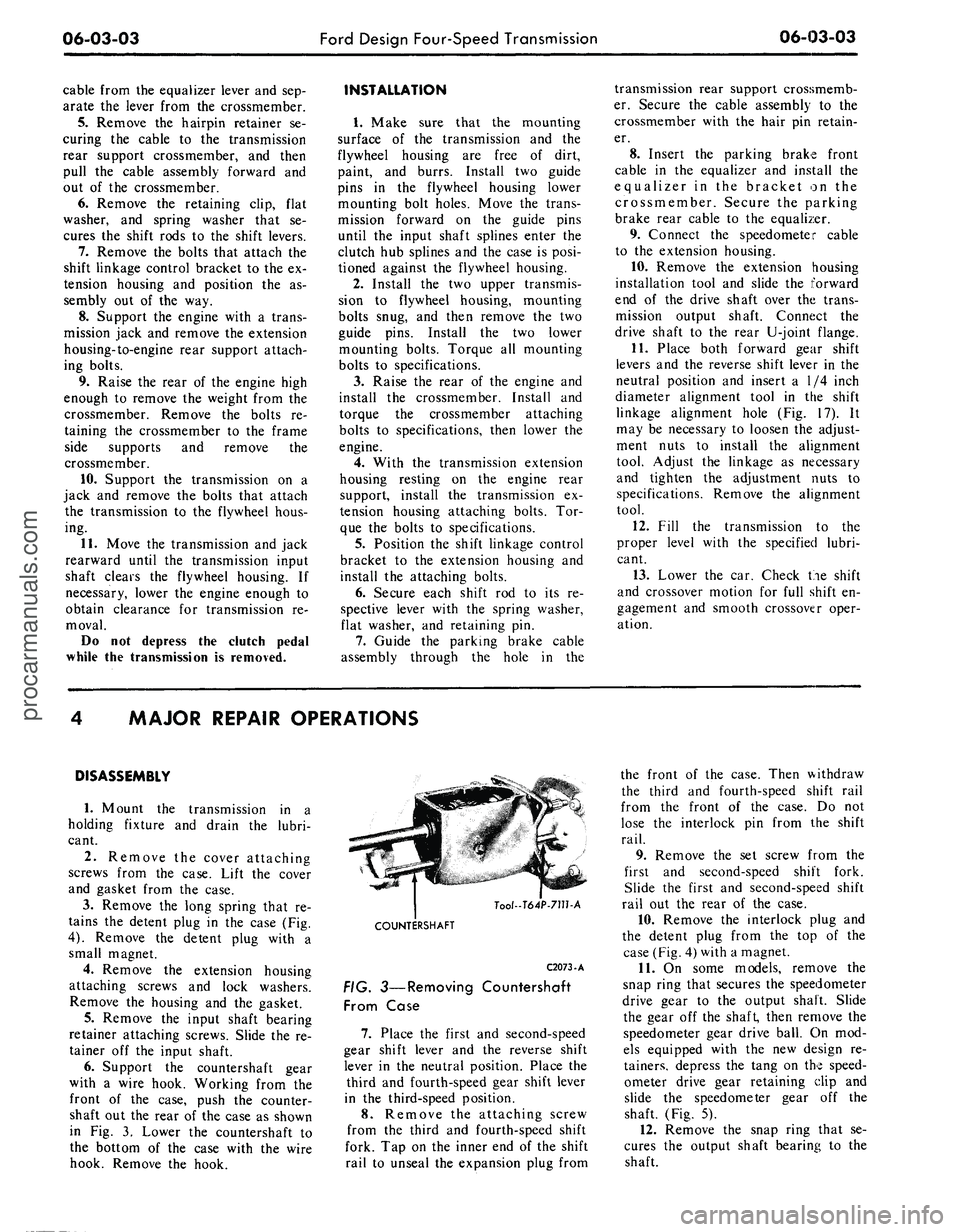
6. Support the countershaft gear
with a wire hook. Working from the
front of the case, push the counter-
shaft out the rear of the case as shown
in Fig. 3. Lower the countershaft to
the bottom of the case with the wire
hook. Remove the hook.
Tool-T64P-711hA
COUNTERSHAFT
C2073-A
FIG. 3—Removing Countershaft
From Case
7.
Place the first and second-speed
gear shift lever and the reverse shift
lever in the neutral position. Place the
third and fourth-speed gear shift lever
in the third-speed position.
8. Remove the attaching screw
from the third and fourth-speed shift
fork. Tap on the inner end of the shift
rail to unseal the expansion plug from
the front of the case. Then withdraw
the third and fourth-speed shift rail
from the front of the case. Do not
lose the interlock pin from the shift
rail.
9. Remove the set screw from the
first and second-speed shift fork.
Slide the first and second-speed shift
rail out the rear of the case.
10.
Remove the interlock plug and
the detent plug from the top of the
case (Fig. 4) with a magnet.
11.
On some models, remove the
snap ring that secures the speedometer
drive gear to the output shaft. Slide
the gear off the shaft, then remove the
speedometer gear drive ball. On mod-
els equipped with the new design re-
tainers, depress the tang on the speed-
ometer drive gear retaining clip and
slide the speedometer gear off the
shaft. (Fig. 5).
12.
Remove the snap ring that se-
cures the output shaft bearing to the
shaft.procarmanuals.com
Page 283 of 413

06-03-04
Ford Design Four-Speed Transmission
06-03-04
13.
Remove the output shaft bear-
ing as shown in Fig. 6.
14.
Remove the input shaft and
bearing and the blocking ring from
the front of the case.
15.
Move the output shaft to the
right side of the case to provide clear-
ance for the shift forks. Rotate the
forks as shown in Fig. 7, then lift
them from the case.
16.
Support the thrust washer and
first-speed gear to prevent them from
sliding off the shaft, then lift the out-
put shaft assembly from the case as
shown in Fig. 8.
17.
Remove the reverse gear shift
fork set screw. Rotate the reverse shift
rail 90 degrees as shown in Fig. 9.
Slide the shift rail out of the rear of
the case. Lift the reverse shift fork
from the case.
18.
Remove the reverse detent plug
and spring from the case with a mag-
net.
19.
Remove the reverse idler gear
shaft from the case as shown in Fig.
10.
20.
Lift the reverse idler gear and
the thrust washers from the case. Be
careful not to drop the bearings and
the dummy shaft from the gear.
21.
Lift the countershaft gear and
the thrust washers from the case. Be
careful not to drop the bearings or the
dummy shaft from the counter-shaft
gear.
22.
Remove the snap ring from the
front of the output shaft. Slide the
third and fourth-speed synchronizer
(Fig. 11) blocking ring and the third-
speed gear off the shaft.
23.
Remove the next snap ring and
the second-speed gear thrust washer
from the shaft. Slide the second-speed
gear and the blocking ring off the
shaft.
24.
Remove the next snap ring.
25.
Remove the thrust washer, first
speed gear and blocking ring from the
rear of the shaft. The first and second
synchronizer hub is a press fit on the
output shaft. To eliminate the possi-
bility of damaging the synchronizer
assembly, remove the synchronizer
hub using an arbor press as shown in
Part 6-2, Fig. 20. Do not attempt to
remove or install the hub by hammer-
ing or prying.
PARTS REPAIR OR
REPLACEMENT
CAM AND
SHAFT SEALS
1.
Remove the attaching nut, lock
washer and the flat washer from each
shift lever and remove the three levers.
2.
Remove the three cam and shafts
from inside the case.
jjL
-SPRING
•
7234
if
Q-* 'DETENT PtUG 7C316
THIRD AND FOURTH
SPEED SHIFT FORK- 7230
SCREW. 377886 - S
DETENT PLUG-fr-fl
7C316 **
INTERLOCK PIN
7235
FIRST AND SECOND SPEED SHIFT RAIL
7240
fl-«-—
SCREW - 377386 • S
FIRST AND SECOND
SPEED SHIFT FORK • 7230
THIRD AND FOU
SPEED SHIFT RAIL
7241
EXPANSION
PLUG-74112-S
MAGNETIC DRAIN PLUG -373719-S
FIG. 4—Shift Rails and Forks Disassembled
C2074-A
SPEEDOMETER DRIVE
GEAR
SPRING CLIP
FRONT
C2052-A
# 5—Speedometer Drive Gear Installationprocarmanuals.com
Page 284 of 413

06-03-05
Ford Design Four-Speed Transmission
06-03-05
DETAIL
4
FORD
AND
MERCURY
DETAIL
5
COUGAR. FAIRLANE,
FALCON,
MONTEGO,
AND MUSTANG
REVERSE SHIFT
RAIL
C1533-B
FIG. 6—Removing Output Shaft Bearing
3.
Remove
and
discard
the
O-ring
from each
cam and
shaft (Fig.
12).
4.
Dip the new
Orings
in
gear
lu-
bricant
and
install them
on the cam
and shafts.
5.
Slide each cam
and
shaft into
its
respective bore
in the
transmission
case.
6. Secure each shaft lever with
a
flat washer, lock washer
and nut.
GEAR SHIFT CONTROL
ASSEMBLY
1.
Remove
the
four screws attach-
ing
the
lower boot
to the
floor
pan.
2.
Remove the two bolts that secure
the gear shift lever
to
the shift control
assembly.
THIRD AND,
FOURTH
SPEED
SHIFT
FORK
FIRST
AND
REVERSE
SPEED
SHIFT
FORK
3.
Remove
the two
piece lock nuts
that secure
the
shift rods
to the
shift
levers.
4.
Remove
the
three bolts attaching
the control assembly
to the
extension
housing. Lower
the
control assembly
and boot
and
remove
the
control
as-
sembly from
the
boot.
5.
Remove the back-up light switch.
6. Remove
the
outer
nut
from
the
selector lever shaft
and
slide
the
shaft
from
the
control assembly.
7.
Lift
the
outer support bracket,
rubber washer, first-second,
and
third-fourth selector levers
off the as-
sembly (Fig.
13).
8. Remove
the two
bolts retaining
the inner support bracket
to the
back
THIRD
AND
FOURTH
SPEED SYNCHRONIZER
OUTPUT SHAFT MOVED
TO RIGHT SIDE
OF
CASE
C2075-A
C2077-A
Tool-T52T-
C2076-A
FIG. 9—Rotating Reverse
Shift Rail
plate. Lift
the
inner support bracket,
selector arm, and reverse selector lever
from
the
back plate.
9. Lubricate
all
mating surfaces
with lithium grease before assembly.
10.
Position
the
reverse gear selec-
tor lever, selector
arm and the
inner
support bracket
on the
back plate.
The reverse gear selector lever will
have
a
flat spot
on the
top
of
the lever
to distinguish
it
from
the
third-fourth
selector lever. Install the two retaining
bolts finger tight.
11.
Insert
a 1/4
inch gauge
pin
through
the
alignment holes
of the se-
lector levers
and
support brackets.
Line
up the
gauge
pin
perpendicular
to the back plate. Torque the two sup-
port bracket-to-back plate retaining
nuts
to
specification
and
remove
the
gauge
pin.
12.
Position
the
rubber washer,
first-second
and
third-fourth selector
levers
in the
outer support bracket.
Position this assembly against
the
inner support
so
that the selector lever
shaft holes
in the
selector levers
and
support brackets
are
aligned.
13.
Install
the
selector lever shaft
"~ REVERSE IDLER
GEAR SHAFT
Tool-T64P-7140
C2078-A
FIG. 7—Removing Shift Fork
From Case
FIG. 8—Removing Output
Shaft Assembly
FIG. TO—Removing Reverse Idler
Gear Shaftprocarmanuals.com