1967 CHEVROLET CAMARO coil
[x] Cancel search: coilPage 568 of 659

ELECTRICAL-BODY
AND
CHASSIS
12-56
DEPRESSED PARK 2-SPEED WIPER
AND
WASHER
CORVETTE
GENERAL DESCRIPTION
The 2-speed windshield wiper
(fig. 91)
consists
of a
compound wound
12
volt dc motor and
a
gear box section
containing
the
gear mechanism
and
relay control.
The
motor armature
is
fitted with
a
worm gear which drives
the main gear assembly and crank arm.
The relay control, consisting
of a
relay coil, relay
armature
and
switch assembly,
is
located in the gear
box"
section and controls the starting and stopping of the wiper
through
a
latching mechanism (fig. 92).
An electric .washer pump
is
mounted
on the
gear box
section
of the
wiper
and is
driven by the wiper unit gear
assembly (fig. 93).
SERVICE OPERATIONS
WIPER MOTOR
AND
WASHER
PUMP ASSEMBLY
REMOVAL AND INSTALLATION
1.
Raise vehicle hood
and
disconnect, ground lead
at
battery.
2.
Remove engine distributor shielding
and
left bank
spark plug wire vertical shield.
3.
Disconnect left bank spark plug wire bracket-to-
manifold and position assembly to one side.
4.
Disconnect ignition resistor at firewall, then remove
washer pump inlet
and
outlet hose
at
pump valve
assembly.
5.
Remove engine distributor
cap
and position
to one
side;
then disconnect washer pump
and
motor
as-
sembly lead wires.
6. Remove glove
box
door
and
compartment. Refer
to
Section
1
for
removal procedure.
7.
Make sure wiper arms
and
wiper motor are both
in
the parked position; then remove
the
wiper trans-
mission retaining clip and disconnect both transmis-
sion and spacer from crank arm (fig. 93).
8. Remove four wiper motor-to-dash wall mounting
bolts and remove wiper motor from vehicle.
9. With
the aid of
an assistant position the wiper motor
to
the
dash wall
and
install the four motor mounting
bolts,
making sure motor assembly
is in
parked
position.
GEAR
BOX
SECTION
—<
MOUNTING
^*^
GROMMET
MOTOR
_/
SECTION
MOUNTING
/"""GROMMET
ARMATURE
END
PLAY
ADJUSTING SCREW
AND LOCK
NUT
P
^
CRANK
^_ /GROMMETS
RELAY
Fig.
92 -
Relay Control
10.
Position left transmission assembly, spacer
and
right transmission assembly
on
crank arm, then in-
stall
the
retaining clip
in the
groove
in
the crank
arm.
11.
Install glove compartment and door assembly. Refer
to Section
1
for
installation procedure.
12.
Install washer pump and motor assembly lead wires;
then install engine-distributor cap.
13.
Install washer pump inlet
and
outlet hose
to
pump
valve assembly, then install ignition resistor
to
firewall.
14.
Connect left bank spark plug wire bracket-to-mani-
fold, vertical shield and engine distributor shielding.
ROTOR
CAM. ^
CAM SLOT-~-*"'-*
WASHER PUMP^.
DRIVE
PIN
m
M
VALVE
— ASSEMBLY
i
Fig.
91 - Wiper Assembly—Corvette
Fig.
93 - Washer Pump
CHEVROLET CHASSIS SERVICE MANUAL
Page 571 of 659

ELECTRICAL-BODY AND CHASSIS 12-59
NOTE: it may be necessary at this point to
rotate the armature slightly before the worm
will engage with the worm gear.
5.
Rotate the case as required to align the holes in the
case with those in the housing.
6. Being very careful not to pinch any of the motor
leads between the case and edge of the field, push the
case onto the field until it butts against the housing.
7.
Secure case to housing with two tie bolts.
8. Install end-play adjusting screws and locknut and
adjust end-play by tightening adjusting screw finger
tight; then back off screw 1/4 turn and tighten
locknut.
GEAR BOX SECTION
The gear box section is subdivided into two areas, (A)
the relay control and latching mechanism and (B) the
drive gear mechanism.
A—Relay Control and Latching Mechanism:
Disassembly
1.
Remove four screws which secure the washer pump
assembly to gear box.
2.
Refer to Figure 97. Disconnect coil spring, remove
"E"
ring and lift the latch and follower assembly off
the pivot pin and relay armature.
3.
Remove the stop assembly retaining screw. This
will permit the stop assembly to be moved as neces-
sary to allow clearance for removing the relay con-
trol assembly.
Fig.
100 - Assembly Gear and Eccentric Shaft
4.
Remove the two screws that secure the relay control
assembly.
5.
Lift the relay control assembly out of the gearbox
and unsolder leads as required.
Reassembly
1.
Solder existing green and yellow wiper leads to relay
control switch and solder the relay coil Iea4 to the
wiper unit terminal board as shown in Figure
B—Drive Gear Mechanism:
Disassembly
Refer to Figure 84 unless other wise specified.
1.
Remove the crank arm retaining nut (No. 1).
2.
Remove crank arm (No. 2), snap ring (No. 3) and
rubber seal (No. 4).
3.
Remove the retaining ring (No. 5), end play washers
(No.
6), shield (No. 7) and spacer washer (No. 8).
4.
Follow Steps 1 through 3 under relay control and
latch mechanism disassembly.
Fig.
99 - Lock and Drive Pawi Mechanism
Fig.
101 - Drive Gear Mechanism Installed
CHEVROLET CHASSIS SER\
Page 572 of 659

ELECTRICAL-BODY AND CHASSIS 12-60
....
£
VALVE ASSEMBLY
mm
BROWN
*yr
RED '
WATER
INTAKE
PORT
|f|i
Wjjm WATER
|HP DISCHARGE
W PORTS
WASHER
PUMP
ASSEMBLY
Fig.
102 - Washer Pump Assembly
5. Remove gear mechanism from the gear box and slide
spacer washer (No. 9) off the gear assembly eccen-
tric shaft.
6. Slide the drive plate and shaft assembly (No.. 11) out
of the gear, assembly, remove the lock and drive
pawls (Nos. 12 and 13) and remove the coil spring
(No.
14).
Reassembly
1.
Assemble lock and drive pawls to the shaft and drive
plate assembly as shown in Figure 99.
2.
Install the assembled parts from Step 1 in the gear
and eccentric shaft as shown in Figure 100.
3.
Connect the coil tension spring between the lock and
drive pawls (fig. 100).
4.
Reinstall spacer washer on the eccentric shaft of the
gear.
5. Reinstall gear mechanism in the housing as shown in
Figure 101.
6. Reassemble the parts removed in Steps 1 through 4
under drive gear disassembly.
The washer pump and/or valve assembly (fig. 102) may
be removed from the wiper assembly as a unit; therefore
it is- not necessary to remove the. wiper assembly from
the vehicle if only the washer pump and/or valve assem-
bly requires service.
WASHER PUMP SECTION
PUMP REPLACEMENT
. To replace the washer pump assembly proceed as
follows:
1.
Raise vehicle hood and remove engine distributor
shielding and distributor cap.
2.
Remove lead wires from washer pump and disconnect
ground wire from screw retained connector; discon-
nect hoses from valve unit.
3.
Remove four screws which secure the washer pump
assembly to the gear box.
a* The water inlet and outlet valve assembly is
serviced as a unit if required; also the rotor cam
is serviced separately.
4.
Install washer pump and cover assembly so that the
slot in the washer pump cam fits over the pin on the
wiper unit drive plate.
5. Install the four washer pump to gear box retaining
screws, position ground lug under lower screw.
6. Connect valve inlet and outlet hoses, attach ground
lead and washer pump lead wires.
7. Install engine distributor cap and shielding.
8. Lower hood and check operation of wiper unit.
SPECIAL TOOLS
J-21932
BEZEL NUT REMOVER
Fig.
103 - Special Tools
CHEVROLET CHASSIS SERVICE MANUAL
Page 614 of 659

driven disk is sandwiched between the magnetic disk and
a field plate. The field plate forms a returning path for
the magnetic field from the magnetic disk.
The gear drive for the magnetic disk is a 90 degree
nylon gear drive with the driven gear rotating both the
magnetic disK and the speedometer drive cable.
Vacuum Switch, Air Bleed and Filter, and Low
Limit Speed Switch
The end of the shaft from the speed sensing assembly
with the rubber drum extends into the air bleed metering
assembly. This rubber drum has a tang extending from
its surface which allows a set of points to close at a
specific car speed. When the car reaches about 20 mph,
the rubber drum has rotated far enough (moved by the
brass driven disk in the magnetic field) so that its tang
has allowed a spring loaded electrical point to contact
another point. These points are in series with the sole-
noid coil so that under 20 mph, no Regulator operation
is possible.
Surrounding the rubber drum is a "U" shaped spring
clip which is held spread away from the drum by the
nose or cam of the solenoid when the solenoid is in the
relaxed position. The rubber drum and this clip com-
prise the speed clutch of the regulator. When the sole-
noid is energized, the solenoid nose moves toward the
drum and releases the ends of the clip. The clip springs
inward and attaches itself by friction to the drum. Now,
ACCESSORIES 15-5
any change in car speed will rotate the drum and move
the "U" clip just as a speedometer moves its needle.
The top of the MUtf clip is attached to the air bleed valve.
The clip moves a sleeve which slides on the orifice
tube thereby covering and uncovering air ports in the
wall of the tube (the tube inner end is plugged) whenever
car speed changes from the speed at which the solenoid
was energized. The direction of drum rotation is such
that resulting bleed valve operation will cause the Servo
to decrease engine power if the car exceeds the preset
speed and increase engine power if car speed decreases.
The air which passes out the orifice tube enters the
Regulator through the openings in the solenoid housing,
passes through the oil wetted polyurethane filter, and then
enters the orifice tube ports.
When the solenoid is de-energized, the nose retracts
and cams the ends of the "U" clip outward so that it re-
leases the rubber drum.
The solenoid also operates a vacuum switch simul-
taneously with the clutching and declutching of the "U"
clip.
The vacuum switch supplies the Servo unit with
manifold vacuum. The solenoid operated vacuum valve
slides over two ports in the Regulator wall. One port
is connected to manifold vacuum and the other is con-
nected to the center port of the Servo unit. When the
solenoid is de-energized, the valve closes the manifold
vacuum port and opens the Servo port to the inside of
the regulator case. When the solenoid is energized, the
valve connects the Servo port to the manifold vacuum
AAAGNET
SPEED CUP
FIELD PLATE
HAIRSPRING
TO SPEEDOMETER
MAGNET HOUSING
ASSEMBLY
ORIFICE TUBE &
CONNECTOR ASSEM.
CONTROL
VALVE
CLUTCH
SPRING
LOW LIMIT
SPEED SWITCH
RUBBER
DRUM
VACUUM PORT
TO SERVO
INPUT CONNECTION
SOLENOID COIL
SOLENOID AND CLUTCH
HOUSING ASSEMBLY
VACUUM PORT
TO ENGINE
VACUUM VALVE
UNLOCKING CAM
•SOLENOID PLUNGER
AIR FILTER
SIDE VIEW SECTION
REGULATOR DISENGAGED
END VIEW SECTION
ENGAGED
Fig.
8 - Regulator-Cross Section '
CHEVROLET CHASSIS SERVICE MANUAL
Page 615 of 659

ACCESSORIES
15-6
port thereby supplying vacuum to the Servo unit.
During system operation
the
following events occur:
1.
Car
speed below
20
mph—no function
of the
unit
because
the
rubber drum
has
not rotated
far
enough
to close
the
solenoid points.
No
energizing current
can flow through the solenoid coil.
2.
Car
speed above
20
mph—The tang
on the
rubber
drum
has
closed
the
solenoid points
and
current
is
flowing through
the 40 ohm
resistance wire
to the
solenoid coil. This current
is
not sufficient to "pull
in", the solenoid.
3.
Driver partially presses Engagement Switch—full
voltage flows through
the
solenoid
to
pull
it
into
operation. Solenoid
cam
tension
on the "U"
clip
is
released and the clip grips the rubber drum. Simul-
taneously the vacuum switch operates; applying man-
ifold vacuum
to the
Servo unit which tightens
the
throttle chain. When
the
driver releases pressure
from
the
accelerator pedal
the
unit will position the
throttle
to
maintain the speed
at
the time
of
solenoid
operation.
Driver releases
the
Engagement Switch—current
flows
to the
solenoid through
the 40
ohm wire and
since the solenoid is "pulled in", the reduced current
flow
is
sufficient to hold
it
in position.
The
car
begins
to
ascend
a
hill—car speed drops
slightly (very slightly) and the magnetic force on the
driven disk
of the
speed sensor
is
decreased.
The
disk rotates slightly
(as
would
a
speedometer shaft
because
of
hairspring tension) turning
the
rubber
drum. Since
the "U"
clip
is
gripping
the
drum,
it
moves
the
slide which COVERS
the air
bleed ports
more. With less air bleeding into the Servo, greater
vacuum exists
in it
and the diaphragm moves toward
the vacuum port opening
the
throttle wider.
The
tapered needle moves into the orifice further and the
diaphragm balances
in a
new position with the wider
throttle opening.
Car
speed
has
been maintained
automatically.
1.
Speedometer Cable
Adapter (From
Transmission)
2.
Gasket
3. Speedometer Cable
Adapter
(To
Speedometer)
4.
Adapter
and
Magnet
Housing
5. Rotating Magnet
6. Helical Ramp
7. Field Plate Adjusting
Pinion
8. Adjusting Pinion
Locating Spring
9. Brass Magnetically
Driven Disk
10.
Field Plate
11.
Hair Spring
12.
Hair Spring Keeper
13.
Rubber Drum
Tang
14.
Rubber Drum
1$.
"U"
Shaped Clutch
Spring
16.
Air
Bleed Sleeve
17.
Orifice Tube
18.
Orifice
19.
Orifice Tube Locknut
20.
Clutch
and
Solenoid
Housing
21.
Vacuum Supply Port
(To Servo)
22.
Vacuum Port (To
Intake Manifold)
23.
Vacuum Valve Slide
24.
Solenoid Coil
25.
Solenoid Plunger
Return Spring
26.
Solenoid Cover Gasket
27.
Air Filter
28.
Solenoid Cover
29.
Air Inlets
Fig.
9-
Regulator
-
Exploded
CHEVROLET CHASSIS SERVICE MANUAL
Page 617 of 659

ACCESSORIES
15-8
BROWN
BRAKE
SWITCH
+12V *
BLACK
CONNECTOR
AT FUSE BLOCK
CRUISE POSITION
BUTTON RELEASED
ENGAGE POSITION
BUTTON PARTIALLY DEPRESSED^ N. ENOAOi SWITCH
TRIM POSITION N. N. I
BUHON FULLY DEPRESSED. \ ^
BROWN
BLUE
ENGAGE SWITCH
CONFIGURATION
BLACK
BLUE
REGULATOR
- SOLENOID COIL
(5 a RESISTANCE)
9 BLACK
BLUE
REGULATOR
Fig.
10 - Wiring Diagram
Replacement
1.
Insert the switch into the turn signal knob, push the
retaining ring firmly against the switch, and push the
operating button onto the switch plunger. " .
SERVO
Service
—
H the Servo unit is found to be defective, re-
placement is required. Note the condition of the hoses
and replace any which are cracked or deteriorated.
CHEVROLET CHASSIS SERVICE MANUAL
Page 618 of 659
ACCESSORIES 15-9
Adjustment- Adjust the bead chain so that it is as tight
as possible without holding the throttle open when the
carburetor is set at its lowest idle throttle position.
When connecting the bead chain (engine stopped) manually
set the fast idle cam at its lowest step and connect the
chain so that it does not hold the idle screw off the cam.
If the chain needs to be cut, cut it three beads beyond the
bead which pulls the linkage.
REGULATOR
Service - A defective regulator, that is one which is not
simply out of adjustment, must be replaced. During re-
placement, check the hoses which connect to the regulator
and replace any which are cracked or deteriorated.
Air Filter
The air filter located in the solenoid cover should be
cleaned and re-oiled at engine oil change intervals.
1.
Snap the solenoid cover off.
2.
Remove the filter and wash it in kerosene or mineral
spirits. Squeeze it dry and wet with SAE 10 engine
oil.
Squeeze out excess oil and reinstall into the
cover.
3.
Attach the cover with neoprene seal to the solenoid
housing. Be certain that the cover fits tightly to the
housing.
One regulator adjustment is possible: Engagement-
Cruising Speed Zeroing (to remove any difference be-
tween engagement and cruising speed).
NOTE:
No regulator adjustment should be
made, however, until the following items have
been checked or serviced:
1.
Bead chain properly adjusted.
2.
All hoses in good condition, properly attached, not
leaking, not pinched or kinked.
3.
Regulator air filter clean and properly oiled.
4.
Electric and vacuum release switches properly
adjusted.
Engagement—Cruising Speed Zeroing
If the cruising speed is lower than the engagement
speed, loosen the orifice tube locknut and turn the tube
outward; if higher, turn the tube inward. Each 1/8 turn
will alter the engagement-cruising speed difference one
mph. Tighten the locknut after adjustment and check the
system operation at 50 mph.
ELECTRICAL SYSTEM CHECK OUT
1.
Check fuse and connector.
2.
Check electric brake switch as follows: Unplug con-
nector at brake switch. Connect ohmmeter at points
A and B on brake switch. The ohmmeter must indi-
cate infinity when the brake pedal is depressed and
continuity when pedal is released. The cruise re-
lease brake switch (electric) is adjusted as is the
standard stop light brake switch. Replace electric
brake switch if needed.
3.
Check engagement switch and connecting wiring as
follows: Unplug push button control connector
(brown, blue, black) at electrical wiring harness con-
nector and perform the following tests. (See Fig-
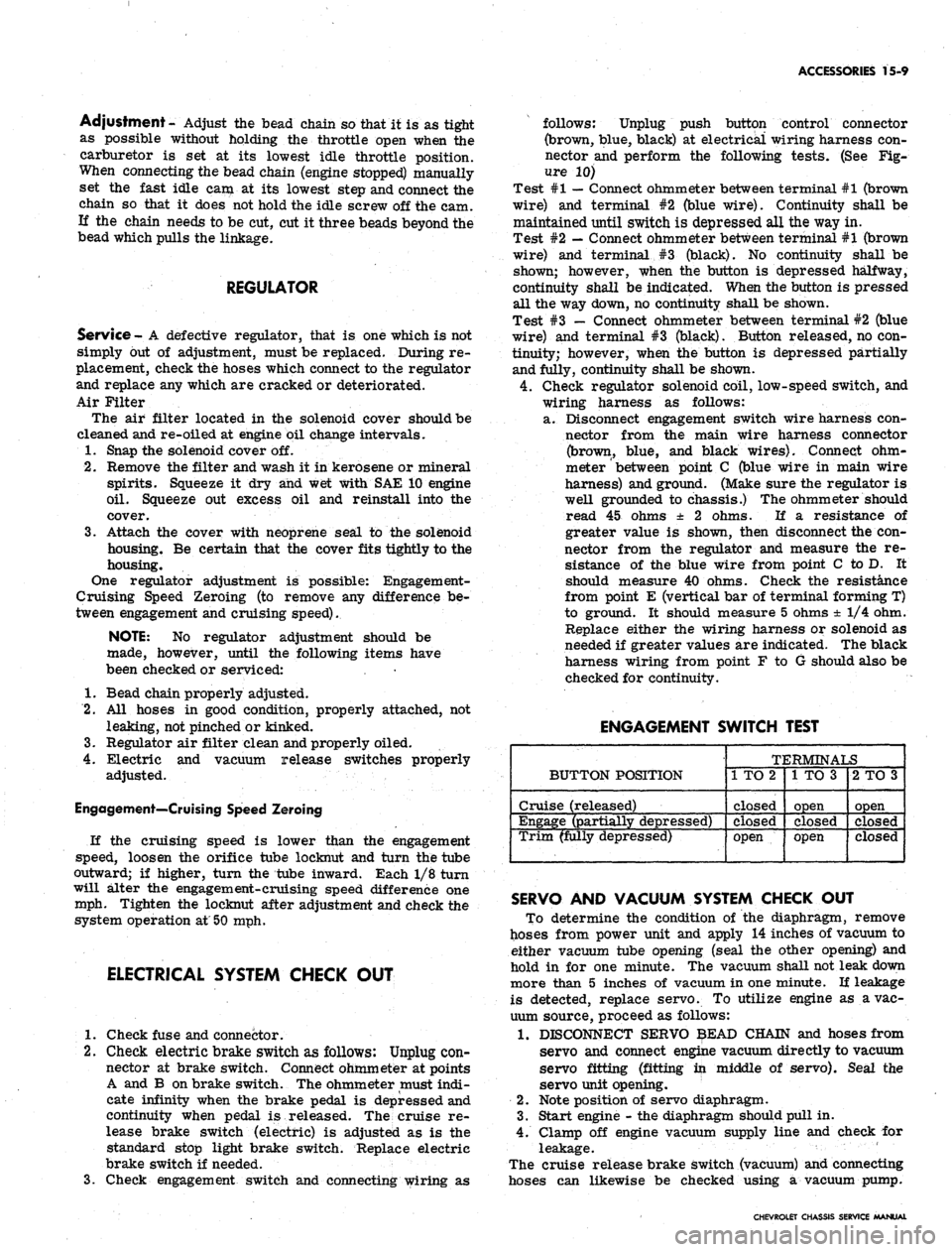
ure 10)
Test #1
—
Connect ohmmeter between terminal #1 (brown
wire) and terminal #2 (blue wire). Continuity shall be
maintained until switch is depressed all the way in.
Test #2
—
Connect ohmmeter between terminal #1 (brown
wire) and terminal #3 (black). No continuity shall be
shown; however, when the button is depressed halfway,
continuity shall be indicated. When the button is pressed
all the way down, no continuity shall be shown.
Test #3 — Connect ohmmeter between terminal #2 (blue
wire) and terminal #3 (black). Button released, no con-
tinuity; however, when the button is depressed partially
and fully, continuity shall be shown.
4.
Check regulator solenoid coil, low-speed switch, and
wiring harness as follows:
a. Disconnect engagement switch wire harness con-
nector from the main wire harness connector
(brown, blue, and black wires). Connect ohm-
meter
'
between point C (blue wire in main wire
harness) and ground. (Make sure the regulator is
well grounded to chassis.) The ohmmeter should
read 45 ohms ± 2 ohms. If a resistance of
greater value is shown, then disconnect the con-
nector from the regulator and measure the re-
sistance of the blue wire from point C to D. It
should measure 40 ohms. Check the resistance
from point E (vertical bar of terminal forming T)
to ground. It should measure 5 ohms ± 1/4 ohm.
Replace either the wiring harness or solenoid as
needed if greater values are indicated. The black
harness wiring from point F to G should also be
checked for continuity.
ENGAGEMENT SWITCH TEST
BUTTON POSITION
Cruise (released)
Engage (partially depressed)
Trim (fully depressed)
TERMINALS
1 TO 2
closed
Closed
open
1 TO 3
open
closed
open
2 TO 3
open
closed
closed
SERVO AND VACUUM SYSTEM CHECK OUT
To determine the condition of the diaphragm, remove
hoses from power unit and apply 14 inches of vacuum to
either vacuum tube opening (seal the other opening) and
hold in for one minute. The vacuum shall not leak down
more than 5 inches of vacuum in one minute. If leakage
is detected, replace servo. To utilize engine as a vac-
uum source, proceed as follows:
1.
DISCONNECT SERVO $EAD CHAIN and hoses from
servo and connect engine vacuum directly to vacuum
servo fitting (fitting in middle of servo). Seal the
servo unit opening.
2.
Note position of servo diaphragm.
3.
Start engine - the diaphragm should pull in.
4.
Clamp off engine vacuum supply line and check for
leakage. '
The cruise release brake switch (vacuum) and connecting
hoses can likewise be checked using a vacuum pump.
CHEVROLET CHASSIS SERVICE MANUAL
Page 621 of 659
ACCESSORIES 15-12
VACUUM
(WIT
P
VACUUM Llh
, AIR SUPPt
LINES
t
SUPERLIFT F
SHOCK ABSO
OPERATED AIR COMPRESSOR
H STORAGE TANK AND
RESSURE REGULATORJV
\A
4E FROM ENG«NE^"^
/ \-HEIGHT CONTROL
•^-Z n VALVE (WITH TIME
^*
EAR II
RBERS
Fig.
12 - Automatic Level Control Schematic
sure,
alternatley to opposite sides of the compressor
diaphragm.
As the compressor cycles, the reservoir air pressure
gradually increases causing a back pressure on the sec-
ond stage piston until it equals the push of pressure
against the diaphragm- At this point, a balanced condi-
tion is reached and the unit stops operating. After res-
ervoir pressure drops due to system air usage, the com-
pressor again begins to cycle and replenish the
reservoir.
Pressure balance will depend upon the prevailing mani-
fold vacuum and atmospheric pressure. Both are af-
fected by altitude above or below sea level. Balance
pressure will vary from approximately 150 to 275 psi.
NOTE: After completion of work on this sys-
tem or when servicing other parts of the car and
the system is deflated, inflate the reservoir to
140 psi or maximum pressure available through
the compressor service valve.
The PRESSURE REGULATOR VALVE is preset and
limits the reservoir outlet pressure to approximately 125
psi to avoid damage to the height control valve and Super-
lift shocks.
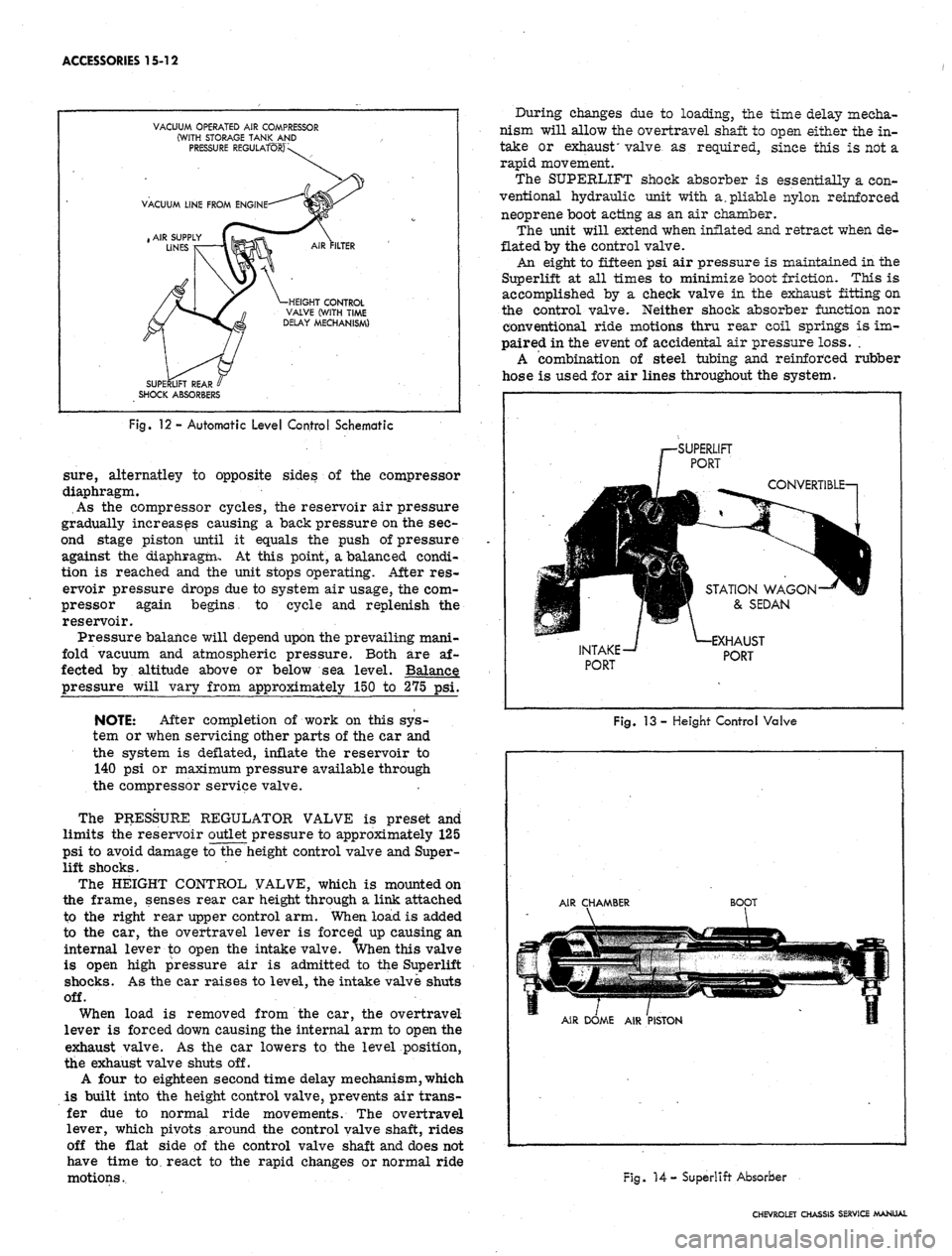
The HEIGHT CONTROL VALVE, which is mounted on
the frame, senses rear car height through a link attached
to the right rear upper control arm. When load is added
to the car, the overtravel lever is forced up causing an
internal lever to open the intake valve, when this valve
is open high pressure air is admitted to the Superlift
shocks. As the car raises to level, the intake valve shuts
off.
When load is removed from the car, the overtravel
lever is forced down causing the internal arm to open the
exhaust valve. As the car lowers to the level position,
the exhaust valve shuts off.
A four to eighteen second time delay mechanism, which
is built into the height control valve, prevents air trans-
fer due to normal ride movements. The overtravel
lever, which pivots around the control valve shaft, rides
off the flat side of the control valve shaft and does not
have time to. react to the rapid changes or normal ride
motions.
During changes due to loading, the time delay mecha-
nism will allow the overtravel shaft to open either the in-
take or exhaust' valve as required, since this is not a
rapid movement.
The SUPERLIFT shock absorber is essentially a con-
ventional hydraulic unit with a. pliable nylon reinforced
neoprene boot acting as an air chamber.
The unit will extend when inflated and retract when de-
flated by the control valve.
An eight to fifteen psi air pressure is maintained in the
Superlift at all times to minimize boot friction- This is
accomplished by a check valve in the exhaust fitting on
the control valve. Neither shock absorber function nor
conventional ride motions thru rear coil springs is im-
paired in the event of accidental air pressure loss. .
A combination of steel tubing and reinforced rubber
hose is used for air lines throughout the system.
-SUPERLIFT
PORT
STATION WAGON
& SEDAN
INTAKE
PORT
HAUST
PORT
Fig. 13 - Height Control Valve
AIR CHAMBER
BOOT
AIR DOME AIR PISTON
Fig. 14- Superlift Absorber
CHEVROLET CHASSIS SERVICE MANUAL