1967 CHEVROLET CAMARO oil
[x] Cancel search: oilPage 99 of 659

HEATER AND AIR CONDITIONING 1A-76
Fig.
112—-Heater Core Removal—Four-Season System (Corvette)
3.
Replace the core case into the car as described
under Heater and Air Distributor Assembly.
COMPRESSOR
The same basic six.cylinder reciprocating compressor
is used in all systems.
Two variations of the basic compressor are used. One,
with a displacement of 12.6 cu. in. is used with the Four-
Season System. The second model, having displacement
of 10.8 cu. in. is used with the Universal and All-Weather
Systems.
AH Systems
Removal
1.
Purge the refrigerant from the system.
2.
Remove connector attaching bolt and connector. Seal
connector outlets.
3.
Disconnect electrical lead to clutch actuating coil.
4.
Loosen brace and pivot bolts and detach belt.
5. Remove the nuts and bolts attaching the compressor
brackets to the mounting bracket.
6. Before beginning any compressor disassembly, drain
and measure oil in the compressor. Check for
evidence of contamination to ..determine if remainder
of system requires servicing. Compressor Servicing
information is located in the Chassis Overhaul
Manual.
Installation
1.
li oil previously drained from the compressor upon
removal shows no evidence of contamination, replace
a like amount of fresh refrigeration oil into the com-
pressor before reinstallatLon. If it was necessary to
service the entire system because of excessive con-
tamination in the oil removed, install a full charge of
"fresh refrigeration oil in the compressor. (See
Checking Compressor Oil Charge under Checking
Oil)
2.
Position compressor on the mounting bracket and
install all nuts, bolts and lock washers.
3.
Install the connector assembly to the compressor
rear head, using new "O" rings.
4.
Connect the electrical lead to the coil and install
and adjust compressor belt.
5. Evacuate and charge the system.
6. Leak test the system and check for proper operation.
Fig.
113—Heater Hoses^-Four-Season System (Corvette)
CHEVROLET CHASSIS SERVICE MANUAL
Page 101 of 659

^\
16B
—>
-COMPRESSOR
Clutch Coil
•To battery pos")
HEATER AND AIR CONDITIONING 1A-78
WIRING DIAGRAMS
Blower
Motor
Resistor
•
Asm
EVAPORATOR—v
ASM.
\
-Diode
(Arc I
suppressor)
^\
16B
—>
-COMPRESSOR
Clutch Coil
•To battery positive
(+) terminal
No vacuum
in hose
#3
Blower
intake
air
Outside
air entry
Valve
by vacuum
in
hose
#3
Valve
normally
closed (spring
held)
Inside
car
air
(Recirc.)
AIR INLET
VALVE
POSITION:
Outside
air
intake
Recirc. air'intake
CONTROL ASM
TEMP CONTROL LEVER
(Operates temp valve
cable
&
equipment
in
chart shown below)
Compressor
Sw.
(Normally closed
Temp valve
begins
to
open
valveV
cable
arm
•Fan Speed Selector Switch
Switch
lever
position
Off
Low
Med
High
Contacts
made
B
to
None
BtoL
B to L
&
M
B to
L
& H
Fan
speed
Low
Low
Med
High
Resistance
in series with
Bio Motor
Hi
Rl
(RiR2)/(Rl+R2)
None
•Blower switch contacts must
be
dosed
before
fan
switch will
be
operable.
COLD
(O.
A.)
COLD a.A.)
Blower
H
y—low
switch
M/
-med
(Norm,
closed
contacts)
Fan speed switch
(See chart
at
left)
To vacuum,
tank
EXTENSION—vy
Horn relay "Bat" WIRE
ASM
X
harness
terminal
V
.**-__.. ;_
1 I panel
Legend:
___. —
Production wiring
Wire
is
part
of
equip.
•—————* Air
conditioning
wrg.
| i
T Agn. sw.
accsy
I term.
I
Temp
Control
Lever
Position
OFF
VENT.
COLD(I.A.)
COLEKO.AJ
HOT
Blower
(Master)
switch
contacts
Open
Closed
Closed
Closed
Closed
Vac switch
connects
vac source
to hose
#
#2
#2
&
#3
None
#3
#2
&
#3
Compressor
switch
contacts:
Open
Open
Closed
Closed
Open
Blower
intake
air
Outside
car air
intake used
Inside
car air
recirculated
Outside
car air
intake used
.Outside
car air
intake used
Fig. 114—Chevrolet—Four-Season Wiring Diagram
CHEVROLET CHASSIS SERVICE MANUAL
Page 102 of 659
HEATER
AND AIR CONDITIONING IA-79
BAT.
CABLE
ASM
A/C
wrg fwd of
dash
exc
bat.
cables,
ext
wire
&
compressor
grd
wire
is
part
of engine wiring harness.
"COMPRESSOR"
SW:
"OFF" POSN
"ON"
POSN
RELAY
ASM
/-DASH
/
PANEL
RESISTOR
ASM
LUTCH
COIL
:OMI
GRD
WIRE
ASM
MPRESSOR
BAT.
TERM
ON START
MTR SOL
EXTENSION WIRE ASM
._
J
J
^-CONTROL
SW
CONTACTS
B TO NONE
BTOL
BTOL&M
BTOL6H
•IGN SW ACCSY TERM.
A/C wrg
to
rear
of
dash
of
inst pnl harness.
Fig.
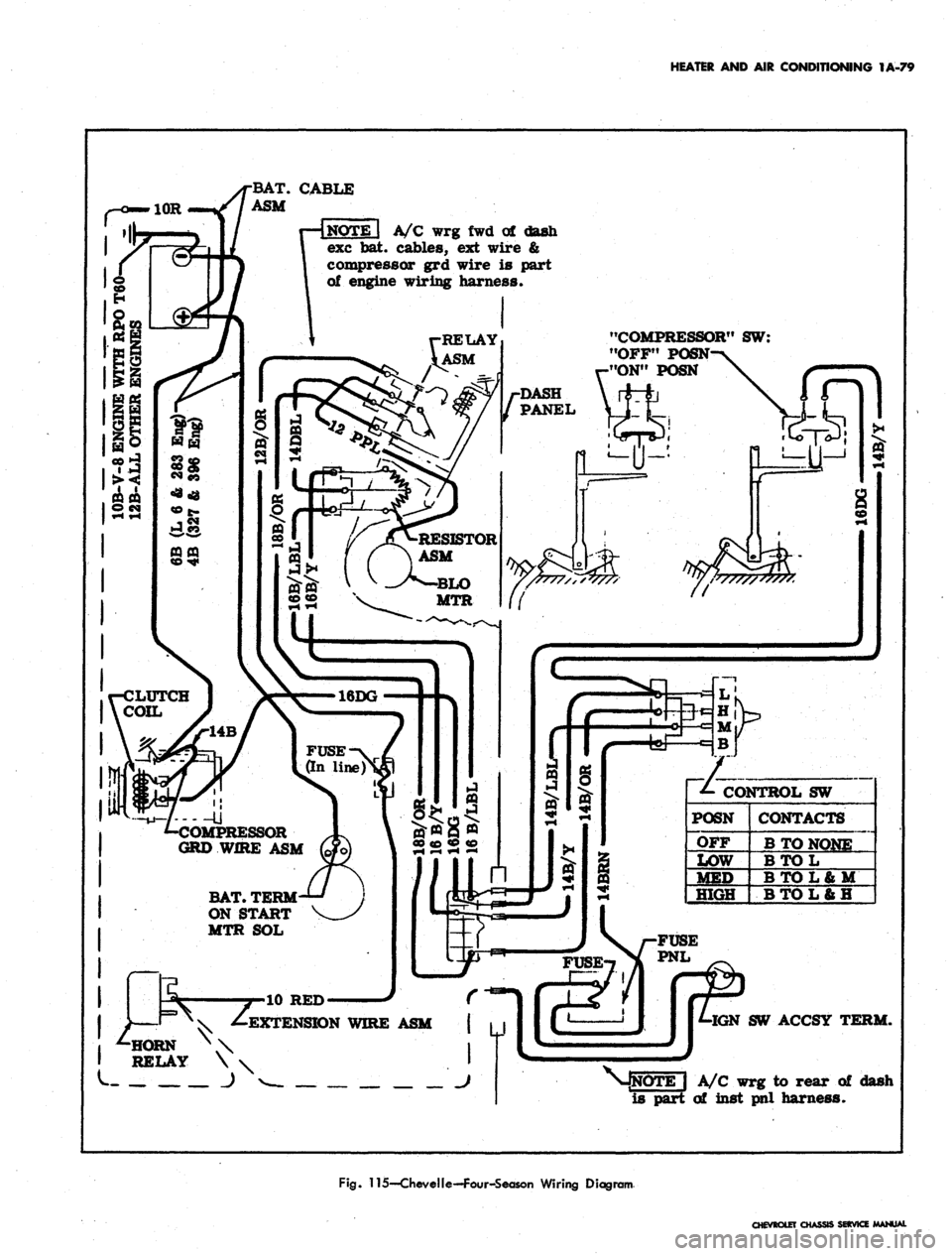
115—CheveIle—Four-Season Wiring Diagram
CHEVROLET
CHASSIS SERVICE MANUAL
Page 103 of 659

HEATER
AND AIR
CONDITIONING
1A-80
EVAPORATOR ASM.
Blower
Motor
INSIDE VALVE
(Normally closed
-spring held)
PLENUM VALVE
(Normally open
-spring held)
Actuator
(Vacuum
operated)
Inside car air (Recirc*
CONTROL ASM
TEMP CONTROL LEVER
•(Operates temp valve
cable
&
equipment in
hart shown below)
Temp valve
begins to
16DG
Fuse (In-line^
COMPRESSOR
Clutch Coil DASH-
PANEL
•Fan Speed Selector Switch
Switch
lever
position
Off
Low
"HeST
High
Contacts
B to
None
BtoL
B to L b U
BtoL&H
Fan
speed
Low
Low
Med
High
Resistance
in series with
Bio Motor
Rl
Rl
RlR2)/(Rl+R2)
None
•Blower switch contacts must be closed
before fan switch will be operable.
-To battery positive
(-0 terminal
•
Horn relay
terminal"
"Batf
To vacuum
tank
EXTENSION
WIRE
ASM
(Normally closed
contacts-*vac
operated)
7
*- Fan speed switch
(See chart at left)
•/-Wire is
\ part of
I inst panel
harness
Legend:
— Production wiring
————
Wire Is part of equip.
•mmmmmmmmmmmmmm*
AIT
Conditioning
WTg*
Temp
Control
Lever
Position
OFF
VENT
COLD
a.A.)
COLD
(O.A.)
HOT
Blower
(Master)
switch
contacts
Open
Closed
Closed
Closed
Closed
Vac switch
connects
vac source
to hose #
#2
&
#3
#2
#3
None
#2
Compressor
switch
contacts^
Open
Open
Closed
Closed
Open
Blower
intake air
Outside car air
intake used
Inside car air
recir culated
Outside car air
intake used
Outside car air
intake used
Fig.
116—Camaro—Four-Season Wiring Diagram
CHEVROLET CHASSIS SERVICE
Page 105 of 659

HEATER AND AIR CONDITIONING 1A-82
•BATTERY
(POS)
CABLE
NOTE
When
control
switch*
is !TOFF"
&
Air
Cond
is
"ON"
(Control
knob
pulled
but) the
blower
fan'will
run at low
speed.
CONTROL
SWITCH
CONNECTIONS
OFF
LOW
MED
HIGH
B
TO
NONE
B
TO L
BTOL&M
B
TO L
&
H
COMPRESSOR
GROUND
WIRE
ASM
BATTERY
(NEGATIVE)
CABLE
COMPRESSOR
ASM
DASHPAJSTEL
GROMMET
16DG
CONTROL
SWITCH
RESISTOR
ASM
14LBL
14BRN
CLUTCH
COIL
EXTENSION
WIRE
ASM
-14BRN--N
JUNC
BLOCKi
OSTATIC
SWITCH
CONTACTS
NORMALLY
CLOSED
STARTING
MOTOR
SOLENOID
BLOWER
MOTOR
AIR
COND
CONTROL
(PUSH-PULL)
KNOB
DOOR
SWITCH
(PUSH
BUTTON
NORMALLY
CLOSED)
RELAY
ASM
HORN
RELAY
DIVERTER
DOOR CABLE
FUSE
PANEL
EVAPORATOR
ASM
IGNITION SWITCH-
ACCESSORY TERMINAL)
Fig. 118—All Weather Wiring Diagram (Chevy II)
CHEVROLET CHASSIS SERVICE MANUAL
Page 107 of 659

HEATER
AND AIR
CONDITIONING
1A-84
SPECIAL TOOLS
18
19 20 21 23 24
28
30
32
Fig.
120—Air Conditioning—Special Tools
1.
1A.
IB.
2.
3.
4.
5.
6.
7.
00*
9.
10.
11.
12.
13.
14.
15.
J-8393
J-22368
J-21530
J-5453
J-9459
J-5420
J-6084
J-8433
J-9395
J-6272
J-6271
J-7151
J-5421
J-5403
J-6435
J-9396
J-9397
Charging Station
Comfortron System fester
Comfortron Temperature Dial Adjuster
Goggles
90° Gauge Line Adapter
Gauge Line Adapter
Leak Detector
Puller
Puller Pilot
No.
3
Multi-Opener (3-Can)
Fitzall Valve (Single
Can)
Non-Magnetic Clutch Shims
Pocket Thermometers
(2)
#21 Snap Ring Pliers
#26 Snap Ring Pliers
Compressor Holding Fixture
Compressing Fixture
16.
J-9403
17.
J-9399
18.
J-9401
19.
J-9480
20.
J-9392
21.
J-9393
22.
J-9298
23.
J-9481
24.
J-8092
25.
J-9521
26.
J-5139
27.
J-9432
28.
J-9553
29.
J-21508
30.
J-21303
31.
J-9527
,
32.
J-9402
Clutch
Hub
Holding Tool
9/16" Thin Wall Socket
Hub
and
Drive Plate Assembly Remover
Hub
and
Drive Plate Assembly Installer
Seal Remover
Seal Seat Remover
Pulley Bearing Remover
Pulley and Bearing installer
Handle
Internal Assembly Support Block
Oil Pickup Tube Remover
Needle Bearing Installer
Seal Seat "O" Ring Remover
Seal Seat "O" Ring Installer
Shaft Seal Protector
Pressure Test Connector
Parts Tray
CHEVROLET CHASSIS SERVICE MANUAL
Page 126 of 659

CORVETTE BODY 1B-T9
Fig.
43—Removing Regulator Assembly
REAR QUARTER
DOOR SILL PLATE AND MOLDING
Figure 49 shows assembly details of both the door sill
plate and molding. The sill plate which retains the car-*
pet, the cowl trim windlace and lock pillar front edge
trim are retained to the body by six screws.
The molding assembly, which replaces a rocker panel,
is quickly and easily replaced by removing 10 retaining
screws. The sill molding retainer is also fastened to the
body with screws.
REAR END
FOLDING TOP COMPARTMENT LID
Adjustments
Hinges
The folding top compartment lid should be adjusted so
that in the closed position the surface of the lid is flush
with surrounding body surfaces and space between lid
edge and body is 1/16" to 3/16" at sides and 3/16" to
1/4" at rear. Whenever lid position is changed on hinges,
lock engagement must be inspected and adjusted if neces-
sary. Adjust hinge position as follows:
1.
Scribe a line on lid surface following contour of hinge
strap.
This will ease observation of lid movement
during adjustment (fig. 51).
2.
To raise or lower top surface of lid, add or remove
hinge shims.
3.
To adjust spacing between lid edges and body, loosen
hinge-to-lid screws and shift lid as required.
Lock
Lock engagement may be adjusted as follows:
1.
Striker plates may be shimmed to adjust the depth
of lock engagement in striker plate. When this ad-
justment is made, release of lock should be tested
and adjusted as required.
2.
Release of lock may be adjusted by loosening lock
assembly retaining bolts and moving lock in ap-
propriate direction to the limit of slotted holes in
, lock base. Further adjustment may be gained by
moving cable retainer in appropriate direction.
Hinges
(Refer to Figure 52)
Removal
1.
Scribe around hinge as shown in Figure 51.
2.
Hinge may be removed as an assembly by opening
top compartment lid fully and removing 3 retaining
screws. Note number of shims found between hinge
frame and compartment floor.
3.
To remove spring from hinge assembly, close top
compartment lid as far as possible and insert Tool
J-9559 between expanded coils in spring. Opening
top compartment lid fully will allow removal of
spring as shown in Figure 53.
4.
As soon as spring is removed, insert long bolt sup-
plied with J-9559 through holes in end of tool, pass-
ing it through spring, and install nut on bolt.
Spring may be removed from J-9559 or J-9559 may be
installed in a new spring, by the following method:
1.
Place a closed 6 or 8 inch "C" clamp in a vise or
fasten it to a heavy bench top (bench should be fas-
tened to floor).
2.
Hook one end of spring in clamp and the other end
in hook of chain hoist, "cherrypicker" or equivalent,
as shown in Figure 54.
3.
Stretch the spring enough to allow insertion of
J-9559. Install through bolt if spring is not to be in-
stalled on hinge at once.
installation
1.
Install same number of shims as removed or, if
repairing collision damage, etc., position hinge in
compartment, install upper mounting screws, fill
gap between floor and hinge frame with shims and
install lower mounting screw.
2.
If spring has been removed from hinge, install
spring in J-9559 and place spring on hinge with com-
partment lid raised; closing lid releases J-9559 for
removal. Upper end of spring should rest in one of
three notches yielding best lid operation. About 3
pounds pressure should be necessary to close lid.
Lock
Removal
1.
Remove cable mounting clamps. Remove retainer
from control cable assembly and disengage cable
from control.
2.
Scribe a mark on lid following outer contour of lock
assembly.
3.
Remove 3 lock assembly retaining screws and re-
move lock from compartment lid.
Installation
1.
Place lock assembly on compartment lid within
scribed line and install retaining screws.
2.
Install end of cable in control assembly and fasten
retainer securely.
3.
Test operation of lock thoroughly, adjusting if neces-
sary as outlined in this section.
Control
Removal
1.
Remove inner mounting clamps from both cables
and disengage cables from control by removing
retainers.
CHEVROLET CHASSIS SERVICE MANUAL
Page 128 of 659
CORVETTE BODY 1B-21
Fig.
45—
Locking Regulator Arm in Place
REAR WINDOW-ADHESIVE CAULKED-
19437 MODEL
For parts identification refer to Figure 55.
1.
Remove the 2 rear window garnish moldings by re-
moving the 14 attaching screws.
2.
Pry molding caps from reveal moldings.
3.
Carefully remove lower, side, and top reveal mold-
ings after marking their position on body with tape.
4.
Secure one end of steel music wire to piece of wood
for handle. Insert other end through caulking mater-
ial at lower corner of rear window; then secure end
of wire to another piece of wood (fig. 56).
5. With the aid of helper, carefully cut through caulking
material (using a sawing motion) with the steel wire;
up side of window, across top, down opposite side,
and across bottom of window.
6. Remove old glass from window opening.
7. Using a sharp scraper or wood chisel, remove ad-
hesive caulking material from body pinchweld flange.
NOTE:
It is not necessary to clean off all the
old caulking material completely from body
opening; however, there should not be any loose
pieces of caulking material left in the opening.
8. Check all reveal molding retaining clips for damage
(24 required). Replace those that are bent or dis-
torted with clips provided in kit.
9. Using weatherstrip adhesive, cement rubber spacers
at bottom, sides, and top of window opening. The
step-type spacers are used at bottom and sides, the
flat type are used at the top, sides, and bottom of
window opening as shown on Figure 55.
10.
Using suction cup holders, position replacement
glass in body opening. Carefully check relationship
of glass to body pinchweld completely around open-
ing. The overlap of glass to body pinchweld and re-
taining flanges should be equal with a minimum over-
lap of 3/16M. Where necessary, position shims under
the lower spacers to obtain required overlap of glass
to body upper and lower flanges.
11.
After proper glass to pinchweld relationship has
been attained, mark position with grease pencil on
glass and body as shown in Figure 57.
12.
Remove glass from body opening and place on pro-
tected surface.
13.
Clean inside edge surface of glass so that glass is
free of any foreign material (oil, grease, etc.).
Using 3/4" masking tape, place tape approximately
1/2 inch from edge of inside surface of glass com-
pletely around glass. Then apply a film of silane
primer to inside edge surface completely around
glass,
also apply silane primer to sealing surface
of pinchweld as shown in Figure 58.
Fig.
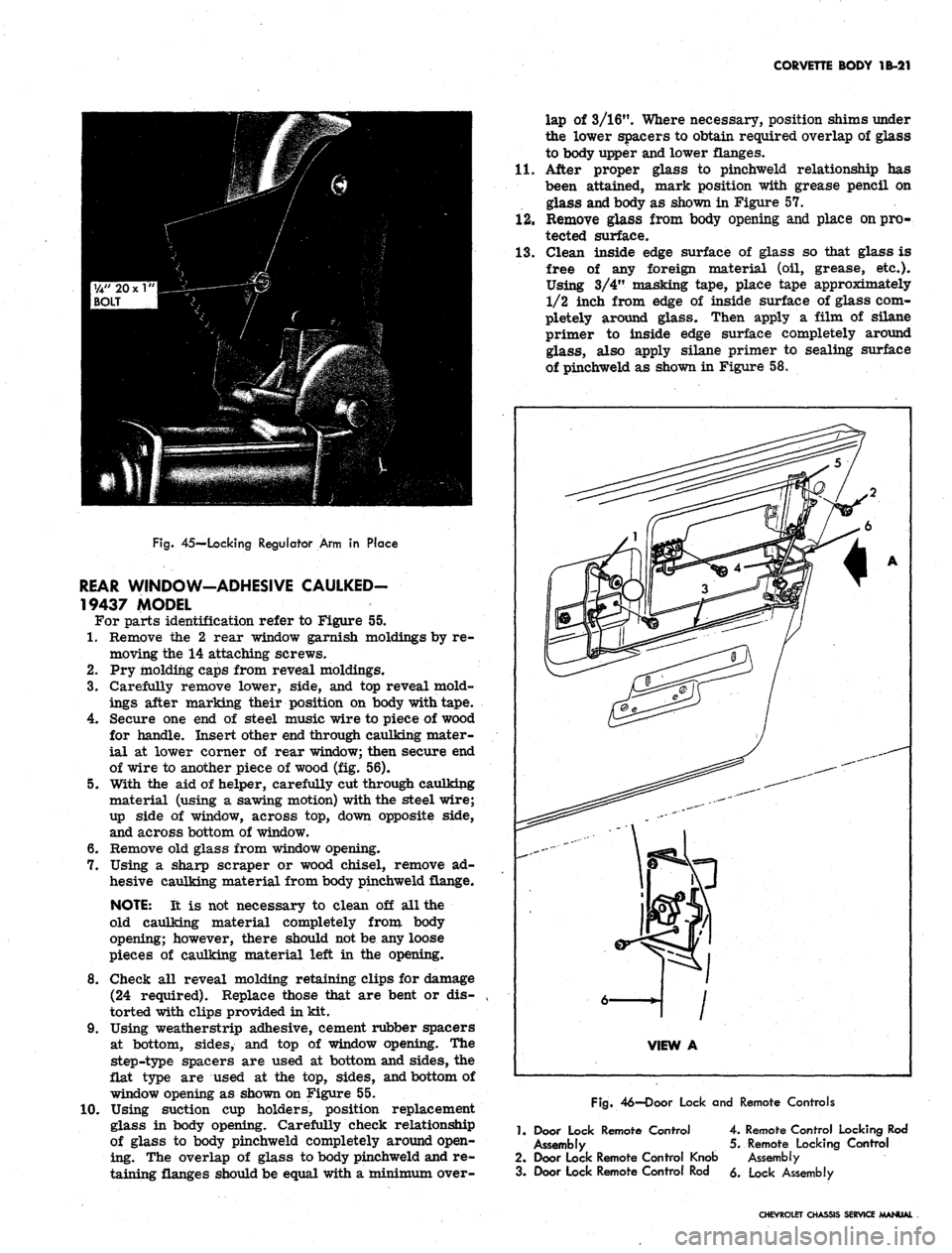
46—Door Lock and Remote Controls
1.
Door Lock Remote Control
Assembly
2.
Door Lock Remote Control Knob
3. Door Lock Remote Control Rod
4.
Remote Control Locking Rod
5. Remote Locking Control
Assembly
6. Lock Assembly
CHEVROLET CHASSIS SERVICE MANUAL