1965 CHEVROLET CORVAIR automatic transmission
[x] Cancel search: automatic transmissionPage 8 of 56
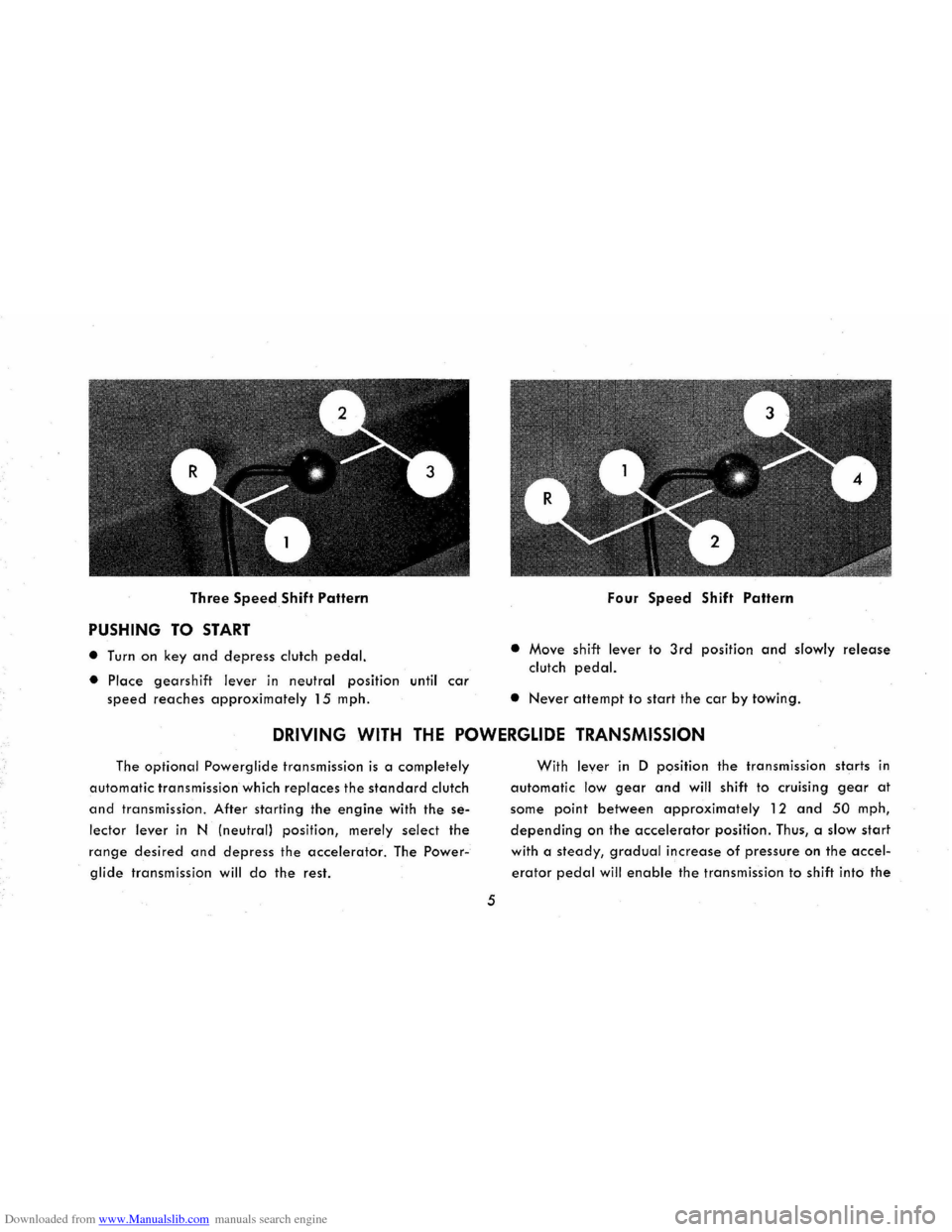
Downloaded from www.Manualslib.com manuals search engine Three Speed Shift Pattern
PUSHING TO START
• Turn on key and depress clutch pedal.
• Place gearshift lever in neutral position until car
speed reaches approximately 15 mph.
Four Speed Shift Pattern
• Move shift lever to 3rd position and slowly release
clutch pedal.
• Never attempt to start the car by towing.
DRIVING WITH THE POWERGLIDE TRANSMISSION
The optional Powerglide transmission is a completely
automatic transmission which replaces the standard clutch
and transmission. After starting the engine with the se
lector lever in N (neutral) position, merely select the
range desired and depress the accelerator. The Power
glide transmission will do the rest.
5
With lever in D position the transmission starts in
automatic low gear and will shift to cruising gear at
some point between approximately 12 and 50 mph,
depending on the accelerator position. Thus, a slow start
with a steady, gradual increase of pressure on the accel
erator pedal will enable the transmission to shift into the
Page 9 of 56
Downloaded from www.Manualslib.com manuals search engine more economical cruising gear in the shortest possible
time. Hard acceleration for fast starts will cause the trans
mission to remain in low gear for a considerably longer
period.
When driving at speeds below 45 mph, the transmis
sion may be shifted back into low range for extra acceler
ation for passing by depressing the accelerator pedal
fully. The transmission will automatically shift back into cruising
gear when the accelerator pedal is momentarily
released.
PUSHING TO START
• Turn off all
electrical loads such as radio, heater and,
if possible, lights until the engine starts.
• Turn on key and move selector lever to neutral. At
20 to 25 mph move lever to l.
• When engine starts, move selector lever to D.
NOTE: Never tow to start.
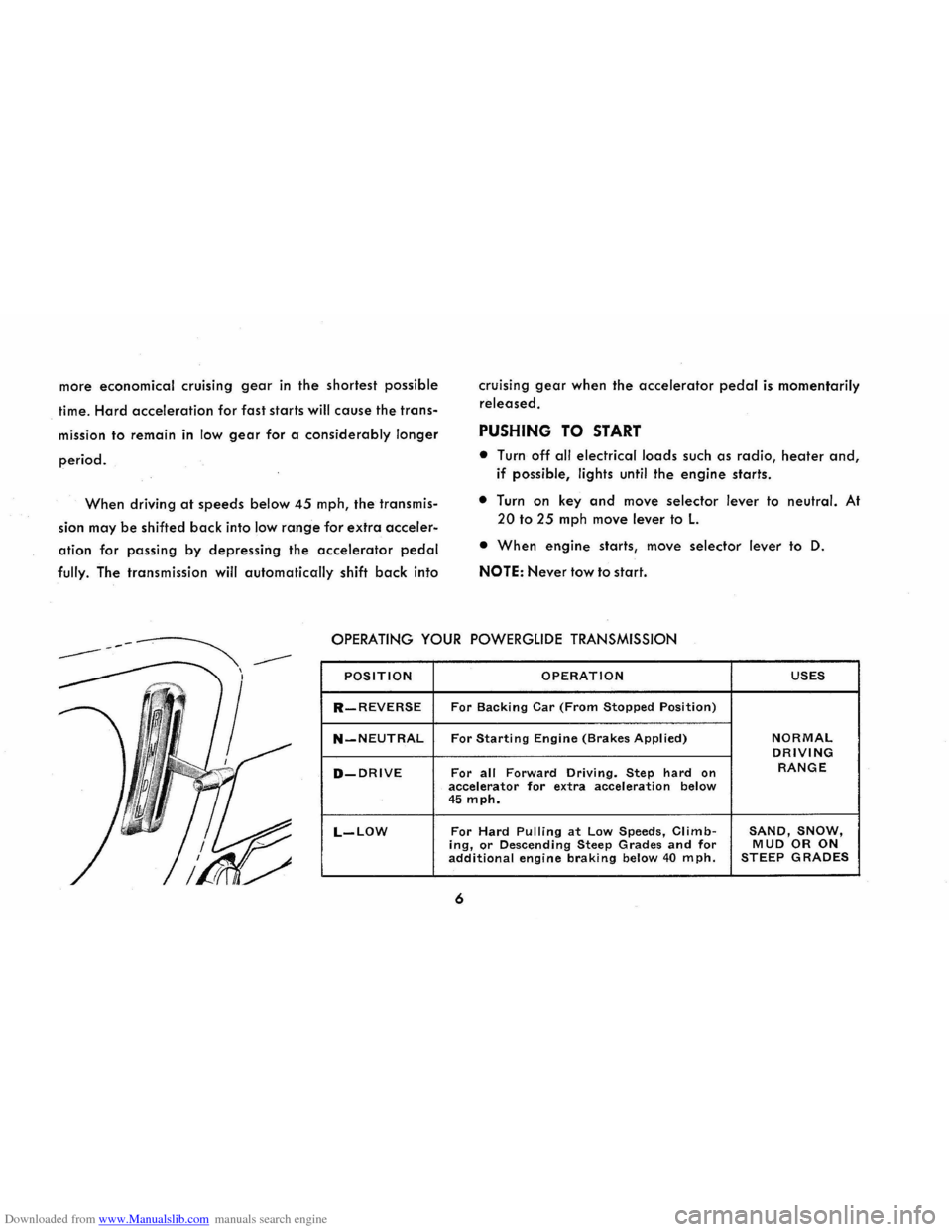
OPERATING YOUR POWERGLIDE TRANSMISSION
POSITION OPERATION USES
R-REVERSE For Backing Car (From Stopped Position)
N-NEUTRAL For Starting Engine (Brakes Applied) NORMAL DRIVING
D-DRIVE For all Forward Driving. Step hard on RANGE
accelerator for extra acceleration below 45 mph.
L-LOW For Hard Pulling at Low Speeds, Climb-SAND, SNOW, ing, or Descending Steep Grades and for MUD OR ON additional engine braking below 40 mph. STEEP GRADES
6
Page 44 of 56
Downloaded from www.Manualslib.com manuals search engine TRANSMISSION-POWERGLIDE
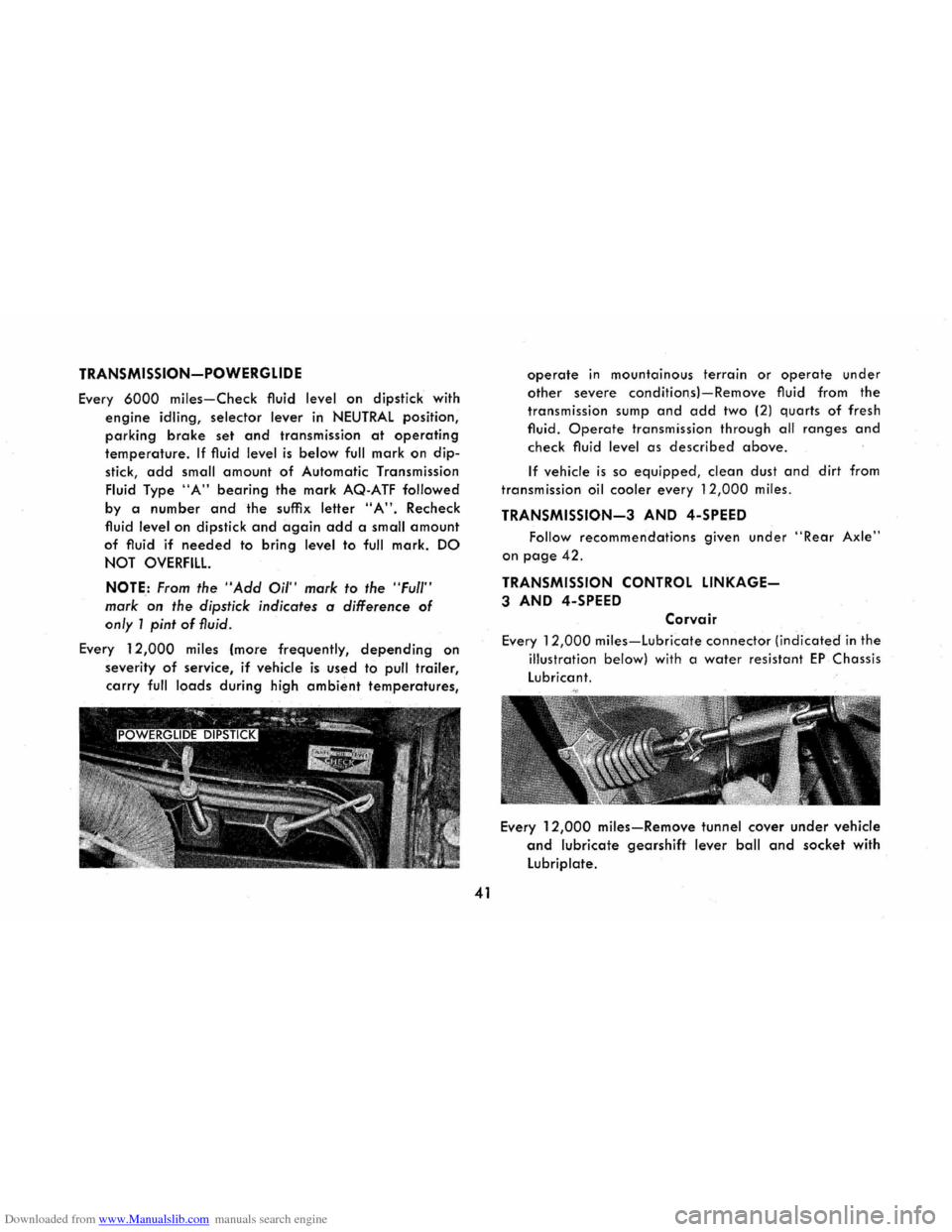
Every 6000 miles-Check fluid level on dipstick with
engine idling, selector lever in NEUTRAL position,
parking brake set and transmission at operating
temperature. If fluid level is below full mark on dip
stick,
add small amount of Automatic Transmission
Fluid Type
"A" bearing the mark AQ-ATF followed
by a
number and the suffix letter "A". Recheck
fluid
level on dipstick and again add a small amount
of fluid if needed to bring level to full mark. DO
NOT
OVERFILL.
NOTE: From the "Add Oil" mark to the "Ful/' ,
mark on the dipstick indicates a difference of
only 1 pint of fluid.
Every 1
2,000 miles (more frequently, depending on
severity of service, if vehicle is used to pull trailer,
carry full loads during high ambient temperatures,
41
operate in mountainous terrain or operate under
other severe condition .sl-Remove fluid from the
transmission sump and add two (2) quarts of fresh
fluid.
Operate transmission through all ranges and
check fluid level as described above.
If vehicle is so equipped, clean dust and dirt from
transmission oil cooler every 12,000 miles.
TRANSMISSION-3 AND 4-SPEED
Follow recommendations given under "Rear Axle"
on page 42.
TRANSMISSION CONTROL LINKAGE-
3 AND 4-SPEED
Corvair
Every 12,000 miles-Lubricate connector (indicated in the
illustration below) with a water resistant EP Chassis
Lubricant.
Every
12,000 miles-Remove tunnel cover under vehicle
and lubricate gearshift lever ball and socket with
Lubriplate.
Page 52 of 56
Downloaded from www.Manualslib.com manuals search engine and blocked AIR CLEANER ELEMENTS. Clean and reoil the air
cleaner elements if necessary. Idle adjustment should be performed
by your Chevrolet Dealer.
If the above Fuel System checks and the checks suggested under
the Electrical System following do not correct the malfunction, it is
recommended that you turn to your Authorized Chevrolet Dealer
for further checks , adjustments or repairs.
ELECTRICAL SYSTEM
If, when the ignition key is turned to START, the engine will not
turn
over, you have good reason to suspect electrical trouble.
(F) When there .is no response at all to attempts to start the car,
check the obvious-your AUTOMATIC TRANSMISSION SElECTOR
LEVER must be in neutral position before the engine can be started.
Turning the IGNITION SWITCH rapidly back and forth several
times will sometimes correct a poor internal switch contact.
(G) The
BATTERY may be discharged. If so, lights will be dim and
the horn will have a poor tone if it will blow at all.
Usually a
garage recharge will be necessary to return the battery
to operation. Occasionally, however , a push start and a long drive
will
recharge the battery.
NOTE : If the battery is determined to be dead, and for no apparent
reason , have your Authorized Chevrolet Dealer check the
battery, the GENERATOR and the VOLTAGE REGULATOR .
GENERA TOR trouble should already have been indicated by
the indicator on the instrument panel. Never remove generator
"BAT" lead without first disconnecting battery ground cable.
49
POOR BATTERY CONNECTIONS may be suspected if the car has operated properly a short time before and now not even the horn
will operate. Check both ends of both battery cables. If the con
nections are corroded, a car may sometimes be restored to opera
tion by removing all cable ends, scraping all contacting surfaces clean with a pen knife , and reassembling . If the cables are broken, they must be replaced. The power supply should now be restored unless the battery is dead.
(H) If, however, the lights and horn work properly but the starter will still not turn over, check the STARTER connections. A "click" from the starter solenoid indicates that the wiring to the starter is properly installed . If the wiring seems to be clean and tightly installed, the trouble is probably in the starter itself and should be referred to your Authorized Chevrolet Dealer.
When the engine will "turn over" but will not start, the following
items may be checked along with Fuel System Checks listed
previously .
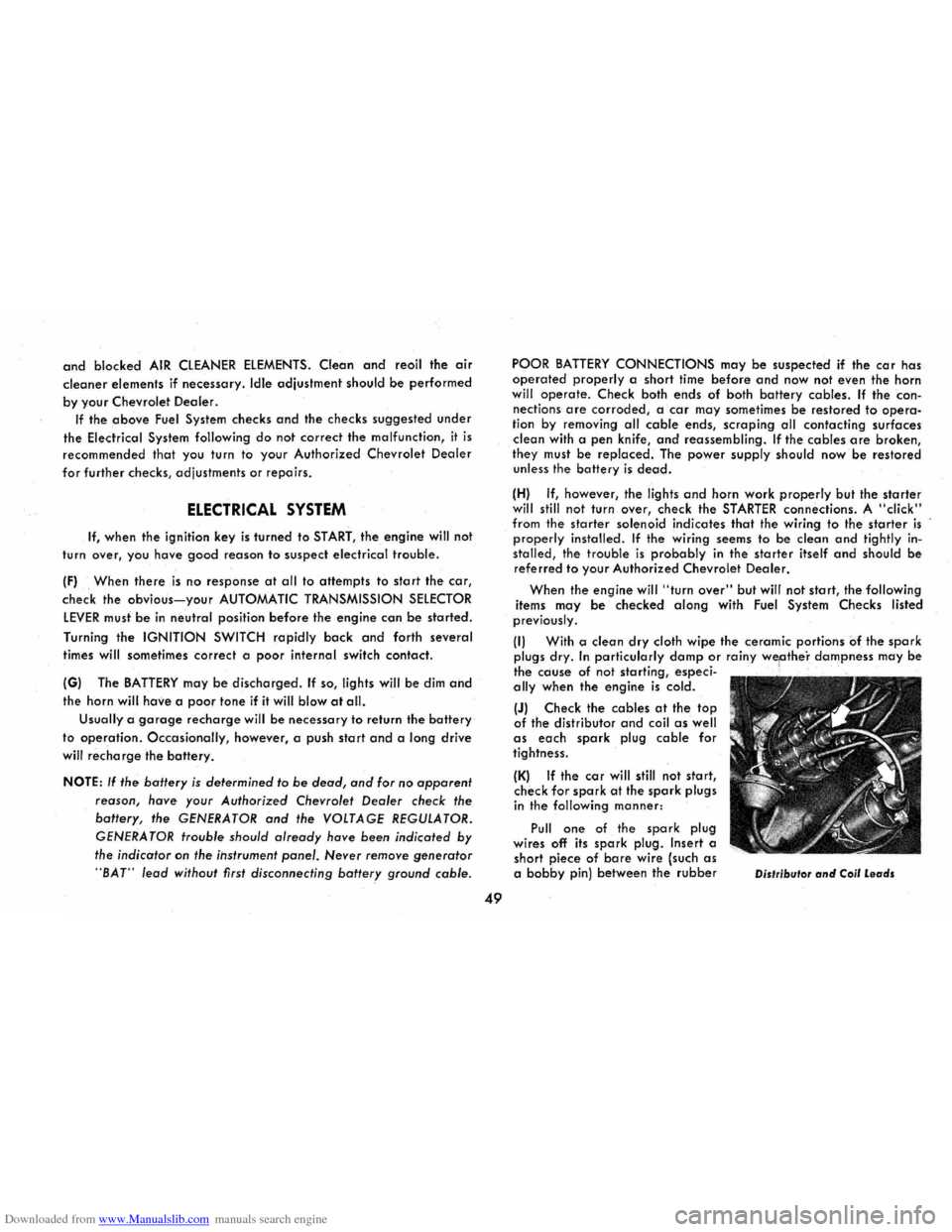
(I) With a clean dry cloth wipe the ceramic portions of the spark plugs dry. In particularly damp or rainy wellthe'r dampness may be the cause of not starting, especi-: . ally when the engine is cold.
(J) Check the cables at the top of the distributor and coil as well as each spark plug cable for tightness.
(K) If the car will still not start, check for spark at the spark plugs in the following manner:
Pull
one of the spark plug
wires off its spark plug. Insert a
short piece of bare wire (such as a bobby pin) between the rubber Oislribulor and Coil Leads