Page 37 of 52
FAN BELT
Every 6,000 miles inspect fan belt for wear, fraying,
cracking and tension. Belt should be retightened
only when
it deflects more than Y2" with modera te thumb pressure applied midway between pulleys.
AIR CLEANER
Ev ery
12,000 miles (more often under dusty o r other
adverse driving conditions) rem ove the polyurethan e
eleme nt from its support screen and clean in suit able
solvent such as Kerosene . Squeeze out all solvent,
then soak i n engine oil and squ eeze out. Remove
excess oil
by then squeezing the element in a clean dry cloth.
OIL FILTER
The oil filter should be changed at 6,000 miles or 6 month intervals, whi ch ever occurs first. During pro
l onged dusty driving conditions the filter should be
cha nged more often.
DISTRIBUTOR
Change cam lubricator end for end at 12,000 mile intervals-Replace at 24,00 0 mile intervals.
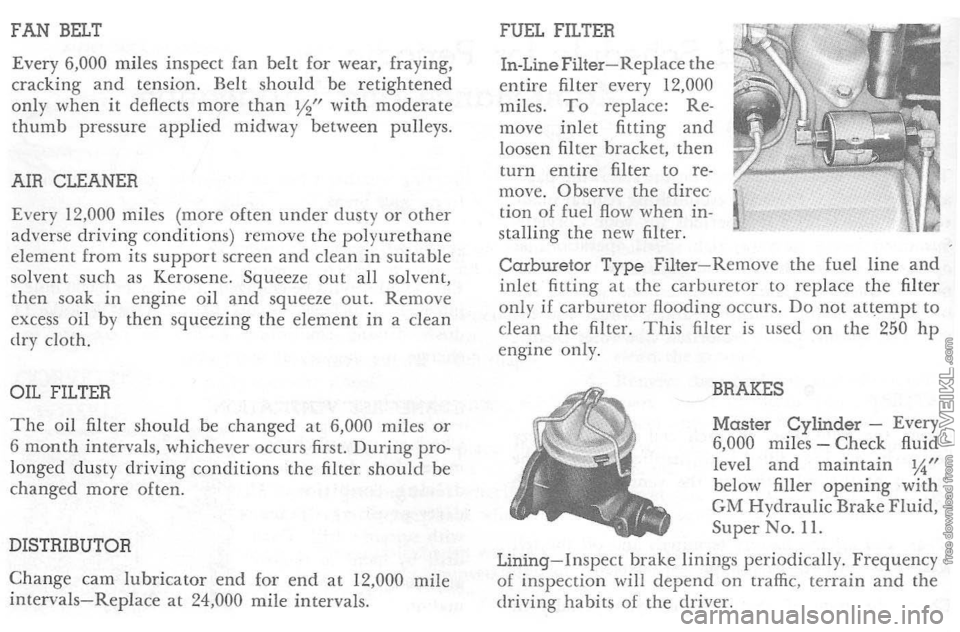
FUEL FILTER
In-Line Filter-Replace
the entire filter every 12,000
miles. To replace: Re
move inlet fitting and
loosen filter bracket, then
turn entire filter
to re
move. 0 hserve the direc
tion of fuel flow when in
stalling the new filter.
Carburetor Type Filter - R emove the fuel line and inlet fitting at the carburetor to replace the filter
only if car bur etor Hooding occurs. Do nor att,cmpt to clean the filter. This filter is used on the 250 hp engine only.
BRAKES
Master Cylinder -Every
6,000 miles - Check fluid
le vel and maintain IA" below filler opening with GM Hydraulic Brake Fluid, Super No. 11.
Lining-Inspe ct brake linings periodi cally. Frequency o[ inspection ,viII depend on traffic, terrain and the
driving habits of the driver.
Page 43 of 52

(E) If the car will start but sta lls w h e n hot or has a roug h idle, you can sus pect a f aulty IDLE ADJUSTMENT, a malfunctioning AUTOMATIC CHOKE or an extremely
dirty and blocked AIR CLEANER ELEMENT. Clean
your air cleaner element if necessary. If the above Fuel Syste m checks and the checks suggested under the Electr ica l System followi ng do not corre ct the malfunction , i t is recommended that you turTI to your Authorized Chevrolet Dealer for further checks, adjust
ments or repairs.
ELECTRICAL SYSTEM If, when the ignition key is turned to "Star t," the engine
will not turn over, you have good reason to sus pec t elec
trical trouble.
(F) '
Vhen there is
no response at all to attempts to star t
the car , check the obv ious-your AUTOMATIC TRANS· M ISSION SELECTOR LEVER mus t be in Neutral or Park position befor e the engine can be started. Turning
the IGNITION SvVITCH rapidly back and forth several
times will sometimes correct a poor internal switch contact.
(G) The BATTER Y may be discha rged. If so, lights will
be dim and the horn will have a poor tone if it will blow a t
all. Usually a
garage recharge will be nece ssary to return the battery to operation. Occasiona lly, however, a p u sh start and long driv e will recharge the battery .
POOR BATTERY CONNECTIONS may be suspec ted if
th e car has operated prope rly a short time befor e and now not eve n the horn will operate. Check both ends o f both battery cables. If the connections are corroded, a car ma y
som etimes be restore d to operation by removing all cab le
e n ds, scraping all contacting surfaces clean with a pen
knife, and reassembling. If the cables a r e broken, they
must be replaced. The power supply should now b e restored
unless the battery is dead.
(H)
If, however, the lights and horn work properly but
th e starter will still not turn ove r , c heck the STARTER connections. A "click " from the starter soleno id indicates
th a t the wirin g to the starter is properly install ed. If the
wiring seems to be clean and tightly installed, the trouble
is proba bly in the starter itself and sho uld be referred to
your Authorized Chevr olet Dealer.
When the e ngine will "turn ove r " but will not start, [h e
foll owin g items may b e checked along with the Fuel Syst em
Checks listed previous ly.
(I) With a clean dry cloth wipe the ceramic portions o f
t he spark plugs dry. In particul arly damp or rainy weather dampness may be the cause of not starting, espec ially when the e ngin e is cold.
0) C heck the cables
at the top of the distributor and coil as well as eac h spark plug cable for tightness.
(K)
If the car w ill stilI not st art. ch eck for spark at the
spark plugs in th e foll owing manner:
Pull o n e of the spark plug wi res off its spark plug. Insert a
short piece of bare wir e (such as a bobby pin) between the
Page 45 of 52

TECHNICAL DATA AND SPECIFICATIONS
Serial and Unit Numbers -Stamped on identifi cation
plat e located on instrument panel brace under glove
box.
Bore Engine Compo Disp. Fuel Cyls. X Exhaust Name Ratio (Cu. In.) Induction Stroke
Corvette V·8 4' x 3~' 10.5 327 4 Bbl. Dual Corvette V·8 4 .... x J~1;. 10.5 327 H.B.4 Bbl. Dual Corvette V·8 4" x 31;4 ~ 11.1 327 Holley 4 Bbl. Dual
ENGINE IDENTIFICATION - Stamped on righ t
front engine boss next to water pump.
Gross Trans. Octane Horsepower Ufters Torque ReQ'menl
350 @ 2800 RPM 250 @ 4400 RPM Hyd. 1·2·4 99·101 360 @ 3200 RPM 300 @ 5000 RPM Hyd. 1·2· 4 99·101 360 @ 4000 RPM 365 @ 6300 RPM Mech. 1·3 100·102
'I. 3·speed 2. 4·speed regular 3. 4·speed close ratio 4. Powerglide
CHASSIS DIMENSIONS
Wheel base Length (Overall) Width (Overall)
Height Loaded-Folding Top Up. Loaded-Hard Top Loaded-Sport Coupe
Tread Front Rear 98"
175.3"
69.6"
49.8" .. 49.3" 49.8"
56.3"
57.00"
ENGINES Firing Order 1·8·4·3·6·5·7 ·2
AMA Horsepower-51.2 Distributor :
Dwell
Point Gap Breaker Arm Tension Spark Plugs .016"
used-
.O 19" new
19·23 oz.
AC
45 or AC 46-City Driving Only AC44 (Orig. Equip.) -Town and Country Driving
AC C43 COM-Heavy duty and h igh output AC C42·l COM-Extended and extreme high output Plug Gap .035"