Page 5 of 38
OPERATING INSTRUCTIONS
BREAKING-IN PERIOD
Sound design and precision manufacturing methods
will permit you to operate your new Corvair in a normal
manner from its very first mile without adhering to a
formal "break-in" schedule. However, during the first
few hundred miles of driving you can, by observing a
few simple precautions, add to the future performance
and economy of your car.
It is recommended that your speed during the first
500 miles be confined to a maximum of 60 M.P.H., but
do not drive for extended periods at anyone constant
speed, either fast or slow. During this period, avoid full
throttle "jack-rabbit" starts and quick, abrupt stops.
Gentle braking during the first few hundred miles of
operation will result in longer brake life and better
future performance. Avoid hard stops especially during
the first 200 miles of operation since brake misuse during
this period will destroy much future brake efficiency.
Always drive at a moderate speed until the engine
has completely warmed up.
2
STARTING THE ENGINE
LOCK OFF ON START
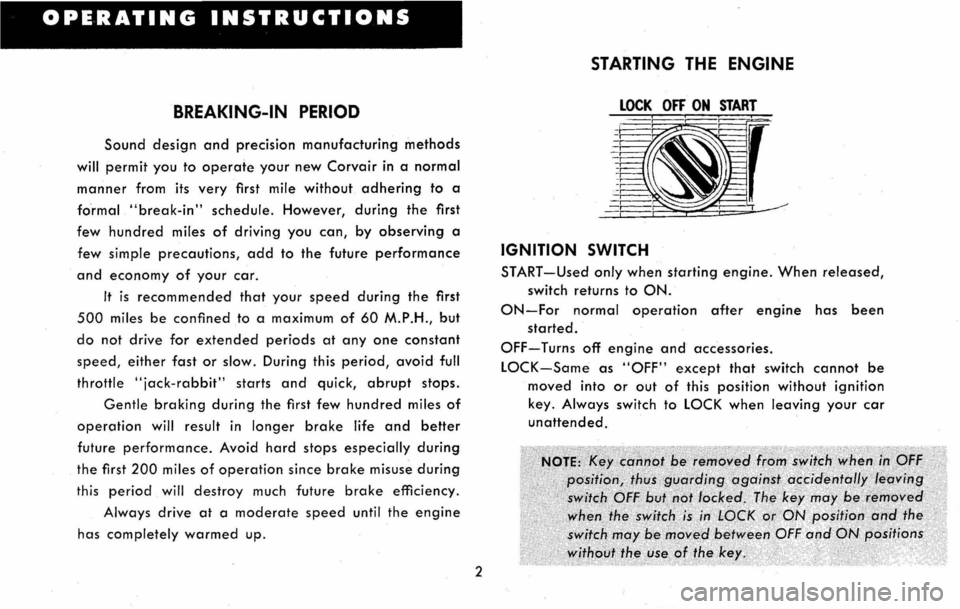
IGNITION SWITCH
START-Used only when starting engine. When released,
switch returns to ON.
ON-For normal operation after engine has been
started.
OFF-Turns off engine and accessories.
LOCK-Same as "OFF" except that switch cannot be
moved into or out of this position without ignition
key. Always switch to LOCK when leaving your car
unattended.
Page 6 of 38
STARTING
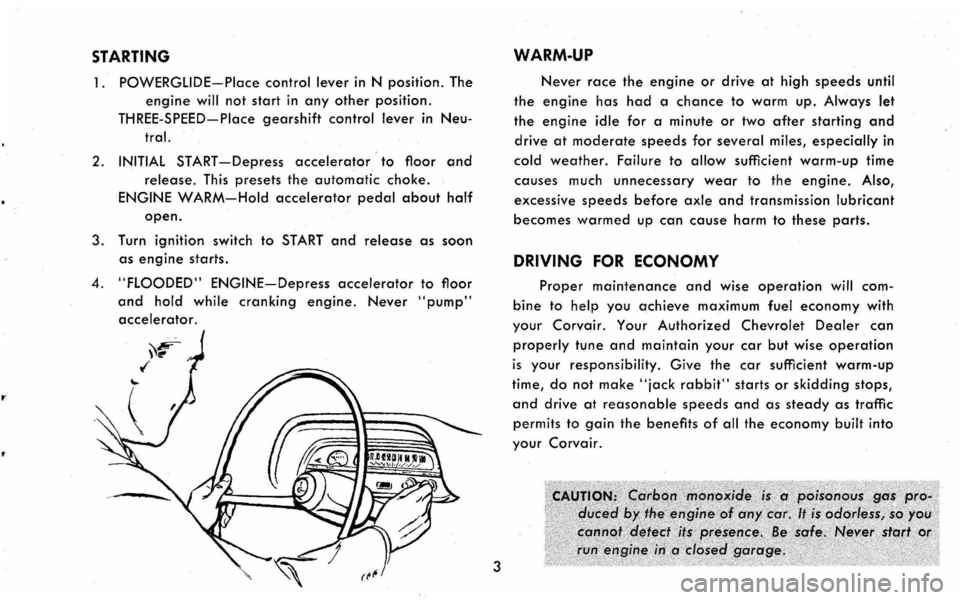
1. POWERGLIDE-Place control lever in N position. The
engine will not start in any other position.
THREE-SPEED-Place gearshift control lever in Neu
tral.
2. INITIAL START -Depress accelerator to floor and
release. This presets the automatic choke.
ENGINE WARM-Hold accelerator pedal about half
open.
3. Turn ignition switch to START and release as soon
as
engine starts.
4.
"FLOODED" ENGINE-Depress accelerator to floor
and hold while cranking engine. Never "pump"
accelerator.
3 WARM-UP
Never race the engine or drive at high speeds until
the engine has had a chance to warm up. Always let
the engine idle for a minute or two after starting and
drive at moderate speeds for several
miles, especially in
cold weather. Failure to allow sufficient warm-up time
causes much unnecessary wear to the engine. Also,
excessive speeds before axle and transmission lubricant
becomes warmed up can cause harm to these parts.
DRIVING FOR ECONOMY
Proper maintenance and wise operation will com
bine to help you achieve maximum fuel economy with
your Corvair. Your Authorized Chevrolet Dealer can
properly tune and maintain your car but wise operation
is your responsibility. Give the car sufficient warm-up
time, do not make "jack rabbit" starts or skidding stops,
and drive at reasonable speeds and as steady as traffic
permits to gain the benefits of all the economy built into
yourCorvair.
Page 7 of 38
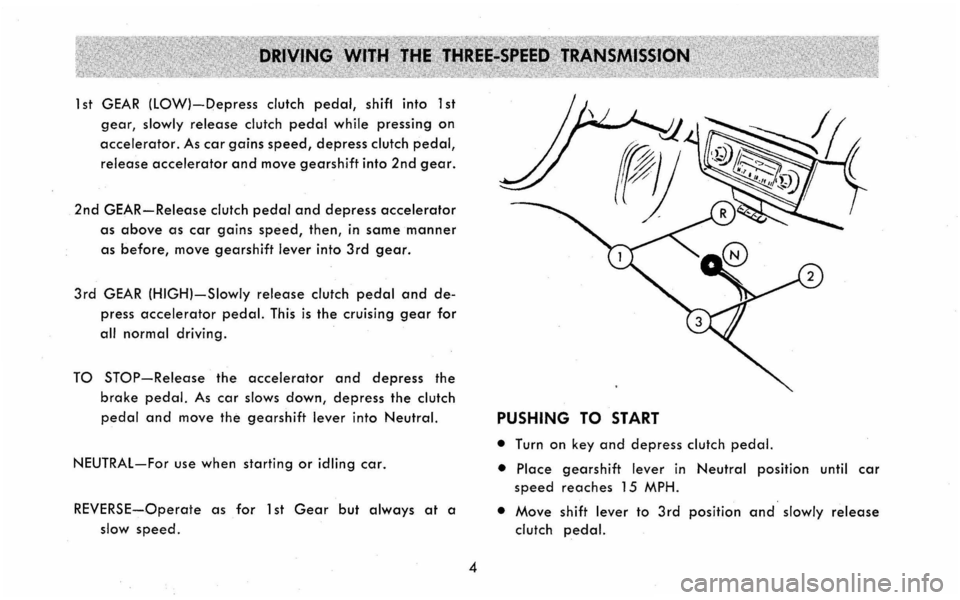
1 st GEAR (lOW}-Depress clutch pedal, shiff into 1 st
gear, slowly release clutch pedal while pressing on
accelerator. As car gains speed, depress clutch pedal,
release accelerator and move gearshift into 2nd gear.
2nd GEAR-Release clutch pedal and depress accelerator
as above as car gains speed, then, in same manner
as before, move gearshift lever into 3rd gear.
3rd GEAR (HIGH}-Slowly release clutch pedal and de
press accelerator pedal. This is the cruising gear for
all normal driving.
TO STOP-Release the accelerator and depress the
brake pedal. As car slows down, depress the clutch
pedal and move the gearshift lever into Neutral.
NEUTRAL-For use when starting or idling car.
REVERSE-Operate as for 1 st Gear but always at a
slow
speed.
4
PUSHING TO START
• Turn on key and depress clutch pedal.
• Place gearshift lever in Neutral position until car
speed reaches 15 MPH.
• Move shift lever to 3rd position and slowly release
clutch pedal.
Page 8 of 38
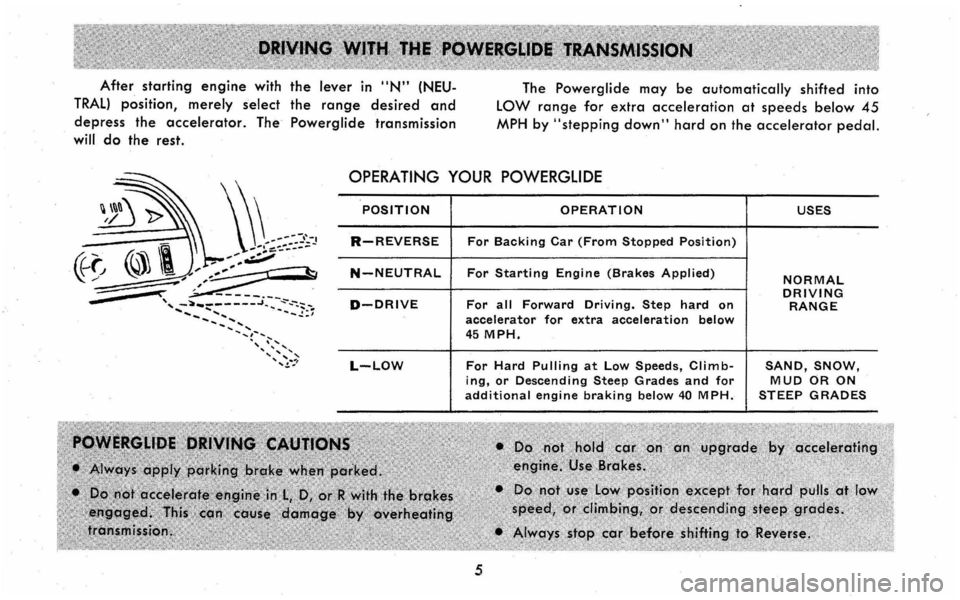
After starting engine with the lever in "N" (NEU
TRAL) position, merely select the range desired and
depress the accelerator. The Powerglide transmission
will do the rest. The
Powerglide may be automatically
shifted into
LOW range for extra acceleration at speeds below 45
MPH by "stepping down" hard on the accelerator pedal.
OPERATING YOUR POWERGLIDE
POSITION OPERATION USES
R-REVERSE For Backing Car (From Stopped Position)
N-NEUTRAL For Starting Engine (Brakes Applied) NORMAL DRIVING D-DRIVE For all Forward Driving. Step hard on RANGE accelerator for extra acceleration below 45 MPH.
L-LOW For Hard Pulling at Low Speeds, Climb-SAND, SNOW, ing, or Descending Steep Grades and for MUD OR ON additional engine braking below 40 MPH. STEEP GRADES
5
Page 9 of 38
POWERGlIDE
PUSHING TO START
• Turn on key and move selector lever to Neutral. At
20 to 25 MPH move lever to "L."
• When engine starts, move selector lever to "D."
NOTE: Never tow to start.
TOWING
• Place selector lever in Neutral.
• If transmission or axle are malfunctioning, tow with
rear wheels raised.
• Never tow faster than 30 MPH.
ROCKING CAR
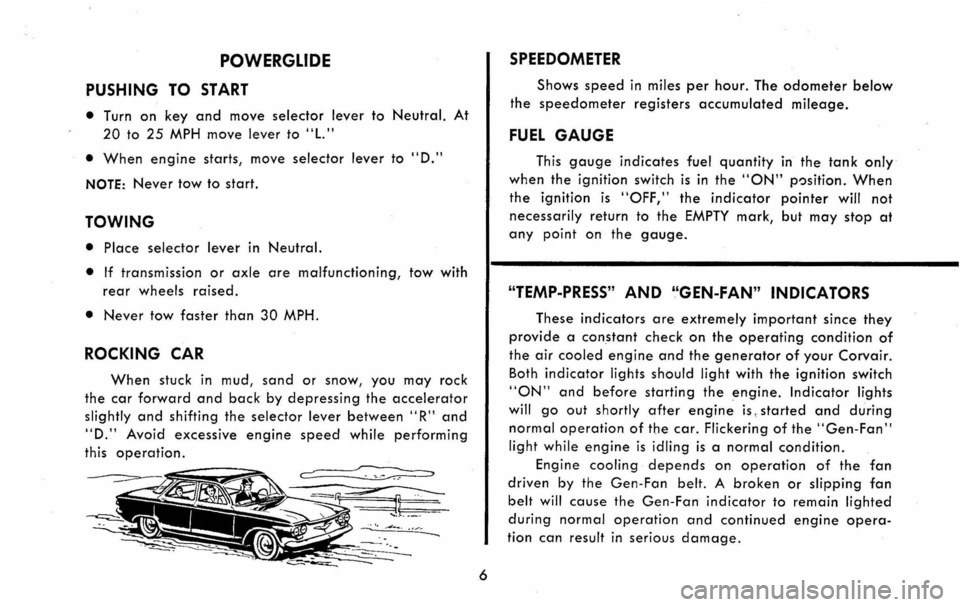
When stuck in mud, sand or snow, you may rock
the car forward and back by depressing the accelerator
slightly and shifting the selector lever between" R" and
"D." Avoid excessive engine speed while performing
this operation.
~ -'.
6
SPEEDOMETER
Shows speed in miles per hour. The odometer below
the speedometer registers accumulated mileage.
FUEL GAUGE
This gauge indicates fuel quantity in the tank only
when the ignition switch is in the "ON" p')sition. When
the ignition is "OFF," the indicator pointer will not
necessarily return to the EMPTY mark, but may stop at
any point on the gauge.
"TEMP-PRESS" AND "GEN-FAN" INDICATORS
These indicators are extremely important since they
provide a constant check on the operating condition of
the air cooled engine and the generator of your Corvair.
Both
indicator lights should light with the ignition switch
"ON" and before starting the engine. Indicator lights
will go out shortly after engine is, started and during
normal operation of the car. Flickering of the "Gen-Fan"
light while engine is idling is a normal condition.
Engine cooling depends on operation of the fan
driven by the Gen-Fan belt. A broken or slipping fan
belt will cause the Gen-Fan indicator to remain lighted
during normal operation and continued engine opera
tion can result in serious damage.