1953 JEEP DJ engine coolant
[x] Cancel search: engine coolantPage 167 of 376

'Jeep*
UNIVERSAL
SERIES
SERVICE
MANUAL
FIG.
G-8—TEMPERATURE SENDING UNIT- HURRICANE
F4
ENGINE
1—Temperature
Sending Unit
b.
Dauntless V-6 Engine.
The
thermo-couple coolant sending unit is mounted
in
the left
rear
area of the intake manifold and is
connected by a single wire to the dash unit of
the instrument cluster.
G-ll.
WATER PUMP
a.
Hurricane
F4 Engine.
The
water pump on the
Hurricane
F4
engine
is a
centrifugal
impeller type of large capacity to
cir
culate water in the entire cooling system. The double row
ball
bearing (Fig. G-9), is integral with
the shaft and is packed at assembly with a special
high melting point grease which
will
last the life of
the bearing. The bearing is sealed to retain the
lubricant
and prevent
dirt
and dust from entering.
The
bearing and shaft are retained in the water
pump body by the bearing retaining wire. The
water
seal bears against the ground seat on the
pump body and the inside of the impeller, maintain
ing a constant pressure against both and preventing
water
leakage. A
drain
hole
in the
bottom
of the
pump body precludes any water
seepage
past the
seal
from entering the bearing.
The
impeller and the pulley hub are pressed on
the shaft under high pressure,
b.
Dauntless V-6 Engine.
A
centrifugal-type water pump, shown in
Fig.
G-10,
circulates
coolant through the Dauntless V-6
engine
and
its cooling system.
This
pump is mounted on
the timing chain cover.
Similar
to the
engine
cooling
fan
mounted on its hub, the pump is driven through
a
V-belt from the crankshaft pulley.
Coolant
enters the water pump at its center.
Centri
fugal force then forces coolant radially outward, through vanes of the pump impeller, and backward
through two discharge passages in the timing chain cover. These passages conduct an equal amount of
coolant to each cylinder bank water jacket.
This
water
pump has a sealed double row
ball
bearing
and
a ceramic water seal, neither of which can be
serviced.
In
event
of bearing or water seal failure, the entire water pump assembly must be replaced.
G-l2.
Water
Pump Inspection
Check
the water pump for leaks, and excessive end play or
looseness
of the shaft in the pump. A
quick
way to check is to work the fan blades up
and
down by hand. If any play is noticed, this
indicates that the bearings are rough. Rough bearings should be checked to see if the water pump
should be replaced or rebuilt.
G-13.
Water Pump
Disassembly
—
Hurricane
F4
Engine
•
Refer to Fig. G-9.
a.
Remove the fan belt, fan blades, and fan pulley.
b.
Remove the
bolts
attaching the water pump
to the block. Remove the pump.
c.
Remove the bearing retainer spring.
d.
Remove the pump impeller and pulley with a suitable puller.
e.
Remove the pump seal, bearing and shaft, and
bearing
slinger.
G-l4.
Water Pump Reassembly
—
Hurricane
F4
Engine
•
Refer to Fig. G-9.
Before assembling the water pump, examine water
seal
seat in the pump body and should it be rough,
install
a new pump body.
To
reassemble the unit, insert the long end of the shaft into the pump body from the front end until
the outer end of the bearing is flush against the
FIG.
G-9—WATER
PUMP-
HURRICANE
F4
ENGINE
1—
Fan
and Pump Pulley
2—
Bearing
and Shaft
3—
Bearing
Retainer Spring
A—Pipe
Plug 5—
Pump
Body
6—
Seal
Washer 7—
Pump
Seal
8—
Impeller
9—
Gasket
167
Page 168 of 376

G
COOLING SYSTEM
12761
FIG.
G-10—WATER
PUMP—
CROSS-SECTIONAL
VIEW
—
DAUNTLESS
V-6
1—
Hub
2—
—Shaft
and Bearing
3—
Cover
4—
Impeller
5—
Ceramic
Seal
6—
Seal
Assembly front end of the pump body. Position the seal,
washer,
and pump seal on shaft flush against the ground seat in the water pump body. Place the
impeller
on an arbor press and press the long end
of the shaft into the impeller until the end of the shaft is flush with the hub of the impeller. Support
the assembly on the impeller end of the shaft and
press the pulley hub on the shaft until the shaft end is flush with the pulley hub. Move the shaft
in
the pump body to align the retaining wire
grooves
in the bearing and pump body and place
the bearing retaining wire in position.
G-l
5. Water Pump Removal and Replacement — Dauntless V-6 Engine
Drain
the cooling system. Remove the fan belt and remove the cooling fan and pulley from the hub on
the water pump. Disconnect the
hoses
from the
water
pump. Remove the cap screws that secure
the water pump to the timing chain cover; remove
the water pump. Do not disassemble the water
pump;
it is serviceable only as an assembly. When
replacing
the water pump, torque the water pump cap screws 6 to 8 lb-ft. [0,829 a 1,106 kg-m.].
G-16.
Antifreeze Solutions
When
water freezes it expands approximately 9%
in
volume. When water, confined in a cooling sys
tem, freezes it exerts tremendous pressures causing
serious damage. To prevent freezing, antifreeze can
be added to the water to lower its freezing point.
The
two
types
of antifreeze commonly used today have either a methanol or ethylene glycol base,
and
contain corrosion inhibitors. The only anti
freeze recommended for the cooling system of
'Jeep'
vehicles is ethylene glycol (permanent type).
Methanol
base antifreeze evaporates with the water
when the vehicle is operated at warmer tempera
tures and requires more attention to avoid
loss
of
protection. Ethylene glycol base antifreeze seldom
evaporates at normal operating temperatures.
Methanol
solution is injurious to vehicle finishes.
Should
any be spilled on the vehicle, it should be
washed off immediately with a
good
supply of cold water without wiping or rubbing. Under ordi
nary
conditions, ethylene glycol is not injurious to
vehicle finishes.
Warning.*
Drinking
ethylene glycol antifreeze or its
solutions can be harmful or fatal. Do not use anti
freeze containers for
food
or beverages.
A
table in Par.
G-2
2
gives
the protection obtained
by the addition of various amounts cf ethylene glycol.
Before installing antifreeze, inspect the cooling sys
tem to be sure it is clean, leak-proof, and otherwise
in
proper operating condition.
Drain
the cooling system, see Par. G-3. Pour in 3 quarts [3 ltr.] of
clean
water, add the required quantity of anti freeze, then add clean water to within 1" [2,54 cm.] of the top of the overflow pipe to allow for expan
sion when hot. Run the
engine
until it is
warm.
Then
recheck the solution level.
Check
the anti
freeze protection with a hydrometer reading.
G-l7.
Inhibited Coolant Solutions
All
'Jeep5 vehicles equipped with either the
Hur
ricane
F4 or Dauntless V-6
engine
should use only
inhibited
year-round, permanent-type
engine
cool
ant
solutions that are formulated to withstand two
full
calendar years of normal operation without
draining
or adding inhibitors. The
engine
cooling
system should be completely drained and the
rec
ommended coolant installed every two years. Be-
fo
a
installing the permanent-type solution, inspect the cooling system to be sure it is clean, leakproof,
and
in proper operating condition.
Note:
Water alone, methanol, or alcohol-type anti
freeze is definitely not recommended for 'Jeep*
Vehicles.
G-l8.
Fan Belt
The
fan, water pump, generator or alternator are
driven
by a V-belt. The drive of the V-belt is on
the side of the V. A fan belt that is too tight
will
cause
rapid
wear of the alternator or generator and
water
pump bearings. If the belt is too
loose,
it may
slip
preventing the water pump from properly cool
ing the
engine
or the generator or alternator from
properly
charging the electrical
circuit.
Use fan belt
tension
gauge
Tool W-283 to properly adjust belt.
The
fan belt is properly adjusted when it can be
deflected Vi" [13 mm.] with strong thumb pres
sure
applied midway
between
the fan and alter
nator
pulleys.
Check
this adjustment and inspect the condition of the fan belt at each
engine
lubri-
168
Page 169 of 376
'Jeep'
UNIVERSAL
SERIES SERVICE
MANUAL
G
cation period. It is
good
preventive maintenance to
replace a badly frayed, worn or cracked fan belt
before it breaks in operation.
To
replace the fan belt,
loosen
the attaching
bolts
at each generator or alternator brace-to-engine mounting and pivot the alternator or generator to
ward
the
engine
to gain slack needed to install the new belt Remove the old belt. Position the new
belt over the fan pulley, over the crankshaft pulley,
then over the generator or alternator pulley.
Pull
the generator or alternator away from the
engine
until
belt tension is
firm.
Then tighten the generator
or
alternator mounting
bolts
and check the tension
as indicated above. Reset the generator or alternator as necessary for correct belt tension.
Finally,
torque
the generator or alternator mounting
bolts
25 to 35 lb-ft. [3,4 a 4,8 kg-m.].
Note:
On the Dauntless V-6
engine
when adjusting
the fan belt tension, the alternator mounting
bolts
should be torqued 30 to 40 lb-ft. [4,14 to 5,53
kg-m.].
If a fan belt tension
gauge
(W-283) is
avail
able, proper tension should be 80 pounds [36,2 kg.].
G-l
9. Engine Overheating
An
engine
will
not be damaged by high coolant
temperatures unless the coolant boils. The pres
surized
cooling system on the 'Jeep' vehicles raises the boiling point of the coolant solution. Should
overheating be encountered, and the fault is be
lieved to be in the cooling system check for the
following:
a.
Proper coolant level. See
Filling
Cooling Sys
tem Par. G-2.
b. Poor air flow.
Check
for dirty radiator core. (See Radiator Par. G-5).
Check
for faulty belt
pulley operation, worn or
loose
fan belt, or dam aged fan.
Clean,
repair, replace or adjust as neces
sary.
c. Foaming coolant.
Check
for air leaks at water
pump,
hose
connection and filler cap. Tighten, re
pair
or replace as necessary.
d.
Surging or "after boil".
Check
pressure cap and
replace if valves or gasket are faulty.
e.
External
leaks.
Check
the following for leaks:
Hoses and clamps, water pump, radiator, head gas
ket, core plugs and drain cocks, as well as the cylin der head or block for
cracks.
f.
Internal
leaks.
Check
for faulty head gasket,
cracked
cylinder head or block.
g. Poor coolant flow.
Check
hose
condition, water pump, fan belt, and repair or replace as necessary. Inspect block for rust or scale, and clean and flush
the system, if necessary.
h.
Check
the temperature
gauge.
169
Page 170 of 376
G
COOLING SYSTEM G-20.
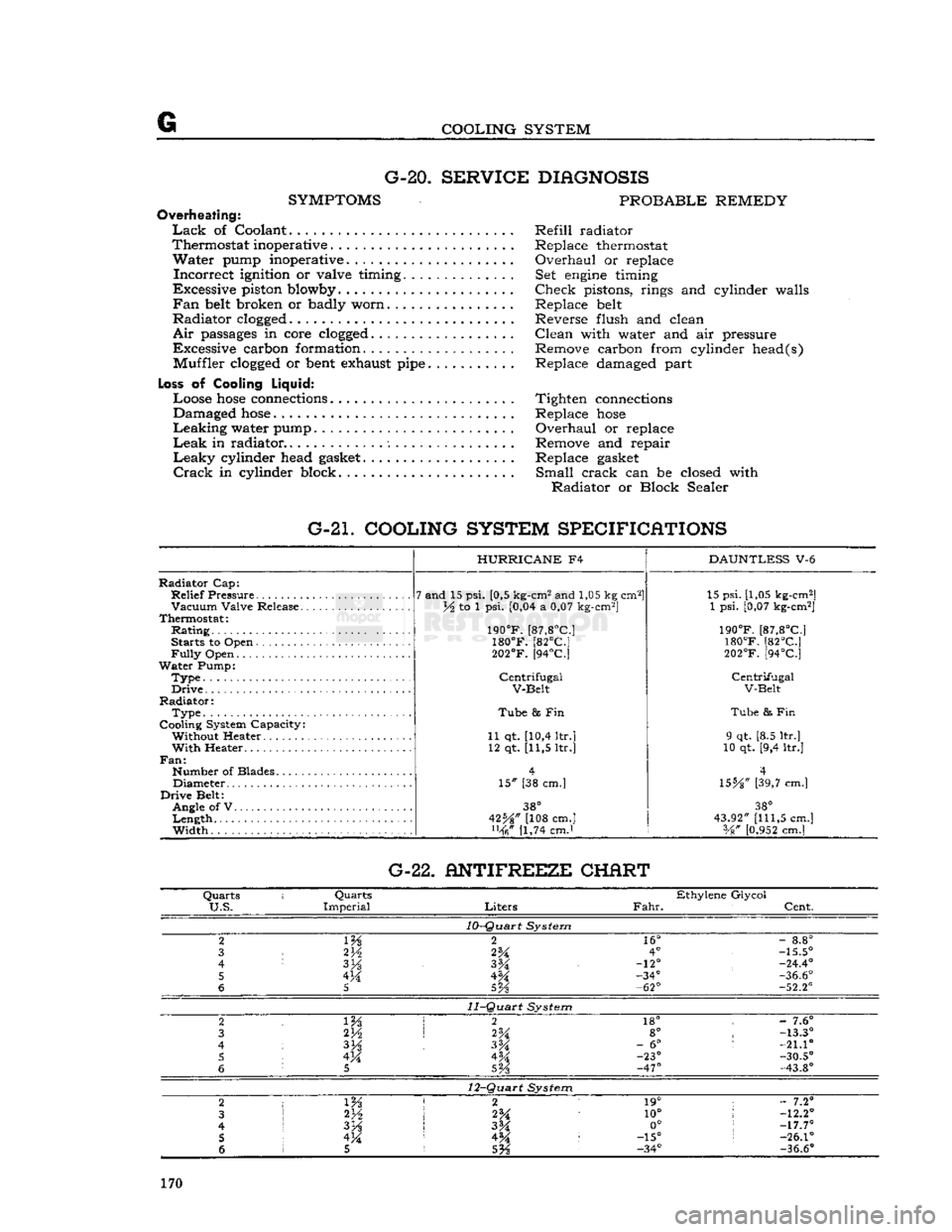
SERVICE DIAGNOSIS
SYMPTOMS
PROBABLE REMEDY
Overheating:
Lack
of Coolant Refill radiator
Thermostat inoperative . Replace thermostat
Water
pump inoperative. Overhaul or replace
Incorrect
ignition or valve timing. Set
engine
timing
Excessive piston blowby Check pistons, rings and cylinder walls
Fan
belt
broken or badly worn Replace
belt
Radiator
clogged
Reverse flush and clean
Air
passages
in core
clogged
Clean with water and air pressure
Excessive carbon formation. Remove carbon from cylinder head(s) Muffler
clogged
or
bent
exhaust
pipe
Replace damaged part
Loss
of Cooling
Liquid:
Loose
hose
connections
Tighten
connections
Damaged
hose
Replace
hose
Leaking
water pump Overhaul or replace
Leak
in radiator Remove and repair
Leaky
cylinder head
gasket
Replace
gasket
Crack
in cylinder block. Small crack can be closed with
Radiator
or Block Sealer
G-21. COOLING SYSTEM SPECIFICATIONS
Radiator
Cap:
Relief
Pressure
Vacuum
Valve Release.
Thermostat:
Rating
Starts to Open
Fully
Open
Water
Pump:
Type.
Drive
Radiator:
Type
Cooling System Capacity: Without Heater
With
Heater..
Fan:
Number of Blades Diameter
Drive
Belt: Angle of V
Length
Width
HURRICANE
F4
7 and 15 psi. [0,5 kg-cm2 and 1,05 kg cm2]
lA to 1 psi. [0,04 a 0,07 kg-cm2]
190°F.
[87,8°C]
180°F.
[82°C]
202°F.
[94°C]
Centrifugal
V-Belt
Tube
8s Fin
11 qt. [10,4 ltr.] 12 qt. [11,5 ltr.]
15" [38 cm.]
38°
42%" [108 cm.] [1,74 cmJ
DAUNTLESS
V-6 15 psi. [1,05 kg-cm2]
1 psi. [0,07 kg-cm2]
190°F.
[87,8°C]
180°F.
[82°C]
202°F.
[94°C]
Centrifugal
V-Belt
Tube
& Fin
9 qt. [8.5 ltr.]
10 qt. [9,4 ltr.]
4
\SbA"
[39,7 cm.]
38°
43.92"
[111,5
cm.] Vg"
[0.952
cm.] G-22. ANTIFREEZE CHERT
Quarts
i
Quarts
Ethylene Glycol
U.S.
Imperial
Liters
Fahr.
Cent.
10-Quart
System
2
m
2
16°
-
8.8°
3
2V2
2%
4°
-15.5°
4
3H
-12°
-24.4°
5 4M -34°
-36.6°
6
5
5Vs
-62°
-52.2°
11-Quart
System
2 2
18° -
7.6°
3 2H
2%
8°
-13.3°
4
3%
-
6°
:
-21.10
5 4M 4M -23°
-30.5°
6
5
SVs
-47°
-43.8°
12-Quart
System
2
1 m 2 1
19° ;
- 7.2°
3
2*A
10°
!
-12.2°
4
I
3H
3M 0°
;
-17.7°
5 !
4M 4^ :
-15°
s
-26.1°
6 1 5
5%
-34°
-36.6°
170
Page 212 of 376

H
ELECTRICAL
SYSTEM
H-124. Testing Indicators and Gauges
Two
gauges
(fuel and temperature) and two in dicators (oil pressure and battery charge) that are
located in the instrument cluster are electrically operated.
The
fuel
gauge
is connected by a single wire to a
float-and-slide-rheostat sending unit in the fuel
tank.
The
temperature
gauge
is connected by a single
wire
to a resistance-type sending unit mounted on the engine.
The
battery charge indicator operates when there
is a difference in potential
between
the generator
and
the battery
.The
battery charge indicator lights
when the generator is not charging the battery. The
indicator
light
goes
out when the generator
begins
to charge the battery.
The
oil pressure indicator is connected by a single
wire
to a diaphragm switch located on the engine.
When
engine
oil pressure is low or zero and the
ignition switch is on, the oil pressure indicator
will
light. When
engine
speed is increased slightly above idle speed, raising the oil pressure to approximately 6 psi. [0,2 kg-cm2], the diaphragm switch
will
open the circuit and the indicator light
will
go out.
A
voltage
regulator maintains a constant
voltage
to the
gauges
in normal operation. On early vehicles,
this
voltage
regulator was mounted on the
rear
of
the instrument cluster. On current vehicles, the
voltage
regulator is integral with the fuel
gauge.
Should
trouble
develop
in the
gauges,
first check the regulator (fuel
gauge
on current production vehicle). If the
voltage
to the regulator is below 10 volts system low
gauge
readings
will
result.
Voltage in
excess
of 16 volts
will
not affect
gauge
readings but may result in premature wear of the
regulator contacts. If the
voltage
to the regulator is
within
the above limits, check the electrical con nections to the regulator (or fuel gauge), especially
the ground connection. If the readings of all the
gauges
is too high, or they all read too low, replace
the regulator (or fuel gauge).
If
the temperature
gauge
or heat indicator in the
instrument cluster have failed, the cause may
originate from the jumper bar shorting out against the instrument case.
Check
the jumper bar
between
the temperature
gauge
and heat indicator at the
rear
of the instrument case. On later production vehicles, the jumper bar is covered with an in
sulating
sleeve
to protect it from shorting out
against the instrument case. If the jumper bar
does
not have this
sleeve,
either install one or
wrap
the bar with plastic electrical tape to
half
an
inch [12,7 mm.] from each end. When installing the jumper bar, be sure the curved
segment
is
closest to the fuel
gauge.
Should
only one of the two
gauges
register incor
rectly,
check the lead wire from the
gauge
to the
sending unit for shorts or open connections. Next disconnect the
gauge
from the sending unit, and
connect the
gauge
to a new fuel tank sending unit
which
has been grounded to the vehicle.
If
the
gauge
registers incorrectly when operating the new unit,
replace the
gauge;
if correctly, replace the sending
unit.
Should
a new fuel tank unit not be available for testing, use a 12-volt
test
light in its place. When
the
gauge
is operating correctly, the pointer
will
move
approximately three-quarters across the
dial.
On
some
vehicles, the temperature
gauge
may
register on or
close
to the H (hot)
mark
when
coolant temperature is
190°F.
to
200°F.
[88°C.
a
93°C.].
In such cases, a 25-ohm,
1-watt
resistor
may be installed on the temperature
gauge
which
will
place the pointer just beyond the center
mark
at a coolant temperature of
190°F.
to
200°F.
Install
the resistor
between
the two terminals on the back
of the
gauge.
Insulate the
exposed
leads of the resistor with electrical tape.
If
the oil pressure indicator
does
not indicate cor
rectly,
first check the light bulb. Next check all
connections and lead wires. If, after all possible
defects
are corrected, the indicator light
does
not go on and off properly, then the diaphragm type
switch in the cylinder block should be replaced.
H-12S.
LIGHTING SYSTEM The
wiring of the lighting systems is shown in
the wiring diagrams, which indicate the various units in relation to their positions in the vehicle.
The
wires in the various circuits are of different
colors or are marked by tracers to aid when check
ing individual circuits.
The
lighting circuits of all models are protected by
an
overload circuit breaker mounted on the back of the main light switch and no replaceable fuse is
required.
The
upper and lower headlight beams are con
trolled by a
foot
switch located on the toe board
to the left of the clutch pedal.
H-126.
Main
Light
Switch
This
switch is a dual functioning unit having two
push-pull
positions and a rotary action. When
pulled out to the first position, the front parking
and
tail
lights are turned on. When pulled all the
way out to the second position, the headlights and
tail
lights are turned on. Rotating the switch to
the right dims the instrument cluster lighting.
The
switch may be removed from the instrument
panel by first loosening the set screw in the control
knob and removing the knob. The retaining nut may then be removed and the switch removed
through the
rear
of the instrument panel.
FIG.
H-51—MAIN
LIGHT
SWITCH
(EARLY)
1—
Battery
4—Parking Lights
2—
Rear
Lights 5—Auxiliary
3—
Head
Lights
212
Page 359 of 376

'Jeep*
UNIVERSAL
SERIES
SERVICE
MANUAL
U
U-10. FRESH AIR HEATER AND
DEFROSTER
Refer to Fig. U-4.
Air
circulation of the
heater
and
defroster
unit
is
accomplished
by the use of a
12-volt,
two-speed
fan
motor.
Outside
air may be drawn
through
the
vehicle
fresh air
intake
shroud
into
the fan and
blown
out
across
the
heater
core
where
it is
heated
by the
hot circulating
coolant
from the
engine.
The
heated
air
then
enters
the transition
duct.
From the transi
tion
duct
the
heated
air
passes
into
the
heat
distri
butor
where
it is
distributed
to the
defroster
nozzle
and/or
floor
diffuser.
The
heater
and
defroster
controls
are
mounted
in the
control
panel
on the
instrument
panel. A
three-position
switch
mounted
in the
control
panel
operates
the
heater
fan.
FIG.
U-3—FRONT
BUMPER
WEIGHT
FIG.
U-4-
-FRESH
AIR
HEATER
AND
DEFROSTER
CJ-5
AND CJ-6 _ 1— Heater Assembly
2— Hose Clamp
3— Defroster
Nozzle
4—
Air
Duct Screen 5—
Air
Duct and Heater Collar
6—
Air
Duct Intake Tube 7— Hose Clamp
8— Straight Hot Water Hose
9— Heater Tube Elbow
10—Heater Hose Support Bracket
I
j—Defroster Hose
12— Hot Water Hose
13— Heater Nipple
14— Reducing Bushing
15— Inverted Flared Tube Nut
16— Inverted Flared Tube Connector
17— Heater Vacuum to Engine Tube
18— Heater Control Tube
19—
Clip
20— Grommet
21— Defroster Bushing
22— Heat Distributor Assembly
23— Heater Control Tube
24— Heater Control Tube
25— Heater Control Assembly
26—
Fuse
Holder Assembly
27— Bowden Wire (Control Panel to Heater)
28— Blower and Air Inlet Assembly 359