1953 JEEP CJ lock
[x] Cancel search: lockPage 337 of 376
'Jeep'
UNIVERSAL
SERIES SERVICE
MANUAL
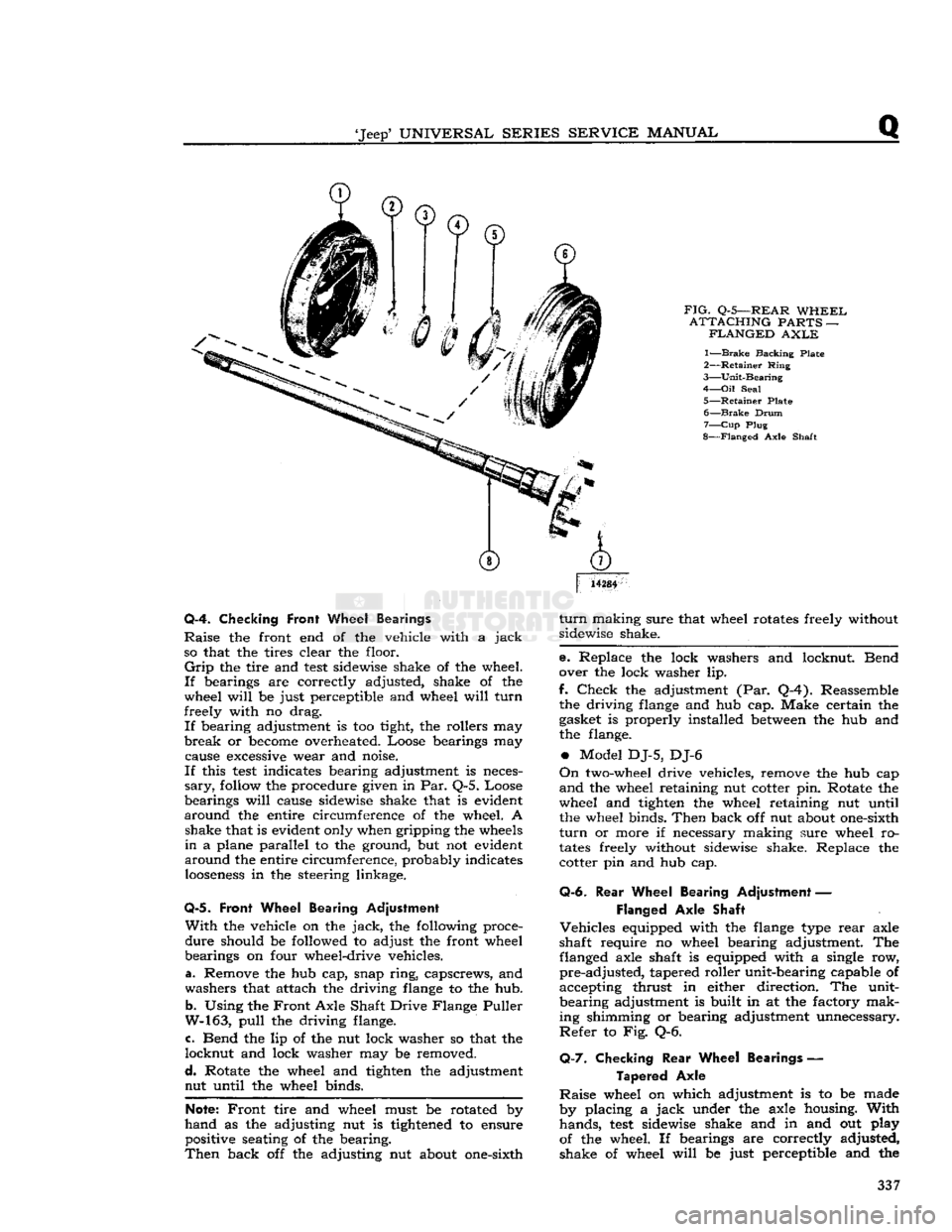
FIG.
Q-5—REAR
WHEEL
ATTACHING
PARTS —
FLANGED
AXLE
1—
Brake
Backing Plate
2—
Retainer
Ring
3—
Unit-Bearing
4—
Oil
Seal
5—
Retainer
Plate 6—
Brake
Drum
7—
Cup
Plug
8—
Flanged
Axle Shaft
14284
Q-4. Checking
Front
Wheel Bearings
Raise
the front end of the vehicle with a
jack
so that the tires clear the floor.
Grip
the tire and
test
sidewise shake of the wheel.
If
bearings are correctly adjusted, shake of the
wheel
will
be just perceptible and wheel
will
turn
freely with no drag.
If
bearing adjustment is too tight, the rollers may
break
or
become
overheated. Loose bearings may cause
excessive
wear and noise.
If
this
test
indicates bearing adjustment is neces
sary,
follow
the procedure given in Par. Q-5. Loose
bearings
will
cause sidewise shake that is evident
around
the entire circumference of the wheel. A shake that is evident only when gripping the
wheels
in
a plane parallel to the ground, but not evident
around
the entire circumference, probably indicates
looseness
in the steering linkage.
Q-5.
Front Wheel Bearing Adjustment
With
the vehicle on the
jack,
the following proce
dure
should be followed to adjust the front wheel
bearings on four wheel-drive vehicles.
a. Remove the hub cap, snap
ring,
capscrews, and
washers that attach the driving
flange
to the hub.
b.
Using the
Front
Axle Shaft Drive Flange Puller
W-163,
pull
the driving flange.
c. Bend the lip of the nut lock washer so that the
locknut
and lock washer may be removed.
d.
Rotate the wheel and tighten the adjustment nut until the wheel binds.
Note:
Front
tire and wheel must be rotated by
hand
as the adjusting nut is
tightened
to ensure positive seating of the bearing.
Then
back off the adjusting nut about one-sixth
turn
making sure that wheel rotates freely without
sidewise shake.
e. Replace the lock washers and locknut. Bend
over the lock washer lip.
f.
Check
the adjustment (Par. Q-4). Reassemble the driving
flange
and hub cap. Make certain the
gasket is properly installed
between
the hub and
the flange.
•
Model DJ-5, DJ-6
On
two-wheel drive vehicles, remove the hub cap
and
the wheel retaining nut cotter pin. Rotate the
wheel and tighten the wheel retaining nut until the wheel binds.
Then
back off nut about one-sixth
turn
or more if necessary making sure wheel ro
tates
freely without sidewise shake. Replace the cotter pin and hub cap.
Q-6.
Rear
Wheel Bearing Adjustment —
Flanged
Axle Shaft
Vehicles
equipped with the
flange
type
rear
axle
shaft require no wheel bearing adjustment. The flanged axle shaft is equipped with a single row,
pre-adjusted,
tapered roller unit-bearing capable of
accepting thrust in either direction. The unit-
bearing
adjustment is built in at the factory mak
ing shimming or bearing adjustment unnecessary.
Refer
to Fig. Q-6.
Q-7.
Checking
Rear
Wheel Bearings —
Tapered
Axle
Raise
wheel on which adjustment is to be made
by placing a
jack
under the axle housing.
With
hands,
test
sidewise shake and in and out play
of the wheel. If bearings are correctly adjusted,
shake of wheel
will
be just perceptible and the 337
Page 345 of 376
'Jeep'
UNIVERSAL
SERIES
SERVICE
MANUAL
s
SPRINGS
AND
SHOCK
ABSORBERS
Contents
SUBJECT
PAR. SUBJECT PAR.
Pivot Bolts S-3 Spring Removal S-4
Shock
Absorbers S-7 Spring Shackles S-2
Spring
Installation S-5 U-Shackles S-6
S-1.
GENERAL
Semielliptical
leaf springs are used for all models.
The
springs are hung longitudinally from the frame
side rails by means of brackets welded to the
rails.
All
axles are firmly attached to the springs by U-
bolts
(spring clips), spring saddles welded to the
underside of the axles, and spring plates under the
springs.
Early
model DJ-5 and DJ-6 front axles (I beam) are attached to the springs with conven
tional
bolts
and spring plates. Spring center
bolts
are
inserted in the axle spring saddles to prevent
shifting of the axle.
All
front springs, except as noted below, are provided with shackles at the front ends of the springs
and
pivot
bolts
at the
rear
ends of the springs. Model CJ-5 up to
Serial
No. 44437 and Model
CJ-6
up to
Serial
No. 11981 are provided with shackles at the
rear
ends of the front springs, and
pivot
bolts
at the front ends.
Note:
Models
CJ-5A
and
CJ-6A
are equipped with
the two
stage
type front and
rear
spring.
All
rear
springs are provided with shackles at the
rear
end and pivot
bolts
at the front end.
Springs
should be examined periodically for broken
or
shifted leaves,
loose
or missing rebound clips,
angle of spring shackles, and position of springs
on the saddles. Springs with shifted leaves do not have their normal strength. Missing rebound clips may permit the spring leaves to fan out or break
on rebound. Broken leaves may make the vehicle
hard
to handle or permit the axle to shift out of
line.
Weakened springs may break causing difficulty
in
steering. Spring attaching clips or
bolts
must be tight. It is
suggested
that they be checked at each
vehicle inspection and torqued 45 to 55 lb-ft. [6,2 a 7,6 kg-m.].
S-2.
Spring Shackles
Rubber-bushed
shackles are provided on all current
production vehicles. The steel-backed rubber (silent bloc) bushings are pressed into the spring
eyes
and mounting brackets. The shackle
bolts
tighten the side plates against the inner steel back
ing of the bushings. Oscillation of the springs is
taken in the rubber bushings.
All
vehicles produced before early 1957 were
equipped with U-shackles and threaded core bush-
*3(
21-
to It is
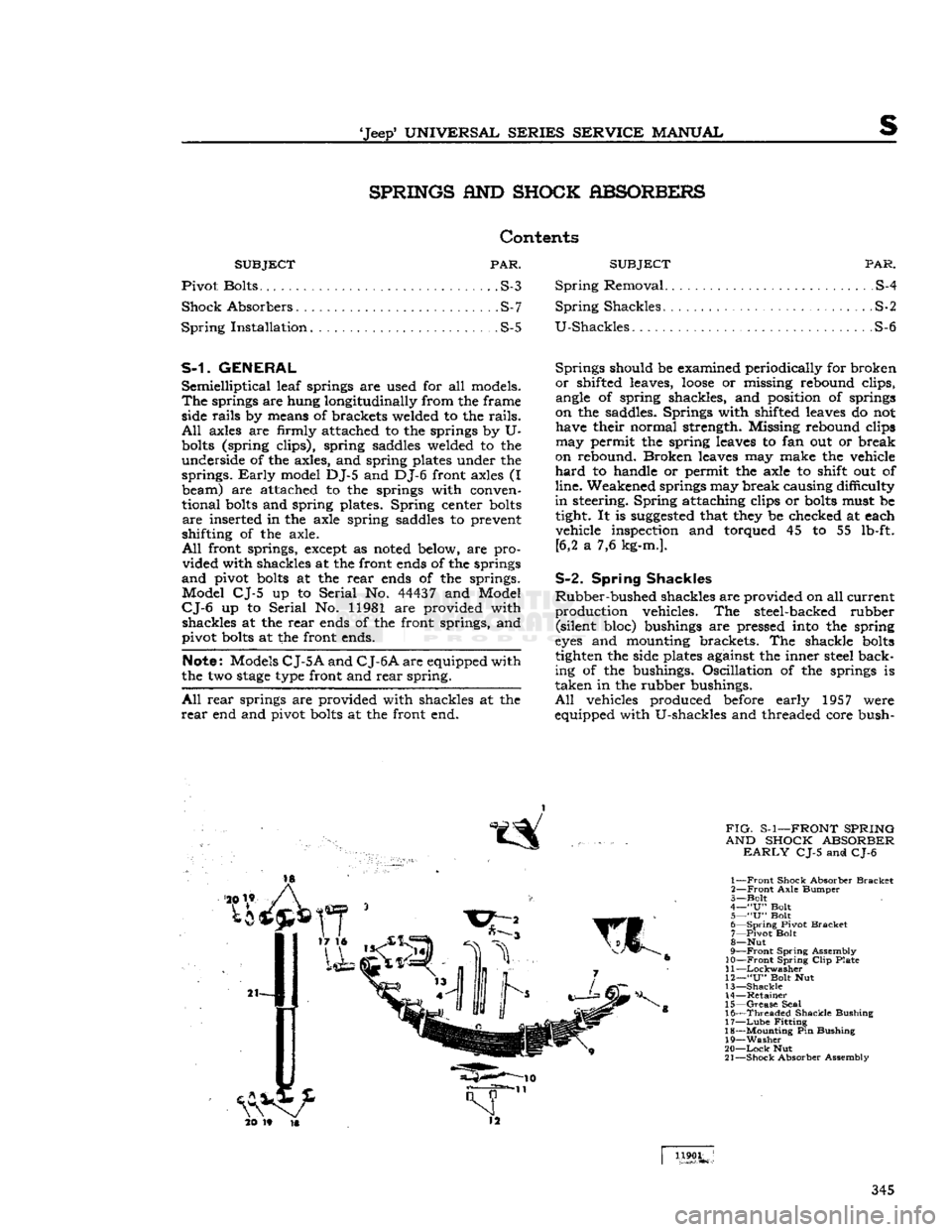
FIG-
S-1—FRONT SPRING
AND SHOCK ABSORBER
EARLY
CJ-5 and CJ-6
1—
Front
Shock Absorber
Bracket
2—
Front
Axle
Bumper
3—
Bolt
4—
"U"
Bolt
5—
"U"
Bolt
6—
Spring
Pivot
Bracket
7—
Pivot
Bolt
8—
Nut
9—
Front
Spring
Assembly
10—Front
Spring
Clip
Plate
11
—Lockwasher
12—
"U"
Bolt Nut
13—
Shackle
14—
Retainer
15—
Grease
Seal
16—
Threaded
Shackle
Bushing
17—
Lube
Fitting
18—
Mounting
Pin Bushing
19—
Washer
20—
Lock
Nut
21—
Shock
Absorber Assembly
1190L
345
Page 346 of 376
SPRINGS
AND
SHOCK
ABSORBERS
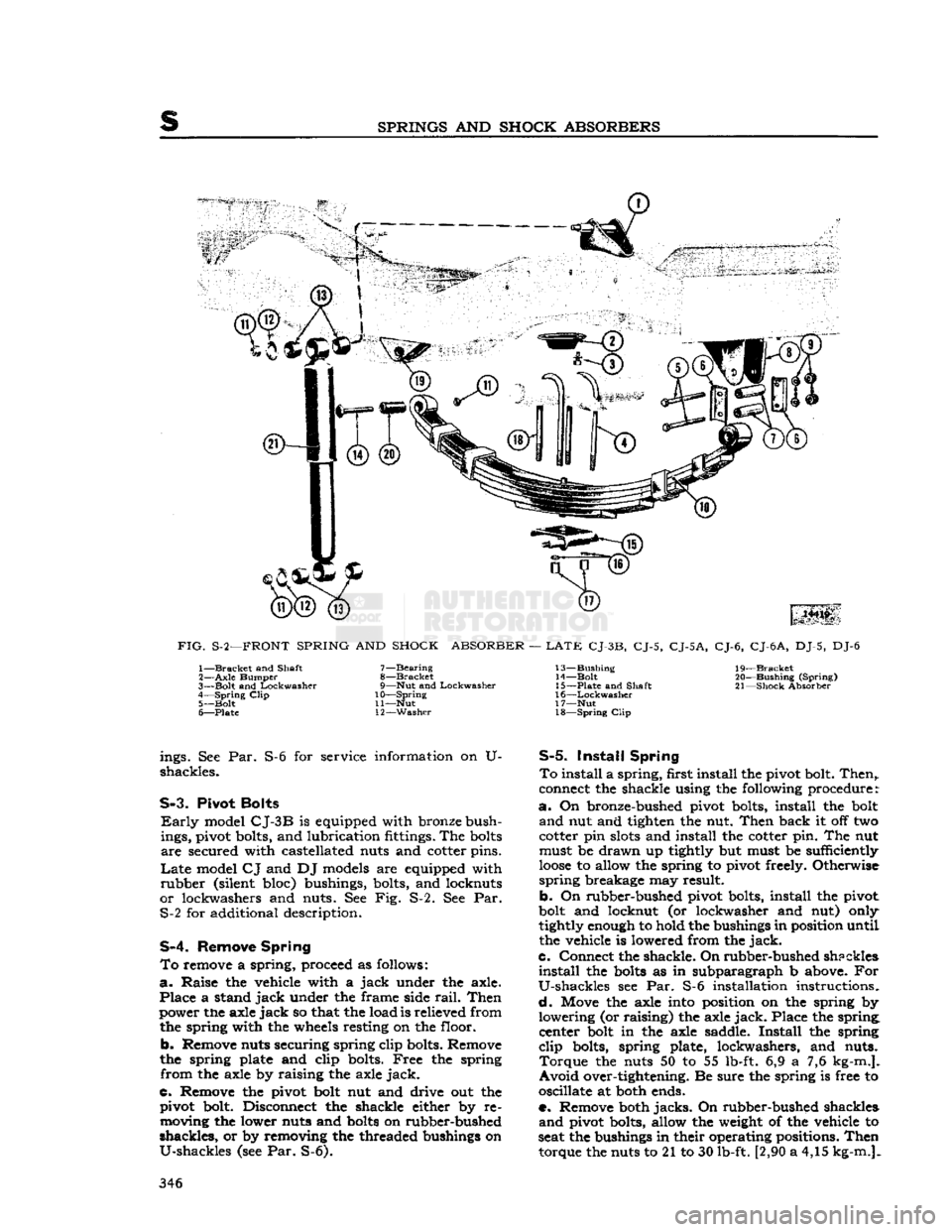
FIG.
S-2—FRONT
SPRING
AND
SHOCK
ABSORBER
—
LATE
CJ-3B,
CJ-5,
CJ-5A,
CJ-6,
CJ-6
A,
DJ-5, DJ-6 1—
Bracket
and Shaft
2—
Axle
Bumper
3—
Bolt
and
Lockwasher
4—
Spring
Clip
5—
Bolt
6—
Plate
7—
Bearing
8—
Bracket
9—
Nut
and
Lockwasher
10—
Spring
11—
Nut
12—
Washer
13—
Bushing
14—
Bolt
15—
Plate
and Shaft
16—
Lockwasher
17—
Nut
18—
Spring
Clip
19—
Bracket
20—
Bushing
(Spring)
21—
Shock
Absorber ings. See Par.
shackles.
S-6 for service information on U-
S-3.
Pivot
Bolts
Early
model
CJ-3B
is equipped with bronze bush
ings, pivot bolts, and lubrication fittings. The
bolts
are
secured with castellated nuts and cotter pins.
Late
model
CJ
and DJ models are equipped with
rubber
(silent bloc) bushings, bolts, and locknuts
or
lockwashers and nuts. See Fig. S-2. See Par. S-2 for additional description.
S-4.
Remove
Spring
To
remove a spring, proceed as follows:
a.
Raise
the vehicle with a
jack
under the axle.
Place
a stand
jack
under the frame side
rail.
Then
power the axle
jack
so that the load is relieved from the spring with the wheels resting on the floor.
b.
Remove nuts securing spring clip bolts. Remove
the spring plate and clip bolts.
Free
the spring
from
the axle by raising the axle
jack.
C.
Remove the pivot bolt nut and drive out the pivot bolt. Disconnect the shackle either by removing the lower nuts and
bolts
on rubber-bushed
shackles,
or by removing the threaded bushings on
U-shackles
(see Par. S-6).
S-5.
Install
Spring
To
install a
spring,
first install the pivot bolt.
Then,,
connect the shackle using the following procedure:
a.
On bronze-bushed pivot bolts, install the bolt
and
nut and tighten the nut.
Then
back it off two
cotter pin
slots
and install the cotter pin. The nut must be
drawn
up tightly but must be sufficiently
loose
to allow the spring to pivot freely. Otherwise
spring
breakage may result.
b.
On rubber-bushed pivot bolts, install the pivot
bolt and locknut (or lockwasher and nut) only
tightly enough to hold the bushings in position until
the vehicle is lowered from the
jack.
c.
Connect the shackle. On
rubber-bushed
shpckles
install
the
bolts
as in subparagraph b above. For
U-shackles
see Par. S-6 installation instructions.
d.
Move the axle into position on the spring by
lowering
(or raising) the axle
jack.
Place the spring, center bolt in the axle saddle.
Install
the spring
clip
bolts, spring plate, lockwashers, and nuts.
Torque
the nuts 50 to 55 lb-ft. 6,9 a 7,6 kg-m.].
Avoid
over-tightening. Be sure the spring is free to
oscillate at both ends.
e. Remove both
jacks.
On rubber-bushed shackles
and
pivot bolts, allow the weight of the vehicle to
seat the bushings in their operating positions.
Then
torque the nuts to 21 to 30 lb-ft. [2,90 a 4,15 kg-m.]. 346
Page 347 of 376
'Jeep'
UNIVERSAL
SERIES
SERVICE
MANUAL
S
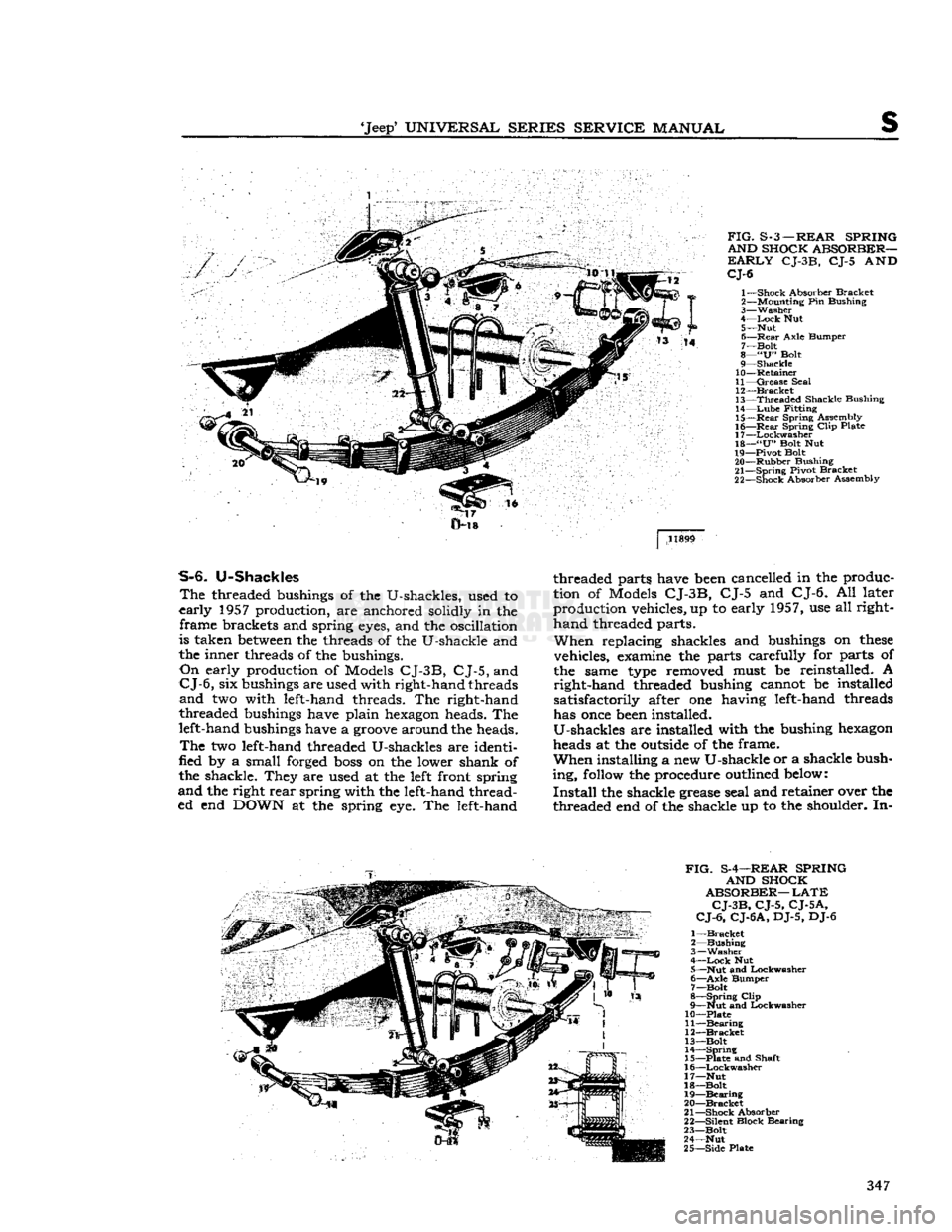
FIG.
S-3—REAR SPRING
AND SHOCK ABSORBER—
EARLY
CJ-3B,
CJ-5 AND
CJ-6
1— Shock Absorber Bracket
2— Mounting Pin Bushing
3—
Washer
4—
Lock
Nut 5— Nut
6—
Rear
Axle Bumper
7— Bolt
8—
"U"
Bolt
9—
Shackle
10—
Retainer
11—
Grease
Seal
12—
Bracket
13—
Threaded
Shackle Bushing
14—
Lube
Fitting
15—
Rear
Spring Assembly
16—
Rear
Spring
Clip
Plate
17—
Lockwasher
18—
"U"
Bolt Nut
19— Pivot Bolt 20—
Rubber
Bushing
21—
Spring
Pivot Bracket
22— Shock Absorber Assembly 11899
S-6. U-Shackles
The
threaded bushings of the U-shackles, used to
early
1957 production, are anchored solidly in the frame brackets and spring
eyes,
and the oscillation
is taken
between
the threads of the U-shackle and
the inner threads of the bushings.
On
early production of Models
CJ-3B, CJ-5,
and
CJ-6,
six bushings are used with right-hand threads
and
two with left-hand threads. The right-hand
threaded bushings have plain
hexagon
heads. The
left-hand bushings have a
groove
around the heads.
The
two left-hand threaded U-shackles are identi
fied by a small forged
boss
on the lower shank of
the shackle. They are used at the
left
front spring
and
the right
rear
spring with the left-hand thread
ed end
DOWN
at the spring eye. The left-hand threaded parts have
been
cancelled in the produc
tion of Models
CJ-3B,
CJ-5 and CJ-6. All later production vehicles, up to early 1957, use all right-
hand
threaded parts.
When
replacing shackles and bushings on
these
vehicles, examine the parts carefully for parts of
the same
type
removed must be reinstalled. A right-hand threaded bushing cannot be installed
satisfactorily after one having left-hand threads
has
once
been
installed.
U-shackles are installed with the bushing
hexagon
heads at the
outside
of the frame.
When
installing a new U-shackle or a shackle bush
ing,
follow
the procedure outlined
below:
Install
the shackle grease seal and retainer over the threaded end of the shackle up to the shoulder. In-
FIG.
S-4—REAR SPRING AND SHOCK
ABSORBER—
LATE
CJ-3B, CJ-5, CJ-5A,
CJ-6, CJ-6 A, DJ-5,
DJ-6
1—
Bracket
2—
Bushing
3—
Washer
4—
Lock
Nut
5— Nut and Lockwasher 6—
Axle
Bumper 7—Bolt
8—
Spring
Clip
9— Nut and Lockwasher
10— Plate 11—
Bearing
12—
Bracket
13— Bolt
14—
Spring
15— Plate and Shaft
16—
Lockwasher
17— Nut
18—Bolt 19—
Bearing
20—
Bracket
21— Shock Absorber
22— Silent Block Bearing
23—Bolt
24—Nut
25— Side Plate 347
Page 348 of 376
SPRINGS
AND
SHOCK ABSORBERS
10016
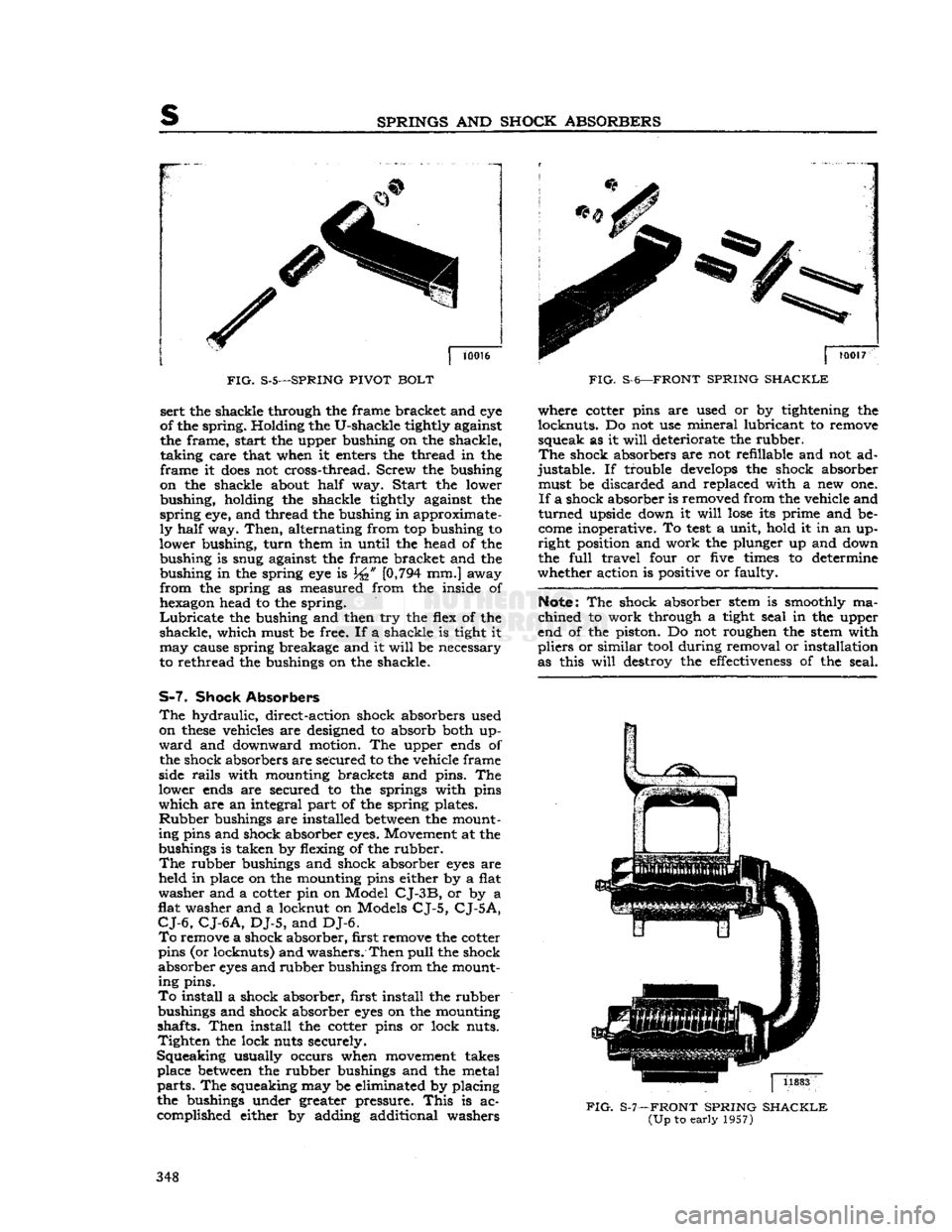
FIG.
S-5—SPRING
PIVOT BOLT
FIG.
S-6—FRONT
SPRING SHACKLE
sert the shackle through the frame bracket and eye
of the spring. Holding the U-shackle tightly against
the frame, start the upper bushing on the shackle,
taking
care that when it enters the thread in the
frame it
does
not cross-thread. Screw the bushing
on the shackle about
half
way.
Start
the lower bushing, holding the shackle tightly against the
spring
eye, and thread the bushing in approximate
ly
half
way.
Then,
alternating from top bushing to
lower bushing,
turn
them in until the head of the bushing is snug against the frame bracket and the bushing in the spring eye is
\{%
[0,794
mm.] away
from
the spring as measured from the inside of hexagon head to the spring.
Lubricate
the bushing and then try the flex of the
shackle,
which must be free. If a shackle is tight it may cause spring breakage and it
will
be necessary
to rethread the bushings on the shackle.
S-7. Shock Absorbers
The
hydraulic, direct-action shock absorbers used
on
these
vehicles are designed to absorb both up
ward
and downward motion. The upper ends of the shock absorbers are secured to the vehicle frame
side
rails
with mounting brackets and pins. The
lower ends are secured to the springs with pins
which
are an integral part of the spring plates.
Rubber
bushings are installed
between
the mount
ing pins and shock absorber
eyes.
Movement at the
bushings is taken by flexing of the rubber.
The
rubber bushings and shock absorber
eyes
are
held in place on the mounting pins either by a flat
washer and a cotter pin on Model
CJ-3B,
or by a
flat washer and a locknut on Models
CJ-5, CJ-5A,
CJ-6, CJ-6A,
DJ-5, and DJ-6.
To
remove a shock absorber, first remove the cotter
pins (or locknuts) and washers.
Then
pull
the shock
absorber
eyes
and rubber bushings from the mount ing pins.
To
install a shock absorber, first install the rubber
bushings and shock absorber
eyes
on the mounting
shafts.
Then
install the cotter pins or lock nuts.
Tighten
the lock nuts securely.
Squeaking usually occurs when movement takes place
between
the rubber bushings and the metal
parts.
The squeaking may be eliminated by placing
the bushings under greater pressure.
This
is ac
complished either by adding additional washers where cotter pins are used or by tightening the
locknuts. Do not use mineral lubricant to remove squeak as it
will
deteriorate the rubber.
The
shock absorbers are not refillable and not ad
justable.
If trouble
develops
the shock absorber must be discarded and replaced with a new one.
If
a shock absorber is removed from the vehicle and
turned
upside down it
will
lose
its prime and be
come
inoperative. To
test
a unit, hold it in an up
right
position and work the plunger up and down
the
full
travel four or five times to determine
whether action is positive or faulty.
Note:
The shock absorber stem is smoothly ma
chined to work through a tight seal in the upper
end of the piston. Do not roughen the stem with
pliers
or similar tool during removal or installation
as this
will
destroy the
effectiveness
of the seal. 11883
FIG.
S-7—FRONT
SPRING SHACKLE (Up
to early 1957)
348
Page 352 of 376
BODY
10728
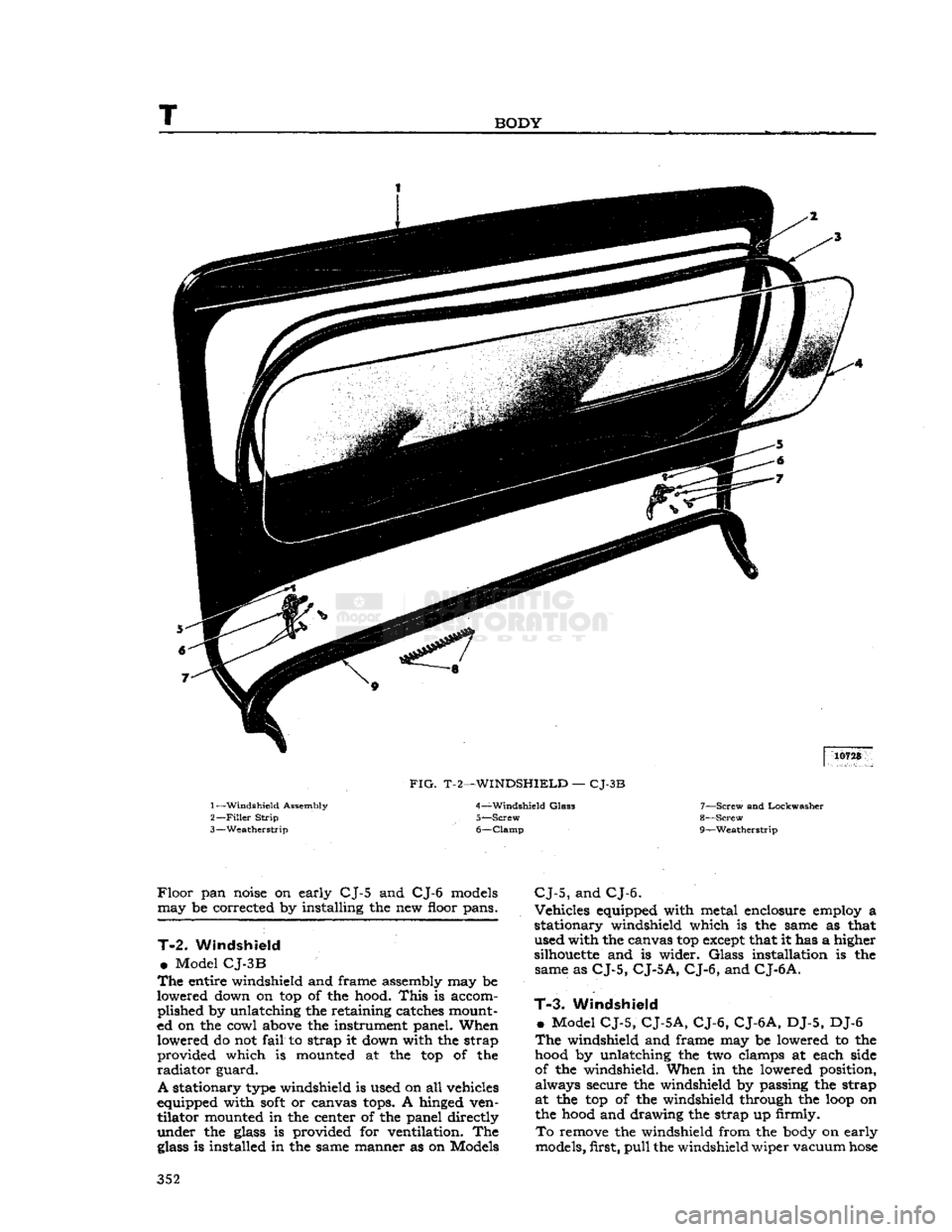
FIG.
T-2—WINDSHIELD
—
CJ-3B
1—
Windshield
Assembly
2—
Filler
Strip
3—
Weatherstrip 4—
Windshield
Glas3
5—
Screw
6—
Clamp
7—
Screw
and Lockwasher
8—
Screw
r
9— —Weatherstrip
Floor
pan
noise
on early CJ-5 and CJ-6
models
may be corrected by installing the new floor pans.
T-2.
Windshield
•
Model
CJ-3B
The
entire windshield and frame assembly may be
lowered down on top of the hood.
This
is accom plished by unlatching the retaining catches mount
ed on the cowl
above
the instrument panel. When lowered do not
fail
to strap it down with the strap provided which is mounted at the top of the
radiator
guard.
A
stationary
type
windshield is used on all vehicles
equipped with
soft
or canvas
tops.
A hinged ven tilator mounted in the center of the panel directly
under the
glass
is provided for ventilation. The
glass
is installed in the same manner as on Models
CJ-5,
and
CJ-6.
Vehicles equipped with metal enclosure employ a
stationary windshield which is the same as that used with the canvas top
except
that it has a higher
silhouette
and is wider.
Glass
installation is the same as
CJ-5,
CJ-5
A, CJ-6,
and
CJ-6
A.
T-3.
Windshield
»
Model
CJ-5, CJ-5A, CJ-6, CJ-6A,
DJ-5, DJ-6
The
windshield and frame may be lowered to the
hood
by unlatching the two clamps at each side
of the windshield. When in the lowered position, always secure the windshield by passing the strap
at the top of the windshield through the
loop
on the
hood
and drawing the strap up firmly.
To
remove the windshield from the
body
on early
models, first,
pull
the windshield wiper vacuum
hose
352
Page 354 of 376
T
BODY
from the windshield wiper vacuum fitting. On
late
models
disconnect electrical wires from wiper
motor. Unlatch the two windshield clamps on each
side
of the windshield.
Fold
the windshield forward
until
the
slot
in the windshield
hinges
aligns with the flat
side
of the pin in the
body
hinges.
Slip wind
shield off the pins and remove from
body.
T-4.
Windshield Glass
The
windshield
glass
is mounted in a rubber
weatherstrip which in turn
mounts
in the frame. A
rubber
locking strip, which
holds
the
glass
firmly in
the frame, is inserted in a moulded
groove
around
the rear
face
of the weatherstrip as shown in Fig.
T-2.
To remove the
glass
it is necessary to first
remove the locking strip which may be pried out
with a screwdriver or similar
tool.
Installation is,
obvious.
T-5.
Canvas Tops
Canvas
tops
are available in
Half
Tops and
Full
Tops.
Installation instructions are provided with
each canvas top kit for each model vehicle.
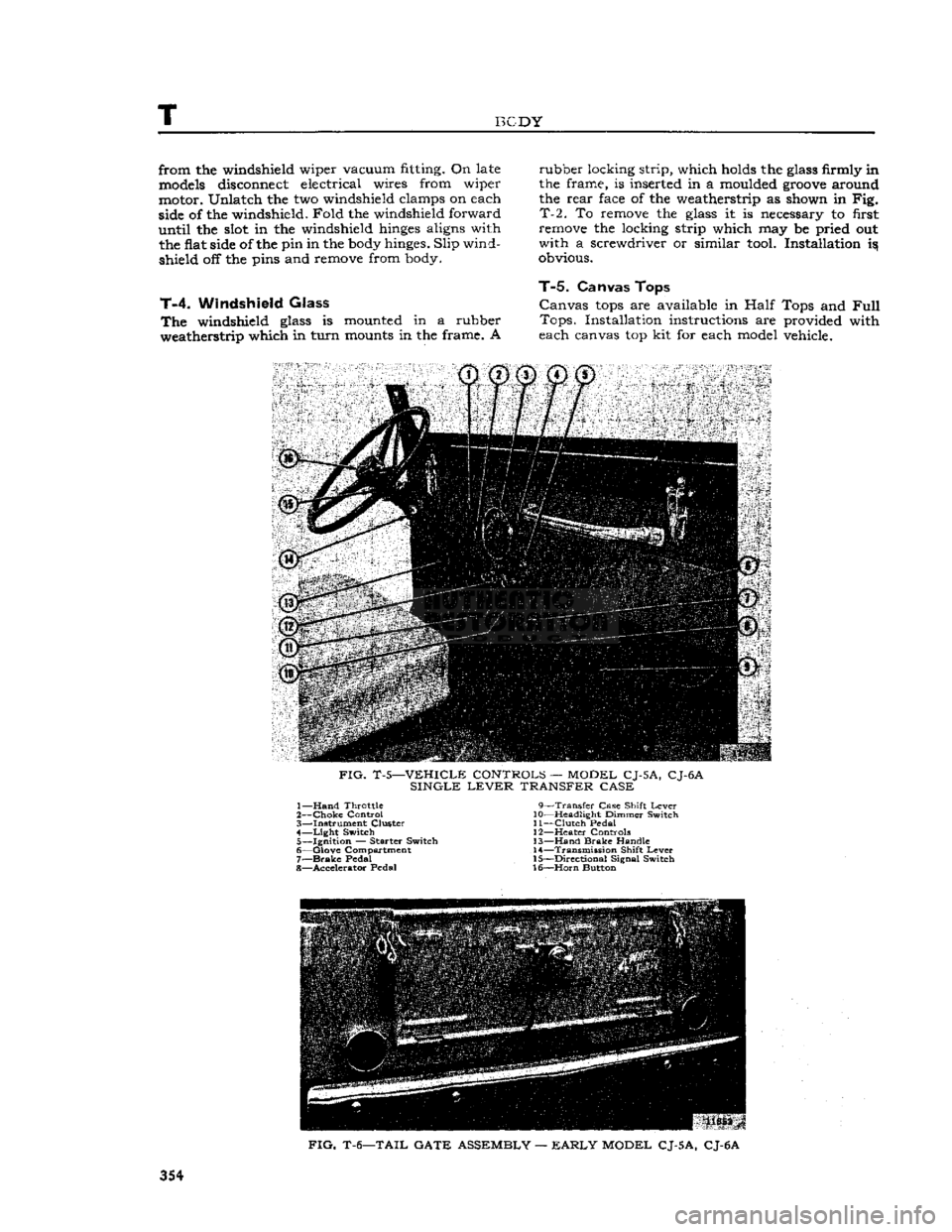
FIG.
T-5—VEHICLE CONTROLS — MODEL CJ-5A, CJ-6A
SINGLE
LEVER
TRANSFER CASE 1—
Hand
Throttle 9—Transfer Case Shift
Lever
2—
Choke
Control 10—Headlight Dimmer Switch
3— Instrument Cluster 11—Clutch Pedal 4—
Light
Switch 12—Heater Controls 5— Ignition — Starter Switch 13—Hand
Brake
Handle
6— Glove Compartment 14—Transmission Shift
Lever
7—
Brake
Pedal 15—Directional Signal Switch
8— Accelerator Pedal 16—Horn Button
FIG.
T-6—TAIL GATE ASSEMBLY —
EARLY
MODEL CJ-5A, CJ-6A
354
Page 356 of 376
T
BODY
lows
the seat to be
moved forward
or
rearward.
Re
positioning
the
lever
to the
left
will
lock
the seat
in
the
desired position.
T-9.
Passenger
Seat
Safety
Catch
Thejfront
passenger seat on
late model vehicles
is
provided
with
a
safety
catch, located
at the
left
rear
base of the seat. To
tilt
the seat
forward,
first
release
the
catch
by
pulling
upwards
on the
catch lever. 11213
.
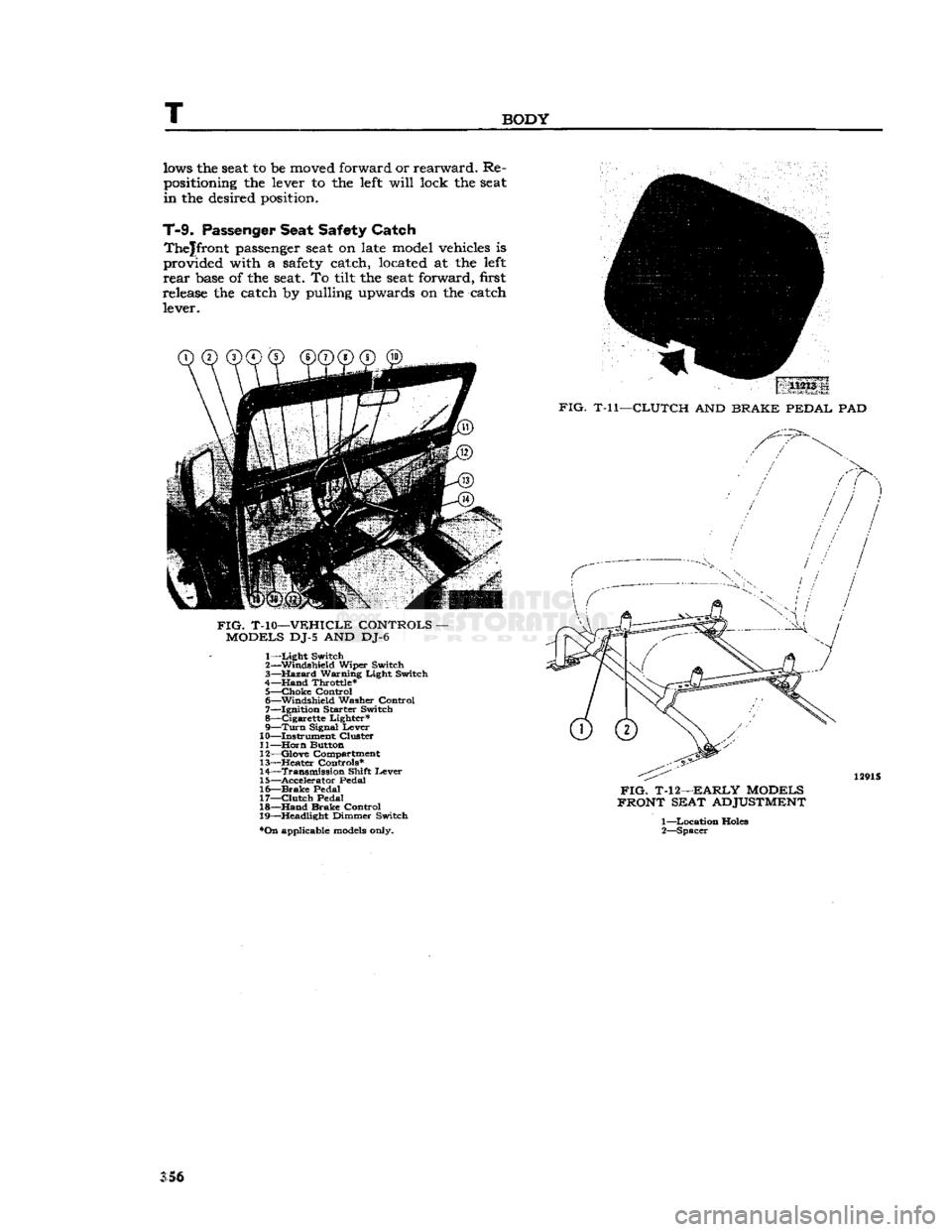
FIG.
T-ll—CLUTCH
AND
BRAKE PEDAL
PAD
FIG.
T-10—VEHICLE CONTROLS
-
MODELS
DJ-5 AND DJ-6 1—
Light
Switch
2— Windshield Wiper Switch
3—
Hazard
Warning Light Switch
4—Hand Throttle*
5—
choke
Control
6— Windshield
Washer
Control
7— Ignition
Starter
Switch
8— Cigarette Lighter* 9—
Turn
Signal Lever
10— Instrument Cluster
11—
Horn
Button
12— Glove Compartment
13—
Heater
Controls*
14— Transmission Shift Lever
15— Accelerator
Pedal
16—
Brake
Pedal
17—
Clutch
Pedal
18—
Hand
Brake Control
19— Headlight Dimmer Switch
*On
applicable
models
only.
FIG.
T-12—EARLY MODELS
FRONT SEAT
ADJUSTMENT
1—
Location Holes
2— Spacer
S5§