1953 JEEP CJ service
[x] Cancel search: servicePage 221 of 376

'Jeep*
UNIVERSAL
SERIES SERVICE
MANUAL
H
H-151.
SERVICE
DIAGNOSIS—Continued
SYMPTOMS PROBABLE
REMEDY
Generator:
(continued)
Fails
To Charge-Open Charging Circuit Correct
Sticking Brushes Repair or Replace
Dirty
or Burned Commutator ... Clean Commutator
Grounded Commutator Replace
Open Circuit in Field Replace
Weak Soldering on Armature. . . Repair Grounded Wiring Repair
Defective
Regulator. .. Replace Regulator
Too High Charging Rate— Regulator Improperly Adjusted Adjust or Replace
Short in Armature Replace Grounded Field-to-regulator Wire Correct
Shorted
Cell
in Battery... Replace Battery
Starting
Motor: Slow Starter Speed— Discharged Battery or Shorted
Cell
Recharge or Repair
Ground
Strap Engine to Frame. Clean Terminals and Tighten
Loose or Dirty Terminals Clean and Tighten
Dirty
Commutator Clean with No. 00 Sandpaper
Worn
Out Brushes Install New Brushes
Weak Brush Spring Tension Replace
Worn
Bearings Replace Burned Starter Switch Contacts Replace Switch
Will
Not
Turn
Engine— Open Circuit at Starter Correct
Solenoid
Open or Stuck Replace
Solenoid
Starter Switch
Defective
Replace Switch
Starter Drive Broken or Stuck. Repair or Replace
Battery Discharged Recharge Battery
Distributor:
Hard
Starting— Distributor
Points
Burned or Pitted Clean
Points
or Replace (Adjust)
Breaker
Arm Stuck on Pivot Pin...... . ... . . . Clean and Lubricate
Breaker
Arm Spring Weak Replace
Points
Improperly Adjusted Adjust
Spark
Plug
Points
Improperly Set Adjust
Spark
Plug Wire Terminals in Distributor
Cap
Corroded Clean
Loose Terminals Check Circuit
Loose or Dirty Terminals on Ground Strap— Engine to Frame. Clean and Tighten
Condenser Faulty Replace Improper Ignition Timing Set Timing
Lights:
Burn
Dim— Loose or Dirty Terminals....... ........ Clean and Tighten
Leak
in Wires. Check Entire Circuit for Broken Insulation
Poor Switch Contact Install New Switch Poor Ground Connection Clean and Tighten
Aim
Headlamp Beams. Use Aiming
Chart
221
Page 222 of 376
H
ELECTRICAL
SYSTEM
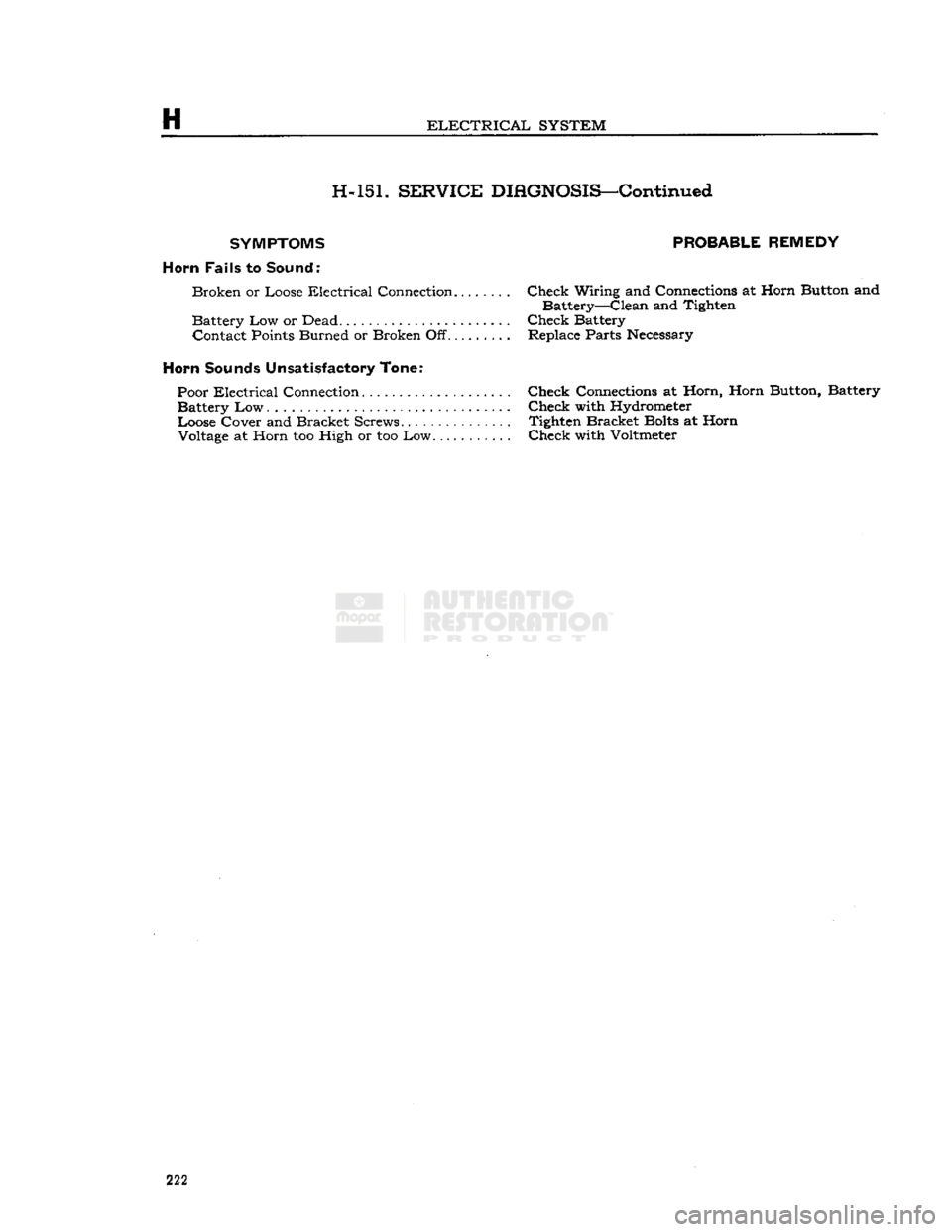
H-151.
SERVICE
DIAGNOSIS—Continued
SYMPTOMS
PROBABLE REMEDY
Horn
Fails
to Sound:
Broken
or Loose
Electrical
Connection Check Wiring and Connections at Horn Button and
Battery—Clean
and Tighten
Battery Low or Dead Check Battery Contact Points Burned or Broken Off. Replace Parts Necessary
Horn
Sounds Unsatisfactory Tone: Poor
Electrical
Connection Check Connections at Horn, Horn Button, Battery Battery Low Check with Hydrometer Loose Cover and Bracket Screws Tighten Bracket Bolts at Horn
Voltage at Horn too High or too Low Check with Voltmeter 222
Page 223 of 376

'Jeep'
UNIVERSAL SERIES SERVICE
MANUAL
H
H-152.
ELECTRICAL
SPECIFICATIONS
MODEL HURRICANE
F4 ENGINE DAUNTLESS
V-6
ENGINE
BATTERY:
Make
Model Hour Rating.
Voltage
Terminal
Ground
SPECIFIC
GRAVITY:
Fully
Charged
Recharged At
Location
GENERATOR:
Make.
Model
Ground
Polarity
Controlled Output
Control
Armature End Play
Brushes
Brush
Spring Tension
REGULATOR:
Make
Model:
For
GJP
7202,
GJP
7402A
Type
Cutout Relay: Closing
Voltage
@
Generator rpm..........
Reverse Current to Open.
Regulated
Voltage
Regulated Current
ALTERNATOR:
Make
Model
Ground
Polarity
Rated Output
Rated Field
Coil
Draw
At
70°F.
and
10-volt
Capacitor Capacity
REGULATOR:
Make
Model
Type
STARTING
MOTOR:
Make
Model
Brush
Spring Tension
LOCK
TEST:
Temperature
Amp.
(Max.)
Volt
Stall
Torque (Min.)
NO LOAD TEST:
Tempesature
Amp.
(Max.)
Volt
Rpm.
(Min.)
DRIVE:
Type
COIL:
Make.
Model
Primary
Resistance Secondary Resistance
Prestolite
HS
11-50
50 Ampere-hour
12-volts
Negative
1.260
1.225
Engine Compartment- Right Rear
Prestolite
GJP-7402A
Negative
35 amp.
CV
Regulator .003" to .010"
[0,076
a 0,25 mm.] 2
18 to 36 oz.
[510 a 1020 gr.]
Prestolite
VBO-4201E-4A
Vibrator
12.6 to 13.6 @ 1325 3 to 5 amp. 14.2 to 14.4
36 amp. max.
Motorola
A12 NW 526
Negative
35 amp.
1.7 to 2.3 amp. .1 mfd.
Motorola
R-2-K-1
Transistor
Prestolite
MDU-7004
32 to 40 oz. [907 a 1134 gr.]
70°F.
[21°C] 295 4
6 lb-ft. [0,83
kg-m.]
70°F.
[21°C.;
50
10
5300
Bendix Folo-Thru
Prestolite
200691
3.9 to 4.2
ohms
9400
to
11,700
ohms
Prestolite
HS
11-50
50 Ampere-hour
12-volts
Negative
1.260
1.225
Engine Compartment- Right Rear
Prestolite
GJP-7402A
Negative
35 amp.
CV
Regulator .003" to .010"
[0,076
a 0,25 mm.] 2
18 to 36 oz.
[510 a 1020 gr.]
Prestolite
VBO-4201E-4A
Vibrator
12.6 to 13.6 @ 1325 3 to 5 amp. 14.2 to 14.4
36 amp. max.
Motorola
A12 NW 528
Negative
35 amp.
1.7 to 2.3 amp. .1 mfd.
Motorola
R-2-K-1
Transistor
Delco-Remy
1107391,
1108366,
1108375
32 to 40 oz. [907 a 1134 gr.]
Not Applicable Not Applicable
70°F.
[21°C] 75
10.6
6200
Overrunning Clutch Delco-Remy
1115247
1.28 to 1.42
ohms
7200
to
9500
ohms
Prestolite
MHA-7008
32 to 40 oz. [907 a 1134 gr.]
70°F.
[21°C] 200 4
3 lb-ft. [0,41
kg-m.]
70°F.
[21°C] 43
10.0
9000
Bendix Folo-Thru
Prestolite
201700
4.25 to 4.60
ohms
5200
to 6100
ohms
223
Page 225 of 376
'Jeep'
UNIVERSAL
SERIES SERVICE
MANUAL
CLUTCH
Contents
SUBJECT
PAR.
GENERAL
.1-1
Clutch
Maintenance 1-2
Clutch
Pedal Linkage and Adjustment.... 1-3
Pilot Bushing Inspection and
Replacement 1-8
CLUTCH
—HURRICANE
F4
ENGINE.
. . .1-4
Clutch
Removal. 1-5
Clutch
Pressure Plate and Disc Inspection.
.
1-6
Clutch
Pressure Plate Adjustment 1-7
Clutch
Installation 1-9
CLUTCH
—DAUNTLESS
V-6
ENGINE,
DIAPHRAGM
SPRING
TYPE
1-10
Clutch
Removal.
........
.1-11
Clutch
Inspection, Diaphragm Spring Type. . 1-12
Clutch
Installation 1-27
SUBJECT
PAR.
SERVICING COIL
SPRING
TYPE CLUTCH
. .1-13 Pressure Plate Adjustment. 1-14
Pressure Plate Disassembly. . . . . 1-15
Inspection of Parts 1-16 thru 1-20 Pressure Plate Reassembly. . . . .1-21 thru 1-23
Clutch
Lever Adjustment 1-24
Clutch
Fitxure . .1-26
CLUTCH
THROWOUT
RELEASE
BEARING
1-25
SERVICE
DIAGNOSIS
1-28
CLUTCH
SPECIFICATIONS
1-29
CLUTCH
ADJUSTING
FIXTURE
DATA
1-30
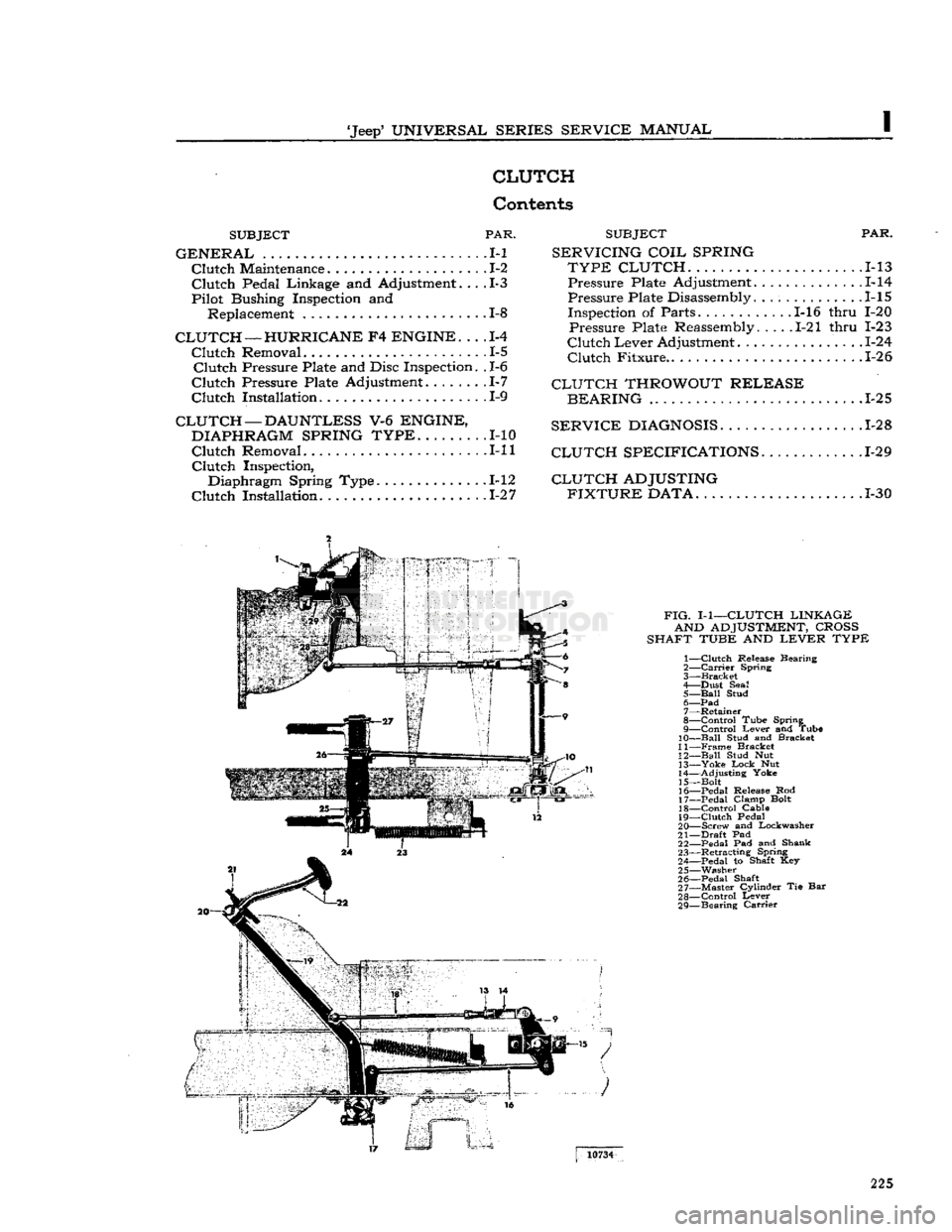
FIG.
I-1—CLUTCH
LINKAGE AND
ADJUSTMENT,
CROSS
SHAFT
TUBE
AND
LEVER
TYPE
1—
Clutch
Release Bearing
2—
Carrier
Spring
3—
Bracket
4— Dust Seal 5—
Ball
Stud 6—
Pad
7— Retainer
8—
Control
Tube Spring
9—
Control
Lever and Tube
10—
Ball
Stud and Bracket
11—
Frame
Bracket
12—
Ball
Stud Nut 13—
Yoke
Lock
Nut
14— Adjusting Yoke
15— Bolt
16— Pedal Release Rod
17— Pedal Clamp Bolt 18—
Control
Cable
19—
Clutch
Pedal
20— Screw and Lockwasher
21—
Draft
Pad 22— Pedal Pad and Shank
23— Retracting Spring
24— Pedal to Shaft Key 25— Washer
26— Pedal Shaft
27— Master Cylinder Tie Bar
28—
Control
Lever
29— Bearing
Carrier
10734
225
Page 227 of 376
![JEEP CJ 1953 Service Manual
Jeep
UNIVERSAL SERIES SERVICE
MANUAL
The
correct distance should be 10%"
[26,04
cm.].
If
the length of the clutch release pedal rod is
other than
10
W
[26,04
cm.], the vheicle is eq](/manual-img/16/57040/w960_57040-226.png "JEEP CJ 1953 Service Manual
Jeep
UNIVERSAL SERIES SERVICE
MANUAL
The
correct distance should be 10%\"
[26,04
cm.].
If
the length of the clutch release pedal rod is
other than
10
W
[26,04
cm.], the vheicle is eq")
'Jeep'
UNIVERSAL SERIES SERVICE
MANUAL
The
correct distance should be 10%"
[26,04
cm.].
If
the length of the clutch release pedal rod is
other than
10
W
[26,04
cm.], the vheicle is equipped with the early
type
Clutch
Control
Lever
and
Tube Assembly, which should be removed, and^trie latest
designed
parts should be installed.
The
free pedal clearance is adjusted by lengthening
or shortening the" clutch fork cable. To make this adjustment,
loosen
the jam nut on the cable clevis
and
lengthen or shorten the cable to obtain %"
[19,05
mm.] free travel at the pedal pad, then
tighten the jam unit.
•
Clutch
Control Cable Type
Refer
to Fig. 1-2.
a.
With the clutch pedal pad against the floor
panel, (pedal up, clutch
engaged)
adjust ball ad
justing nut until slack is removed from the cable
and
the clutch throwout bearing contacts the clutch
pressure plate, release levers or diaphragm plate.
b. Back-off ball adjusting nut 2
V2
turns to obtain
approximately %"
[19,05
mm.] free travel.
Lock
hex nut.
FIG.
1-3—AUBURN
CLUTCH
ASSEMBLY —
HURRICANE F4 ENGINE 1—
Driven
Plate and Hub
2—
Pressure
Plate
3—
Pivot Pin
4—
Bracket
5—
Spring
Cup 6—
Pressure
Spring 7— Release
Lever
8—
Return
Spring
9—
Adjusting
Screw
10—
Jam
Nut 11—
Washer
Note:
Some older 'Jeep' vehicles may
develop
side
movement
of the clutch and brake pedals resulting
from wear of the pedals, shafts, and bushings. One way to
compensate
for this wear is to install a pedal
slack
adjuster kit 1-4.
CLUTCH
—
HURRICANE
F4
ENGINE
•
Auburn
Vehicles equipped with the Hurricane F4
engine
have a 9.25" [23,4 cm.] driven plate. The auburn clutch driving (pressure) plate assembly (Fig. 1-3)
has three pressure springs and three levers or
fingers.
1-5.
Clutch
Removal
When
necessary to remove the clutch,
follow
the procedures outlined in Section J for the removal
of the transmission and transfer case from the vehicle. Then remove the flywheel housing and use
the following procedures for removing the clutch assembly.
Note:
The F4
engine
may be removed from the
vehicle when inspecting or replacing the clutch.
Refer
to Section D for Hurricane F4
engine
removal and then
follow
the instructions given
below
to remove the clutch assembly.
a.
Mark
the clutch pressure plate and
engine
fly
wheel with a center punch so the clutch assembly
may be installed in the same position after adjust
ments
or replacement are completed.
b. Remove the clutch pressure plate bracket
bolts
equally, a little at a time, to prevent distortion and
to relieve the clutch springs evenly.
c. Remove the pressure plate assembly and driven
plate from the flywheel.
1-6.
Clutch
Pressure Plate and Disc Inspection
Inspect the pressure plate face for
cracks,
chips,
and
warpage.
Check
the pressure plate levers for
excessive
wear and the springs for breaks. If any of the
above
conditions exist, the
complete
pressure
plate must be replaced.
Check
the clutch disc for
excessive
wear,
loose
or damaged facings, broken
vibration damper springs and evidence of grease
or oil. If any of the
above
conditions exist, replace
the clutch disc.
1-7.
Clutch
Pressure Plate Adjustment —
Auburn
The
clutch pressure plate must be checked
before
installing a new or reconditioned clutch. The proper 11339
FIG.
1-4—CHECKING
AUBURN
CLUTCH
LEVER
ADJUSTMENT
1— Adjustment Gauge
2—
Fixture
Mounting Bolt
3—
Clutch
Fixture
227
Page 229 of 376
'Jeep'
UNIVERSAL
SERIES SERVICE
MANUAL
I
Note:
The clutch release bearing is lubricated at
time of assembly and no attempt should be made
to lubricate it Refer to Fig. 1-23 when lubricating
the clutch throwout bearing collar. c. Reassembly
To
assemble the clutch to the flywheel, first put
a
small amount of light cup grease in the flywheel
pilot bushing, install the driven plate, with short
end of hub toward the flywheel, then place the pressure plate assembly in position.
With
a clutch
plate aligning arbor or a spare transmission main
shaft, align the driven plate splines leaving the
arbor
in position while tightening the pressure plate
screws evenly.
Next, assemble the flywheel housing to the
engine
and
reinstall the transmission and transfer case or
install
the
engine
in the vehicle, depending on the
procedure of removal. Make sure that the clutch
release bearing
carrier
return spring is hooked in place. For the remainder of the assembly reverse
the operations that were used in removing the
transmission and transfer case or the
engine
referring
to the instructions given in Section J for the transmission and Section D and Dl for the
engine.
d.
Adjust the clutch control cable so there is 3A" [19,05 mm.] free pedal travel. (Refer to Par. 1-3)
1-10.
CLUTCH
—
DAUNTLESS
V-6
ENGINE
•
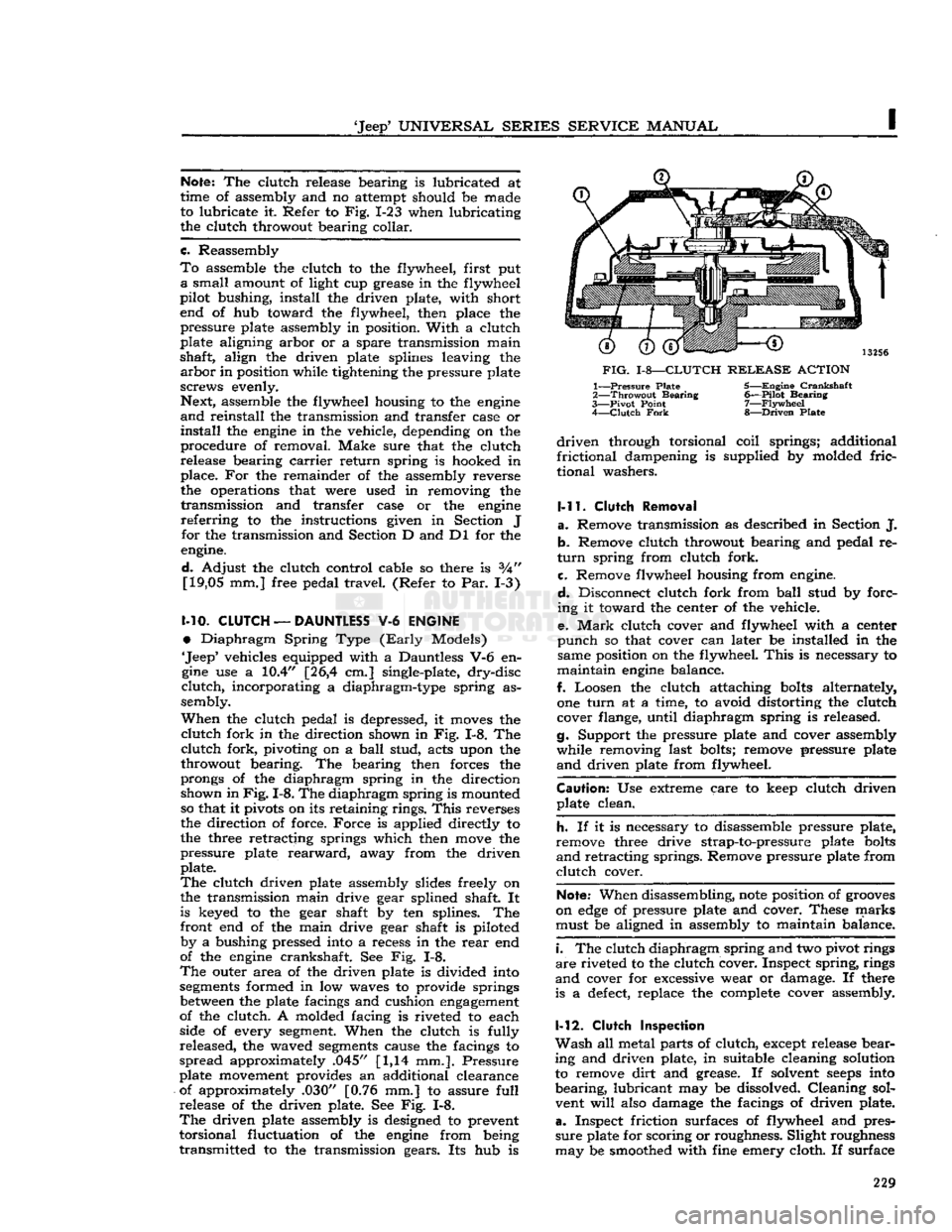
Diaphragm Spring Type
(Early
Models)
*
Jeep' vehicles equipped with a Dauntless V-6 en
gine
use a 10.4" [26,4 cm.] single-plate, dry-disc
clutch,
incorporating a diaphragm-type spring as
sembly.
When
the clutch pedal is depressed, it
moves
the
clutch
fork in the direction shown in Fig. 1-8. The
clutch
fork, pivoting on a
ball
stud, acts upon the
throwout bearing. The bearing then forces the
prongs of the diaphragm spring in the direction shown in
Fig.
1-8. The diaphragm spring is mounted
so that it pivots on its retaining rings.
This
reverses
the direction of force.
Force
is applied directly to
the three retracting springs which then
move
the
pressure plate
rearward,
away from the driven plate.
The
clutch driven plate assembly slides freely on
the transmission main drive gear splined shaft. It is keyed to the gear shaft by ten splines. The
front end of the main drive gear shaft is piloted by a bushing pressed into a recess in the
rear
end
of the
engine
crankshaft. See Fig. 1-8.
The
outer area of the driven plate is divided into
segments
formed in low waves to provide springs
between
the plate facings and cushion
engagement
of the clutch. A molded facing is riveted to each
side of every
segment.
When the clutch is fully
released, the waved
segments
cause the facings to
spread
approximately .045" [1,14 mm.]. Pressure
plate movement provides an additional clearance
of approximately .030" [0.76 mm.] to assure
full
release of the driven plate. See Fig. 1-8.
The
driven plate assembly is designed to prevent
torsional fluctuation of the
engine
from being
transmitted to the transmission gears. Its hub is
FIG.
1-8—CLUTCH
RELEASE
ACTION
1—
Pressure
Plate 5—Engine
Crankshaft
2—
Throwout
Bearing
6—Pilot
Bearing
3—
Pivot
Point
7—Flywheel
4—
Clutch
Fork
8—Driven
Plate
driven
through torsional coil springs; additional
frictional
dampening is supplied by molded
fric-
tional washers.
1-11.
Clutch
Removal
a.
Remove transmission as described in Section J. b. Remove clutch throwout bearing and pedal re
turn
spring from clutch fork.
c. Remove flvwheel housing from engine.
d.
Disconnect clutch fork from
ball
stud by forc
ing it toward the center of the vehicle.
e.
Mark
clutch cover and flywheel with a center
punch
so that cover can later be installed in the same position on the flywheel.
This
is necessary to
maintain
engine
balance.
f. Loosen the clutch attaching
bolts
alternately,
one
turn
at a time, to avoid distorting the clutch
cover flange, until diaphragm spring is released.
g. Support the pressure plate and cover assembly
while removing last bolts; remove pressure plate
and
driven plate from flywheel.
Caution:
Use extreme care to keep clutch driven plate clean.
h.
If it is necessary to disassemble pressure plate,
remove three drive strap-to-pressure plate
bolts
and
retracting springs. Remove pressure plate from
clutch
cover.
Note:
When disassembling,
note
position of
grooves
on
edge
of pressure plate and cover. These marks must be aligned in assembly to maintain balance.
i.
The clutch diaphragm spring and two pivot rings
are
riveted to the clutch cover. Inspect spring, rings
and
cover for excessive wear or damage. If there
is a
defect,
replace the complete cover assembly.
1-12.
Clutch
inspection
Wash
all metal parts of clutch, except release bear
ing and driven plate, in suitable cleaning solution to remove
dirt
and grease. If solvent
seeps
into
bearing,
lubricant may be dissolved. Cleaning sol
vent
will
also damage the facings of driven plate,
a.
Inspect friction surfaces of flywheel and pres
sure
plate for scoring or roughness. Slight roughness
may be smoothed with fine emery cloth. If surface 229
Page 231 of 376

'Jeep1
UNIVERSAL
SERIES SERVICE
MANUAL
I
14172
FIG.
1-11—CLUTCH
MOUNTED
ON
ADJUSTING
FIXTURE
1— Mounting Bolt
2—
Gauge
3—
Lever
4—
Adjusting
Nut
5—
Pressure
Plate 6—
Spacer
7—
Clutch
Fixture
W-296
a.
Place the proper thickness
spacers
between the
pressure
plate face and the
clutch
adjusting
fixture.
Locate the
spacers
under the
pressure
plate fingers
and at the center of the
pressure
plate face as
shown
in Fig. I-11.
b.
With
the
spacers
properly installed,
bolt
the
pressure
plate to the adjusting
fixture.
Draw the
bolts
down evenly, a
little
at a
time,
until
they are
tight.
e. Using the proper
gage
length, check the lever
adjustment.
d.
Lever adjustment can be altered by removing
the lever clips loosening the
lock
nut and
turning
the adjusting screw in or out as required.
1-15.
Clutch
Disassembly
The
clutch
cover and
pressure
plate are under
spring
tension at all times. Therefore,
care
must be
exercised when a
clutch
cover assembly is disas
sembled. Place the
clutch
cover assembly in an arbor
press
with
a hard
wood
block under the pres-
FIG.
1-12—COMPRESSING
SPRING
TO
REMOVE
NUTS
sure
plate. Have the block of such a length that
the cover can move down and not interfere
with
the block. Place a
wood
block
across
the top of the cover so that it
rests
on the spring
bosses
and
does
not interfere
with
the eyebolt adjusting nuts
as shown in Fig. 1-12.
Compress the
clutch
cover in the
press
until
the
clutch
release
levers are free. Remove the adjust
ing
nuts.
Release
the
press
slowly
to prevent the
springs
from
flying
out.
Remove
felt
grease
pads.
Caution:
When
relieving
the spring
pressure,
be
sure
the cover
does
not stick on the
pressure
plate
bosses.
1-16.
INSPECTION
OF
CLUTCH
PARTS 1-17. Inspect
Clutch
Pressure
Springs
A
thorough inspection of the
clutch
springs should always be made. They should be tested for spring
tension when the spring is compressed to a given
length.
On
the
clutch
for the V6 engine, springs
with
black
color
markings, used adjacent to the
clutch
levers,
must exert a force of 240 lb. ±5 lb. [100,8 kg.
±2,3
kg.] when compressed to 1%" [3,7 cm.].
Springs
with
yellow
markings, used between springs adjacent to the
clutch
levers, must exert a force of 145 lb. ±5 lb. [65,6 kg. ±2,3 kg.] when com
pressed
to 1%" [3,7 cm.].
1-18. Inspect
Clutch
Adjusting
Levers
A
thorough inspection should be given the levers,
the eyebolt pin, and the
fulcrum.
If they show
any wear, replace them. To remove the
release
levers,
grasp
a lever and eyebolt between the
thumb
and fingers so that the inner end of the
FIG.
1-13—REMOVING
ADJUSTING
LEVERS
l—Eyebolt
2—Fulcrum
3—Lever
231
Page 233 of 376
'Jeep*
UNIVERSAL SERIES
SERVICE
MANUAL
b.
Check
the anti-rattle springs in the clutch cover
and
place the cover on top of the pressure plate
assembly. The top of each pressure spring must enter its spring seat in the cover.
Line
up punch
marks
on cover and pressure plate for balance.
c.
Slowly compress the cover making sure that
the
eyebolts
and pressure plate lugs are guided through the proper
holes
in the cover.
d.
Hold the clutch under compression and screw
down the adjusting nuts until they are flush with
the
tops
of the eyebolts. Release the spindle of
the press.
1-24.
Clutch
Lever Adjustment
Important:
Always inspect release lever height
adjustment when installing a new clutch drive
plate.
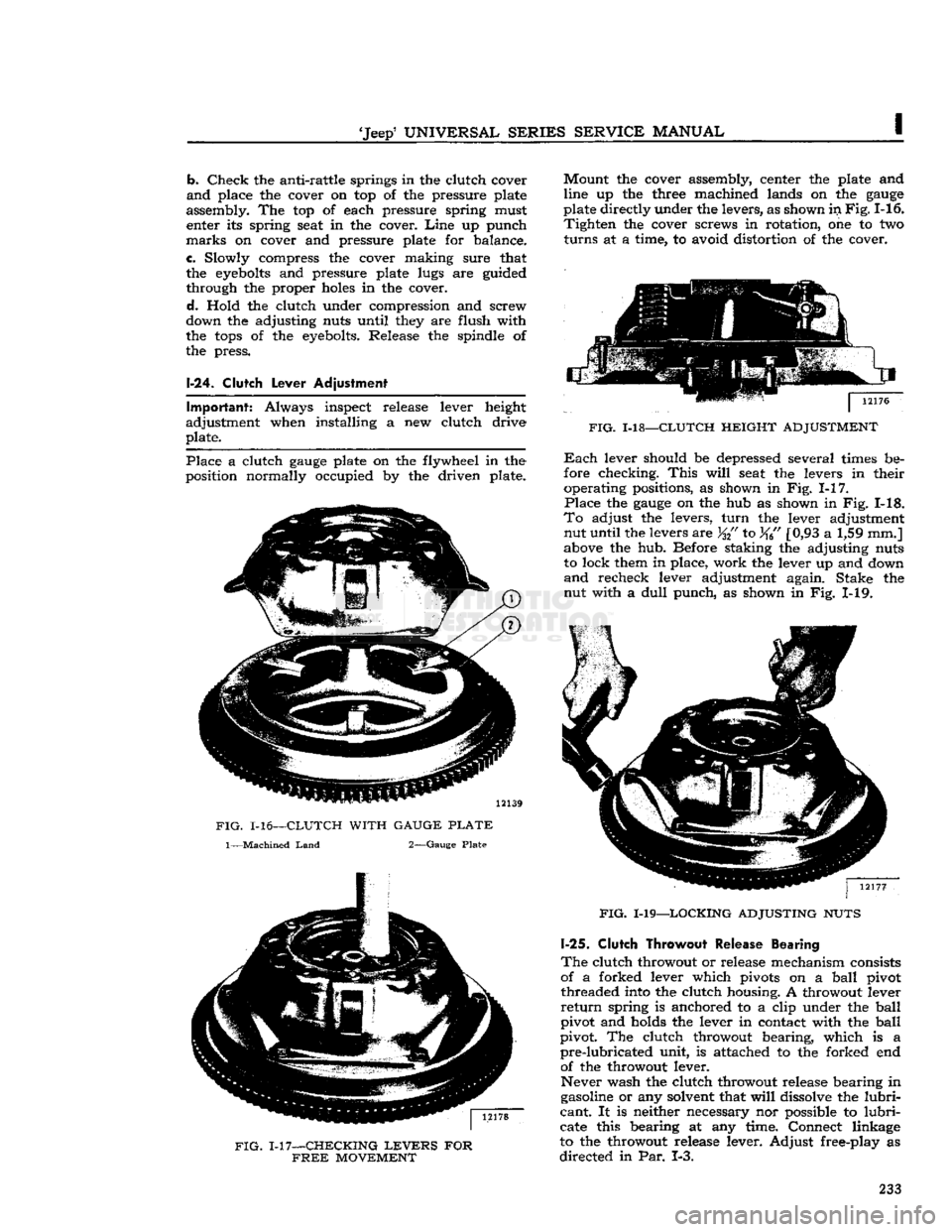
Place
a clutch
gauge
plate on the flywheel in the
position normally occupied by the driven plate.
FIG.
1-16—CLUTCH WITH GAUGE
PLATE
1—Machined
Land
2—Gauge Plate
FIG.
1-17—CHECKING
LEVERS
FOR
FREE
MOVEMENT
Mount
the cover assembly, center the plate and
line up the three machined lands on the
gauge
plate directly under the levers, as shown in
Fig.
1-16.
Tighten
the cover screws in rotation, one to two
turns
at a time, to avoid distortion of the cover.
FIG.
1-18—CLUTCH HEIGHT ADJUSTMENT
Each
lever should be depressed several times be
fore checking.
This
will
seat the levers in their operating positions, as shown in Fig. 1-17.
Place
the
gauge
on the hub as shown in Fig. 1-18.
To
adjust the levers,
turn
the lever adjustment nut until the levers are
%{'
to %6" [0,93 a 1,59 mm.]
above the hub. Before staking the adjusting nuts
to lock them in place, work the lever up and down
and
recheck lever adjustment again. Stake the nut with a
dull
punch, as shown in Fig. 1-19.
FIG.
1-19—LOCKING ADJUSTING NUTS
1-25.
Clutch Throwout
Release Bearing
The
clutch throwout or release mechanism consists
of a forked lever which pivots on a
ball
pivot threaded into the clutch housing. A throwout lever
return
spring is anchored to a clip under the
ball
pivot and holds the lever in contact with the
ball
pivot. The clutch throwout bearing, which is a
pre-lubricated
unit, is attached to the forked end of the throwout lever.
Never wash the clutch throwout release bearing in
gasoline or any solvent that
will
dissolve the
lubri
cant.
It is neither necessary nor possible to
lubri
cate this bearing at any time. Connect linkage
to the throwout release lever. Adjust free-play as
directed
in Par. 1-3. 233