Chevrolet Corvette Owner Manual (GMNA-Localizing-U.S./Canada/Mexico-
17272984) - 2024 - CRC - 2/20/23
292 Vehicle Care
Replace the tire if:
.The indicators at three or more
places around the tire can be seen.
.There is cord or fabric showing
through the tire's rubber.
.The tread or sidewall is cracked, cut,
or snagged deep enough to show
cord or fabric.
.The tire has a bump, bulge, or split.
.The tire has a puncture, cut, or other
damage that cannot be repaired well
because of the size or location of the
damage.
Tire Rotation
Tires should be rotated according to the
interval listed in the maintenance
schedule. SeeMaintenance Schedule
0 316.
Tires are rotated to achieve uniform
wear for all tires. The first rotation is
the most important.
Anytime unusual wear is noticed, rotate
the tires as soon as possible, check for
proper tire inflation pressure, and check for damaged tires or wheels. If the
unusual wear continues after the
rotation, check the wheel alignment.
See
When It Is Time for New Tires
0 293 and
Wheel Replacement 0297.
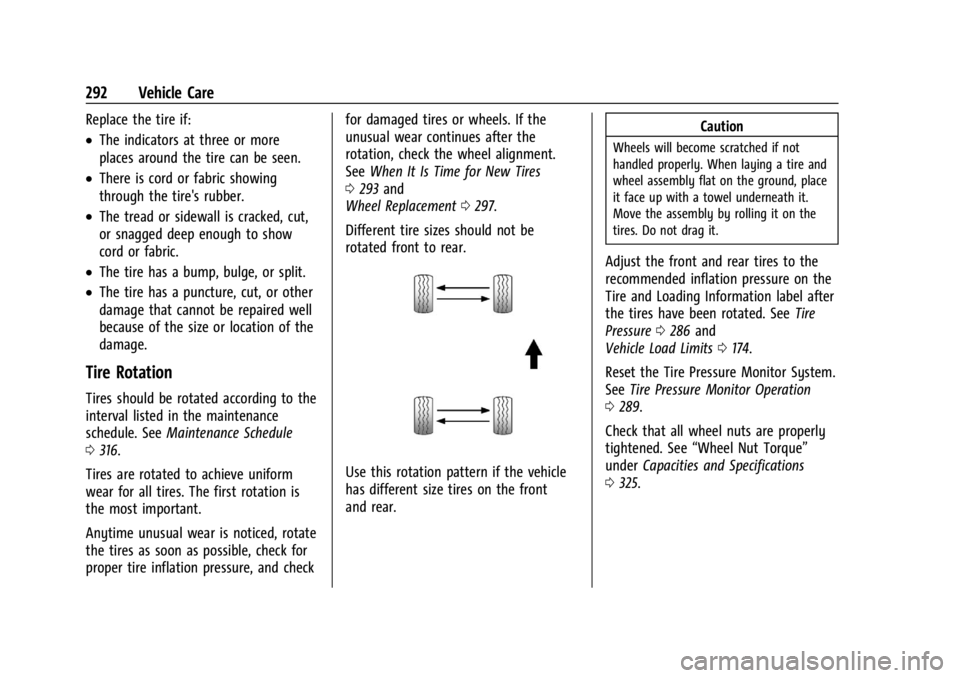
Different tire sizes should not be
rotated front to rear.
Use this rotation pattern if the vehicle
has different size tires on the front
and rear. Caution
Wheels will become scratched if not
handled properly. When laying a tire and
wheel assembly flat on the ground, place
it face up with a towel underneath it.
Move the assembly by rolling it on the
tires. Do not drag it.
Adjust the front and rear tires to the
recommended inflation pressure on the
Tire and Loading Information label after
the tires have been rotated. See
Tire
Pressure 0286 and
Vehicle Load Limits 0174.
Reset the Tire Pressure Monitor System.
See Tire Pressure Monitor Operation
0 289.
Check that all wheel nuts are properly
tightened. See “Wheel Nut Torque”
under Capacities and Specifications
0 325.
Chevrolet Corvette Owner Manual (GMNA-Localizing-U.S./Canada/Mexico-
17272984) - 2024 - CRC - 2/20/23
Vehicle Care 297
Tire Chatter/Hop
When driving at slow speeds and in very
tight turns, the vehicle may have tire
chatter/hop. This is normal and the vehicle
does not require service.
Wheel Replacement
Replace any wheel that is bent, cracked,
or badly rusted or corroded. If wheel nuts
keep coming loose, the wheel, wheel bolts,
and wheel nuts should be replaced. If the
wheel leaks air, replace it. Some aluminum
wheels can be repaired. See your dealer if
any of these conditions exist.
Your dealer will know the kind of wheel that
is needed.
Each new wheel should have the same
load-carrying capacity, diameter, width,
offset, and be mounted the same way as
the one it replaces.
Replace wheels, wheel bolts, wheel nuts,
or Tire Pressure Monitor System (TPMS)
sensors with new GM original equipment
parts.
{Warning
Using the wrong wheel studs can cause
wheel nuts to not engage the stud
threads and/or wheel. The wheel could
come off and cause personal injury
and/or death. Carbon fiber wheels require
a longer stud than aluminum wheels due
to a thicker hub. When changing the
wheel type between aluminum and
carbon fiber, the studs must match the
wheel type. Incorrect studs will not have
the correct thread engagement. Use the
correct wheel studs for your wheel
assembly.
{Warning
Installing wheel nuts on carbon fiber
wheels when temperatures are below
freezing can result in a damaged
assembly. Once temperatures rise, the
wheel nut removal torque can be very
high making it difficult to remove wheels
nuts. This can result in damaged wheel
nuts and/or wheel nut inserts. Use of
damaged parts could cause the wheel to(Continued)
Warning (Continued)
come off and cause personal injury,
and/or death. Do not install wheel nuts
when temperatures are below freezing.
{Warning
Using the wrong replacement wheels,
wheel bolts, or wheel nuts can be
dangerous. It could affect the braking and
handling of the vehicle. Tires can lose air
and cause loss of control, resulting in a
crash. Always use the correct wheel,
wheel bolts, and wheel nuts for
replacement.
{Warning
Replacing a wheel with a used one is
dangerous. How it has been used or how
far it has been driven may be unknown.
It could fail suddenly and cause a crash.
When replacing wheels, use a new GM
original equipment wheel.
Chevrolet Corvette Owner Manual (GMNA-Localizing-U.S./Canada/Mexico-
17272984) - 2024 - CRC - 2/20/23
326 Technical Data
ApplicationCapacities
Metric English
Engine Oil with Filter
I5.5L V8 Engine (LT6) –Z06 7.6 L
8.0 qt
I6.2L V8 Engine (LT2) –Stingray and E-Ray 7.1 L
7.5 qt
Front Hybrid Drive Unit (E-Ray)** 3.0 L3.2 qt
Fuel Tank 70.0 L18.5 gal
Wheel Nut Torque 190Y 140 lb ft
All capacities are approximate. When adding, be sure to fill to the approximate level, as recommended in this manual. Recheck fluid level
after filling
*Engine cooling system capacity values are based on the entire cooling system and its components.
** After draining.
Chevrolet Corvette Owner Manual (GMNA-Localizing-U.S./Canada/Mexico-
17272984) - 2024 - CRC - 2/20/23
Technical Data 327
Engine Specifications
EngineVIN Code Transmission Spark Plug GapFiring Order
5.5L V8 Engine (LT6) –Z06 3 Dual Clutch Transmission 0.65-0.75 mm (0.026-
0.030 in)1-4-3-8-7-6-5-2
6.2L V8 Engine (LT2) –Stingray
and E-Ray 4 Dual Clutch Transmission 0.95-1.10 mm
(0.037-0.043 in)1-8-7-2-6-5-4-3
Spark plug gaps are preset by the manufacturer. Re-gapping the spark plug is not recommended and can damage the spark plug.
Engine Data
Engine Horsepower TorqueDisplacement Compression Ratio
5.5L V8 Engine (LT6)
– Z06 670
460 lb ft 5.5 L12.5:1
6.2L V8 Engine (LT2) with
Performance Exhaust –
Stingray and E-Ray 495
470 lb ft 6.2 L 11.5:1
6.2L V8 Engine (LT2) with
Standard Exhaust –
Stingray 490
465 lb ft 6.2 L 11.5:1