6077-2. Steps to take in an emergency
PRIUS_OM_OM47F32E_(EE)
7
When trouble arises
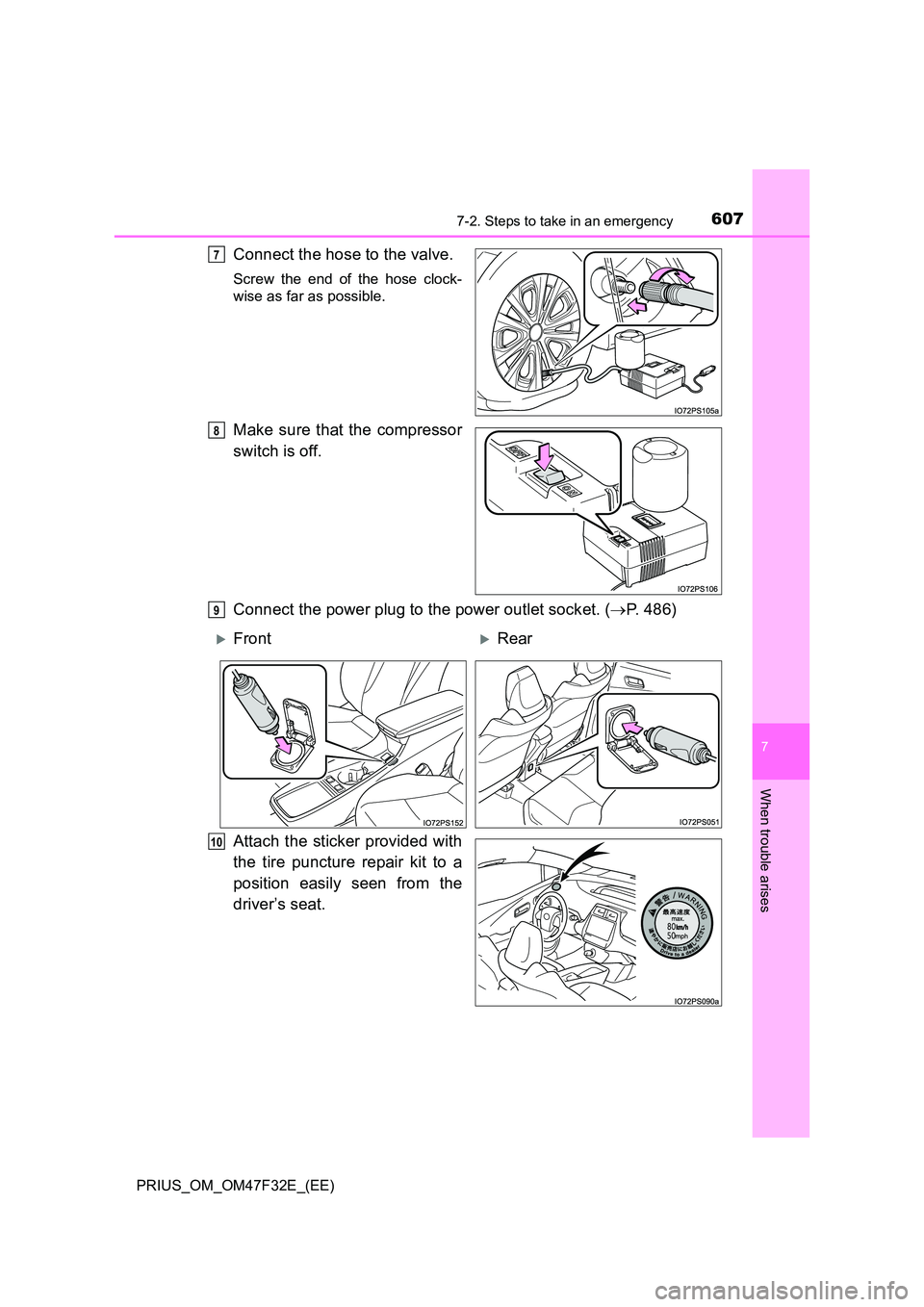
Connect the hose to the valve.
Screw the end of the hose clock-
wise as far as possible.
Make sure that the compressor
switch is off.
Connect the power plug to the power outlet socket. ( P. 486)
Attach the sticker provided with
the tire puncture repair kit to a
position easily seen from the
driver’s seat.
7
8
9
FrontRear
10
6097-2. Steps to take in an emergency
PRIUS_OM_OM47F32E_(EE)
7
When trouble arises
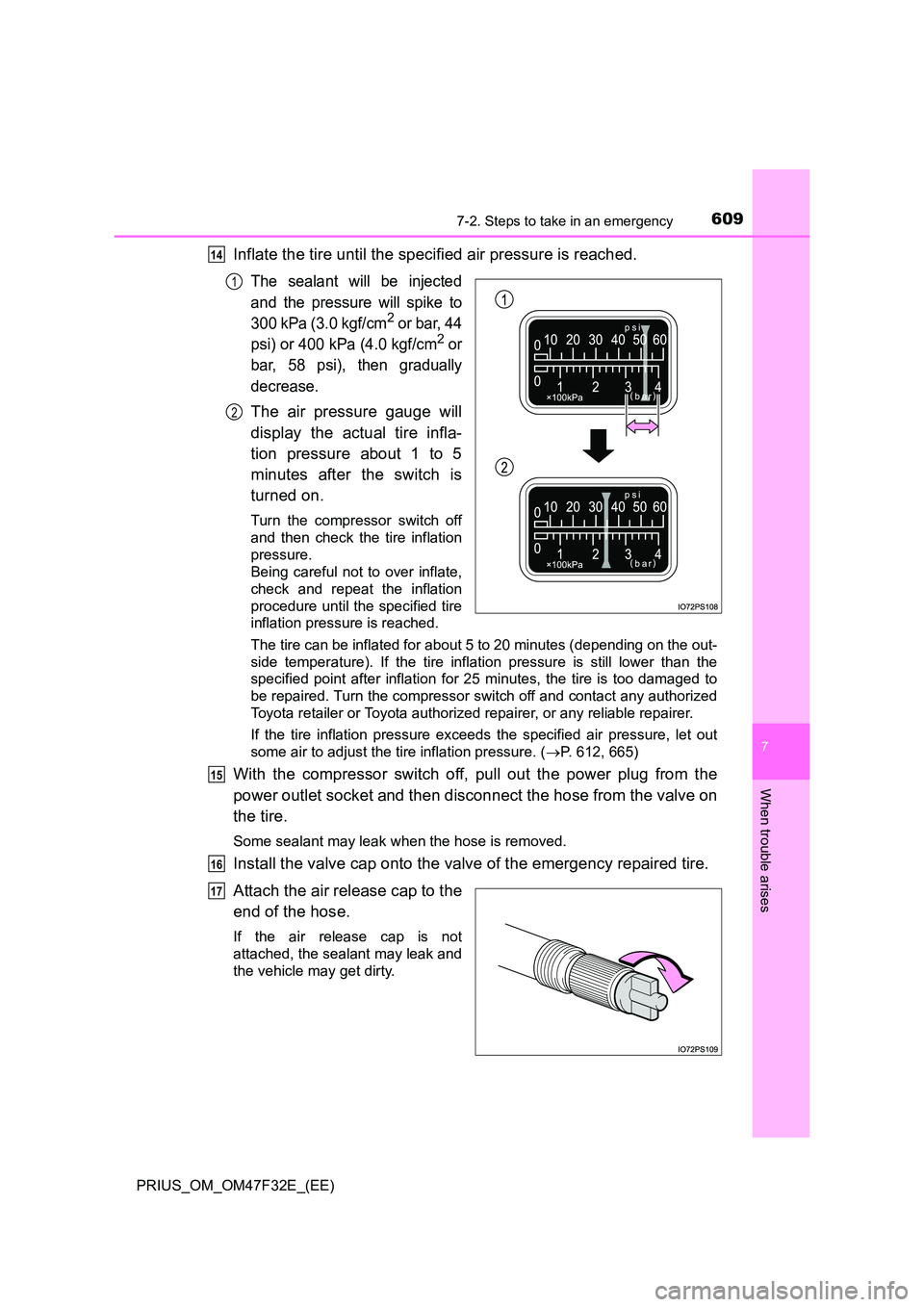
Inflate the tire until the specified air pressure is reached.
The sealant will be injected
and the pressure will spike to
300 kPa (3.0 kgf/cm2 or bar, 44
psi) or 400 kPa (4.0 kgf/cm2 or
bar, 58 psi), then gradually
decrease.
The air pressure gauge will
display the actual tire infla-
tion pressure about 1 to 5
minutes after the switch is
turned on.
Turn the compressor switch off
and then check the tire inflation
pressure.
Being careful not to over inflate,
check and repeat the inflation
procedure until the specified tire
inflation pressure is reached.
The tire can be inflated for about 5 to 20 minutes (depending on the out-
side temperature). If the tire inflation pressure is still lower than the
specified point after inflation for 25 minutes, the tire is too damaged to
be repaired. Turn the compressor switch off and contact any authorized
Toyota retailer or Toyota authorized repairer, or any reliable repairer.
If the tire inflation pressure exceeds the specified air pressure, let out
some air to adjust the tire inflation pressure. ( P. 612, 665)
With the compressor switch off, pull out the power plug from the
power outlet socket and then disconnect the hose from the valve on
the tire.
Some sealant may leak when the hose is removed.
Install the valve cap onto the valve of the emergency repaired tire.
Attach the air release cap to the
end of the hose.
If the air release cap is not
attached, the sealant may leak and
the vehicle may get dirty.
14
1
2
15
16
17