2023 TOYOTA HIGHLANDER cushion
[x] Cancel search: cushionPage 26 of 552

261-1. For safe use
Make sure that all occupants are
wearing their seat belts before
driving the vehicle. (P.27)
Use a child restraint system
appropriate for the child until the
child becomes large enough to properly wear the vehicle’s seat
belt. (
P.50)
Make sure that you can see
backward clearly by adjusting
the inside and outside rear view
mirrors properly. ( P.149, 150,
160)
WARNING
■For safe driving
Observe the following precau-
tions. Failure to do so may result
in death or serious injury.
●Do not adjust the position of the
driver’s seat while driving.
Doing so could cause the driver
to lose control of the vehicle.
●Do not place a cushion between
the driver or passenger and the
seatback. A cushion may pre-
vent correct pos ture from being
achieved, and reduce the effec-
tiveness of the seat belt and
head restraint.
●Do not place anything under the
front seats. Objects placed
under the front seats may
become jammed in the seat
tracks and stop the seat from
locking in place . This may lead
to an accident and the adjust-
ment mechanism may also be
damaged.
●Always observe the legal speed
limit when driving on public
roads.
●When driving over long dis-
tances, take regular breaks
before you start to feel tired.
Also, if you feel tired or sleepy
while driving, do not force your-
self to continue driving and take
a break immediately.
Correct use of the seat
belts
Adjusting the mirrors
Page 33 of 552
331-1. For safe use
1
For safety and security
seat belt pretensioners will be pre-
pared to operate.
WARNING
■Seat belt pretensioners
Observe the following precautions
to reduce the risk of injury in the
event of sudden braking, sudden
swerving or an accident. Failure
to do so may cause death or seri-
ous injury.
●Do not place anything, such as
a cushion, on the front passen-
ger’s seat. Doing so will
disperse the passenger’s
weight, which prevents the sen-
sor from detecting the passen-
ger’s weight properly. As a
result, the seat belt pretensioner
for the front passenger’s seat
may not activate in the event of
a collision.
●If the pretensioner has acti-
vated, the SRS warning light will
come on. In that case, the seat
belt cannot be used again and
must be replaced at your Toyota
dealer.
Page 34 of 552
341-1. For safe use
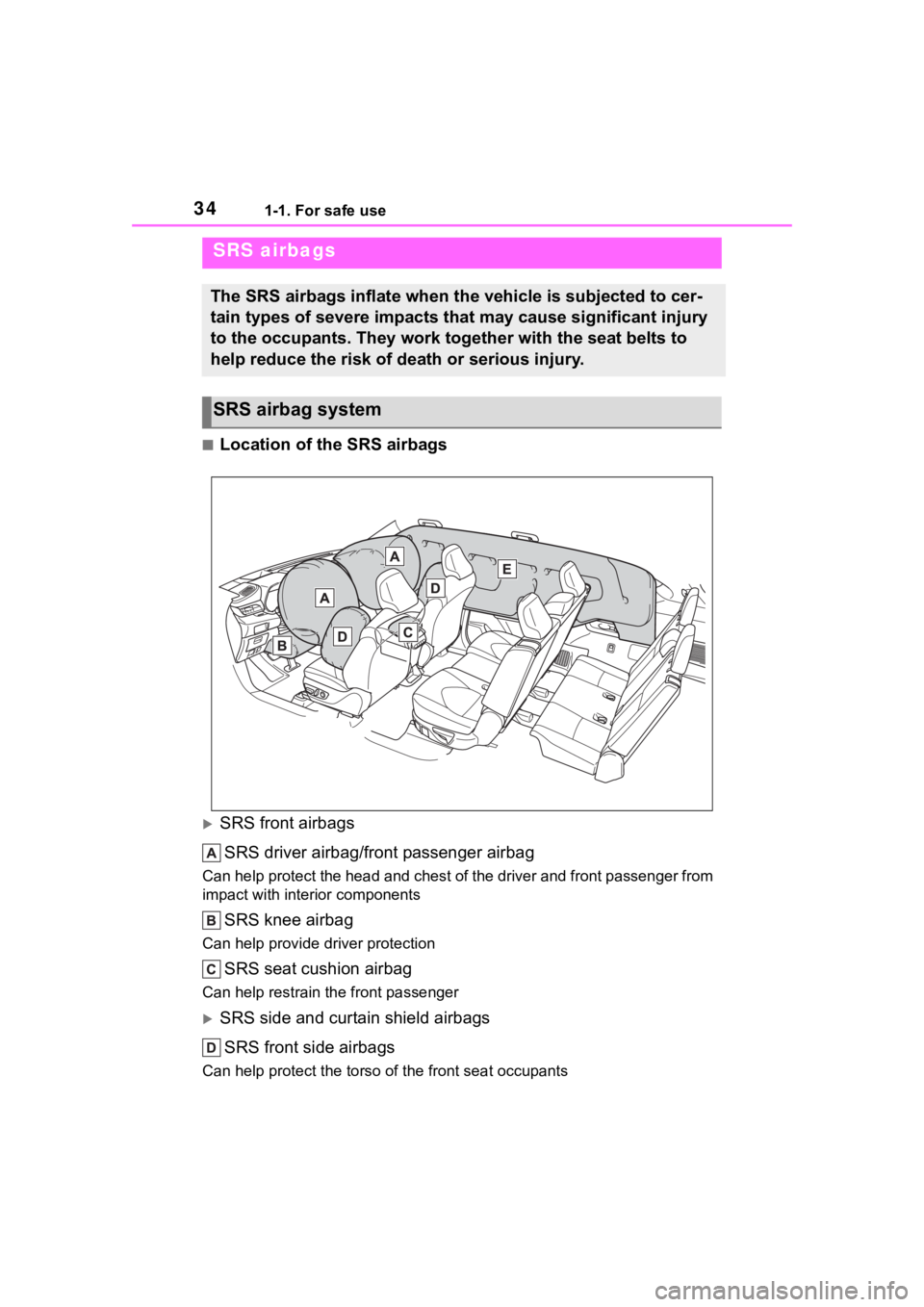
■Location of the SRS airbags
SRS front airbagsSRS driver airbag/front passenger airbag
Can help protect the head and chest of the driver and front passenger from
impact with interior components
SRS knee airbag
Can help provide dr iver protection
SRS seat cushion airbag
Can help restrain the front passenger
SRS side and curtain shield airbags
SRS front side airbags
Can help protect the torso of the front seat occupants
SRS airbags
The SRS airbags inflate when the vehicle is subjected to cer-
tain types of severe impacts that may cause significant injury
to the occupants. They work together with the seat belts to
help reduce the risk of death or serious injury.
SRS airbag system
Page 35 of 552

351-1. For safe use
1
For safety and security
SRS curtain shield airbags
• Can help protect primarily the head of occupants in the outer seats
• Can help prevent the occupants from being thrown from the vehi cle in the
event of vehicle rollover
■SRS airbag system components
Front passenger airbag
“PASS AIR BAG ON” and “PASS AIR BAG OFF” indicator lights
Front side airbags
Curtain shield airbags
Side impact sensors (rear)
SRS warning light
Front passenger occupant classification system (ECU and sen-
sors)
Driver airbag
Side impact sensors (front door)
Side impact sensors (front)
Seat belt pretensioners and force limiters
Seat cushion airbag
Driver’s seat position sensor
Driver’s knee airbag
Driver’s seat bel t buckle switch
Front impact sensors
Page 37 of 552

371-1. For safe use
1
For safety and security
●The SRS front airbags for the front
passenger will not activate if there
is no passenger sitting in the front
passenger seat. However, the
SRS front airbags for the front
passenger may de ploy if luggage
is put in the seat, even if the seat
is unoccupied.
●The SRS seat cushion airbag on
the front passen ger seat will not
operate if the occupant is not
wearing a seat belt.
■SRS airbag deployment condi-
tions (SRS side and curtain
shield airbags)
●The SRS side and curtain shield
airbags will deploy i n the event of
an impact that exceeds the set
threshold level (the level of force
corresponding to the impact force
produced by an approximately
3300 lb. [1500 kg] vehicle colliding
with the vehicle cabin from a
direction perpendicular to the
vehicle orientation at an approxi-
mate speed of 12 - 18 mph [20 -
30 km/h]).
●Both SRS curtain shield airbags
may deploy in the event of a
severe side collision.
●Both SRS curtain shield airbags
will deploy in the event of vehicle
rollover.
●Both SRS curtain shield airbags
may also deploy in the event of a
severe frontal collision.
■Conditions under which the
SRS airbags may deploy
(inflate), other t han a collision
The SRS front airbags and SRS cur-
tain shield airbags may also deploy
if a serious impact occurs to the
underside of your vehicle. Some
examples are shown in the illustra-
tion.
●Hitting a curb, edge of pavement
or hard surface
●Falling into or jumping over a deep
hole
●Landing hard or falling
The SRS curtain shield airbags may
also deploy under the situations
shown in the illustration.
●The angle of vehicle tip-up is mar-
ginal.
●The vehicle skids and hits a curb
stone.
■Types of collisions that may not
deploy the SRS airbags (SRS
front airbags)
The SRS front airbags do not gener-
ally inflate if the vehicle is involved
in a side or r ear collision, if it rolls
over, or if it is involved in a
low-speed frontal collision. But,
whenever a collis ion of any type
causes sufficient forward decelera-
tion of the vehicle, deployment of
the SRS front airbags may occur.
●Collision from the side
●Collision from the rear
●Vehicle rollover
Page 40 of 552

401-1. For safe use
WARNING
• Slightly recline the back of the seat.
Although vehicle designs vary,
many drivers can achieve the
10 in. (250 mm) distance, even
with the driver seat all the way
forward, simply by reclining the
back of the seat somewhat. If
reclining the back of your seat
makes it hard to see the road,
raise yourself by using a firm,
non-slippery cushion, or raise
the seat if your vehicle has that
feature.
• If your steering wheel is adjust- able, tilt it downward. This
points the airbag toward your
chest instead of your head and
neck.
The seat should be adjusted as
recommended by NHTSA above,
while still maintaining control of
the foot pedals, steering wheel,
and your view of the instrument
panel controls.
●If the seat belt extender has
been connected to the front
seat belt buckles but the seat
belt extender has not also been
fastened to the latch plate of the
seat belt, the SRS front airbags
will judge that the driver and
front passenger are wearing the
seat belt even though the seat
belt has not been connected. In
this case, the SRS front airbags
may not activate correctly in a
collision, resulting in death or
serious injury in the event of a
collision. Be su re to wear the
seat belt with the seat belt
extender.
●The SRS front passenger air-
bag also deploys with consider-
able force, and can cause death
or serious injury especially if the
front passenger is very close to
the airbag. The front passenger
seat should be as far from the
airbag as possible with the seat-
back adjusted, so the front pas-
senger sits upright.
Page 42 of 552
421-1. For safe use
WARNING
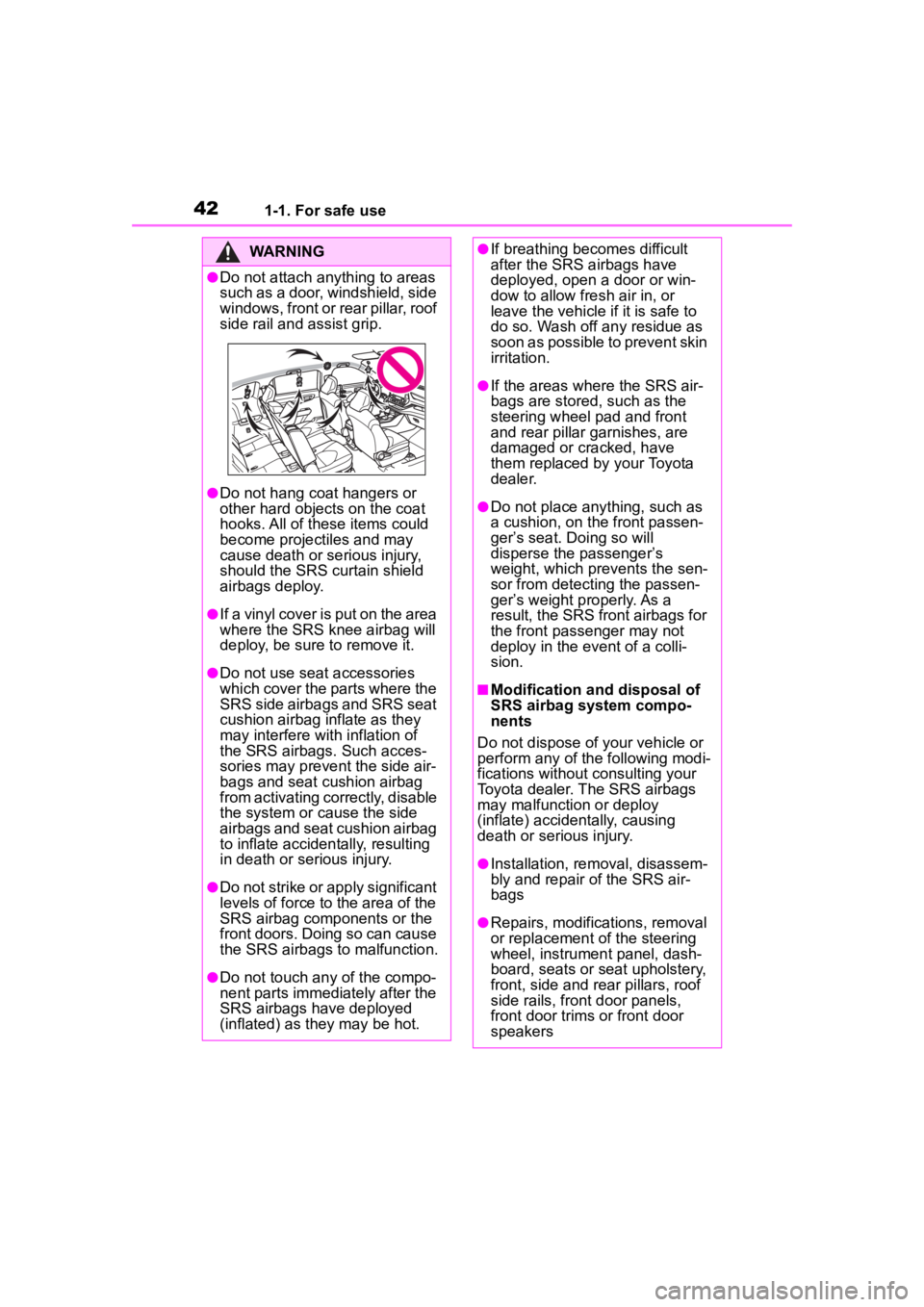
●Do not attach anything to areas
such as a door, windshield, side
windows, front or rear pillar, roof
side rail and assist grip.
●Do not hang coat hangers or
other hard objects on the coat
hooks. All of these items could
become projectiles and may
cause death or serious injury,
should the SRS curtain shield
airbags deploy.
●If a vinyl cover is put on the area
where the SRS knee airbag will
deploy, be sure to remove it.
●Do not use seat accessories
which cover the parts where the
SRS side airbags and SRS seat
cushion airbag inflate as they
may interfere with inflation of
the SRS airbags. Such acces-
sories may prevent the side air-
bags and seat cushion airbag
from activating correctly, disable
the system or cause the side
airbags and seat cushion airbag
to inflate accidentally, resulting
in death or serious injury.
●Do not strike or apply significant
levels of force to the area of the
SRS airbag components or the
front doors. Doing so can cause
the SRS airbags to malfunction.
●Do not touch any of the compo-
nent parts immediately after the
SRS airbags have deployed
(inflated) as they may be hot.
●If breathing becomes difficult
after the SRS airbags have
deployed, open a door or win-
dow to allow fresh air in, or
leave the vehicle if it is safe to
do so. Wash off any residue as
soon as possible to prevent skin
irritation.
●If the areas where the SRS air-
bags are stored, such as the
steering wheel pad and front
and rear pillar garnishes, are
damaged or cracked, have
them replaced by your Toyota
dealer.
●Do not place anything, such as
a cushion, on the front passen-
ger’s seat. Doing so will
disperse the passenger’s
weight, which prevents the sen-
sor from detecting the passen-
ger’s weight properly. As a
result, the SRS front airbags for
the front passenger may not
deploy in the event of a colli-
sion.
■Modification and disposal of
SRS airbag system compo-
nents
Do not dispose of your vehicle or
perform any of the following modi-
fications without consulting your
Toyota dealer. The SRS airbags
may malfunction or deploy
(inflate) accidentally, causing
death or serious injury.
●Installation, re moval, disassem-
bly and repair of the SRS air-
bags
●Repairs, modific ations, removal
or replacement of the steering
wheel, instrument panel, dash-
board, seats or seat upholstery,
front, side and rear pillars, roof
side rails, front door panels,
front door trims or front door
speakers
Page 43 of 552

431-1. For safe use
1
For safety and security
Vehicles with 8-inch audio
system screenSRS warning light
Driver’s and front passen-
ger’s seat belt reminder light
“PASS AIR BAG OFF” indica-
WARNING
●Modifications to the front door
panel (such as making a hole in
it)
●Repairs or modifications of the
front fender, front bumper, or
side of the occ upant compart-
ment
●Installation of a grille guard (bull
bars, kangaroo bar, etc.), snow
plows, winches or roof luggage
carrier
●Modifications to the vehicle’s
suspension system
●Installation of electronic devices
such as mobile two-way radios
and CD players
●Modifications to your vehicle for
a person with a physical disabil-
ity
Front passenger occu-
pant classification
system
Your vehicle is equipped
with a front passenger
occupant classification sys-
tem. This system detects
the conditions of the front
passenger seat and acti-
vates or deactivates the
front passenger airbag and
seat cushion airbag.
System components