2023 TOYOTA COROLLA headlights
[x] Cancel search: headlightsPage 214 of 468
2144-5. Using the driving support systems
WARNING
●When a detectable object is
approaching your vehicle
●When your vehicle or a detect-
able object is wandering
●When the movement of a
detectable object changes
(change in direction, sudden
acceleration or deceleration,
etc.)
●When suddenly approaching a
detectable object
●When a preceding vehicle or
motorcycle is not directly in front
of your vehicle
●When there is a structure above
a detectable object
●When part of a detectable
object is hidden by another
object (large luggage, umbrella,
guardrail, etc.)
●When multiple detectable
objects are overlapping
●When a bright light, such as the
sun or headlights of another
vehicle, is reflecting off of the
detectable object
●When the detectable object is
white and looks extremely bright
●When the color or brightness of
the detectable object causes it
to blend in with its surroundings
●When a detectable object cuts
in front of or emerges from
beside a vehicle
●When approaching a vehicle
ahead which is perpendicular or
at an angle to the vehicle, or is
facing the vehicle
●If a parked vehicle is perpendic-
ular or at an angle to the vehicle
●When a bicycle is a child sized
bicycle, is carrying a large load,
is carrying an extra passenger,
or has an unusual shape (bicy-
cles equipped with a child seat,
tandem bicycles, etc.)
●When a pedestrian or bicyclist is
shorter than app roximately 3.2
ft. (1 m) or talle r than approxi-
mately 6.5 ft. (2 m)
●When the silhouette of a pedes-
trian or bicyclist is unclear (such
as when they are wearing a
raincoat, long skirt, etc.)
●When a pedestrian or bicyclist is
bending forward or squatting
●When a pedestrian or bicyclist is
moving at high speed
●When a pedestrian is pushing a
stroller, wheelchair, bicycle or
other vehicle
●When a detectable object
blends in with the surrounding
area, such as when it is dim (at
dawn or dusk) or dark (at night,
in a tunnel, etc.)
●When the lane width is 13.1 ft.
(4 m) or more
●When the lane width is 8.2 ft.
(2.5 m) or less
●When the vehicle has not been
driven for a certain amount of
time after the engine was
started
●While turning left or right or a
few seconds after turning left or
right
●While changing lanes or a few
seconds after changing lanes
●When entering a curve, driving
around a curve and a few sec-
onds after driving around a
curve
Page 340 of 468
3406-3. Do-it-yourself maintenance
Check the wattage of the light
bulb to be replaced. ( P.398)
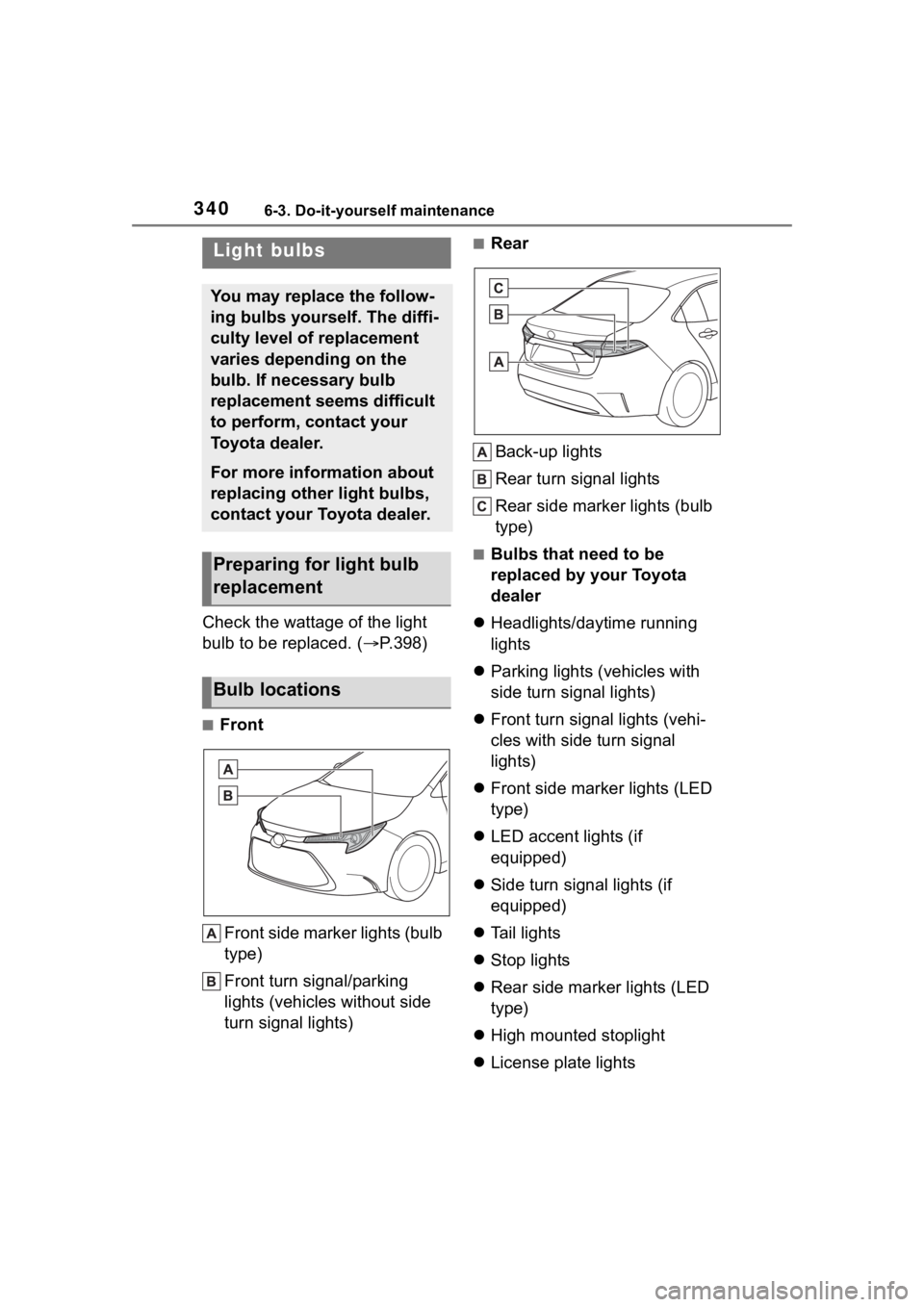
■Front
Front side marker lights (bulb
type)
Front turn signal/parking
lights (vehicles without side
turn signal lights)
■RearBack-up lights
Rear turn signal lights
Rear side marker lights (bulb
type)
■Bulbs that need to be
replaced by your Toyota
dealer
Headlights/daytime running
lights
Parking lights (vehicles with
side turn signal lights)
Front turn signal lights (vehi-
cles with side turn signal
lights)
Front side marker lights (LED
type)
LED accent lights (if
equipped)
Side turn signal lights (if
equipped)
Tail lights
Stop lights
Rear side marker lights (LED
type)
High mounted stoplight
License plate lights
Light bulbs
You may replace the follow-
ing bulbs yourself. The diffi-
culty level of replacement
varies depending on the
bulb. If necessary bulb
replacement seems difficult
to perform, contact your
Toyota dealer.
For more information about
replacing other light bulbs,
contact your Toyota dealer.
Preparing for light bulb
replacement
Bulb locations
Page 379 of 468
3797-2. Steps to take in an emergency
7
When trouble arises
One of the following may be the
cause of the problem:
There may not be sufficient
fuel in the vehicle’s tank.
Refuel the vehicle.
The engine may be flooded.
Try to restart the engine again
following correct starting pro-
cedures. ( P.154, 155)
There may be a malfunction
in the engine immobilizer sys-
tem. ( P.77)
One of the following may be the
cause of the problem:
The battery may be dis-
charged. ( P.383)
NOTICE
■Driving with tire chains and
the compact spare tire
Do not fit tire chains to the com-
pact spare tire. Tire chains may
damage the vehicle body and
adversely affect driving perfor-
mance.
■When replacing the tires
(vehicles with a tire pressure
warning system)
When removing or fitting the
wheels, tires or the tire pressure
warning valve and transmitter,
contact your Toyota dealer as the
tire pressure warning valve and
transmitter may be damaged if not
handled correctly.
■To avoid damage to the tire
pressure warning valves and
transmitters (vehicles with a
tire pressure warning system)
When a tire is repaired with liquid
sealants, the tire pressure warn-
ing valve and transmitter may not
operate properly. If a liquid seal-
ant is used, contact your Toyota
dealer or other qualified service
shop as soon as possible. Make
sure to replace the tire pressure
warning valve and transmitter
when replacing the tire.
If the engine will not
star t
If the engine will not start
even though correct starting
procedures are being fol-
lowed ( P.154, 155), con-
sider each of the following
points:
The engine will not start
even though the starter
motor operates normally.
The starter motor turns
over slowly, the interior
lights and headlights are
dim, or the horn does not
sound or sounds at a low
volume.
Page 380 of 468

3807-2. Steps to take in an emergency
The battery terminal connec-
tions may be loose or cor-
roded. ( P.308)
The engine starting system may
be malfunctioning due to an
electrical problem such as elec-
tronic key battery depletion or a
blown fuse. However, an interim
measure is available to start the
engine. ( P.380)
One of the following may be the
cause of the problem:
The battery may be dis-
charged. ( P.383)
One or both of the battery ter-
minals may be disconnected.
( P.308)
Vehicles without a smart key
system: There may be a mal-
function in the steering lock
system.
Contact your Toyot a dealer if the
problem cannot be repaired, or if
repair procedures are unknown.
When the engine does not start,
the following steps can be used
as an interim measure to start
the engine if the engine switch is
functioning normally.
Do not use this starting proce-
dure except in case of emer-
gency.
1 Set the parking brake.
( P.168)
2 Check that the shift lever is in
P.
3 Turn the engine switch to
ACC
*.
4 Press and hold the engine
switch for about 15 seconds
while depressing the brake
pedal firmly.
Even if the engi ne can be started
using the above steps, the system
may be malfunctioning. Have the
vehicle inspected by your Toyota
dealer.
*: ACC mode can be enabled/dis- abled on the customize menu.
( P.412)
The starter motor does
not turn over (vehicles
with a smart key system)
The starter motor does
not turn over, the interior
lights and headlights do
not turn on, or the horn
does not sound.
Emergency start function
(vehicles with a smart key
system)
Page 385 of 468
3857-2. Steps to take in an emergency
7
When trouble arises
approximately 5 minutes to
recharge the battery of your
vehicle.
5 Vehicles with a smart key
system: Open and close any
of the doors of your vehicle
with the engine switch OFF.
6 Maintain the engine speed of
the second vehicle and start
the engine of your vehicle by
turning the engine switch to
ON.
7 Once the vehicle’s engine
has started, remove the
jumper cables in the exact
reverse order from which
they were connected.
Once the engine starts, have the
vehicle inspected at your Toyota
dealer as soon as possible.
■Starting the engine when the
battery is discharged
The engine cannot be started by
push-starting.
■To prevent battery discharge
●Turn off the headlights and the
audio system while the engine is
off.
●Turn off any unnecessary electri-
cal components when the vehicle
is running at a low speed for an
extended period, such as in heavy
traffic.
■When the battery is removed or
discharged
●Information stor ed in the ECU is
cleared. When the battery is
depleted, have the vehicle
inspected at you r Toyota dealer.
●Some systems may require initial-
ization. ( P.422)
■When removing the battery ter-
minals
When the battery terminals are
removed, the information stored in
the ECU is cleared. Before remov-
ing the battery term inals, contact
your Toyota dealer.
■Charging the battery
The electricity stored in the battery
will discharge grad ually even when
the vehicle is not in use, due to nat-
ural discharge and the draining
effects of certain electrical appli-
ances. If the vehicle is left for a long
time, the battery may discharge,
and the engine may be unable to
start. (The battery recharges auto-
matically during driving.)
■When recharging or replacing
the battery (vehicles with a
smart key system)
●In some cases, it may not be pos-
sible to unlock the doors using the
smart key system when the bat-
tery is discharged. Use the wire-
less remote control or the
mechanical key to lock or unlock
the doors.
●The engine may not start on the
first attempt after the battery has
recharged but will start normally
after the second attempt. This is
not a malfunction.
●The engine switch mode is memo-
rized by the vehicle. When the
battery is reconnected, the system
will return to the mode it was in
before the bat tery was dis-
charged. Before disconnecting the
battery, turn the engine switch off.
If you are unsure what mode the
engine switch wa s in before the
battery discharged, be especially
careful when reconnecting the
battery.
■When replacing the battery
●Use a battery that conforms to
European regulations.
●Use a battery that the case size is
same as the previous one (LN1),
Page 395 of 468
3958-1. Specifications
8
Vehicle specifications
the vehicle is operated at high
speeds, or under extreme
load conditions.
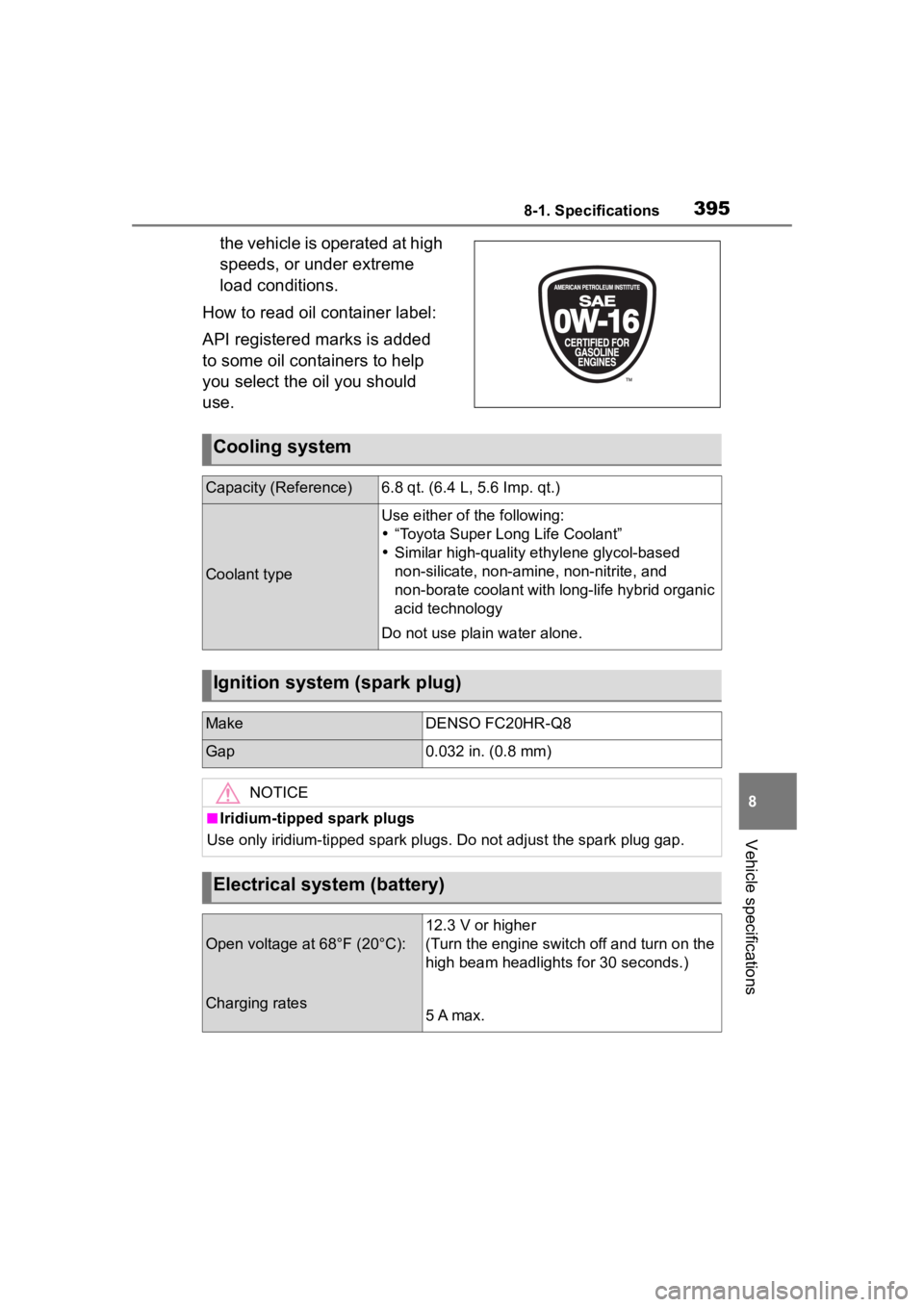
How to read oil container label:
API registered marks is added
to some oil containers to help
you select the oil you should
use.
Cooling system
Capacity (Reference)6.8 qt. (6.4 L, 5.6 Imp. qt.)
Coolant type
Use either o f the following:
“Toyota Super Long Life Coolant”
Similar high-quality et hylene glycol-based
non-silicate, non -amine, non-nitrite, and
non-borate coolant with long-life hybrid organic
acid technology
Do not use pla in water alone.
Ignition system (spark plug)
MakeDENSO FC20HR-Q8
Gap0.032 in. (0.8 mm)
NOTICE
■Iridium-tipped spark plugs
Use only iridium-tipped spark plugs. Do not adjust the spark pl ug gap.
Electrical system (battery)
Open voltage at 68°F (20°C):
12.3 V or higher
(Turn the engine switch off and turn on the
high beam headlights for 30 seconds.)
Charging rates5 A max.
Page 417 of 468

4178-2. Customization
8
Vehicle specifications
■Moon roof* ( P.137)
*: If equipped
■Automatic light control system ( P.173)
■Lights ( P.173)
*: Except for Canada
■PCS (Pre-Collision System) ( P.190)
*1: The system is automatically enabled each time the engine switch is
turned to ON.
*2: This setting changes in ac cordance with My Settings
FunctionDefault settingCustomized setting
Linked operation of com-
ponents when key is
used (open only)
Slide onlyTilt only——O
Linked operation of com-
ponents when wireless
remote control is used
Slide onlyTilt only——O
FunctionDefault settingCustomized setting
Light sensor sensitivityStandard-2 to 2O—O
Time elapsed before
headlights automatically
turn off after doors are
closed
30 seconds
Off
O—O60 seconds
90 seconds
Windshield wiper linked
headlight illuminationOnOff——O
FunctionDefault settingCustomized setting
Daytime running light
systemOnOff*O—O
FunctionCustomized setting
PCS (Pre-Collision Sys-
tem)
*1On, Off—O—
Warning timing*2Later, Default, Earlier—O—
Page 443 of 468
443Alphabetical Index
H
Head restraints ....................... 128
Headlight aim .......................... 339
HeadlightsAHB (Automatic High Beam) 175
Light switch .......................... 173
Headlights/daytime running lightsReplacing light bulbs ............ 341
Heated steering wheel ........... 269
Heaters Automatic air conditioning sys-tem ..................................... 263
Heated steering wheel ......... 269
Manual air conditioning system ........................................... 258
Outside rear view mirrors ... 260, 265
Seat heaters ......................... 269
High mounted stoplight Replacing light bulbs ............ 341
Hill-start assist control .......... 249
Hood Open .................................... 302
Hooks Coat hooks ........................... 285
Retaining hooks (floor mat) .... 24
Horn ......................................... 130
I
I/M test ..................................... 298
Identification Engine .................................. 393
Vehicle.................................. 392
Ignition switch (engine switch) ....................................... 154, 155Auto power off function ........ 159
Changing the engine switch modes ................................ 158
If your vehicle has to be stopped in an emergency................. 348 Illuminated entry system .......272
Indicators ..................................84
Initialization
Items to initialize ...................422
Maintenance .........................295
Power windows ....................134
Inside rear view m irror ...........131
Instrument panel light control88, 91
Interior lights...........................271 Front interior light .................271
Rear interior light ..................271
Wattage ................................398
J
JackPositioning a floor jack .........303
Vehicle-equipped jack ..........371
Jack handle .............................371
Jam protection function Moon roof .............................137
Power windows ....................134
K
Keyless entrySmart key system .................120
Wireless remote control........108
Keys Battery-saving function .........121
Electronic key .......................106
Engine switch ...............154, 155
If the electronic key does not operate properly .................381
If you lose your keys.............381
Key number plate .................106
Keyless entry ................ 111, 120
Mechanical key.....................106
Replacing the battery ...........333
Warning buzzer ....................120
Wireless remote control........108
Knee airbags .............................31