Page 283 of 814

281
4Driving
C-HR_HEV_OM_Europe_OM10764E
4-1. Before driving
Driving the vehicle ............. 282
Cargo and luggage ............ 293
Trailer towing ..................... 294
4-2. Driving procedures
Power (ignition) switch ....... 303
EV drive mode ................... 310
Hybrid transmission
(2ZR-FXE engine) ........... 313
Hybrid transmission
(M20A-FXS engine) ......... 317
Turn signal lever ................ 322
Parking brake .................... 323
Brake Hold ......................... 328
4-3. Operating the
lights and wipers
Headlight switch ................ 331
Automatic High Beam ........ 336
Fog light switch .................. 341
Windshield wipers and
washer ............................. 343
Rear window wiper and
washer ............................. 346
4-4. Refueling
Opening the
fuel tank cap .................... 348
4-5. Using the driving support
systems
Toyota Safety Sense ......... 353
PCS
(Pre-Collision System) ..... 367
LTA
(Lane Tracing Assist)....... 385
RSA (Road Sign Assist)..... 400
Dynamic radar cruise
control with
full-speed range ............... 408
Cruise control..................... 425
Driving mode select ........... 430
Speed limiter ...................... 432
BSM
(Blind Spot Monitor) ......... 435
Toyota parking
assist-sensor ................... 454
RCTA (Rear Crossing
Traffic Alert) ..................... 467
PKSB (Parking Support
Brake) .............................. 475
Parking Support Brake
function (static objects) .... 483
Parking Support Brake
function
(rear-crossing vehicles) ... 487
S-IPA (Simple Intelligent
Parking Assist System).... 490
GPF (Gasoline Particulate
Filter) system .................. 529
Driving assist systems ....... 530
4-6. Driving tips
Hybrid Electric Vehicle
driving tips ....................... 538
Winter driving tips .............. 541
Page 297 of 814
2954-1. Before driving
4
Driving
C-HR_HEV_OM_Europe_OM10764E
◆Weight limits
Check the allowable towing capacity, GVM (Gross Vehicle Mass),
MPAC (Maximum Permissible Axle Capacity), and permissible
drawbar load before towing. ( P. 764)
◆Towing hitch/bracket
Toyota recommends the use of the Toyota hitch/bracket for your
vehicle. Other products of a suitable nature and comparable qua lity
may also be used.
For vehicles where the towing device blocks any of the lights o r
license plate, the following shall be observed:
● Do not use towing devices that cannot be easily removed or
repositioned.
● Towing devices must be removed or repositioned when not in
use.
■Total trailer weight and permissible drawbar load
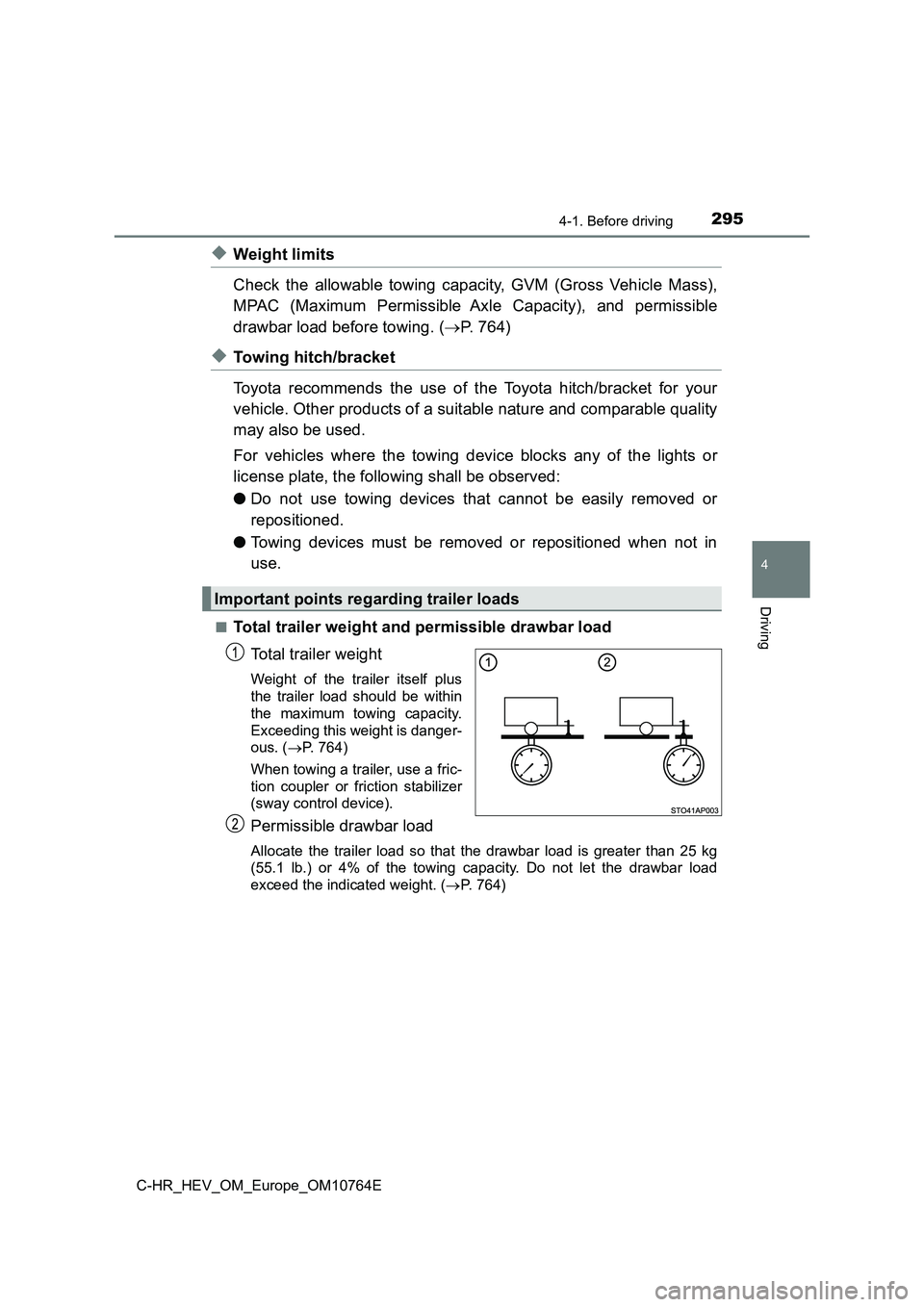
Total trailer weight
Weight of the trailer itself plus
the trailer load should be within
the maximum towing capacity.
Exceeding this weight is danger-
ous. ( P. 764)
When towing a trailer, use a fric-
tion coupler or friction stabilizer
(sway control device).
Permissible drawbar load
Allocate the trailer load so that the drawbar load is greater t han 25 kg
(55.1 lb.) or 4% of the towing capacity. Do not let the drawbar load
exceed the indicated weight. ( P. 764)
Important points regarding trailer loads
Page 300 of 814
2984-1. Before driving
C-HR_HEV_OM_Europe_OM10764E
■Tire information
● Increase the tire inflation pressure to 20.0 kPa (0.2 kgf/cm2 or bar, 3 psi)
greater than the recommended value when towing. ( P. 774)
● Increase the air pressure of the trailer tires in accordance with the total
trailer weight and according to the values recommended by the m anufac-
turer of your trailer.
■ Trailer lights
Please consult at any authorized retailer or Toyota authorized repairer, or any
reliable repairer when installing trailer lights, as incorrect installation may
cause damage to the vehicle’s lights. Please take care to compl y with your
state’s laws when installing trailer lights.
■ Break-in schedule
Toyota recommends that vehicles fitted with new power train com ponents
should not be used for towing trailers for the first 800 km (50 0 miles).
■ Safety checks before towing
● Check that the maximum load limit for the towing hitch/bracket and hitch ball
is not exceeded. Bear in mind that the coupling weight of the t railer will add
to the load exerted on the vehicle. Also make sure that the tot al load exerted
on the vehicle is within the range of the weight limits. ( P. 295)
● Ensure that the trailer load is secure.
● Supplementary outside rear view mirrors should be added to the vehicle if
the traffic behind cannot be clearly seen with standard mirrors . Adjust the
extending arms of these mirrors on both sides of the vehicle so that they
always provide maximum visibility of the road behind.
■ Maintenance
● Maintenance must be performed more frequently when using the vehicle for
towing due to the greater weight burden placed on the vehicle c ompared to
normal driving.
● Retighten all bolts securing the hitching ball and bracket after towing for
approximately 1000 km (600 miles).
Page 302 of 814
3004-1. Before driving
C-HR_HEV_OM_Europe_OM10764E
Your vehicle will handle differently when towing a trailer. In order to
avoid accident, death or serious injury, keep the following in mind
when towing:
■Checking connections between trailer and lights
Stop the vehicle and check the operation of the connection betw een
the trailer and lights after driving for a brief period as well as before
starting off.
■Practicing driving with a coupled trailer
● Get the feel for turning, stopping and reversing with the trailer
coupled by practicing in an area with no or light traffic.
● When reversing with a coupled trailer, hold the section of the
steering wheel nearest to you and rotate clockwise to turn the
trailer left or counterclockwise to turn it right. Always rotat e a little
at a time to prevent steering error. Have someone guide you
when reversing to lessen the risk of an accident.
■Increasing vehicle-to-vehicle distance
At a speed of 10 km/h (6 mph), the distance to the vehicle runn ing
ahead of you should be equivalent to or greater than the combin ed
length of your vehicle and trailer. Avoid sudden braking that m ay
cause skidding. Otherwise, the vehicle may spin out of control. This
is especially true when driving on wet or slippery road surface s.
■Sudden acceleration/steering input/cornering
Executing sharp turns when towing may result in the trailer col liding
with your vehicle. Decelerate well in advance when approaching
turns and take them slowly and carefully to avoid sudden brakin g.
■Important points regarding turning
The wheels of the trailer will travel closer to the inside of t he curve
than the wheels of the vehicle. To make allowance for this, tak e the
turns wider than you would normally do.
Guidance
Page 304 of 814
3024-1. Before driving
C-HR_HEV_OM_Europe_OM10764E
WARNING
Follow all the instructions described in this section.
Failure to do so could cause an accident resulting in death or serious injury.
■ Trailer towing precautions
When towing, make sure that none of the weight limits are excee ded.
( P. 295)
■ To avoid accident or injury
● Vehicles with a compact spare tire:
Do not tow a trailer when the compact spare tire is installed o n your vehi-
cle.
● Vehicles with an emergency tire puncture repair kit:
Do not tow a trailer when the tire installed is repaired with t he emergency
tire puncture repair kit.
● Do not use the following systems when trailer towing.
• Cruise control*
• Dynamic radar cruise control with full-speed range*
• LTA (Lane Tracing Assist)*
• PCS (Pre-Collision System)*
• BSM (Blind Spot Monitor)*
*: If equipped
■ Vehicle speed in towing
Observe the legal maximum speeds for trailer towing.
■ Before descending hills or long declines
Reduce speed and downshift. However, never downshift suddenly w hile
descending steep or long downhill grades.
■ Operation of the brake pedal
Do not hold the brake pedal depressed often or for long periods of time.
Doing so may result in the brake overheating or reduce braking effects.
NOTICE
■Do not directly splice trailer lights
Directly splicing trailer lights may damage your vehicle’s elec trical system
and cause a malfunction.
Page 324 of 814
3224-2. Driving procedures
C-HR_HEV_OM_Europe_OM10764E
Turn signal lever
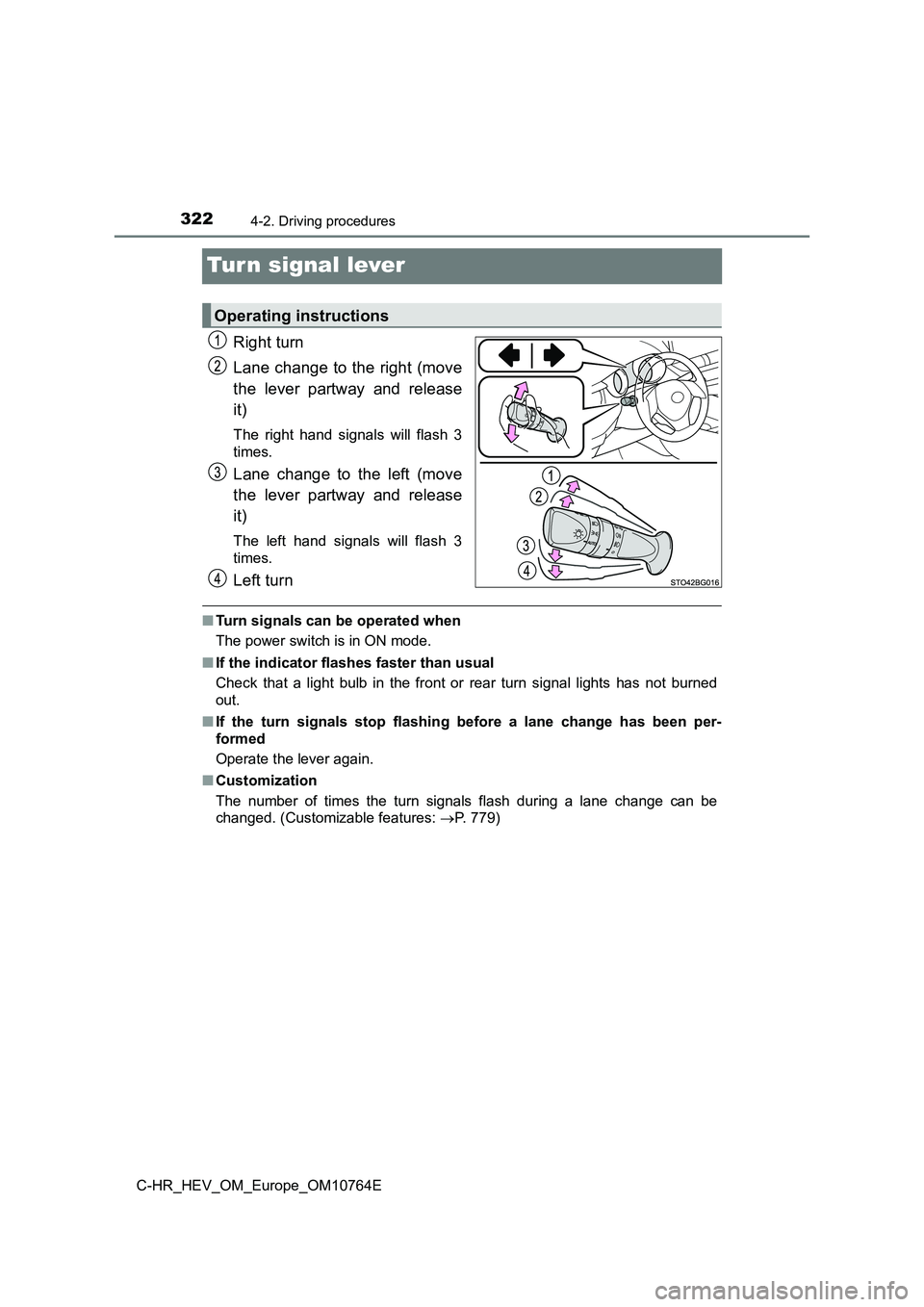
Right turn
Lane change to the right (move
the lever partway and release
it)
The right hand signals will flash 3
times.
Lane change to the left (move
the lever partway and release
it)
The left hand signals will flash 3
times.
Left turn
■ Turn signals can be operated when
The power switch is in ON mode.
■ If the indicator flashes faster than usual
Check that a light bulb in the front or rear turn signal lights has not burned
out.
■ If the turn signals stop flashing before a lane change has been per-
formed
Operate the lever again.
■ Customization
The number of times the turn signals flash during a lane change can be
changed. (Customizable features: P. 779)
Operating instructions
Page 333 of 814
331
4
4-3. Operating the lights and wipers
Driving
C-HR_HEV_OM_Europe_OM10764E
Headlight switch
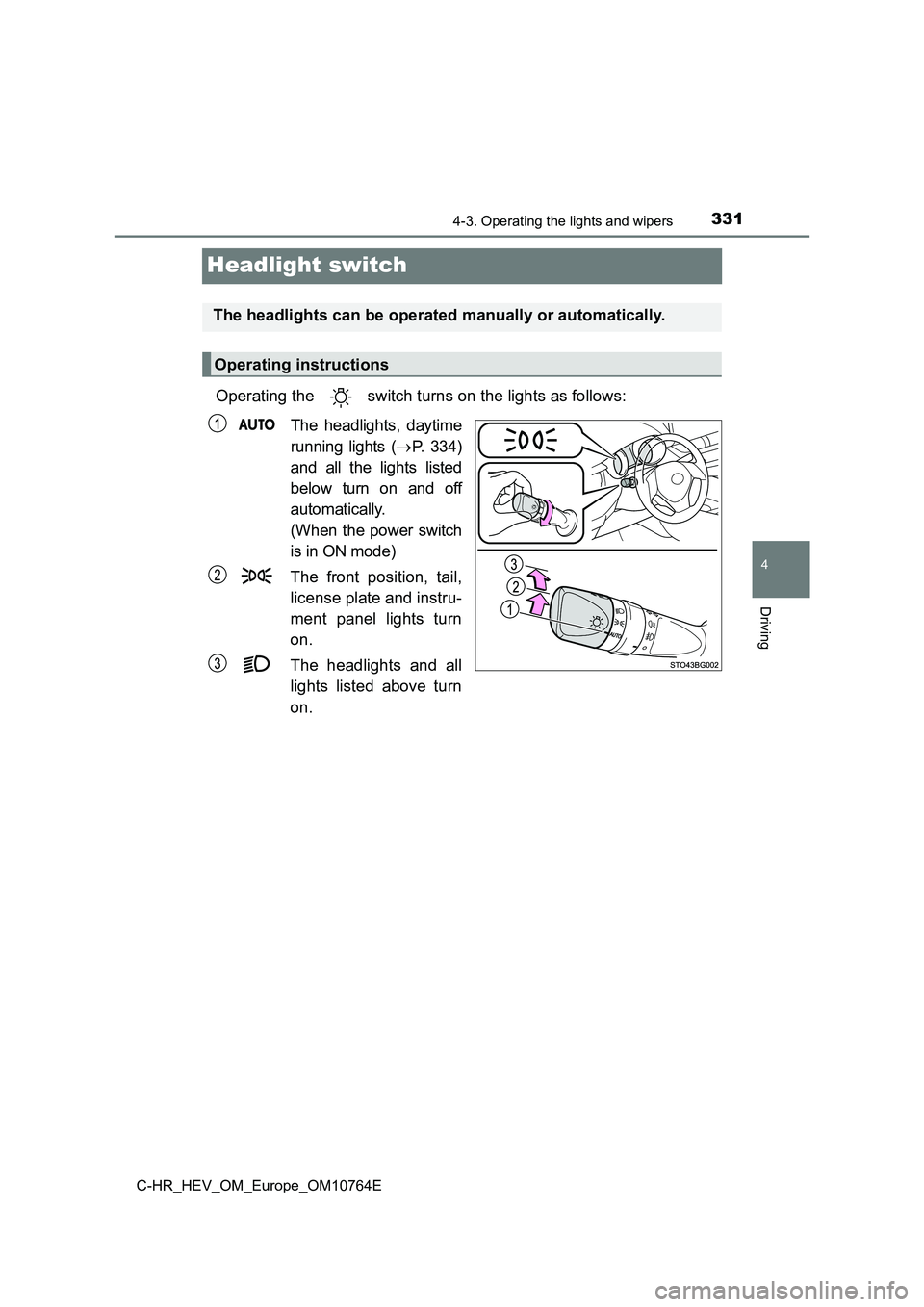
Operating the switch turns on the lights as follows:
The headlights, daytime
running lights ( P. 3 3 4 )
and all the lights listed
below turn on and off
automatically.
(When the power switch
is in ON mode)
The front position, tail,
license plate and instru-
ment panel lights turn
on.
The headlights and all
lights listed above turn
on.
The headlights can be operated manually or automatically.
Operating instructions
Page 334 of 814
3324-3. Operating the lights and wipers
C-HR_HEV_OM_Europe_OM10764E
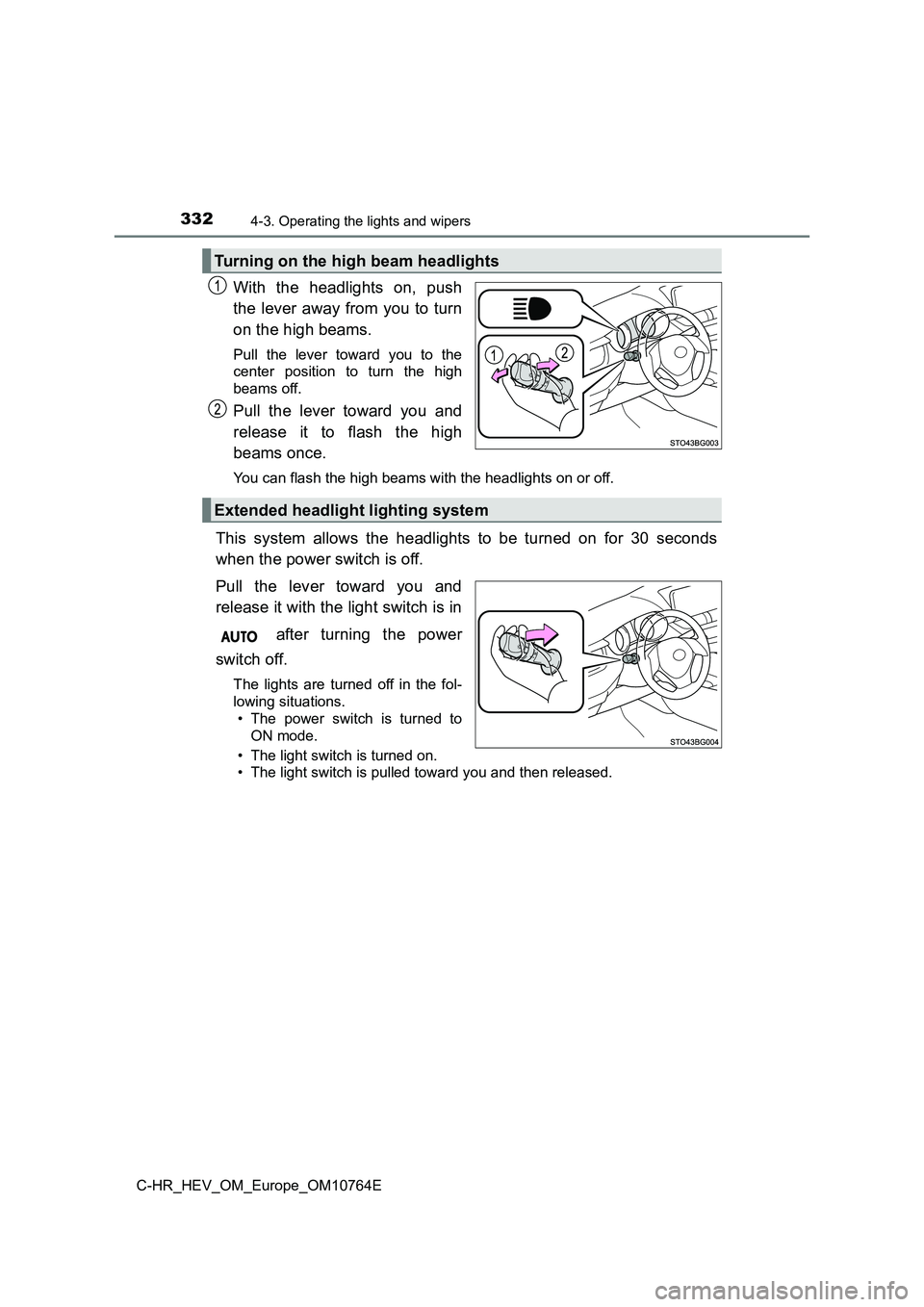
With the headlights on, push
the lever away from you to turn
on the high beams.
Pull the lever toward you to the
center position to turn the high
beams off.
Pull the lever toward you and
release it to flash the high
beams once.
You can flash the high beams with the headlights on or off.
This system allows the headlights to be turned on for 30 second s
when the power switch is off.
Pull the lever toward you and
release it with the light switch is in
after turning the power
switch off.
The lights are turned off in the fol-
lowing situations.
• The power switch is turned to
ON mode.
• The light switch is turned on.
• The light switch is pulled toward you and then released.
Turning on the high beam headlights
Extended headlight lighting system